Thank you for visiting SNEWPapers!
Sign up free
Rhode Island American And Providence Gazette
Providence, Providence County, Rhode Island
What is this article about?
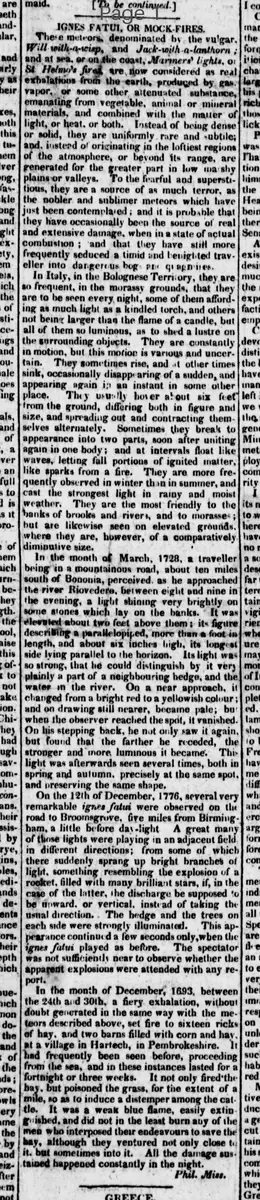
Article explains ignes fatui (will-o'-the-wisps) as natural gaseous exhalations from marshes, causing terror and occasional damage. Describes frequent sightings in Italy's Bolognese territory, specific 1728 observation near Bologna, 1776 event near Birmingham, and 1693 fire in Harlech, Wales.
Clipping
OCR Quality
Full Text
These meteors, denominated by the vulgar,
Will-with-a-wisp, and Jack-with-a-lantern ;
and at sea, or on the coast, Mariners' lights, or
St. Elmo's fires are, now considered as real
exhalations from the earth, produced by gas,
vapor, or some other attenuated substance,
emanating from vegetable, animal or mineral
materials, and combined with the matter of
light, or heat, or both. Instead of being dense
or solid, they are uniformly rare and subtile;
and, instead of originating in the loftiest regions
of the atmosphere, or beyond its range, are
generated for the greater part in low marshy
plains or valleys. To the fearful and superstitious,
they are a source of as much terror, as
the nobler and sublimer meteors which have
just been contemplated; and it is probable that
they have occasionally been the source of real
and extensive damage, when in a state of actual
combustion ; and that they have still more
frequently seduced a timid and benighted traveller
into dangerous bog and quagmires.
In Italy, in the Bolognese Territory, they are
so frequent, in the morassy grounds, that they
are to be seen every night, some of them affording
as much light as a kindled torch, and others
not being larger than the flame of a candle, but
all of them so luminous, as to shed a lustre on
the surrounding objects. They are constantly
in motion, but this motion is various and uncertain.
They sometimes rise, and at other times
sink, occasionally disappearing of a sudden, and
appearing again in an instant in some other
place. They usually hover about six feet
from the ground, differing both in figure and
size, and spreading out and contracting themselves
alternately. Sometimes they break to
appearance into two parts, soon after uniting
again in one body; and at intervals float like
waves, letting fall portions of ignited matter
like sparks from a fire. They are more frequently
observed in winter than in summer, and
cast the strongest light in rainy and moist
weather. They are the most friendly to the
banks of brooks and rivers, and to morasses;
but are likewise seen on elevated grounds,
where they are, however, of a comparatively
diminutive size.
In the month of March, 1728, a traveller
being in a mountainous road, about ten miles
south of Bononia, perceived, as he approached
the river Reno, between eight and nine in
the evening, a light shining very brightly on
some stones which lay on the banks. It was
elevated about two feet above them: its figure
describing a parallelepiped, more than a foot in
length, and about six inches high, its longest
side lying parallel to the horizon. Its light was
so strong, that he could distinguish by it very
plainly a part of a neighbouring hedge, and the
water in the river. On a near approach, it
changed from a bright red to a yellowish colour;
and on drawing still nearer, became pale; but
when the observer reached the spot, it vanished.
On his stepping back, he not only saw it again,
but found that the farther he receded, the
stronger and more luminous it became. This
light was afterwards seen several times, both in
spring and autumn, precisely at the same spot,
and preserving the same shape.
On the 12th of December, 1776, several very
remarkable ignes fatui were observed on the
road to Bromsgrove, five miles from Birmingham,
a little before day-light. A great many
of those lights were playing in an adjacent field,
in different directions; from some of which
there suddenly sprang up bright branches of
light, something resembling the explosion of a
rocket, filled with many brilliant stars, if, in the
case of the latter, the discharge be supposed to
be upward, or vertical, instead of taking the
usual direction. The hedge and the trees on
each side were strongly illuminated. This appearance
continued a few seconds only, when the
ignes fatui played as before. The spectator
was not sufficiently near to observe whether the
apparent explosions were attended with any report.
In the month of December, 1693, between
the 24th and 30th, a fiery exhalation, without
doubt generated in the same way with the meteors
described above, set fire to sixteen ricks
of hay, and two barns filled with corn and hay,
at a village in Harlech, in Pembrokeshire. It
had frequently been seen before, proceeding
from the sea, and in these instances lasted for a
fortnight or three weeks. It not only fired the
hay, but poisoned the grass, for the extent of a
mile, so as to induce a distemper among the cattle.
It was a weak blue flame, easily extinguished,
and did not in the least burn any of the
men who interposed their endeavours to save the
hay, although they ventured not only close to
it, but sometimes into it. All the damage sustained
happened constantly in the night.
Phil. Mag.
What sub-type of article is it?
What themes does it cover?
What keywords are associated?
Where did it happen?
Story Details
Location
Italy (Bolognese Territory, Near Bononia And River Reno); Near Birmingham (Road To Bromsgrove); Harlech, Pembrokeshire
Event Date
March 1728; 12th December 1776; December 1693 (24th 30th)
Story Details
Scientific explanation of ignes fatui as marsh gas exhalations causing lights mistaken for spirits; frequent in Italian marshes with described behaviors; specific sightings include 1728 traveler near Reno River seeing shaped light that vanishes on approach; 1776 explosive lights near Birmingham; 1693 fiery exhalation igniting hay ricks and barns in Harlech, poisoning grass without burning people.