Thank you for visiting SNEWPapers!
Sign up free
Story
July 13, 1812
Norfolk Gazette And Publick Ledger
Norfolk, Virginia
What is this article about?
In Albany on July 2, two local gentlemen were arrested on suspicion of high treason for allegedly sending intelligence to the enemy via letters mistaken for those from British minister Mr. Foster but actually mercantile correspondence from John Jacob Astor. They were released after the error was clarified.
Clipping
OCR Quality
96%
Excellent
Full Text
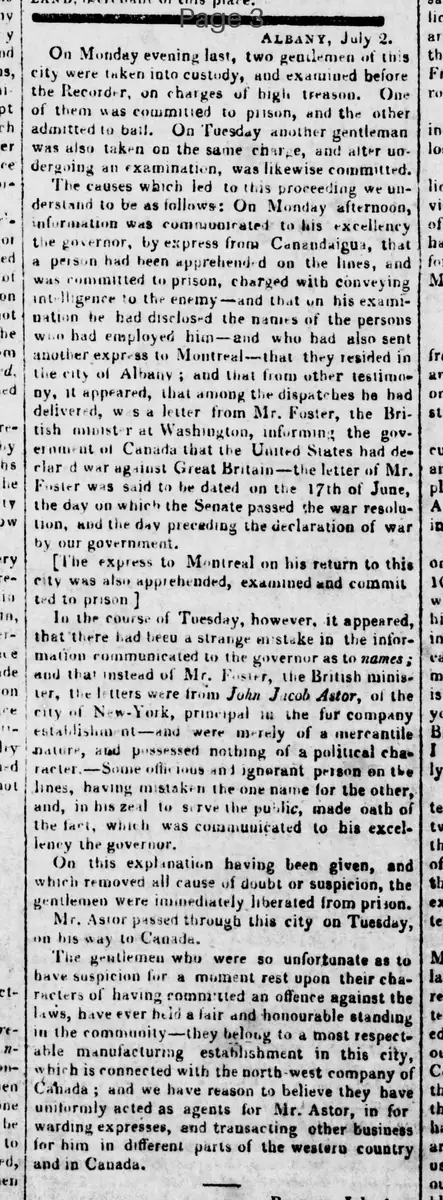
ALBANY, July 2.
On Monday evening last, two gentlemen of this city were taken into custody, and examined before the Recorder, on charges of high treason. One of them was committed to prison, and the other admitted to bail. On Tuesday another gentleman was also taken on the same charge, and after undergoing an examination, was likewise committed.
The causes which led to this proceeding we understand to be as follows: On Monday afternoon, information was communicated to his excellency the governor, by express from Canandaigua, that a person had been apprehended on the lines, and was committed to prison, charged with conveying intelligence to the enemy--and that on his examination he had disclosed the names of the persons who had employed him--and who had also sent another express to Montreal---that they resided in the city of Albany; and that from other testimony, it appeared, that among the dispatches he had delivered, was a letter from Mr. Foster, the British minister at Washington, informing the government of Canada that the United States had declared war against Great Britain--the letter of Mr. Foster was said to be dated on the 17th of June, the day on which the Senate passed the war resolution, and the day preceding the declaration of war by our government.
[The express to Montreal on his return to this city was also apprehended, examined and committed to prison.]
In the course of Tuesday, however, it appeared, that there had been a strange mistake in the information communicated to the governor as to names; and that instead of Mr. Foster, the British minister, the letters were from John Jacob Astor, of the city of New-York, principal in the fur company establishment--and were merely of a mercantile nature, and possessed nothing of a political character.--Some officious and ignorant person on the lines, having mistaken the one name for the other, and, in his zeal to serve the public, made oath of the fact, which was communicated to his excellency the governor.
On this explanation having been given, and which removed all cause of doubt or suspicion, the gentlemen were immediately liberated from prison.
Mr. Astor passed through this city on Tuesday, on his way to Canada.
The gentlemen who were so unfortunate as to have suspicion for a moment rest upon their characters of having committed an offence against the laws, have ever had a fair and honourable standing in the community--they belong to a most respectable manufacturing establishment in this city, which is connected with the north-west company of Canada; and we have reason to believe they have uniformly acted as agents for Mr. Astor, in forwarding expresses, and transacting other business for him in different parts of the western country and in Canada.
On Monday evening last, two gentlemen of this city were taken into custody, and examined before the Recorder, on charges of high treason. One of them was committed to prison, and the other admitted to bail. On Tuesday another gentleman was also taken on the same charge, and after undergoing an examination, was likewise committed.
The causes which led to this proceeding we understand to be as follows: On Monday afternoon, information was communicated to his excellency the governor, by express from Canandaigua, that a person had been apprehended on the lines, and was committed to prison, charged with conveying intelligence to the enemy--and that on his examination he had disclosed the names of the persons who had employed him--and who had also sent another express to Montreal---that they resided in the city of Albany; and that from other testimony, it appeared, that among the dispatches he had delivered, was a letter from Mr. Foster, the British minister at Washington, informing the government of Canada that the United States had declared war against Great Britain--the letter of Mr. Foster was said to be dated on the 17th of June, the day on which the Senate passed the war resolution, and the day preceding the declaration of war by our government.
[The express to Montreal on his return to this city was also apprehended, examined and committed to prison.]
In the course of Tuesday, however, it appeared, that there had been a strange mistake in the information communicated to the governor as to names; and that instead of Mr. Foster, the British minister, the letters were from John Jacob Astor, of the city of New-York, principal in the fur company establishment--and were merely of a mercantile nature, and possessed nothing of a political character.--Some officious and ignorant person on the lines, having mistaken the one name for the other, and, in his zeal to serve the public, made oath of the fact, which was communicated to his excellency the governor.
On this explanation having been given, and which removed all cause of doubt or suspicion, the gentlemen were immediately liberated from prison.
Mr. Astor passed through this city on Tuesday, on his way to Canada.
The gentlemen who were so unfortunate as to have suspicion for a moment rest upon their characters of having committed an offence against the laws, have ever had a fair and honourable standing in the community--they belong to a most respectable manufacturing establishment in this city, which is connected with the north-west company of Canada; and we have reason to believe they have uniformly acted as agents for Mr. Astor, in forwarding expresses, and transacting other business for him in different parts of the western country and in Canada.
What sub-type of article is it?
Historical Event
Curiosity
Mystery
What themes does it cover?
Deception
Misfortune
Justice
What keywords are associated?
High Treason
False Arrest
Mistaken Identity
John Jacob Astor
War Declaration
Mercantile Letters
Albany Gentlemen
What entities or persons were involved?
Two Gentlemen Of Albany
Another Gentleman
John Jacob Astor
Mr. Foster
The Governor
Where did it happen?
Albany
Story Details
Key Persons
Two Gentlemen Of Albany
Another Gentleman
John Jacob Astor
Mr. Foster
The Governor
Location
Albany
Event Date
July 2
Story Details
Two Albany gentlemen and an express were arrested on suspicion of treason for conveying dispatches mistaken as from British minister Mr. Foster to Canada, but actually mercantile letters from John Jacob Astor; all were released after the name confusion was corrected.