Thank you for visiting SNEWPapers!
Sign up free
The Independent
Elizabeth City, Pasquotank County, North Carolina
What is this article about?
Senator P. H. Williams argues against investing state funds in developing Wilmington's port, claiming it lacks converging rail lines, offers no statewide advantage, and would burden taxpayers, based on the State Ship and Waterway Commission's findings favoring only Wilmington-Southport.
Merged-components note: Continuation of the article on Wilmington port advantages; matching topic on state shipping and rail issues.
Clipping
OCR Quality
Full Text
IN WILMINGTON
Senator Williams
Contends
That Money Invested There
in Ports Terminals Useless
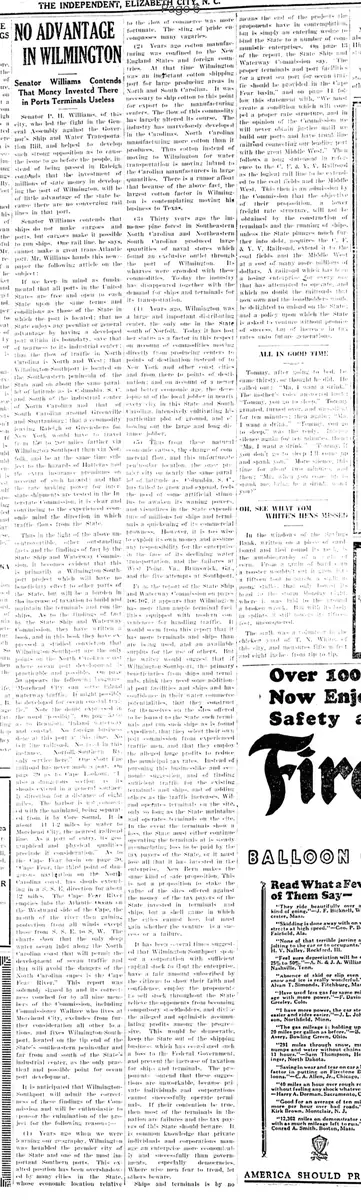
Senator P. H. Williams, of this city, who led the fight in the General Assembly against the Governor's Ship and Water Transportation Bill, and helped to develop such strong opposition as to cause the issue to go before the people, instead of being passed in Raleigh contends that the investment of millions of state money in developing the port of Wilmington, will be of little advantage to the state because there are no converging rail lines in that port.
Senator Williams contends that ships do not make cargoes and ports, but cargoes make it possible to run ships. One rail line, he says, cannot make a great trans-Atlantic port. Mr. Williams hands this newspaper the following article on the subject:
If we keep in mind as fundamental that all ports in the United States are free and open to each State upon the same terms and conditions as those of the State in which the port is located; that no State enjoys any peculiar or general advantage by having a developed port within its boundaries, save that of nearness to its industrial centers; that the flow of traffic in North Carolina is North and West; that Wilmington Southport is located on the Southeastern peninsula of the State and on almost the same parallel or latitude as is Columbia, S. C. and South of the industrial center of North Carolina and that of South Carolina around Greenville and Spartanburg; that a community leaving Raleigh or Durham for New York would have to travel from 150 to 200 miles farther via Wilmington Southport than via Norfolk, and be at the same time subject to the hazards of Hatteras and the serious insurance premiums on account of such hazard; and that the rate making power for inter-state shipments are vested in the Inter-state Commerce Commission, it is clear and convincing to the experienced economic mind the direction in which traffic flows from the State.
Thus in the light of the above incontrovertible, other outstanding facts and the findings of fact by the State Ship and Waterway Commission, it becomes evident that this is primarily a Wilmington-Southport project which will have no beneficial effect to other parts of the State, but will be a burden in the increase of taxation to build and maintain the terminals and run the ships. As to the findings of fact by the State Ship and Waterway Commission, they have written a book, and in this book they have expressed a studied conclusion that Wilmington Southport are the only points on the North Carolina coast where ocean ship route is practicable and possible, so far as the following: 'Morehead City can handle inland waterway traffic. It might possibly be developed for mean coastal to fi.' Note the doubt expressed in the word 'possibly', on page 18, a 'i. iea.ot. inland w.etw.s and coastal. No foreign business dug a this port a his time. No I.l lin ruilmoad. No :e.I in this instance. Norfolk-Southern Ry. only service here.' Comm s'or! The million ha- meser mae: jr, en juge i9 us t. 4'aj: 1.koni. 1 also a dnsorou- stio: 1s is shoals extend in a goter! sutier. in dirution for a di-tanee uf eight mile., Th harbuor i- n: sut. ed with the mainlani, bing separat o from it by Core Soud. It in aluout 11 1-2 miles iy water to Morehead city. the nearest railroad line. As a jort ot outry. is gou sraphieal an phasieal qualitie- proulude it consieration.' As to th calu Far basin on page :o. 'eapn Fear. the ihir! pint of dan- sorons nasigution on tha Norh carolina coast. has shoals extenl. Ing in a S. S. E. diration for alwont 12 mikes. The Cap: Foar Riser empiies into the Atlantie Olcan on the Westward site of the Cape, the mouth of the river then gainin- jotection frol all winds exccjt those from S. S. E. to S. W. The charts show that the ouly doap water ovan inlet along the North carolina coast that will prmit the developtent of ocan traffie and that wili avoid the dangers of the Noth Carolina caps is the Cape Fear River.' This report was solemnly sisuod by and its corroct. jess vouehed for by all nine men- b:rs of the comnission, ineluding Conmissjoner Wallaee wbo lives at Motehuead city. exeludes frou fur: Uher cousideratioy all other lo a: tions, and fixes Wilmington-South: port, Jeate ou the tip cnd of the State's southeastern peninsular and far from and south of the State's industrial center, as the ouly prae: Ueal and possible point for oceay port deselopent.
It in anticipated that Wilmington- Southport will admit the correet. ness of these findings of the com: missjou and wili l enthusiastie to potsor the culmination of the pro- ject for the following reasons:
(1) Years ago when we were harning our geography, wilmington was hetaldel the premier city of the State and one of the most im- portant Southern ports. This ex. alted position has been overshadow. ed by many cities in the State. whose economie location relative
to the flow of commerce was more fortunate. The sting of pride en- compasses many vagaries.
(2) Years ago cotton manufacturing was confined to the New England States and foreign conn- tries. At that time Wilmington was an important cotton shipping port for large producing areas in North and South Carolina. It was necessary to ship cotton to this point for export to the manufacturing centers. The flow of this commodity has largely altered its course. The industry has marvelously developed in the Carolinas, North Carolina manufacturing more cotton than it produces. This cotton instead of moving to Wilmington for water transportation is moving inland to the Carolina manufacturers in large quantities. There is a rumor afloat that because of the above fact, the largest cotton factor in Wilmington is contemplating moving his business to Texas.
(3) Thirty years ago the immense pine forest in Southeastern North Carolina and Northeastern South Carolina produced large quantities of naval stores which found an exclusive outlet through the port of Wilmington. Its wharves were crowded with these commodities. Today the industry has disappeared together with the demand for ships and terminals for its transportation.
(4) Years ago, Wilmington was a large and important distributing center, the only one in the State south of Norfolk. Today it has lost her status as a factor in this respect on account of commodities moving directly from producing centers to points of destination instead of to New York and other coast cities and from there to points of destination: and on account of the newer and better economic age, the scope of the local jobber in nearly every city in this State and South Carolina, intensively cultivating his particular plot of ground, and knowing out the large and long distance jobber.
(5) Thus from these natural economic causes, the change of commercial flow, and this unfortunate particular location, the other city on nearly the same parallel I! .r latiude as Columbia, S. C. has failed to grow and expand, feels the need of some artificial stimulus to awaken its waning powers, and visualizes in the State expenditure of millions for ships and terminals a quickening of its commercial prowness. However, it is too wise to exploit its own money and assume any responsibility for the enterprise in the face of its declining water transportation, and the failure at West Point, Va., Brunswick, Ga., and the first attempts at Southport.
In the report of the State Ship and Waterway Commission on pages 100-110, it appears that Wilmington has more than ample terminal facilities currently with modern convenience for handling traffic. It would seem from this report that it has more terminals and ships than are being used, and an available surplus for the use of others. But the writer would suggest that if Wilmington Southport, the primary beneficiary for ships and terminals, think these would some additional port facilities and ships and has confidence in their water commerce potentialities, that they construct for themselves on the sites offered to be loaned to the state such terminals and run such ships as is found expedient, that they select their own port commission from experienced traffic men, and that they employ the alleged huge profits to reduce the municipal tax rates. Instead of pursuing this businesslike and conservative suggestion, and of finding sufficient traffic for the existing terminals and ships, and of adding others as the traffic increases, will- and operate terminals on the site only so long as the State maintains and operates terminals on the site. In the event the terminals show a loss, the State must either continue operating the terminals at its steady accumulating loss to be paid by the tax payers of the State, or it must lose all that it has invested in the enterprise. New Bern makes the same kind of state proposition. This is not a proposition to stake the value of the sites offered against the money of the tax payers or the State invested in terminals and ships, but a shell game in which the cities cannot lose, but must gain whether the venture is a success or a failure.
It has been several times suggested that Wilmington Southport sponsor a corporation with sufficient capital stock to float the enterprise, have a fair amount subscribed by the citizens to show their faith and confidence, employ the proponents i. sell stock throughout the State relieve the opponents from being compulsory stockholders, and divide the alleged and optimistic accumulating profits among the progressive. This would be democratic, keep the State out of the shipping business which has caused such a loss to the Federal Government, and prevent the increase of taxation for ships and terminals. The proponents contend that these suggestions are unworkable, because: private individuals and corporations cannot successfully operate terminals. If their contention be true, let most of the terminals in the nation are failures and the tax payers of this State should beware. It is common knowledge that private individuals and corporations manage an enterprise more economical. iv and successfully than governments, especially democracies. Where wise men fear to tread, let others beware.
Ships and terminals is by no means the end of the projects the proponents have in contemplation, but is simply an entering wedge to bind the State to a number of communistic enterprises. On page 15 of the report, the State Ship and Waterway Commission say, 'The proper terminals and port facilities for a great sea port for ocean traffic should be provided in the Cape Fear basin,' and on page 11 follow this statement with, 'we must create a condition which will compel a proper rate structure, and in the opinion of the commission we will never obtain justice until we build our ports and have trunk line railroad connecting our leading port with the great Middle West.' Then follows a long statement in reference to the C. F. & Y. V. Railroad as the logical rail line to be extended to the coal fields and the Middle West. This then is an admission by the Commission that the objective of their proposition, a lower freight rate structure, will not be obtained by the construction of terminals and the running of ships, unless the State plunges much further into debt, acquires the C. F. & Y. V. Railroad, extends it to the coal fields and the Middle West at a cost of many more millions of dollars. A railroad which has been a losing enterprise for every one that has attempted to operate, and which no doubt the railroads that now own and the bondholders would be delighted to unload on the State; and a policy upon which the State is asked to venture without promise of success, or increase in tax rates into future generations.
What sub-type of article is it?
What themes does it cover?
What keywords are associated?
What entities or persons were involved?
Where did it happen?
Story Details
Key Persons
Location
Wilmington, North Carolina
Story Details
Senator Williams opposes state investment in Wilmington port development, arguing it benefits only local interests, lacks rail connectivity, and imposes taxation burdens, citing commission findings and economic shifts.