Thank you for visiting SNEWPapers!
Sign up free
Story
February 16, 1832
Richmond Enquirer
Richmond, Richmond County, Virginia
What is this article about?
An unsigned response in a Virginia newspaper rebuts an article by 'Appomattox' criticizing a recent House of Delegates debate on slavery abolition and deportation. The writer defends the debaters, cites Jefferson's support for abolition, and accuses 'Appomattox' of arrogance and outdated views.
Clipping
OCR Quality
95%
Excellent
Full Text
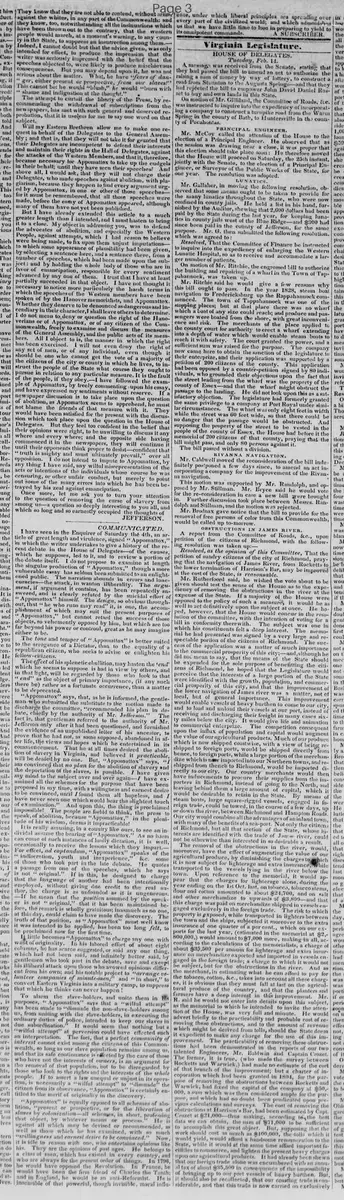
I have seen in the Enquirer of Saturday the 4th, an article of great length and virulence, signed "Appomattox," in which the writer undertakes to give a history of the recent debate in the House of Delegates—of the causes, which he supposes, led to it, and to review a portion of the debate itself.
I do not propose to examine at length the singular production of "Appomattox," though a more vulnerable essay has seldom been submitted to an enlightened public. The narration abounds in errors and inaccuracies—the attack, in wanton illiberality. The argument, if argument it contains, has been repeatedly answered, and is clearly refuted by the suicidal effort of "Appomattox" himself. The design, so obvious throughout, that "he who runs may read" it, is one, the accomplishment of which may suit the present purposes of "Appomattox," but cannot retard the success of those objects, so vehemently opposed by him, but which are too far beyond his power or controul, great as he may imagine either to be.
The tone and temper of "Appomattox" is better suited to the arrogance of a Dictator, than to the equality of a republican citizen, who seeks to advise or enlighten his fellow-citizens. The effect of his splenetic ebullition, may hasten the 'end' which he seems to suppose is had in view by others, and in that light, will be regarded by those who look to that "end" as the object of primary importance, (if any such there be) rather as a fortunate occurrence, than a matter to be deprecated.
"Appomattox" says, that, as he is informed, the gentleman who submitted the substitute to the motion made to discharge the committee, "recommended his plan in debate, chiefly by the authority of Mr. Jefferson." The fact is, that gentleman referred to the authority of Mr. Jefferson only after it had been questioned, and furnished the evidence of an unpublished letter of his ancestor, to prove that he had not, as some supposed, abandoned in after life, the views and hopes which he entertained in its commencement. That he at all times desired the abolition of slavery in Virginia, and believed it practicable, will be denied by no one.
But, "Appomattox" says, "I am convinced that no plan for the abolition of slavery and the deportation of the slaves, is possible. I have given my mind to the subject over and over again—I have examined all the schemes for the purpose that have been proposed in my time, with a willingness and earnest desire to be convinced, until I found them all hopeless, and I have never seen one which would bear the slightest touch of examination." And upon this, the thing is proclaimed impossible! The people are forbid to think, the press to speak, of abolition, because "Appomattox," in the plenitude of his wisdom, deems it impracticable! It is really amusing, in a country like ours, to see an individual assume the bearing of "Appomattox." As no harm can come of such instances of lordly dictation, it is well, occasionally to receive the lessons which they impart.
For effect, ad captandum, "Appomattox" speaks of the "indiscretion, youth and inexperience," &c. some of those who took part in the late debate. He quotes a passage from one of the speeches, which he says is not "original." If in this, he designed to charge that the language of another had been intentionally employed, without giving due credit to the real author, the charge is as unfounded as it is ungenerous. If he mean that the position assumed by the speaker is not "original," that it has been maintained before, the remark is wholly gratuitous; inasmuch as no one, at this day, could claim to have made the discovery. The truth of that position, as "Appomattox" must well know it was intended to be applied, has been too long felt, to be proclaimed now for the first time.
It little becomes "Appomattox" to charge any one with want of originality. In his labored effort of about eight columns, he has scarce suggested, or said any one thing, which had not been said, and infinitely better said, by gentlemen who took part in the debate, save and except his illiberal attack upon those who avowed opinions different from his own; and his notable project to "arrange volunteer companies of minute-men;" and "in short," to convert Eastern Virginia into a military camp, to suppress that which he thinks can never happen!
To alarm the slave-holders, and unite them in his purposes, "Appomattox" says that a "wilful attempt" has been made to "dissuade the non-slave-holders among us, from uniting with the slave-holders, in executing the ordinary duties of police, intended to keep our slaves in due subordination." It would seem that nothing but a "wilful attempt" at perversion could have effected such an interpretation. The fact, that a perfect community of interest cannot exist among the citizens of this Commonwealth, so long as our slave population remains among us, and that its safe continuance is effected by the care of those who have not the interests of owners, is an argument for the removal of that population, not to be disregarded by those who look to the rights and the interests of the whole people. If to assert a law unequal or unjust in its operation, is necessarily a "wilful attempt" to "dissuade" the citizen from its observance, "Appomattox" is certainly entitled to the merit of originality in the discovery.
"Appomattox" is equally opposed to all schemes of abolition, "present or prospective, or for the liberation of slaves by colonization—all schemes, in short, professing that object, by whatever means or process." He is against all which may be devised or recommended, as well as those which he has examined, with so much "willingness and earnest desire to be convinced." Now, it is idle to reason with one, who entertains opinions like his. They are the opinions of past ages. He belongs to a class of men, which has existed in every country, and who are always for the present order of things. In 1796, he would have opposed the Revolution. In France, he would have been the firm friend of Charles the Tenth: and in England, he would be an anti-Reformist. He is insensible of that powerful, though invisible, moral influence
I do not propose to examine at length the singular production of "Appomattox," though a more vulnerable essay has seldom been submitted to an enlightened public. The narration abounds in errors and inaccuracies—the attack, in wanton illiberality. The argument, if argument it contains, has been repeatedly answered, and is clearly refuted by the suicidal effort of "Appomattox" himself. The design, so obvious throughout, that "he who runs may read" it, is one, the accomplishment of which may suit the present purposes of "Appomattox," but cannot retard the success of those objects, so vehemently opposed by him, but which are too far beyond his power or controul, great as he may imagine either to be.
The tone and temper of "Appomattox" is better suited to the arrogance of a Dictator, than to the equality of a republican citizen, who seeks to advise or enlighten his fellow-citizens. The effect of his splenetic ebullition, may hasten the 'end' which he seems to suppose is had in view by others, and in that light, will be regarded by those who look to that "end" as the object of primary importance, (if any such there be) rather as a fortunate occurrence, than a matter to be deprecated.
"Appomattox" says, that, as he is informed, the gentleman who submitted the substitute to the motion made to discharge the committee, "recommended his plan in debate, chiefly by the authority of Mr. Jefferson." The fact is, that gentleman referred to the authority of Mr. Jefferson only after it had been questioned, and furnished the evidence of an unpublished letter of his ancestor, to prove that he had not, as some supposed, abandoned in after life, the views and hopes which he entertained in its commencement. That he at all times desired the abolition of slavery in Virginia, and believed it practicable, will be denied by no one.
But, "Appomattox" says, "I am convinced that no plan for the abolition of slavery and the deportation of the slaves, is possible. I have given my mind to the subject over and over again—I have examined all the schemes for the purpose that have been proposed in my time, with a willingness and earnest desire to be convinced, until I found them all hopeless, and I have never seen one which would bear the slightest touch of examination." And upon this, the thing is proclaimed impossible! The people are forbid to think, the press to speak, of abolition, because "Appomattox," in the plenitude of his wisdom, deems it impracticable! It is really amusing, in a country like ours, to see an individual assume the bearing of "Appomattox." As no harm can come of such instances of lordly dictation, it is well, occasionally to receive the lessons which they impart.
For effect, ad captandum, "Appomattox" speaks of the "indiscretion, youth and inexperience," &c. some of those who took part in the late debate. He quotes a passage from one of the speeches, which he says is not "original." If in this, he designed to charge that the language of another had been intentionally employed, without giving due credit to the real author, the charge is as unfounded as it is ungenerous. If he mean that the position assumed by the speaker is not "original," that it has been maintained before, the remark is wholly gratuitous; inasmuch as no one, at this day, could claim to have made the discovery. The truth of that position, as "Appomattox" must well know it was intended to be applied, has been too long felt, to be proclaimed now for the first time.
It little becomes "Appomattox" to charge any one with want of originality. In his labored effort of about eight columns, he has scarce suggested, or said any one thing, which had not been said, and infinitely better said, by gentlemen who took part in the debate, save and except his illiberal attack upon those who avowed opinions different from his own; and his notable project to "arrange volunteer companies of minute-men;" and "in short," to convert Eastern Virginia into a military camp, to suppress that which he thinks can never happen!
To alarm the slave-holders, and unite them in his purposes, "Appomattox" says that a "wilful attempt" has been made to "dissuade the non-slave-holders among us, from uniting with the slave-holders, in executing the ordinary duties of police, intended to keep our slaves in due subordination." It would seem that nothing but a "wilful attempt" at perversion could have effected such an interpretation. The fact, that a perfect community of interest cannot exist among the citizens of this Commonwealth, so long as our slave population remains among us, and that its safe continuance is effected by the care of those who have not the interests of owners, is an argument for the removal of that population, not to be disregarded by those who look to the rights and the interests of the whole people. If to assert a law unequal or unjust in its operation, is necessarily a "wilful attempt" to "dissuade" the citizen from its observance, "Appomattox" is certainly entitled to the merit of originality in the discovery.
"Appomattox" is equally opposed to all schemes of abolition, "present or prospective, or for the liberation of slaves by colonization—all schemes, in short, professing that object, by whatever means or process." He is against all which may be devised or recommended, as well as those which he has examined, with so much "willingness and earnest desire to be convinced." Now, it is idle to reason with one, who entertains opinions like his. They are the opinions of past ages. He belongs to a class of men, which has existed in every country, and who are always for the present order of things. In 1796, he would have opposed the Revolution. In France, he would have been the firm friend of Charles the Tenth: and in England, he would be an anti-Reformist. He is insensible of that powerful, though invisible, moral influence
What sub-type of article is it?
Historical Event
What themes does it cover?
Moral Virtue
Justice
Social Manners
What keywords are associated?
Slavery Abolition
Virginia Debate
House Of Delegates
Appomattox
Thomas Jefferson
Deportation Schemes
What entities or persons were involved?
Appomattox
Mr. Jefferson
Where did it happen?
Virginia
Story Details
Key Persons
Appomattox
Mr. Jefferson
Location
Virginia
Event Date
Recent
Story Details
An anonymous writer criticizes 'Appomattox''s article on a House of Delegates debate advocating slavery abolition and deportation, defending the use of Jefferson's authority, refuting claims of impossibility, and portraying 'Appomattox' as arrogant and reactionary.