Thank you for visiting SNEWPapers!
Sign up free
Washington Telegraph
Washington, Hempstead County, Arkansas
What is this article about?
Biography of Monroe Edwards, a Kentucky-born schemer who partnered with C. Dart in a Texas slave plantation venture funded by $85,000. Edwards mismanaged it, forged deeds to claim ownership, escaped justice, and later committed forgeries in England and New York, leading to imprisonment.
Clipping
OCR Quality
Full Text
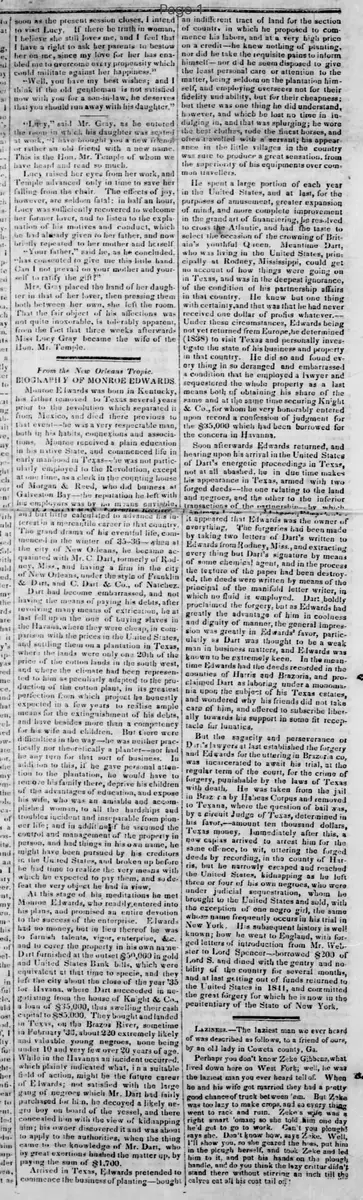
BIOGRAPHY OF MONROE EDWARDS
Monroe Edwards was born in Kentucky, his father removed to Texas several years prior to the revolution which separated it from Mexico, and died there previous to that event—he was a very respectable man, both in his habits, connexions and associations. Monroe received a plain education in his native State, and commenced life in early manhood in Texas—he was not particularly employed in the Revolution, except at one time, as a clerk in the counting house of Morgan & Reed, who did business at Galveston Bay—the reputation he left with his employers was by no means enviable, and but little calculated to advance his interest in a mercantile career in that country.
The grand drama of his eventful life, commenced in the winter of '35-36—when at the city of New Orleans, he became acquainted with Mr. C. Dart, formerly of Rodney, Miss., and having a firm in the city of New Orleans, under the style of Franklin & Dart, and C. Dart & Co., of Natchez. Dart had become embarrassed, and not having the means of paying his debts, after revolving many means of extrication, he at last fell upon the one of buying slaves in the Havana, where they were cheap, in comparison with the prices in the United States, and settling them on a plantation in Texas, where the lands were only one 20th of the price of the cotton lands in the south west, and whose climate had been represented to him as peculiarly adapted to the production of the cotton plant, in its greatest perfection. From which project he honestly expected in a few years to realise ample means for the extinguishment of his debts, and have besides more than a competency for his wife and children. But there were difficulties in the way—he was neither practically nor theoretically a planter—nor had he any turn for that sort of business. In addition to this, if he gave personal attention to the plantation, he would have to remove his family there, deprive his children of the advantages of education, and expose his wife, who was an amiable and accomplished woman, to all the hardships and troubles incident and inseparable from pioneer life; and in addition if he assumed the control and management of the property in person, and had things in his own name, he might have been pursued by his creditors in the United States, and broken up before he had time to realize the very means with which he expected to pay them, and so defeat the very object he had in view.
At this stage of his meditations he met Monroe Edwards, who readily entered into his plans, and promised an entire devotion to the success of the enterprise. Edwards had no money, but in lieu thereof he was to furnish talents, vigor, enterprise, &c., and to cover the property in his own name. Dart furnished at the outset $50,000 in gold and United States Bank bills, which were equivalent at that time to specie, and they left the city about the close of the year '35 for Havana, where Dart succeeded in negotiating from the house of Knight & Co., a loan of $35,000, thus swelling their cash capital to $85,000. They bought and landed in Texas, on the Brazos River, sometime in February '36, about 220 extremely likely and valuable young negroes, none being under 10 and very few over 20 years of age.
While in the Havana an incident occurred, which plainly indicated what, in a suitable field of action, might be the future career of Edwards; not satisfied with the large gang of negroes which Mr. Dart had fairly purchased for him, he decoyed a likely negro boy on board of the vessel, and there concealed him with the view of kidnapping him; his owner discovered it and was about to apply to the authorities, when the thing came to the knowledge of Mr. Dart, who by great exertions hushed the matter up, by paying the sum of $1,700.
Arrived in Texas, Edwards pretended to commence the business of planting—bought an indifferent tract of land for the section of country, in which he proposed to commence his labors, and at a very high price on a credit—he knew nothing of planting, nor did he take the requisite pains to inform himself—nor did he seem disposed to give the least personal care or attention to the matter, being seldom on the plantation himself, and employing overseers not for their fidelity and ability, but for their cheapness; but there was one thing he did understand, however, and which he lost no time in indulging in, and that was splurging; he wore the best clothes, rode the finest horses, and often travelled with a servant; his appearance in the little villages in the country was sure to produce a great sensation, from the superiority of his equipments over common travellers.
He spent a large portion of each year in the United States, and at last, for the purposes of amusement, greater expansion of mind, and more complete improvement in the grand art of financiering, he resolved to cross the Atlantic, and had the taste to select the occasion of the crowning of Britain's youthful Queen. Meantime Dart, who was living in the United States, principally at Rodney, Mississippi, could get no account of how things were going on in Texas, and was in the deepest ignorance, of the condition of his partnership affairs in that country. He knew but one thing with certainty, and that was that he had never received one dollar of profits whatever.
Under these circumstances, Edwards being not yet returned from Europe, he determined (1838) to visit Texas and personally investigate the state of his business and property in that country. He did so and found everything in so deranged and embarrassed a condition that he employed a lawyer and sequestered the whole property as a last means both of obtaining his share of the same and at the same time securing Knight & Co., for whom he very honorably entered upon record a confession of judgment for the $35,000 which had been borrowed for the concern in Havana.
Soon afterwards Edwards returned, and hearing upon his arrival in the United States of Dart's energetic proceedings in Texas, not at all abashed, he in due time makes his appearance in Texas, armed with two forged deeds—the one relating to the land and negroes, and the other to the inferior transactions of the partnership—by which it appeared that Edwards was the owner of everything. The forgeries had been made by taking two letters of Dart's written to Edwards from Rodney, Miss., and extracting everything but Dart's signature by means of some chemical agent, and in the process the texture of the paper had been destroyed, the deeds were written by means of the principle of the manifold letter writer, in which no fluid is employed. Dart boldly proclaimed the forgery, but as Edwards had greatly the advantage of him in coolness and dignity of manner, the general impression was greatly in Edwards' favor, particularly as Dart was thought to be a weak man in business matters, and Edwards was known to be extremely keen. In the meantime Edwards had the deeds recorded in the counties of Harris and Brazoria, and proclaimed Dart as laboring under a monomania upon the subject of his Texas estates, and wondered why his friends did not take care of him, and offered to subscribe liberally towards his support in some fit receptacle for lunatics.
But the sagacity and perseverance of Dart's lawyers at last established the forgery and Edwards for the uttering in Brazoria Co., was incarcerated to await his trial, at the regular term of the court, for the crime of forgery, punishable by the laws of Texas with death. He was taken from the jail in Brazoria by Habeas Corpus and removed to Texana, where the question of bail was, by a circuit Judge of Texas, determined in his favor,—amount ten thousand dollars, Texas money. Immediately after this, a new capias arrived to arrest him for the same offence, to wit, uttering the forged deeds by recording, in the county of Harris, but he narrowly escaped and reached the United States, kidnapping as he left three or four of his own negroes, who were under judicial sequestration, whom he brought to the United States and sold, with the exception of one negro girl, the same whose name frequently occurs in his trial in New York. His subsequent history is well known; how he went to England, with forged letters of introduction from Mr. Webster to Lord Spencer—borrowed $200 of Lord S. and dined with the gentry and nobility of the country for several months, and at last getting out of funds returned to the United States in 1841, and committed the great forgery for which he is now in the penitentiary of the State of New York.
What sub-type of article is it?
What themes does it cover?
What keywords are associated?
What entities or persons were involved?
Where did it happen?
Story Details
Key Persons
Location
Texas, New Orleans, Havana, England, New York
Event Date
Winter Of '35 36 To 1841
Story Details
Monroe Edwards partners with C. Dart to buy slaves and start a Texas plantation with $85,000, but mismanages it extravagantly. Dart sequesters property; Edwards forges deeds to claim ownership, escapes arrest, kidnaps slaves, forges in England, and is imprisoned in New York for forgery.