Thank you for visiting SNEWPapers!
Sign up free
Daily National Intelligencer
Washington, District Of Columbia
What is this article about?
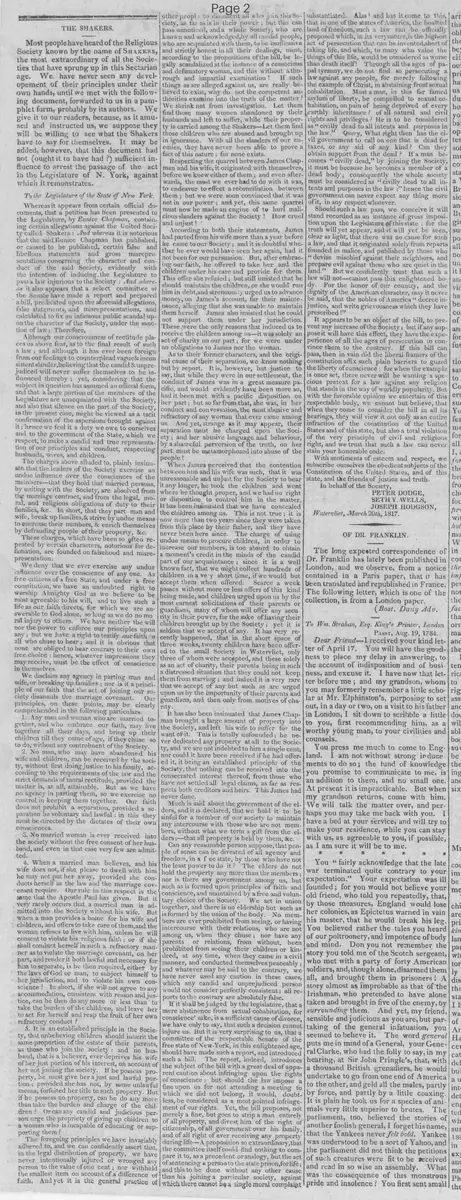
The Shakers' society issues a formal remonstrance to the New York Legislature against a proposed bill based on false allegations by Eunice Chapman, denying claims of undue influence, family separation, and property fraud. They outline their principles on marriage, children, and property, defending their celibate faith. Signed March 20, 1817, from Watervliet.
Clipping
OCR Quality
Full Text
Most people have heard of the Religious Society known by the name of SHAKERS. The most extraordinary of all the Societies that have sprung up in this Sectarian age. We have never seen any development of their principles under their own hands, until we met with the following document, forwarded to us in a pamphlet form, probably by its authors. We give it to our readers, because, as it amused and instructed us, we suppose they will be willing to see what the Shakers have to say for themselves. It may be added, however, that this document had not (ought it to have had?) sufficient influence to arrest the passage of the act in the Legislature of N. York, against which it remonstrates.
To the Legislature of the State of New Yorke
Whereas it appears from certain official documents, that a petition has been presented to the Legislature, by Eunice Chapman, containing certain allegations against the United Society called Shakers: And whereas it is notorious that the said Eunice Chapman has published or caused to be published, certain false and libellous statements and gross misrepresentations concerning the character and conduct of the said Society, evidently with the intention of inducing the Legislature to pass a law injurious to the Society: And whereas it also appears that a select committee of the Senate have made a report and prepared a bill, predicated upon the aforesaid allegations, false statements, and misrepresentations, and calculated to fix an infamous public scandal upon the character of the Society, under the sanction of law; Therefore,
Although our consciousness of rectitude places us above fear, as to the final result of such a law: and although it has ever been foreign from our feelings to counterplead vague & inconsistent slander, believing that the candid & unprejudiced will never suffer themselves to be influenced thereby; yet, considering that the subject in question has assumed an official form, and that a large portion of the members of the Legislature are unacquainted with the Society, and also that silence on the part of the Society, in the present case, might be viewed as a tacit confirmation of the aspersions brought against it; hence we feel it a duty we owe to ourselves and to the government of the State, which we respect, to make a candid and true representation of our principles and conduct, respecting husbands, wives, and children.
The charges above alluded to, plainly insinuate that the leaders of the Society exercise an undue influence over the consciences of the members—that they hold that married persons, by uniting with the Society, are absolved from the marriage contract, and from the legal, moral, and religious obligations of duty to their families, &c. In short, that they part man and wife, break up families, & strive by undue means to encrease their numbers, & enrich themselves by defrauding people of their property, &c.
These charges, which have been so often repeated by certain characters, notorious for defamation, are founded on falsehood and misrepresentation.
We deny that we ever exercise any undue influence over the conscience of any one. As free citizens of a free State, and under a free constitution, we have an undoubted right to worship Almighty God as we believe to be most agreeable to his will, and to live such a life as our faith directs, for which we are answerable to God alone, so long as we do no moral injury to others. We have neither the will nor the power to enforce our principles upon any; but we have a right to testify our faith to all who chuse to hear; and it is obvious that none are obliged to hear contrary to their own free choice: hence, whatever impressions they may receive, must be the effect of conscience in themselves.
We disclaim any agency in parting man and wife, or breaking up families; nor is it a principle of our faith that the act of joining our society disannuls the marriage covenant. Our principles, on these points, may be clearly comprehended in the following particulars.
1. Any man and woman who are married together, and who embrace our faith, may live together all their days, and bring up their children till they come of age, if they chuse so to do, without any controlment of the Society.
2. No man, who may have abandoned his wife and children, can be received by the society, without first doing justice to his family, according to the requirements of the law and the strict demands of moral rectitude, provided the matter is, at all, attainable. But as we have no agency in parting them, so we exercise no control in keeping them together. Our faith does not prohibit a separation, provided a separation be voluntary and lawful: in this they must be directed by the dictates of their own consciences.
3. No married woman is ever received into the society without the free consent of her husband, and even in that case very few are admitted.
4. When a married man believes, and his wife does not, if she please to dwell with him he may not put her away, provided she conducts herself as the law and the marriage covenant require. Our rule in this respect is the same that the Apostle Paul has given. But it very rarely occurs that a married man is admitted into the Society without his wife. But when a man provides a home for his wife and children, and offers to take care of them, and the woman refuses to live with him, unless he will consent to violate his religious faith; or if she shall conduct herself in such a refractory manner as to violate the marriage covenant, on her part, and render it both lawful and necessary for him to separate, is he then required, either by the laws of God or man, to subject himself to her jurisdiction, and to violate his own conscience? In short, if she will not agree to any accommodation, consistent with reason and justice, can he then do any more or less than to take the burden of the children, and leave her to act for herself and reap the fruit of her own refractory conduct?
5. It is an established principle in the Society, that unbelieving children should inherit the same proportion of the estate of their parents, as those who join the society: and no husband, that is a believer, ever deprives his wife of her just portion of his interest, on account of her not joining the society. If he possess property, he must give her a just and lawful portion; provided she has not, by some unlawful means, forfeited her title to such property. But if he possess no property, can he do any more than take the burden and charge of the children? Or can any candid and judicious person urge the propriety of giving up children to a woman who is incapable of educating or supporting them?
The foregoing principles we have invariably adhered to, and we can confidently assert that, in the legal distribution of property, we have never intentionally injured or wronged any person to the value of one cent; nor withheld the smallest item on account of a difference of faith. And yet it is the general practice of other people to disinherit all who join this Society, as far as is in their power; but this can pass unnoticed, and a whole Society, who are known and acknowledged, by all candid people who are acquainted with them, to be inoffensive and strictly honest in all their dealings, must, according to the propositions of the bill, be legally scandalized at the instance of a censorious and defamatory woman, and this without a thorough and impartial examination! If such things as are alleged against us, are really believed to exist, why do not the competent authorities examine into the truth of the matter? We shrink not from investigation. Let them find those many women abandoned by their husbands and left to suffer, while their property is carried among the Shakers—Let them find those children who are abused and brought up in ignorance. With all the slanders of our enemies, they have never been able to prove a fact of this nature; for none exists.
Respecting the quarrel between James Chapman and his wife, it originated with themselves before we knew either of them; and even afterwards, the most we ever had to do with it was to endeavor to effect a reconciliation between them; but we were soon convinced that it was not in our power; and yet, this same quarrel must now be made an engine of to hurl malicious slanders against the Society! How cruel and unjust!
According to both their statements, James had parted from his wife more than a year before he came to our Society; and it is doubtful whether he ever would have seen her again, had it not been for our persuasion. But, after embracing our faith, he offered to take her and the children under his care and provide for them. This offer she refused; but still insisted that he should maintain the children, or she would run him in debt, and strenuously urged us to advance money, on James's account, for their maintenance, alleging that she was unable to maintain them herself. James also insisted that he could not support them under her jurisdiction. These were the only reasons that induced us to receive the children among us—it was solely an act of charity on our part; for we were under no obligations to James nor the woman.
As to their former characters, and the original cause of their separation, we know nothing but by report. It is, however, but justice to say, that while they were in our settlement, the conduct of James was in a great measure pacific, and would evidently have been more so, had it been met with a pacific disposition on her part; but so far from that, she was, in her conduct and conversation, the most abusive and refractory of any woman that ever came among us. And yet, strange as it may appear, their separation must be charged upon the Society; and her abusive language and behaviour, by a shameful perversion of the truth, on her part, must be metamorphosed into abuse of the people!
When James perceived that the contention between him and his wife was such, that it was unreasonable and unjust for the Society to bear it any longer, he took the children and went where he thought proper, and we had no right or disposition to control him in the matter.
It has been insinuated that we have concealed the children among us. This is not true; it is now more than two years since they were taken from this place by their father, and they have never been here since. The charge of using undue means to procure children, in order to increase our numbers, is too absurd to obtain a moment's credit in the minds of the candid part of our acquaintance; since it is a well known fact, that we might collect hundreds of children in a very short time, if we would but accept them when offered. Scarce a week passes without more or less offers of this kind being made, and children urged upon us by the most earnest solicitations of their parents or guardians, many of whom will offer any security in their power, for the sake of having their children brought up by the Society: yet it is seldom that we accept of any. It has very recently happened, that in the short space of three weeks, twenty children have been offered to the small Society in Watervliet, only three of whom were accepted, and these solely as an act of charity, their parents being in such a distressed situation that they could not keep them from starving; and indeed it is very rare that we accept of any but such as are urged upon us by the importunity of their parents and guardians, and then only from motives of charity.
It has also been insinuated that James Chapman brought a large amount of property into the Society, and left his wife to suffer for the want of it. This is totally unfounded; he never dedicated any property at all to the Society, and we are not indebted to him a single cent; nor could it have been received if he had offered it, it being an established principle of the Society, that nothing can be received into the consecrated interest thereof, from those who have not settled all legal claims, as far as respects both creditors and heirs. This James had never done.
Much is said about the government of the elders, and it is declared, that we hold it to be sinful for a member of our society to maintain any intercourse with those who are not members, without what we term a gift from the elders;—that all property is held by them, &c. Can any reasonable person suppose, that people of sense can be divested of all agency and freedom, in a free state, by those who have not the least power to do it? The elders do not hold the property any more than the members; nor is there any government among us, but such as is formed upon principles of faith and conscience, and maintained by a free and voluntary choice of the Society. We act in union together, and there is no eldership but such as is formed by the union of the body. No members are ever prohibited from seeing or having intercourse with their relations, who are not among us, when they chuse; nor have any parents or relations, from without, been prohibited from seeing their children or kindred, at any time, when they came in a civil manner, and conducted themselves peaceably; and whatever may be said to the contrary, we have never used any caution in these cases, which any candid and unprejudiced person would not consider perfectly consistent; all reports to the contrary are absolutely false.
If it shall be judged by the legislature, that a mere abstinence from sexual cohabitation, for conscience' sake, is a sufficient cause of divorce, we have only to say, that such a decision cannot injure us. But it is very surprising to us, that a committee of the respectable Senate of the free state of New-York, in this enlightened age, should have made such a report, and introduced such a bill. The report, indeed, introduces the subject of the bill with a great deal of apparent caution about infringing upon the rights of conscience; but should the law impose a fine upon us for not attending a meeting to which we did not belong, it would, doubtless, be considered as a most pointed infringement of our rights. Yet, the bill proposes, not merely a fine, but goes to strip a man entirely of all property, and divest him of the right of citizenship, of all government over his family, and of all right of ever receiving any property during life—A proposition so extraordinary, that the committee itself could find nothing to compare it to, as a precedent or analogy, but the act of sentencing a person to the state prison, for life; and this to be done without any other cause than his joining a particular society, against which there cannot be a single moral complaint substantiated. Alas! and has it come to this, that in one of the states of America, the boasted land of freedom, such a law can be officially proposed which, in its very nature, is the highest act of persecution that can be invented, short of taking life, and which, to many who value the things of this life, would be considered as worse than death itself! Through all the ages of papal tyranny, we do not find so persecuting a law against any people, for merely following the example of Christ, in abstaining from sexual cohabitation. Must a man, in this far famed asylum of liberty, be compelled to sexual cohabitation, on pain of being deprived of every earthly inheritance? of all natural and civil rights and privileges? He is to be considered as "civilly dead to all intents and purposes in the law." Query, What right then has the civil government to call on one that is dead for taxes, or any aid of any kind? Can they obtain support from the dead? If a man becomes "civilly dead," by joining the Society, it must be because he becomes a member of a dead body; consequently the whole society must be considered as "civilly dead to all intents and purposes in the law;" hence the civil government can never expect any thing more of it, in any respect whatever.
Should such a law pass, we conceive it will stand recorded as an instance of gross imposition upon the Legislature of this state, for the truth will yet appear, and it will yet be seen, clear as light, that there was no cause for such a law, and that it originated solely from reports founded in malice, and published by those who "devise mischief against their neighbors, and prepare evil against those who are quiet in the land." But we confidently trust that such a law will not—cannot pass this enlightened body. For the honor of our country, and the dignity of the American character, may it never be said, that the nobles of America "decree injustice, and write grievousness which they have prescribed!"
It appears to be an object of the bill, to prevent any increase of the Society; but if any suppose it will have this effect, they have the experience of all the ages of persecution to convince them to the contrary. If this bill can pass, then in vain did the liberal framers of the constitution affix such plain barriers to guard the liberty of conscience: for when the example is once set, there never will be wanting a specious pretext for a law against any religion that stands in the way of worldly popularity. But with the favorable opinion we entertain of this respectable body, we cannot but believe, that when they come to consider the bill in all its bearings, they will view it not only as an entire infraction of the constitution of the United States and of this state, but also a total violation of the very principle of civil and religious right, and we trust that such a law can never stain your honorable code.
With sentiments of esteem and respect, we subscribe ourselves the obedient subjects of the Constitution of the United States, and of this state, and the friends of justice and truth.
In behalf of the Society,
PETER DODGE,
SETH Y. WELLS,
JOSEPH HODGSON,
Watervliet, March 20th, 1817.
What sub-type of article is it?
What themes does it cover?
What keywords are associated?
What entities or persons were involved?
Where did it happen?
Story Details
Key Persons
Location
Watervliet, New York
Event Date
March 20th, 1817
Story Details
The Shakers remonstrate against a legislative bill prompted by Eunice Chapman's false allegations of family separation and property fraud, detailing their principles on marriage, voluntary separation, child inheritance, and charity admissions, while refuting claims in the Chapman case and decrying the bill as unconstitutional persecution of their celibate faith.