Thank you for visiting SNEWPapers!
Sign up free
Boon's Lick Times
Fayette, Howard County, Missouri
What is this article about?
Secretary of the Treasury T. Ewing's 1841 report details U.S. finances for 1840, showing receipts of $25M and expenditures of $27M, leaving a deficit. Recommends tariff increases, a funded loan, and re-establishing a national bank as fiscal agent. Senate committee report supports a new Bank of the United States based on the 1816 charter with modifications.
Merged-components note: Merged continuation of the Treasury Secretary's report on finances across pages 1 and 2; changed label from 'story' for the page 2 portion to 'domestic_news' as it fits government financial reporting.
Clippings
1 of 2
OCR Quality
Full Text
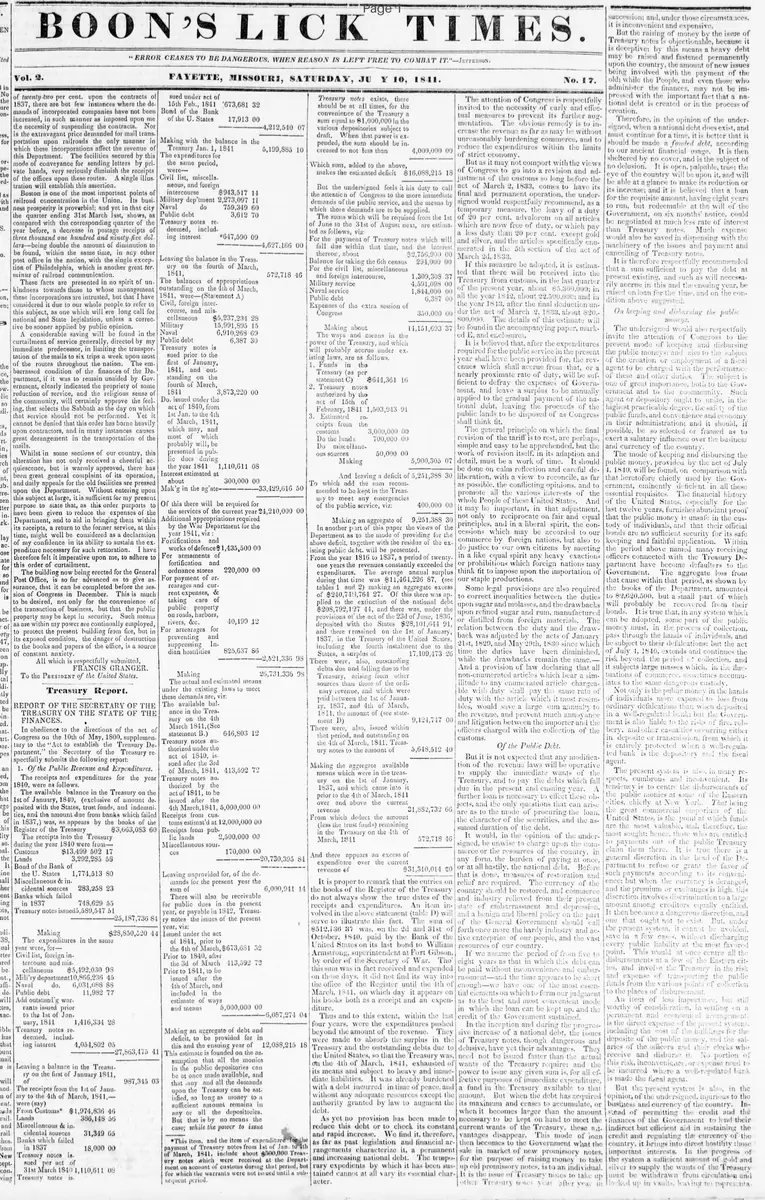
REPORT OF THE SECRETARY OF THE TREASURY ON THE STATE OF THE FINANCES.
In obedience to the directions of the act of Congress on the 10th of May, 1800, supplementary to the "Act to establish the Treasury Department," the Secretary of the Treasury respectfully submits the following report:
1. Of the Public Revenue and Expenditures.
The receipts and expenditures for the year 1840 were as follows,
The available balance in the Treasury on the 1st of January, 1840, (exclusive of amount deposited with the States, trust funds, and indemnities, and the amount due from banks which failed in 1837,) was, as appears by the books of the Register of the Treasury $3,603,053 60
The receipts into the Treasury during the year 1840 were from—
Customs $13,499,502 17
Lands 3,292,285 59
Bond of the Bank of the U. States 1,774,513 80
Miscellaneous & incidental sources 283,259 23
Banks which failed in 1837 743,629 55
Treasury notes issued 5,589,517 51
Making $25,187,736 81
The expenditures in the same year were, for—
Civil list, foreign intercourse and miscellaneous $5,193,030 99
Military department 10,866,236 45
Naval do. 6,031,088 88
Public debt 11,982 77
Add outstanding warrants issued prior to the 1st of January, 1841 1,416,334 28
Treasury notes redeemed, including interest 4,051,802 05
$27,863,475 44
Leaving a balance in the Treasury on the first of January 1841, of $1,937,315 07
The receipts from the 1st of January to the 4th of March, 1841,— were (say)
From Customs* $1,974,835 46
Lands 386,118 56
Miscellaneous & incidental sources 31,319 65
Banks which failed in 1837 . 18,000 00
Treasury notes issued (to 31st March 1840) 1,110,611 08
Treasury notes issued (from 1st Jan. to 4th March 1841)
*This item, and the item of expenditure for the payment of Treasury notes from 1st of Jan. to 4th of March, 1841, include about $500,000 Treasury notes which were received at the Department on account of customs during that period, but for which the warrants were not issued until a subsequent period.
Demands for the present year the sum of 6,000,911 14
There will also be receivable for public dues in the present year, or payable in 1841, 'Treasury notes the issues of the present year, viz:
Issued under the act of 1841, prior to the 4th of March, $673,681 32
Prior to 1840, after the 3d of March 113,392 72
Prior to 1841, to be issued after the 1st of March, and included in the estimate of ways and means 5,000,000 00
—6,057,274 04
Making an aggregate of debt and deficit, to be provided for in this and the ensuing year of 13,058,215 18
This estimate is founded on the assumption that all the monies in the public depositories can be at once made available, and that any and all the demands upon the Treasury can be satisfied, so long as money to a sufficient amount remains in any or all the depositories.
But that is by no means the case; while the power to issue Treasury notes exists, there should be at all times, for the convenience of the Treasury a sum equal to $1,000,000 in the various depositories subject to draft. When that power is expended, the sum should be increased to not less than
It is proper to remark that the entries on the books of the Register of the Treasury do not always show the true dates of the receipts and expenditures. An item involved in the above statement (table D) will serve to illustrate this fact. The sum of $512,136 37 was, on the 2d and 31st of October, 1840, paid by the Bank of the United States on its last bond to William Armstrong, superintendent at Fort Gibson, by order of the Secretary of War. Though this sum was in fact received and expended on those days, it did not find its way into the office of the Register until the 4th of March, 1841, on which day it appears on his books both as a receipt and an expenditure.
Thus and to this extent, within the last four years, were the expenditures pushed beyond the amount of the revenue. They were made to absorb the surplus in the Treasury and the outstanding debts due to the United States, so that the Treasury was, on the 4th of March, 1841, exhausted of its means and subject to heavy and immediate liabilities.
It was already burdened with a debt incurred in time of peace, and without any adequate resources except the authority granted by law to augment the debt.
As yet no provision has been made to reduce this debt or to check its constant and rapid increase. We find it, therefore, as far as past legislation and financial arrangements characterize it, a permanent and increasing national debt. The temporary expedients by which it has been sustained cannot at all vary its essential character.
The attention of Congress is respectfully invited to the necessity of early and effectual measures to prevent its further augmentation. The obvious remedy is to increase the revenue as far as may be without unreasonably burdening commerce, and to reduce the expenditures within the limits of strict economy.
But as it may not comport with the views of Congress to go into a revision and adjustment of the customs so long before the act of March 2, 1833, comes to have its final and permanent operation, the undersigned would respectfully recommend, as a temporary measure, the levy of a duty of 20 per cent. ad valorem on all articles which are now free of duty, or which pay a less duty than 20 per cent. except gold and silver, and the articles specifically enumerated in the 5th section of the act of March 2d, 1833.
If this measure be adopted, it is estimated that there will be received into the Treasury from customs, in the last quarter of the present year, about $5,300,000; in all the year 1841, about 22,500,000; and in the year 1842, after the final deduction under the act of March 2, 1833, about $20,800,000. The details of this estimate will be found in the accompanying paper, marked E, and enclosures.
It is believed that, after the expenditures required for the public service in the present year shall have been provided for, the revenues which shall accrue from that, or a nearly proximate rate of duty, will be sufficient to defray the expenses of Government, and leave a surplus to be annually applied to the gradual payment of the national debt, leaving the proceeds of the public lands to be disposed of as Congress shall think fit.
The general principle on which the final revision of the tariff is to rest, are perhaps, simple and easy to be apprehended, but the work of revision itself, in its adaptation and detail, must be a work of time. It should be done on calm reflection and careful deliberation, with a view to reconcile, as far as possible, the conflicting opinions, and to promote all the various interests of the whole People of these United States. And it may be important, in that adjustment, not only to reciprocate on fair and equal principles, and in a liberal spirit, the concessions which may be accorded to our commerce by foreign nations, but also to do justice to our own citizens by meeting in a like equal spirit any heavy exactions or prohibitions which foreign nations may think fit to impose upon the importation of our staple productions.
Some legal provisions are also required to correct inequalities between the duties upon sugar and molasses, and the drawbacks upon refined sugar and rum, manufactured or distilled from foreign materials. The relation between the duty and the drawback was adjusted by the acts of January 21st, 1829, and May 29th, 1830 since which time the duties have been diminished, while the drawbacks remain the same.
And a provision of law declaring that all non-enumerated articles which bear a similitude to any enumerated article chargeable with duty shall pay the same rate of duty with the article which it most resembles, would save a large sum annually to the revenue, and prevent much annoyance and litigation between the importer and the officers charged with the collection of the customs.
Of the Public Debt.
But it is not expected that any modification of the revenue laws will be operative to supply the immediate wants of the Treasury, and to pay the debts which fall due in the present and ensuing year. A further loan is necessary to effect these objects, and the only questions that can arise are as to the mode of procuring the loan, the character of the securities, and the assumed duration of the debt.
It would, in the opinion of the undersigned, be unwise to charge upon the commerce or the resources of the country, in any form, the burden of paying at once, or at all hastily, the national debt. Before that is done, measures of restoration and relief are required. The currency of the country should be restored, and commerce and industry relieved from their present state of embarrassment and depression, and a benign and liberal policy on the part of the General Government should call forth once more the hardy industry and active enterprise of our people, and the vast resources of our country.
If we assume the period of from five to eight years as that in which this debt can be paid without inconvenience and embarrassment—and the time appears to be short enough—we have one of the most essential elements on which to form our judgment as to the best and most convenient mode in which the loan can be kept up, and the credit of the Government sustained.
In the inception and during the progressive increase of a national debt, the issues of Treasury notes, though dangerous and delusive, have yet their advantages. They need not be issued faster than the actual wants of the Treasury require: and the power to issue any given sum is, for all effective purposes of immediate expenditure, a fund in the Treasury available to that amount. But when the debt has acquired its maximum and ceases to accumulate, or when it becomes larger than the amount necessary to be kept on hand to meet the current wants of the Treasury, these advantages disappear. This mode of loan then becomes to the Government what the sale in market of new promissory notes, for the purpose of raising money to take up old promissory notes, is to an individual.
It is the issue of Treasury notes to take up other Treasury notes year after year in succession: and, under those circumstances, it is inconvenient and expensive.
But the raising of money by the issue of Treasury notes is objectionable, because it is deceptive; by this means a heavy debt may be raised and fastened permanently upon the country, the amount of new issues being involved with the payment of the old; while the People, and even those who administer the finances, may not be impressed with the important fact that a national debt is created or in the process of creation.
Therefore, in the opinion of the undersigned, when a national debt does exist, and must continue for a time, it is better that it should be made a funded debt, according to our ancient financial usage. It is then sheltered by no cover, and is the subject of no delusion. It is open, palpable, true; the eye of the country will be upon it, and will be able at a glance to make its reduction or its increase; and it is believed that a loan for the requisite amount, having eight years to run, but redeemable at the will of the Government, on six months' notice, could be negotiated at much less rate of interest than Treasury notes. Much expense would also be saved in dispensing with the machinery of the issues and payment and cancelling of Treasury notes.
It is therefore respectfully recommended that a sum sufficient to pay the debt at present existing, and such as will necessarily accrue in this and the ensuing year, be raised on loan for the time, and on the condition above suggested.
On keeping and disbursing the public moneys.
The undersigned would also respectfully invite the attention of Congress to the present mode of keeping and disbursing the public moneys: and also to the subject of the creation or employment of a fiscal agent to be charged with the performance of these and other duties. The subject is one of great importance, both to the Government and to the community. Such agent or depository ought to unite, in the highest practicable degree, the safety of the public funds, and convenience and economy in their administration: and it should, if possible, be so selected or framed as to exert a salutary influence over the business and currency of the country.
The mode of keeping and disbursing the public money, provided by the act of July 1, 1840, will be found, on comparison with that heretofore chiefly used by the Government, eminently deficient in all these essential requisites. The financial history of the United States, especially for the last twelve years, furnishes abundant proof that the public money is unsafe in the custody of individuals, and that their official bonds are no sufficient security for its safe keeping and faithful application. Within the period above named many receiving officers connected with the Treasury Department have become defaulters to the Government. The aggregate loss from that cause within that period, as shown by the books of the Department, amounted to $2,620,500, but a small part of which will probably be recovered from their bonds. It is true that, in any system which can be adopted, some part of the public money must, in the process of collection, pass through the hands of individuals, and be subject to their defalcations: but the act of July 1, 1840, extends and continues the risk beyond the period of collection, and it subjects large masses which, in the fluctuations of commerce, sometimes accumulate to the same dangerous custody.
Not only is the public money in the hands of individuals more exposed to loss from ordinary defalcations than when deposited in a well-regulated bank: but the Government is also liable to the risks of fire, robbery, and other casualties occurring either in deposite or transmission, from which it is entirely protected when a well-regulated bank is the depository and the fiscal agent.
The present system is also, in many respects, cumbrous and inconvenient. Its tendency is to centre the disbursements of the public monies at some of the Eastern cities, chiefly at New York. That being the great commercial emporium of the United States, is the point at which funds are the most valuable, and, therefore, the most sought: hence, those who are entitled to payments out of the public Treasury claim them there. It is true there is a general discretion in the head of the Department to refuse or grant the favor of such payments according to its convenience: but when the currency is deranged and the premium or exchanges is high, this discretion involves discrimination to a large amount among creditors equally entitled.
It then becomes a dangerous discretion, and one that ought not to exist But, under the present system, it cannot be avoided, save in a few cases, without discharging every public liability at the most favored point. This would at once centre all the disbursements at a few of the Eastern cities, and involve the Treasury in the risk and expense of transporting the public funds from the various points of collection to the places of disbursement
An item of less importance, but still worthy of consideration, in settling on a permanent and economical arrangement, is the direct expense of the present system, including the cost of the buildings for the deposit of the public money, and the salaries of the officers and their clerks who receive and disburse it. No portion of this risk, inconvenience, or expense need to be incurred where a well-regulated bank is made the fiscal agent.
But the present system is also, in the opinion, of the undersigned, injurious to the business and currency of the country. Instead of permitting the credit and the finances of the Government to lend their indirect but efficient aid in sustaining the credit and regulating the currency of the country, it brings into direct hostility those important interests. In the progress of the system a sufficient amount of gold and silver to supply the wants of the Treasury must be withdrawn from circulation and locked up in vaults, leaving no representative to supply its place in the general circulation.
A large amount, also, in the hands of
those who pay to or receive from the
Treasury, is equally withdrawn from gen-
eral circulation, and made to flow through
those channels alone which lead into and
out of the public coffers. The other ave-
nues of commerce and intercourse are
thus deprived of their proportion of the
precious metals.
Within the fifty two years during which
our constitutional Government has existed
we have had, for two periods of twenty
years each, a bank chartered by Congress
as a depository of the public moneys and
as a fiscal agent. We have had, also, at
two intervals, amounting to about nine
years, State banks employed for like pur-
poses; and, during the remainder of the
time, the funds of the Government have
been kept and the finances administered
partly by banks and partly, by individual
officers and agents. The losses sustained
by State banks, and depositories, during
the first period of their employment, ex-
tending from 1811 to 1816, agreeably to a
statement prepared by the Secretary of
the Treasury in 1833, and revised and re-
published in 1837, were $1,000,676. In
the latter period, from 1833 to 1837, though
no actual loss is believed to have occurred,
yet the Treasury and the country suffered
inconvenience and embarrassment from
the fiscal arrangements with those numer-
ous and disconnected institutions. But,
during the forty years that the two banks
of the United States were the depositories
of the public money and the fiscal agents
of the Government, no loss whatever was
sustained, nor any delay or any expense
incurred in transmitting or disbursing the
public moneys, so far as the agency of
those institutions extended. Then, as re-
gards the wants of the Treasury merely,
the safety of the public funds, and economy
to their administration, experience has de-
monstrated the superior utility of a bank
constituted and adapted by Congress as a
fiscal agent. It has also proved to us that
the active business of the country, its cur-
rency, its credit, its industry, and its com-
merce, are intimately connected with and
dependent upon the financial arrangements
of the General Government. If they be
wise and beneficent, they indirectly, but
efficiently, promote those great interests of
the People: if constant and uniform in their
action, they give to those interests confi-
dence and stability.
Since the removal of the public deposits
from the Bank of the United States, in
1833, the Government has had no perma-
nent fiscal agent and no definite financial
system. All has been experiment, transfer,
and change. The business of the country
has yielded to the unsteady impulse, and
moved forward with wild irregularity; at
one time stimulated to excessive action, at
another sunk into lethargy. And, in pro-
viding for the wants of the Treasury, it is
surely important to look, also to the wants
and welfare of the community, from the
products of whose industry the Treasury is
supplied.
And as regards those great interests, we
find the testimony of past years is no less
distinct and strong in favor of a monied in-
stitution chartered by the General Govern-
ment, and possessed of its confidence and
credit. The period embracing the last ten
years of the existence of the late Bank of
the United States as the fiscal agent is fresh
in the memory of us all, and is looked back
to as a period of great public prosperity;
and though other causes did, doubtless, co-
operate to produce that favorable condition
of things, yet one of the governing princi-
ples on which depended the steady advance
of the country in commerce, in industry,
and in substantial wealth, was the existence
of a fiscal agent established by the General
Government, and charged with the equali-
zation of exchanges, and the regulation of
the currency.
In the present condition of our country,
the relief to be anticipated from such an in-
stitution cannot be immediate, but must be
the work of time. The business of the
country would, however, in the opinion of
the undersigned, steadily and certainly re-
vive under its influence.
In whatever point of light the undersign-
ed is able to view this subject, he is irresist-
ibly led to the conclusion that such fiscal
agent, so framed as to possess those impor-
tant functions, is alike essential to the wants
of the Treasury and of the community.—
Such an institution should be framed with
deliberation, for it must have high duties to
perform, and extensive interests to protect
and promote, and it should be granted with
care, for it will be liable to great and dan-
gerous abuses. As the fiscal agent of the
Government, and an effective regulator of
the currency in a wide-spread community,
it should be steady and uniform in its action,
and fixed and stable in its character.
The undersigned has no doubt of the
power of Congress to create such an insti-
tution. Experience has proved its necessi-
ty to carry out other expressly granted pow-
ers; it has been exercised and recognized
by the Legislative and Executive depart-
ments of the Government during four-fifths
of the whole period of our national exis-
tencc, and it has received the uniform sanc-
tion of our highest judicial tribunal.
Yet the power has been questioned by
many wise and patriotic statesmen whose
opinions are entitled to consideration and
respect; and in a measure like this of high
political import, which, if wisely conceived
and cordially concurred in, must have a
great and enduring influence on the prosper-
ity of the country, it is important, as far as
possible, to obviate objection and reconcile
opinion.
If such an institution can be so conceiv-
ed in principle and guarded in its details so
as to remove all scruples touching the ques-
tion of constitutional power, and thus avoid
the objections which have been urged against
those heretofore created by Congress, it
will, in the opinion of the undersigned, pro-
duce the happiest results, and confer lasting
and important benefits on the country.
The undersigned, therefore, respectfully
recommends the creation of such fiscal
agent, and the repeal of the act of July
4th, 1840, providing "for the collection,
safe-keeping, transfer and disbursement of
the public revenue," except the penal pro-
visions therefor, which will probably re-
quire revision and modification.
All which is respectfully submitted.
T. EWING.
Secretary of the Treasury.
Treasury Department, June 2, 1841.
PROPOSED BANK OF THE UNITED
STATES.
The following is the report of the Select
Committee of the Senate on the Currency,
&c., of which Mr. Clay of Ky., is Chair-
man, as read by him in the Senate:
The committee to which was referred so
much of the President's Message as relates
to a uniform currency, and a suitable fiscal
agent capable of adding increased facili-
ties in the collection and disbursement, and
security of the public revenue, have had
the same under consideration, and beg
leave to report:
That after the most attentive and anx-
ious consideration of the state of the cur-
rency, and the finances of the government,
in all their interesting and important bear-
ings, the committee have arrived at the
same conclusion with the Secretary of the
Treasury, that a sound and just policy re-
quires the establishment of a Bank of the
United States with as little delay as practi-
cable.
The committee have neither time nor in-
clination to enter into a discussion of the
question of the power of Congress, under
the Constitution of the United States, to
establish a National Bank. After all that
has been said and written on that question
during the long period of half a century,
nothing remains to be added that would be
likely to shed much new light upon it. It
ought, in the opinion of the committee, to
be regarded as a settled question—settled
by the approbation and judgment of the
people, by the authority of the Legislature,
by the sanction of the Executive Depart-
ment of the Government, and by the sol-
enn adjudication of the Judiciary. If it
be not regarded as a decided question
when, in the collision and conflicts among
men, arising out of a diversity of opinion
and judgment, is a controverted matter to
be considered as terminated and quieted?
Nor do the committee deem it necessary
to discuss the question of the expediency
of establishing such an institution as a
Bank of the United States. On this there
is even less contrariety of opinion than on
the former question. On both, it is the de-
liberate conviction of the committee that a
vast majority of the people of the United
States concur: and that they are now
looking, with anxious solicitude, to the de-
liberations of Congress, under the confi-
dent hope that a Bank of the United States
will be established at the present extraor-
dinary session of Congress.
Passing by, therefore, those two ques-
tions as being unnecessary to be further
argued, and assuming, what the committee
verily believe, that a National Bank is in-
dispensably necessary, they will proceed,
at once, to the particular form, powers, and
faculties with which it may be expedient
to invest such an institution. And here
the committee have no hesitation in saying
that, confiding in the experience of forty
years, during which the nation has enjoyed
the benefit of a National Bank, and during
the greater part of which it has realized
every reasonable hope and expectation in
the operations of such an institution, they
came to the conclusion that it would be
wisest to dismiss all experiments, and to
cling to experience and assume the last
charter granted by Congress as the basis
of a new bank, engrafting upon it such re-
strictions, guaranties, amendments, and
conditions, as have been found necessary
by actual experience.
The Secretary of the Treasury came to
a similar conclusion; and in his report,
and the draught of a bill which accompa-
nies it, he has taken as a model the charter
granted by Congress in 1816. On that he
has suggested a great many valuable im-
provements, most of which the committee
have incorporated in the draught of a bill
which they now report to the Senate. On
this draught they wish to offer to the Sen-
ate some brief explanations and obser-
vations.
The committee have adopted Washing-
ton city, proposed by the Secretary of the
Treasury, as the place of location of the
principal bank. They believe the place of
its location is a subordinate question; but
there are many advantages from the prox-
ximity of the Bank to the Government. The
distribution of the capital of the Bank
among the several commercial cities, in
proportion to their respective wants and
magnitude, is what they naturally desire,
and what will doubtless be done. But to
guard against the exercise of any undue
Government or official influence, or the
imputation of any unworthy transactions,
the committee have thought it expedient to
deprive the parent Bank of all power to
make any discounts or loans whatever, ex-
cept loans to Government, authorized by
express law. In order to ensure the com-
mand of the best financial abilities of the
country, the bill provides that the Directors
of the Parent Board, which is to consist of
nine members, shall be paid for their servi-
ces by the Corporation, and all compensa-
tion to the Directors, in the usual form of
bank accommodations, is utterly prohibited.
Thus, the Directors of the Bank at
Washington will become a Board of Con-
trol, superintending the branches, supply-
ing them with a currency, and banking ex-
clusively through the agency of their
offices of discount and deposit.
The capital of the Bank, proposed by the
Secretary, is retained: but a power is re-
served to Congress to augment it by the
addition of twenty millions, making the ag-
gregate amount ultimately fifty millions of
dollars, if that should be found necessary.
To guard against undue expansions of
the currency by the operations of the
Bank, various restrictions and securities
are introduced
1. The dividends are limited to seven
per cent. per annum; and, after accumula-
ting a reserved sum of two millions of dol-
lars, to cover losses and contingencies, the
excess beyond that seven per cent. is to be
paid into the public Treasury. And what-
ever excess remains at the end of the char-
ter, beyond the reimbursement to the stock-
holders of the capital stock, is also to be
paid into the Treasury. If the dividends
fall below the seven per cent. during any
year of the charter, the deficiency is to be
made good out of the surplus previously
paid into the Treasury. The effect of this
provision is, to make a permanent and in-
variable seven per cent. bank stock, assum-
ing that the administration of the Bank is
conducted with integrity and ability.
2. The debts due to the Bank are re-
quired not to exceed the amount of the cap-
ital stock actually paid in, and 75 per cent.
thereon, which is a greater restriction than
usual.
The total amount of debts which the
Bank is authorized to contract, over and
above the deposits, is not to exceed twen-
ty-five millions of dollars, which is also
a greater restriction than was placed upon
the late Bank of the United States.
3. The publicity which is required of the
general condition of the Bank, and the full
and complete exposure to committees of
Congress, and to the Secretary of the Trea-
sury, which is amply secured, of all the
books and transactions of the Bank, inclu-
ding private accounts.
4. The publication of the renewal of any
loan: thus putting an end to all mere ac-
commodation paper, as far as practicable,
and confining the Bank to fair business
transactions.
And 5. The Bank is prohibited from ma-
king any further discounts or loans when-
ever its notes in circulation exceed three
times the amount of specie in its vaults.
To protect the community and the stock-
holders against mismanagement of the
Bank, several provisions have been inserted,
which it is hoped have been effectual.
1. No paid officer of the Bank is to re-
ceive loans or accommodations in any form
whatever.
2. Securities are provided against abu-
sive use of proxies, such as that no officer
of the Bank can be a proxy; no proxy can
give more than 300 votes; no proxy to be
good which is of longer standing than
ninety days, &c.
3. A prohibition against the Corpora-
tion's transacting any other than legitimate
banking business; excluding all dealing in
stocks, and commercial operations.
4. A requisition that a majority of the
whole number of the Board of Directors
shall be necessary to transact the business
of the Corporation.
5. Ample power to make the most thor-
ough examination into the condition and
proceedings of the Bank, down to the ac-
counts of individuals, by totally removing
from the Secretary of the Treasury and
committees of Congress the veil of secresy.
And 6. By denouncing and punishing as
felony the crime of embezzlement of the
funds of the Bank when perpetrated by any
of its officers, agents or servants.
Concurring entirely in the sentiment ex-
pressed by the Secretary of the Treasury,
that many wise and patriotic statesmen,
whose opinions are entitled to considera-
tion and respect, have questioned the pow-
er of Congress to establish a National Bank;
and that it is desirable, as far as possible, to
obviate objections and reconcile opinions,
the committee have attentively and earnest-
ly examined the provision, incorporated in
the draught of the bill of the Secretary, in
regard to the branching power of the Bank
and they would have been happy if they
could have reconciled it to their sense of
duty to adopt it. But, after the fullest con-
sideration, they have been unable to arrive
at that result.
It was not without some hesitation that
the committee agreed to the location of the
Bank in the District of Columbia. This
they did because they believed that the util-
ity of the Bank did not so much depend
upon the place of its location as upon the
capital, facilities and powers which should
be given to it. But to isolate it in this Dis-
trict, without giving it any other branching
power than such as it might deserve from
the consent of particular States, would be
to create an enormous District Bank, devoid
of effectual national character. Such a
bank would be a bank only of the District
of Columbia, and its offices of discount and
deposite would be nothing more than banks
of the States which might allow them to be
planted within their respective limits. For
all national purposes Congress might as
well re-charter one of the existing District
banks, enlarge its capital, and give it au-
thority to establish offices of discount and
deposite in any State that would permit it
to be done.
The committee believe that the capital of
a bank so constituted would never be taken;
and that, if taken, the institution would be
wholly unable to accomplish the great and
salutary purposes for which it is desired
and should be designed.
But the question of establishing a bank
thus to be restricted and circumscribed in-
volves higher and graver considerations
than those of mere expediency. The Gen-
eral Government has or has not the power
to establish a National Bank. If it has the
power, it derives from it the existing grants
in the Constitution of the United States.
The committee believe it has the power,
and ought to exercise it. But after a con-
test during the last ten or twelve years in
respect to the constitutional power of Con-
gress, which has been marked by so much
animation and bitterness, a forbearance to
exercise the power would be a virtual sur-
render of the power. If a bank were to
be created, whose operations within the
limits of the States were dependent not
upon the will of Congress, but upon the will
of each State, separately announced, the
creation of such a bank would add another
to the list of disastrous experiments, and
would be tantamount to a relinquishment
of the national power, and it could never
be resumed.
The power of the Federal Government
is only to be found in the grants of the
Constitution. If they are inadequate to
the fulfilment of the great purposes of its
establishment, they can only be increased
in the mode of amendment which the in-
strument itself has prescribed. They can-
not be augmented by the grants or consent
of any State or States short of the number
of two-thirds, whose concurrence is neces-
sary to give validity to an amendment. A
derivation of power to the General Gova-
ernment from the consent of particular
States would be unsound in principle, and
the committee apprehended dangerous in
practice. Admit such consent to be a le-
gitimate source of power, the Government
would not operate equally in all the States.
and the Constitution, losing its uniform
character, would exhibit an irregular and
incongruous action.
Entertaining these deliberate views, the
committee are decidedly of opinion that
no bill for the establishment of a bank in
the District of Columbia will be effectual
which does not contain a clear recognition
of the constitutional power of Congress to
establish branches wherever, in the United
States, the public wants, in its judgment,
require them. They cannot consent that
a Bank, emanating from the will of the na-
tion, and imperatively demanded by the
necessities of the Government and of the
nation, shall be wholly dependent for its
useful operation upon the will of each and
every State, distinctly expressed.
Accordingly, in the draught of a bill now
reported, the right is asserted to exercise
the branching power of the bank inde-
pendent of the assent of the States. The
committee dare not allow themselves to be-
lieve that the bill is free from all defects, but
they do hope that these in a spirit of liber-
ality, will be corrected by the superior
wisdom of the Senate and of the House.
and that the present session will be signal-
ized by the establishment of a national in-
stitution which has become a desideratum
to the general prosperity.
The advantages which will flow from
such an institution, in both our domestic
and foreign relations, are manifest and in-
contestable.
It will give the people a sound currency
of uniform value throughout the Union,
which is just as necessary to the successful
operation of all branches of business as
pure air or water is to the preservation of
human life or health.
It will revive and extend commercial in-
tercourse, which for the want of a common
medium, has been almost suspended be-
tween different parts of the Union.
It will reduce domestic exchange from
the enormous premiums and discounts now
frequently paid to the moderate standard
growing out of the mere cost and insurance
on the risk of transporting specie from one
to another part of the Union.
It will, consequently, save hundreds of
thousands of dollars now annually lost in
transactions of exchange.
It will essentially benefit the manufac-
turing interest by enabling it to realize sales
and the proceeds of sales.
It will powerfully contribute to the re-
sumption of specie payments by the banks,
whose existing delinquency is the greatest
source of all prevailing pecuniary and
financial embarrassments.
It will greatly tend to prevent and cor-
rect the excesses and abuses of the local
banks.
It will furnish a medium common to all
parts of the Union for the payment of debts
and dues to the Government; thus render-
ing duties and taxes uniform in fact as well
as in name.
It is indispensable to the convenient and
successful financial operations of the Gov-
ernment in all the departments of collection,
safe-keeping and disbursements of the pub-
lic revenue.
Such are some of the domestic benefits
which the committee fully believe will be
secured by a National Bank. Those which
appertain to our foreign relations are also
worthy of serious consideration.
If it be true that money is power, its con-
centration under the direction of one will,
sole or collective, must augment the power.
A nation, without such a concentration of
power maintaining extensive commercial
intercourse with another nation possessing
it, must conduct that intercourse on a con-
dition of inequality and disadvantage.
National Banks, in other countries, beget
the necessity, therefore, of a National Bank
in this country, in like manner as National
Governments in foreign nations must be
met by a National Government in ours.
Accordingly, we have seen the influence
exerted by the Bank of England upon
American interests, when those interests
were exposed to the action of that Bank.
and were left without the protection of a
Bank of the United States. The commit-
tee do not wish to be understood as intend-
ing to express any approbation of the com-
mercial operations in which the Pennsyl-
vania Bank, assuming the name of the Bank
of the United States, engaged when that
state of things arose.
But they do mean to say that the inter-
ests and dignity of the United States de-
mand that they should not be exposed, be-
yond the necessary and legitimate influ-
ence of monetary and commercial opera-
tions, to the action of a foreign banking
institution. They believe that, without a
competent Bank of the United States, for-
eign National Banks may and probably will
exercise an undue and possibly pernicious
influence upon our interests.
In this view of the case, the question is,
whether it is better that we should be left
liable to be materially affected by a foreign
institution, in which we have no interest,
over which we can exert no control, which
is administered solely in reference to for-
eign interests, or we shall have an Ameri-
can Bank, the creature of our will, subject
to American authority, and animated by
American
interests, feelings, and sym-
pathies?
The committee could not entertain a
doubt in such an alternative. And, in re-
ference to the foreign aspect of the Bank,
the committee thought it expedient to allow
it to deal in foreign bills of exchange,
which are the barometer of the state of
our foreign trade.
In conclusion the committee think it
proper to say that they have given due con-
sideration to the various memorials refer-
red to them, and to the instructions moved
by a Senator from Mississippi.
They subjoin that wherever, in this re-
port, the committee is mentioned, a major-
ity of the committee is to be understood.
All which is respectfully submitted.
What sub-type of article is it?
What keywords are associated?
What entities or persons were involved?
Where did it happen?
Domestic News Details
Primary Location
Washington, D.C.
Event Date
June 2, 1841
Key Persons
Outcome
treasury balance on jan 1, 1841: $1,937,315.07; projected debt and deficit: $13,058,215.18. recommends 20% ad valorem duty on low-duty goods, funded loan for 5-8 years, and creation of a national bank with $30m capital (expandable to $50m). senate committee endorses bank establishment with restrictions.
Event Details
Secretary Ewing submits report on 1840 finances, detailing receipts ($25,187,736.81) and expenditures ($27,863,475.44), highlighting deficit and debt increase. Urges revenue enhancement via tariffs, debt funding via loan, and fiscal agent (national bank) to manage moneys safely. Senate committee, chaired by Clay, reports in favor of re-chartering Bank of the United States based on 1816 model with amendments for restrictions, publicity, and branching power independent of states.