Thank you for visiting SNEWPapers!
Sign up free
Editorial
November 4, 1842
The Daily Madisonian
Washington, District Of Columbia
What is this article about?
Editorial from Albany Argus defends President Tyler against Whig-led congressional opposition, citing facts from Spencer, Cushing, and Webster. Details failed attempts to undermine Tyler over re-election rumors, cabinet resignations, and legislative gridlock on bank bill and revenue, prioritizing anti-Tyler politics over national interests.
Clipping
OCR Quality
95%
Excellent
Full Text
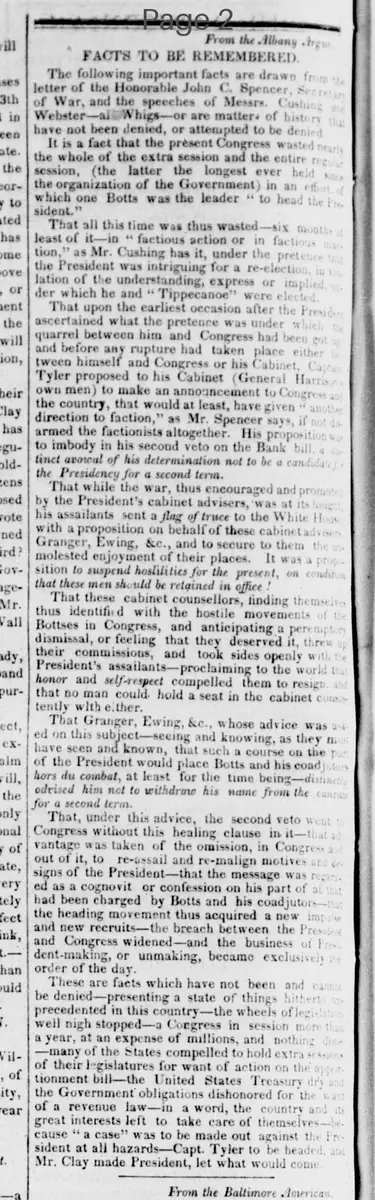
From the Albany Argus.
FACTS TO BE REMEMBERED.
The following important facts are drawn from a letter of the Honorable John C. Spencer, Secretary of War, and the speeches of Messrs. Cushing and Webster—Whigs—or are matters of history, and have not been denied, or attempted to be denied.
It is a fact that the present Congress wasted the whole of the extra session and the entire regular session, (the latter the longest ever held since the organization of the Government) in an attempt, in which one Botts was the leader, "to head the President."
That all this time was thus wasted—six months at least of it—in "factious action or in faction," as Mr. Cushing has it, under the pretence that the President was intriguing for a re-election.
That upon the earliest occasion after the President had ascertained what the pretence was under which the quarrel between him and Congress had been got up, and before any rupture had taken place either between himself and Congress or his Cabinet. (a fact which Mr. Spencer admits,) President Tyler proposed to his Cabinet (General Harrison's own men) to make an announcement to Congress and the country, that would at least, have given "a direction to faction," as Mr. Spencer says, if not disarmed the factionists altogether. His proposition was to embody in his second veto on the Bank bill a distinct avowal of his determination not to be a candidate for the Presidency for a second term.
That while the war, thus encouraged and prolonged by the President's cabinet advisers, was at its height, his assailants sent a flag of truce to the White House, with a proposition on behalf of these cabinet advisers—Bell, Granger, Ewing, &c., and to secure to them the unmolested enjoyment of their places. It was a proposition to suspend hostilities for the present, on condition that these men should be retained in office!
That these cabinet counsellors, finding themselves thus identified with the hostile movements of the Bottses in Congress, and anticipating a peremptory dismissal, or feeling that they deserved it, threw up their commissions, and took sides openly with the President's assailants—proclaiming to the world that honor and self-respect compelled them to resign, that no man could hold a seat in the cabinet consistently with either.
That Granger, Ewing, &c., whose advice was asked on this subject—seeing and knowing, as they must have seen and known, that such a course on the part of the President would place Botts and his coadjutors hors du combat, at least for the time being—dissuaded him not to withdraw his name from the list of candidates for a second term.
That, under this advice, the second veto was sent to Congress without this healing clause in it—that advantage was taken of the omission, in Congress, out of it, to re-assail and re-malign motives and designs of the President—that the message was tortured as a cognovit or confession on his part of all that had been charged by Botts and his coadjutors—and the heading movement thus acquired a new impulse and new recruits—the breach between the President and Congress widened—and the business of President-making, or unmaking, became exclusively the order of the day.
These are facts which have not been and cannot be denied—presenting a state of things bitter unprecedented in this country—the wheels of legislation well nigh stopped—a Congress in session more than a year, at an expense of millions, and nothing done—many of the States compelled to hold extra sessions of their legislatures for want of action on the apportionment bill—the United States Treasury dry, the Government obligations dishonored for the want of a revenue law—in a word, the country and its great interests left to take care of themselves—because "a case" was to be made out against their President at all hazards—Capt. Tyler to be headed. Mr. Clay made President, let what would come.
FACTS TO BE REMEMBERED.
The following important facts are drawn from a letter of the Honorable John C. Spencer, Secretary of War, and the speeches of Messrs. Cushing and Webster—Whigs—or are matters of history, and have not been denied, or attempted to be denied.
It is a fact that the present Congress wasted the whole of the extra session and the entire regular session, (the latter the longest ever held since the organization of the Government) in an attempt, in which one Botts was the leader, "to head the President."
That all this time was thus wasted—six months at least of it—in "factious action or in faction," as Mr. Cushing has it, under the pretence that the President was intriguing for a re-election.
That upon the earliest occasion after the President had ascertained what the pretence was under which the quarrel between him and Congress had been got up, and before any rupture had taken place either between himself and Congress or his Cabinet. (a fact which Mr. Spencer admits,) President Tyler proposed to his Cabinet (General Harrison's own men) to make an announcement to Congress and the country, that would at least, have given "a direction to faction," as Mr. Spencer says, if not disarmed the factionists altogether. His proposition was to embody in his second veto on the Bank bill a distinct avowal of his determination not to be a candidate for the Presidency for a second term.
That while the war, thus encouraged and prolonged by the President's cabinet advisers, was at its height, his assailants sent a flag of truce to the White House, with a proposition on behalf of these cabinet advisers—Bell, Granger, Ewing, &c., and to secure to them the unmolested enjoyment of their places. It was a proposition to suspend hostilities for the present, on condition that these men should be retained in office!
That these cabinet counsellors, finding themselves thus identified with the hostile movements of the Bottses in Congress, and anticipating a peremptory dismissal, or feeling that they deserved it, threw up their commissions, and took sides openly with the President's assailants—proclaiming to the world that honor and self-respect compelled them to resign, that no man could hold a seat in the cabinet consistently with either.
That Granger, Ewing, &c., whose advice was asked on this subject—seeing and knowing, as they must have seen and known, that such a course on the part of the President would place Botts and his coadjutors hors du combat, at least for the time being—dissuaded him not to withdraw his name from the list of candidates for a second term.
That, under this advice, the second veto was sent to Congress without this healing clause in it—that advantage was taken of the omission, in Congress, out of it, to re-assail and re-malign motives and designs of the President—that the message was tortured as a cognovit or confession on his part of all that had been charged by Botts and his coadjutors—and the heading movement thus acquired a new impulse and new recruits—the breach between the President and Congress widened—and the business of President-making, or unmaking, became exclusively the order of the day.
These are facts which have not been and cannot be denied—presenting a state of things bitter unprecedented in this country—the wheels of legislation well nigh stopped—a Congress in session more than a year, at an expense of millions, and nothing done—many of the States compelled to hold extra sessions of their legislatures for want of action on the apportionment bill—the United States Treasury dry, the Government obligations dishonored for the want of a revenue law—in a word, the country and its great interests left to take care of themselves—because "a case" was to be made out against their President at all hazards—Capt. Tyler to be headed. Mr. Clay made President, let what would come.
What sub-type of article is it?
Partisan Politics
What keywords are associated?
President Tyler
Whig Opposition
Congressional Faction
Cabinet Resignations
Bank Veto
Political Intrigue
Legislative Waste
What entities or persons were involved?
John C. Spencer
Messrs. Cushing And Webster
President Tyler
Botts
Bell
Granger
Ewing
Mr. Clay
Editorial Details
Primary Topic
Defense Of President Tyler Against Whig Congressional Opposition
Stance / Tone
Strongly Supportive Of Tyler, Critical Of Whig Factionalism
Key Figures
John C. Spencer
Messrs. Cushing And Webster
President Tyler
Botts
Bell
Granger
Ewing
Mr. Clay
Key Arguments
Congress Wasted Sessions Trying To Undermine President Tyler Led By Botts
Opposition Pretended Tyler Sought Re Election
Tyler Proposed Announcing No Re Election Bid In Veto To End Faction
Cabinet Advisers Prolonged Conflict And Resigned
Advice From Granger And Ewing Led To Omitting The Announcement
Omission Allowed Continued Attacks, Widening Breach
Legislative Gridlock Harmed National Interests To Oust Tyler For Clay