Thank you for visiting SNEWPapers!
Sign up free
The Virginia Gazette
Richmond, Williamsburg, Richmond County, Virginia
What is this article about?
In the House of Commons on February 17, Sir William Howe and Lord Howe moved for parliamentary papers on their conduct during the American war from 1775-1778, defending against criticisms. Governor Johnstone responded, reiterating his views on the war's mismanagement without directly blaming the Howes and calling for a fair inquiry.
Clipping
OCR Quality
Full Text
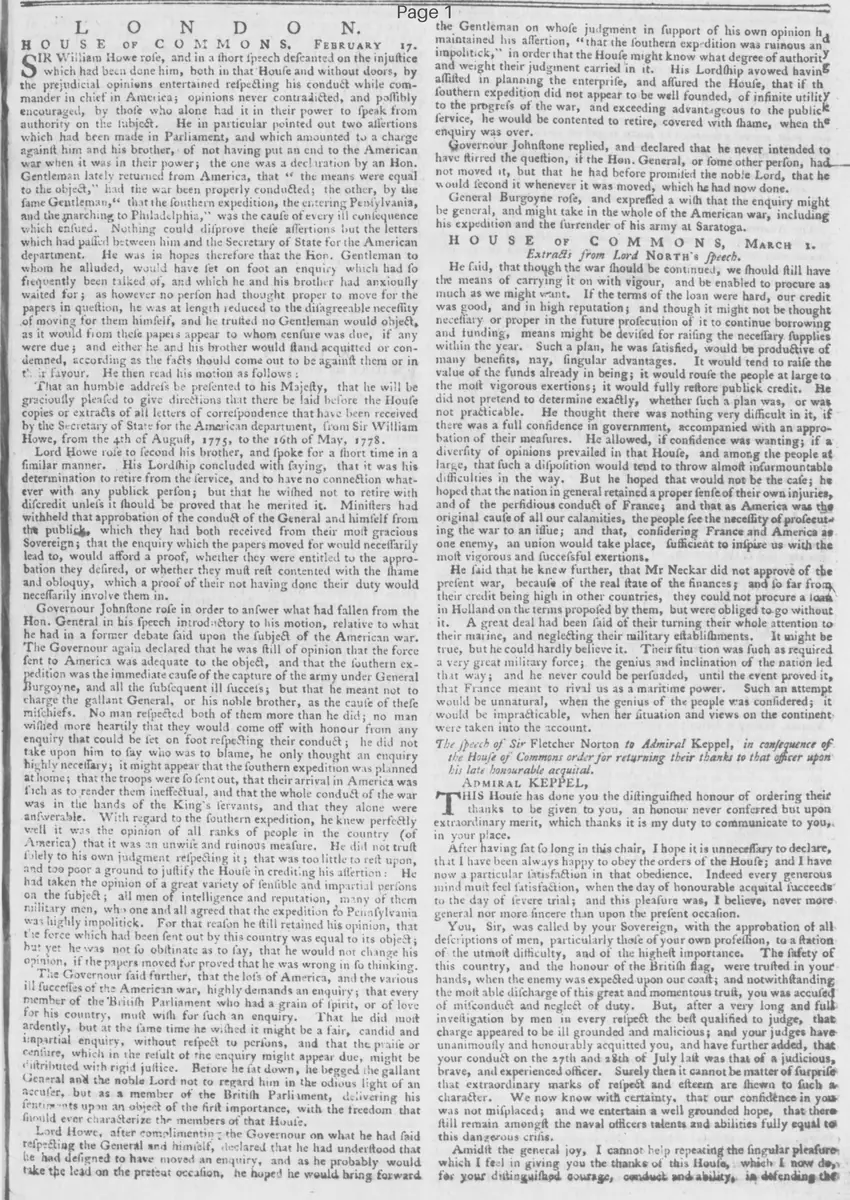
HOUSE OF COMMONS.
FEBRUARY 17.
Sir William Howe rose, and in a short speech descanted on the injustice which had been done him, both in that House and without doors, by the prejudicial opinions entertained respecting his conduct while commander in chief in America; opinions never contradicted, and possibly encouraged, by those who alone had it in their power to speak from authority on the subject. He in particular pointed out two assertions which had been made in Parliament, and which amounted to a charge against him and his brother, of not having put an end to the American war when it was in their power; the one was a declaration by an Hon. Gentleman lately returned from America, that "the means were equal to the object," had the war been properly conducted; the other, by the same Gentleman, "that the southern expedition, the entering Pennsylvania, and the marching to Philadelphia," was the cause of every ill consequence which ensued. Nothing could disprove these assertions but the letters which had passed between him and the Secretary of State for the American department. He was in hopes therefore that the Hon. Gentleman to whom he alluded, would have set on foot an enquiry which had so frequently been talked of, and which he and his brother had anxiously waited for; as however no person had thought proper to move for the papers in question, he was at length reduced to the disagreeable necessity of moving for them himself, and he trusted no Gentleman would object, as it would from these papers appear to whom censure was due, if any were due; and either he and his brother would stand acquitted or condemned, according as the facts should come out to be against them or in their favour. He then read his motion as follows:
'That an humble address be presented to his Majesty, that he will be graciously pleased to give directions that there be laid before the House copies or extracts of all letters of correspondence that have been received by the Secretary of State for the American department, from Sir William Howe, from the 4th of August, 1775, to the 16th of May, 1778.'
Lord Howe rose to second his brother, and spoke for a short time in a similar manner. His Lordship concluded with saying, that it was his determination to retire from the service, and to have no connection whatever with any publick person; but that he wished not to retire with discredit unless it should be proved that he merited it. Ministers had withheld that approbation of the conduct of the General and himself from the publick, which they had both received from their most gracious Sovereign; that the enquiry which the papers moved for would necessarily lead to, would afford a proof, whether they were entitled to the approbation they desired, or whether they must rest contented with the shame and obloquy, which a proof of their not having done their duty would necessarily involve them in.
Governor Johnstone rose in order to answer what had fallen from the Hon. General in his speech introductory to his motion, relative to what he had in a former debate said upon the subject of the American war. The Governor again declared that he was still of opinion that the force sent to America was adequate to the object, and that the southern expedition was the immediate cause of the capture of the army under General Burgoyne, and all the subsequent ill success; but that he meant not to charge the gallant General, or his noble brother, as the cause of these mischiefs. No man respected both of them more than he did; no man wished more heartily that they would come off with honour from any enquiry that could be set on foot respecting their conduct; he did not take upon him to say who was to blame, he only thought an enquiry highly necessary; it might appear that the southern expedition was planned at home; that the troops were so sent out, that their arrival in America was such as to render them ineffectual, and that the whole conduct of the war was in the hands of the King's servants, and that they alone were answerable. With regard to the southern expedition, he knew perfectly well it was the opinion of all ranks of people in the country (of America) that it was an unwise and ruinous measure. He did not trust solely to his own judgment respecting it; that was too little to rest upon, and too poor a ground to justify the House in crediting his assertion: He had taken the opinion of a great variety of sensible and impartial persons on the subject; all men of intelligence and reputation, many of them military men, who one and all agreed that the expedition to Pennsylvania was highly impolitick. For that reason he still retained his opinion, that the force which had been sent out by this country was equal to its object; but yet he was not so obstinate as to say, that he would not change his opinion, if the papers moved for proved that he was wrong in so thinking. The Governor said further, that the loss of America, and the various ill successes of the American war, highly demands an enquiry; that every member of the British Parliament who had a grain of spirit, or of love for his country, must wish for such an enquiry. That he did most ardently, but at the same time he wished it might be a fair, candid and impartial enquiry, without respect to persons, and that the praise or censure, which in the result of the enquiry might appear due, might be distributed with rigid justice. Before he sat down, he begged the gallant General and the noble Lord not to regard him in the odious light of an accuser, but as a member of the British Parliament, delivering his sentiments upon an object of the first importance, with the freedom that should ever characterize the members of that House.
Lord Howe, after complimenting the Governor on what he had said respecting the General and himself, declared that he had understood that he had designed to have moved an enquiry, and as he probably would take the lead on the present occasion, he hoped he would bring forward
What sub-type of article is it?
What keywords are associated?
What entities or persons were involved?
Where did it happen?
Foreign News Details
Primary Location
America
Event Date
February 17
Key Persons
Outcome
motion made for copies or extracts of letters from sir william howe to the secretary of state for the american department from 4th of august, 1775, to 16th of may, 1778, to enable inquiry into conduct during the american war; no final resolution reported.
Event Details
Sir William Howe addressed the House of Commons, complaining of unjust criticisms of his conduct as commander in chief in America and moving for parliamentary papers to refute charges that he and his brother failed to end the war when possible, specifically regarding the southern expedition and march to Philadelphia. Lord Howe seconded, expressing intent to retire unless discredited. Governor Johnstone defended his prior statements that the force was adequate but the southern expedition caused failures like Burgoyne's capture, attributing blame possibly to planning at home, and called for a fair inquiry without accusing the Howes directly. Lord Howe complimented Johnstone and hoped he would lead the inquiry.