Thank you for visiting SNEWPapers!
Sign up free
Alexandria Daily Gazette, Commercial & Political
Alexandria, Virginia
What is this article about?
Report on the seizure of the American brig Charleston in Bordeaux under the French Milan Decree of December 17, 1807, despite a prior visit by a British privateer on November 1, 1807. French advocate de La Grange argues against retroactive application, but the vessel is condemned. Broader critique of French decrees violating neutral rights amid Anglo-French trade wars.
Merged-components note: These two components form a single continuous article on the interpretation of French decrees from the New-York Evening Post.
Clipping
OCR Quality
Full Text
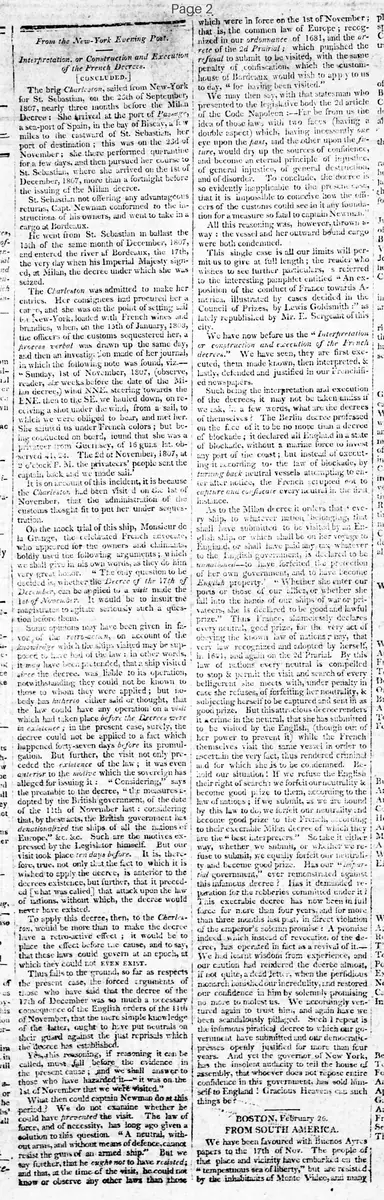
Interpretation, or Construction and Execution
of the French Decrees
[CONCLUDED.]
The brig Charleston, sailed from New-York
for St. Sebastian, on the 26th of September,
1807, nearly three months before the Milan
Decree: She arrived at the port of Passage,
a sea-port of Spain, in the bay of Biscay, a few
miles to the eastward of St. Sebastien, her
port of destination; this was on the 23d of
November: she there performed quarantine
for a few days, and then pursued her course to
St. Sebastian, where she arrived on the 1st of
December, 1807, more than a fortnight before
the issuing of the Milan decree.
St. Sebastian not offering any advantageous
returns, Capt. Newman conformed to the in-
structions of his owners, and went to take in a
cargo at Bordeaux.
He went from St. Sebastian in ballast the
15th of the same month of December, 1807.
and entered the river of Bordeaux, the 17th,
the very day when his Imperial Majesty sign-
ed, at Milan, the decree under which she was
seized.
The Charleston was admitted to make her
entries. Her consignees had procured her a
cargo, and she was on the point of setting sail
for New-York, loaded with French wines and
brandies, when, on the 18th of January, 1808,
the officers of the customs sequestered her, a
process verbal was drawn up the same day,
and then an investigation made of her journal,
in which the following note was found, viz.--
"Sunday, 1st of November, 1807, (observe,
reader, six weeks before the date of the Mi-
lan decree,) wind NNE. steering towards the
ENE. then to the SE. we hauled down, on re-
ceiving a shot under the wind, from a sail, to
which we were obliged to bear, and met her.
She saluted us under French colors: but be-
ing conducted on board, found that she was a
privateer from Guernsey, of 16 guns lat. ob-
served 41, 24. The 2d of November, 1807, at
2 o'clock P. M. the privateer's people sent the
captain back and we made sail.
It is on account of this incident, it is because
the Charleston had been visited on the 1st of
November, that the administration of the
customs thought fit to put her under sequestra-
tion.
On the mock trial of this ship, Monsieur de
La Grange, the celebrated French advocate,
who appeared for the owners and claimants,
boldly used the following arguments; which
we shall give in his own words, as they do him
very great honor. "The only question to be
decided is, whether the Decree of the 17th of
December, can be applied to a visit made the
1st of November. It would be to insult the
magistrates to agitate seriously such a ques-
tion before them.
Some opinions may have been given in fa-
vor of the retro-action, on account of the
knowledge which the ships visited may be sup-
posed to have had of the law: in other words,
it may have been pretended, that a ship visited
since the decree was liable to its operation
notwithstanding they could not be known to
those to whom they were applied; but no-
body has hitherto either said or thought, that
the law could have any operation on a visit
which had taken place before the Decrees were
in existence; in the present case, surely, the
decree could not be applied to a fact which
happened forty-seven days before its promul-
gation. But further, the visit not only pre-
ceded the existence of the law; it was even
anterior to the motive which the sovereign has
alleged for issuing it: "Considering," says
the preamble to the decree, "the measures a-
adopted by the British government, of the date
of the 11th of November last: considering
that, by these acts, the British government has
denationalized the ships of all the nations of
Europe," &c. &c. Such are the motives ex-
pressed by the Legislator himself. But our
visit took place ten days before. It is, there-
fore, true, not only that the fact to which it is
wished to apply the decree, is anterior to the
decrees existence, but further, that it preced-
ed what was called that attack upon the law
of nations, without which, the decree would
never have existed.
To apply this decree, then, to the Charles-
ton, would be more than to make the decree
have a retro-active effect; it would be to
place the effect before the cause, and to say,
that these laws could govern at an epoch, at
which they could not even exist.
Thus falls to the ground, so far as respects
the present case, the forced arguments of
those who have said that the decree of the
17th of December was so much a necessary
consequence of the English orders of the 11th
of November, that the mere simple knowledge
of the latter, ought to have put neutrals on
their guard against the just reprisals which
the decree has established.
Yes, this reasoning, if reasoning it can be
called, must fall before the evidence in
the present cause; and we shall answer to
those who have hazarded it--"it was on the
1st of November that we were visited."
What then could captain Newman do at this
period.? We do not examine whether he
could have prevented the visit. The law of
force, and of necessity, has long ago given a
solution to this question. "A neutral, with-
out arms, and without means of defence, cannot
resist the guns of an armed ship." But we
say further, that he ought not to have resisted:
and that, at the time of the visit, he could not
know or observe any other laws than those
which were in force on the 1st of November:
that is, the common law of Europe; recog-
nized in our ordonnance of 1681, and the ar-
rete of the 2d Prairial; which punished the
refusal to submit to be visited, with the same
penalty of confiscation, which the custom-
house of Bordeaux would wish to apply to us
to day, "for having been visited."
We may then say, with that statesman who
presented to the legislative body the 2d article
of the Code Napoleon:--Far be from us the
idea of those laws with two faces (having a
double aspect) which, having incessantly one
eye upon the past, and the other upon the fu-
ture, would dry up the sources of confidence,
and become an eternal principle of injustice.
of general injustice, of general destruction.
and of disorder. To conclude, the decree is
so evidently inapplicable to the present case,
that it is impossible to conceive how the offi-
cers of the customs could see in it any founda-
tion for a measure so fatal to captain Newman."
All this reasoning was, however, thrown a-
way: the vessel and her outward bound cargo
were both condemned.
This single case is all our limits will per-
mit us to give at full length; the reader who
wishes to see further particulars, is referred
to the interesting pamphlet entitled "An ex-
position of the conduct of France towards A-
merica, illustrated by cases decided in the
Council of Prizes, by Lewis Goldsmith:" as
lately republished by Mr. E. Sargent of this
city.
We have now before us the "Interpretation
or construction and execution of the French
decrees." We have seen, they are first exe-
cuted, then made known, then interpreted, &
lastly, defended and justified in our Frenchifi-
ed newspapers.
Such being the interpretation and execution
of the decrees, it may not be taken amiss if
we ask, in a few words, what are the decrees
of themselves? The Berlin decree professed
on the face of it to be no more than a decree
of blockade; it declared all England in a state
of blockade, without a marine force to invest
any part of the coast; but instead of executing
it according to the law of blockade, by
turning back neutrals attempting to enter after notice, the French scrupled not to
capture and confiscate every neutral in the first
instance.
As to the Milan decree it orders that every
ship, to whatever nation belonging, that
shall have submitted to be visited by an En-
glish ship, or which shall be on her voyage to
England, or shall have paid any tax whatever
to the English government, is declared to be
unnationed--to have forfeited the protection
of her own government, and to have become
English property." "Whether she enter our
ports or those of our allies, or whether she
fall into the hands of our ships of war or pri-
vateers, she is declared to be good and lawful
prize." Thus France, shamelessly declares
every neutral, good prize, for the very act of
obeying the known law of nations; nay, that
very law recognized and adopted by herself.
in 1681, and again on the 2d Prairial. By this
law of nations every neutral is compelled
to stop & permit the visit and search of every
belligerent she meets with, under penalty in
case she refuses, of forfeiting her neutrality, &
subjecting herself to be captured and sent in as
good prize. But this atrocious decree renders
it a crime in the neutral, that she has submitted
to be visited by the English, (though out of
her power to prevent it) while the French
themselves visit the same vessel in order to
ascertain the very fact, thus rendered criminal
and for which she is to be condemned. Be-
hold our situation! If we refuse the English
their right of search: we forfeit our neutrality &
become good prize to them, according to the
law of nations; if we submit, as we are bound
by this law to do, we forfeit our neutrality and
become good prize to the French, according
to their execrable Milan decree of which they
are the "best interpreters." So take it either
way, whether we submit, or whether we re-
fuse to submit, we equally forfeit our neutrality
and become good prize. Has our "impartial
government," ever remonstrated against
this infamous decree? Has it demanded re-
paration for the robberies committed under it?
This execrable decree has now been in full
force for more than four years, and for more
than three months last past, in direct violation
of the emperor's solemn promise: A promise
indeed which instead of revocation of the de-
cree, has operated in fact as a revival of it.-
We had learnt wisdom from experience, and
our caution had rendered the decree almost,
if not quite, a dead letter, when the perfidious
monarch banished our incredulity, and restored
our confidence in him by solemnly promising
no more to molest us. He accordingly ven-
tured again to trust him, and again have we
been scandalously pillaged. Such is
this infamous piratical decree to which our go-
vernment have submitted and our democratic-
presses openly justified for more than four
years. And yet the governor of New York,
has the insolent audacity to tell the house of
assembly, that whoever does not repose entire
confidence in this government, has sold him-
self to England! Gracious Heavens can such
things be?!
What sub-type of article is it?
What keywords are associated?
What entities or persons were involved?
Where did it happen?
Foreign News Details
Primary Location
Bordeaux, France
Event Date
November 1807 January 1808
Key Persons
Outcome
the brig charleston and her cargo of french wines and brandies were sequestered on january 18, 1808, and subsequently condemned by french authorities.
Event Details
The American brig Charleston, en route from New York to St. Sebastian, was visited by a Guernsey privateer on November 1, 1807. After proceeding to Bordeaux for cargo, she was seized on January 18, 1808, under the Milan Decree of December 17, 1807, for the prior visit. Advocate de La Grange argued the decree's inapplicability due to retroactivity and predating motives, but the condemnation proceeded. The article critiques the French decrees as violating neutral rights in response to British orders.