Thank you for visiting SNEWPapers!
Sign up free
Daily National Intelligencer
Washington, District Of Columbia
What is this article about?
A private citizen submits observations to Congress via the National Intelligencer, critiquing a committee report on roads and canals. He argues that federal powers over internal improvements cannot be expanded through state consents or liberal constitutional constructions, as this violates the fixed division of powers established by the people, risking consolidation of authority.
Merged-components note: The content on page 3 is a direct continuation of the letter to the editor starting on page 2; relabel the second part from editorial to letter_to_editor.
Clippings
1 of 2
OCR Quality
Full Text
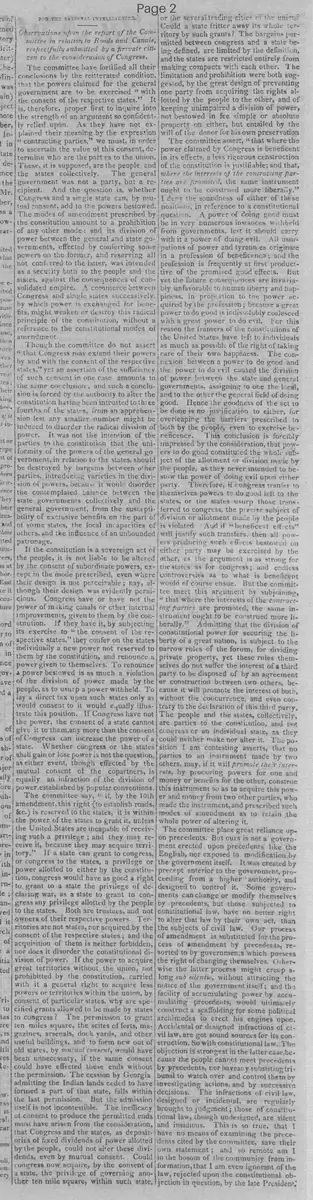
Observations upon the report of the Committee in relation to Roads and Canals, respectfully submitted by a private citizen to the consideration of Congress.
The committee have fortified all their conclusions by the reiterated condition, that the powers claimed for the general government are to be exercised "with the consent of the respective states." It is, therefore, proper first to inquire into the strength of an argument so confidently relied upon. As they have not explained their meaning by the expression "contracting parties," we must, in order to ascertain the value of this consent, determine who are the parties to the union. These, it is supposed, are the people and the states collectively. The general government was not a party, but a recipient. And the question is, whether Congress and a single state can, by mutual consent, add to the powers bestowed. The modes of amendment prescribed by the constitution amount to a prohibition of any other mode: and its division of power between the general and state governments, effected by conferring some powers on the former, and reserving all not conferred to the latter, was intended as a security both to the people and the states, against the consequences of consolidated empire. A commerce between Congress and single states successively, by which power is exchanged for benefits, might weaken or destroy this radical principle of the constitution, without a reference to the constitutional modes of amendment.
Though the committee do not assert "that Congress may extend their powers by and with the consent of the respective states." yet an assertion of the sufficiency of such consent in one case amounts to the same conclusion; and such a conclusion is forced by the authority to alter the constitution having been intrusted to three fourths of the states, from an apprehension lest any smaller number might be induced to disorder the radical division of power. It was not the intention of the parties to the constitution that the uniformity of the powers of the general government, in relation to the states, should be destroyed by bargains between other parties, introducing varieties in the division of powers, because it would disorder the contemplated balance between the state governments collectively and the general government, from the susceptibility of exclusive benefits on the part of some states, the local incapacities of others, and the influence of an unbounded patronage.
If the constitution is a sovereign act of the people, it is not liable to be altered by the consent of subordinate powers, except in the mode prescribed, even where their design is not perceivable; nay, although their design was evidently pernicious. Congress have or have not the power of making canals or other internal improvements, given to them by the constitution. If they have it, by subjecting its exercise to "the consent of the respective states," they confer on the states individually a new power not reserved to them by the constitution, and renounce a power given to themselves. To renounce a power bestowed is as much a violation of the division of power made by the people, as to usurp a power withheld. To lay a direct tax upon such states only as would consent to it would equally illustrate this position. If Congress have not the power, the consent of a state cannot give it to them, any more than the consent of Congress can increase the power of a state. Whether congress or the states shall gain or lose power is not the question, as either event, though effected by the mutual consent of the copartners, is equally an infraction of the division of power, established by popular conventions.
The committee say, "if, by the 10th amendment, this right (to establish roads, &c.) is reserved to the states, it is within the power of the states to grant it, unless the United States are incapable of receiving such a privilege; and they may receive it, because they may acquire territory." If a state can grant to congress, or congress to the states, a privilege or power allotted to either by the constitution, congress would have as good a right to grant to a state the privilege of declaring war, as a state to grant to congress any privilege allotted by the people to the states. Both are trustees, and not owners of their respective powers. Territories are not states, nor acquired by the consent of the respective states; and the acquisition of them is neither forbidden, nor does it disorder the constitutional division of power. If the power to acquire great territories without the union, not prohibited by the constitution, carried with it a general right to acquire less powers or territories within the union, by consent of particular states, why are specified grants allowed to be made by states to congress? The permission to grant ten miles square, the sites of forts, magazines, arsenals, dock yards, and other useful buildings, and to form new out of old states, by mutual consent, would have been unnecessary, if the same consent could have effected these ends without the permission. The cession by Georgia admitting the Indian lands ceded to have formed a part of that state, falls within the last permission. But the admission itself is not incontestible. The delicacy of consent to produce the permitted ends must have arisen from the consideration, that Congress and the states, as depositories of fixed dividends of power allotted by the people, could not alter these dividends, even by mutual consent. Could congress now acquire, by the consent of a state, the privilege of governing another ten miles square, or could a state grant to congress the privilege of exercising municipal, within such state, for the several trading cities of the union? Could a state fritter away its whole territory by such grants? The bargains permitted between congress and a state being defined, are limited by the definition, and the states are restricted entirely from making compacts with each other. The limitation and prohibition were both suggested, by the great design of preventing one party from acquiring the rights allotted by the people to the other, and of keeping unimpaired a division of power, not bestowed in fee simple or absolute property on either, but entailed by the will of the donor for his own preservation.
The committee assert, "that where the power claimed by Congress is beneficent in its effects, a less rigorous construction of the constitution is justifiable; and that, where the interests of the contracting parties are promoted, the same instrument ought to be construed more liberally."
I deny the soundness of either of these positions, in reference to a constitutional question. A power of doing good must be in very numerous instances withheld from governments, lest it should carry with it a power of doing evil. All usurpations of power and tyrannies originate in a profession of beneficence; and the profession is frequently at first productive of the promised good effects. But yet the future consequences are invariably unfavorable to human liberty and happiness, in proportion to the power acquired by the profession; because a great power to do good is indissolubly coalesced with a great power to do evil. For this reason the framers of the constitutions of the United States have left to individuals as much as possible of the right of taking care of their own happiness. The connexion between a power to do good and the power to do evil caused the division of power between the state and general governments, assigning to one the local, and to the other the general field of doing good. Hence the goodness of the act to be done is no justification to either, for overleaping the barriers prescribed to both by the people, even to exercise beneficence. This conclusion is forcibly impressed by the consideration, that powers to do good constituted the whole subject of the allotment or division made by the people, as they never intended to bestow the power of doing evil upon either party. Therefore, if congress transfer to themselves powers to do good left to the states, or the states usurp those transferred to congress, the precise subject of division or allotment made by the people is violated. And if "beneficent effects" will justify such transfers, then all powers producing such effects bestowed on either party may be exercised by the other, as the argument is as strong for the states as for congress; and endless controversies as to what is beneficent would of course ensue. But the committee meet this argument by subjoining, "that where the interests of the contracting parties are promoted, the same instrument ought to be construed more liberally." Admitting that the division of constitutional power for securing the liberty of a great nation, is subject to the narrow rules of the forum, for dividing private property, yet these rules themselves do not suffer the interest of a third party to be disposed of by an agreement or construction between two others, because it will promote the interest of both, without the concurrence, and even contrary to the declaration of this third party. The people and the states, collectively, are parties to the constitution, and not congress or an individual state, as they could neither make nor alter it. The position I am contesting asserts, that no parties to an instrument made by two others, may, if it will promote their interests, by procuring powers for one and money or benefits for the other, construe this instrument so as to acquire this power and money from two other parties, who made the instrument, and prescribed such modes of amendment as to retain the whole power of altering it.
The committee place great reliance upon precedents. But ours is not a government erected upon precedents like the English, nor exposed to modification by the government itself. It was created by precept anterior to the government, proceeding from a higher authority, and designed to control it. Some governments can change or modify themselves by precedents, but those subjected to constitutional law, have no better right to alter that law by their own act, than the subjects of civil law. Our process of amendment is substituted for the process of amendment by precedents, resorted to by governments which possess the right of changing themselves. Otherwise the latter process might creep along sub silentio, without attracting the notice of the government itself; and the facility of accumulating power by accumulating precedents, would ultimately construct a scaffolding for some political Archimedes to erect his engines upon. Accidental or designed infractions of civil law, are not sound sources for its construction. So with constitutional law. The objection is strongest in the latter case, because the people cannot meet precedents by precedents, nor have any subsisting tribunal to watch over and control them by investigating actions, and by successive decisions. The infractions of civil law, designed or incidental, are regularly brought to judgment; those of constitutional law, though undesigned, are silent and insidious. This is so true, that I have no means of examining the precedents cited by the committee, save their own statement; and so remote am I in the bosom of the community from information, that I am even ignorant of the law, rejected upon the constitutional objection in question, by the late President.
But the failure of this law, upon full consideration of the point in doubt, is of more weight, than any number of precedents, without such consideration. A solemn union of opinion, between a minority of Congress, invested by the constitution with a power of arresting laws, the late President, and the existing Executive strongly solicits Congress to resist a construction extending their own power, and forcibly recommends an appeal to the constitutional tribunal. The pacific use of precedents, seems to be exemplified in no small degree by the references of the committee. Territorial roads, and a road made by a fatigue party of the army, are cited as cases in point.
The power given to Congress "of making all needful rules and regulations respecting the territory of the United States" seems clearly to include the former, so needful for advancing the sale of public land, and for territorial prosperity; and also the power of making pecuniary advances for any other needful territorial purposes, whether such advances are drawn from the treasury or reimbursed by those sales. Besides, as territories until converted into states, are national property, the "general welfare" requires that they should be taken care of. And surely the President, as commander of the army, possesses the power of ordering out a fatigue party, for purposes essential to military operations, such as the march of troops, and the transportation of cannon and supplies. Such is the power of demolishing buildings when it is necessary for defence. But, if private property is injured by its exercise, compensation follows. The President and the individuals through whose lands this road ran, were the only parties to the transaction. He, in his military character; they, as having power over their own property. At least I cannot perceive the propriety of contending, that the exclusive act of the executive power is a good precedent for enlarging the construction of the constitution, unless it be to prove, that each separate department, legislative, executive and judicial, possesses the same right of re-moulding the constitution by the same means.
Several arguments used by the committee may be condensed into a disavowal of any use of the phrase, common defence and general welfare; an admission that the powers contended must appear to be expressly granted, or that they are necessary and proper for carrying into execution some other express power: an inference, that a power to make roads and canals is necessary and proper for carrying into execution the express powers to establish post offices and post roads, to declare war and to regulate commerce with foreign nations, among the several states, and with the Indian tribes; and, if all these fail, to bestow the constructive powers claimed, an assertion that they are still reached by the right of appropriating money. Thus five express powers are resorted to as roots, from which to extract, by the help of the phrase "necessary and proper," one constructive power. For roads and canals are quite similar, except that roads are given a sixth root, in the post office clause. It seems hardly possible, that the able composers of the constitution, whilst aiming at definition, should have left this power to be extracted by a construction to be sought for in so many different sources, and the more capacious for being recondite—a construction sufficient to bestow on the words "necessary and proper" the exploded and sweeping efficacy at one time claimed for the phrase "common defence and general welfare." The committee lay down this broad doctrine, "a power to carry on war implies the necessary and proper means of conducting it to a safe and proper issue." Grant this, and it only remains to declare the means necessary and proper, to reduce the argument to a syllogism. But it would prove too much. Martial law to be established by Congress throughout the Union, might be necessary and proper, in their opinion, for conducting a war to a safe and proper issue, and thus at one blow they could supersede, by the terms of it, all the powers reserved to the states. The means useful in war, or to prepare for war, are so unlimited, that it is as impossible to foresee the extent of such a construction of the phrase "necessary and proper," as of a similar construction of the abandoned phrase. Unless both are liable to some restriction, the limitations and division of power intended to be established by the constitution, may all be defeated without much ingenuity. Both are subject to the same restriction, or to none. It is this—Doubtful inferences were not invested by the constitution with the power of destroying plain stipulations, and rendering the whole instrument nugatory. Inferences are subordinate to these stipulations, and not the stipulations to inferences. The prohibition of giving a preference, by any regulation of commerce, to the ports of one state over those of another, furnishes inferences at least as plausible as those which extract a power of making canals, out of a power to declare war. Its plain purpose is to prevent partialities in favor of particular states. May not canals for conducting commerce to a particular port, draw it out of one state into another, and constitute a preference of great magnitude; and may not some states be locally unsuspceptible of such benefits? Thus, preferences intended to be prohibited might be practised, and the evils of real or imagined partialities, intended to be excluded, might follow.
It is seriously urged, that the power to establish post offices and post roads, would be ineffectual, without the constructive power contended for, as the states might discontinue their ferries, break down their bridges, and shut up their roads. Upon the same ground it might be contended, that the power of declaring war might be rendered ineffectual, by the states refusing to appoint militia officers, and, therefore, that Congress might, constructively, assume that power; or that, by forbearing to appoint senators, they might destroy or impede the entire operations of the general government, unless Congress should have the power of preventing the evil. Does this degree of confidence inspire a belief, that the states were not intended to be intrusted with the diminutive affair, comparatively, of roads and canals? But the committee contend, that representation and responsibility are complete securities against the abuse of the constructive powers claimed by Congress. This is another argument, which, by demanding too much, has a right to nothing. Under its boundless efficacy, were it sound, the state governments might, with the same propriety, assume the care of the general interest, as Congress can of local interests. Suggestions that the trustee of the general interest, or the trustees of local interests, may abuse the trust, or fail in duty, can be no justification for either to invade the province of the other, since the responsibility of both to the people is the same, and, as it would open the road to both to destroy the constitutional division of power.
The sufficiency of representation, unaided by a division of powers, to secure liberty and happiness to a nation, has been often practically exploded, and is flatly denied by all our forms of government. Ancient nations tried it unsuccessfully. In modern times, the representatives of the people of Denmark, coolly established a despotism without consulting their constituents. Those of Sweden imitated the example of their neighbors. The representatives of the people of France recently overturned a constitution, and made a despot, called a first consul, without consulting their constituents. To avoid evils like these, we have divided powers between two orders of representation, for different purposes, and limited to different objects. Can either monopolize the confidence attached to representation? and, if either, which has the best title to it, the greater or the lesser mass? An argument which proves too much is strictly assignable to the list of plausibilities.
We come now to the last and boldest argument urged by the committee. If a limited power of making internal improvements is not given to Congress expressly or impliedly, yet an unlimited power of appropriating money to any object whatsoever is claimed. The successive sources resorted to for the purpose of extending the powers of Congress, have been the phrases "common defence and general welfare," "necessary and proper for carrying into execution the foregoing powers;" and, lastly, the power of appropriation. This last power rendered a reference to an amplifying construction of the two phrases quoted, unnecessary, if it is not subordinate, like its coadjutors, to the expressed division of powers. The special question is, whether Congress can appropriate money to objects reserved to the states, or inconsistently with the restrictions imposed upon themselves. Could they evade the prescribed uniformity of taxation, by restoring to a favored state the amount it might pay in beneficial donations; in digging canals, in maintaining its paupers, in supporting its civil government, in patronizing the whole extent of its local interests, or in gratuitous favors? Could they build cities as well as dig canals, to facilitate its commerce, or give a preference to one port over another, by retaining duties received at one, and restoring those received at another?
The power of raising and applying money, is given in the following words: "Congress shall have power to lay and collect taxes, duties, imposts, and excises, to pay the debts, and provide for the common defence and general welfare of the United States." The latter member of this sentence is a striking explanation of the meaning attached to the same words in the declaratory clause of the constitution. "Congress shall have power to lay and collect taxes, duties, imposts, and excises." For what purpose? "To pay the debts and provide for the common defence and general welfare of the United States." Not to be expended in local or special objects reserved to the states, but in objects of common or general interest, according to the obvious principle upon which our form of government is constructed. Precedents of appropriations, however liberal or extravagant, which do not disclose an application of money by Congress knowingly, to the use of powers, rights, or duties, reserved to the states, do not apply to the point in debate; and if there are any which do apply, ought they not rather to awaken the public attention to the subtlety & efficacy of precedents in modifying the constitution, than to a conviction of the legitimacy of their authority? For, I conclude, that the power of applying money, given by the phrase quoted, is restrained and limited by the same principle of construction, which restrains and limits the two phrases "common defence and general welfare," and "necessary and proper for carrying into execution the foregoing powers," namely, that neither of the three can be correctly construed, so as to defeat, in any one instance, the division of powers prescribed by the constitution; since, if either could be so used, all might, as the same mode of construction would apply equally to all these phrases; and if one power can be thus transplanted, the rest are exposed to the same operation.
I have not considered or compared the advantages and disadvantages of constituting our nation into one consolidated government, or of its remaining a union of states, according to the title it has taken. The mode of construction adopted by the committee, evidently leans towards the first idea: that I have endeavored to defend supports the second. It is admitted that theirs might be attended with many means for creating a splendid empire, and it is left to others to counterbalance that consideration, by the advantages of a free and moderate government, practically enjoyed, and apparently resulting, from the division of powers between the state and general governments. Nor have I considered the policy of transferring to Congress the additional powers recommended by the President. I have only endeavored to prove, that an acquisition by Congress of a power over roads, canals, and seminaries of learning, by the help of construction, would be a precedent, upon the authority of which the care of all local state interests, physical and moral, may hereafter be claimed; and that such a mode of acquiring additional powers, is infinitely more dangerous to the principle of union, and more conformable to that of consolidation, than a gift of additional powers, according to the constitutional mode of amendment, by which they can be limited, defined, and sparingly bestowed. The difference between an accession of other limited powers by amendment, and an acquisition of the whole circle of local interests by construction, is so striking that I think no precedent has ever more seasonably obeyed the injunction of the constitution, "to recommend to the consideration of Congress such measures as he shall judge necessary and proper." Even the disinterestedness of assailing executive patronage, by recommending a repeal of taxes, is not comparable to the merit of preferring the chastity of the constitution to his own wishes, and the wisdom of the nation to his own judgment. Nor is it my intention that the least censure should be reflected upon the committee from the arguments I have used, or the applause bestowed on the President. Their patriotism and integrity are unquestionable. My whole object has been to suggest such thoughts as occurred to a private citizen, upon a subject embracing consequences too numerous to be foreseen, penetrating deeply into our political system, and productive of a difference of opinion among honest and patriotic citizens.
What sub-type of article is it?
What themes does it cover?
What keywords are associated?
What entities or persons were involved?
Letter to Editor Details
Author
A Private Citizen
Recipient
Congress
Main Argument
the federal government cannot expand its powers over roads and canals through state consents or liberal constitutional interpretations, as this would violate the fixed division of powers between federal and state governments established by the people, leading to potential consolidation and loss of liberty.
Notable Details