Thank you for visiting SNEWPapers!
Sign up free
Story
November 26, 1891
Bridgeton Pioneer
Bridgeton, Cumberland County, New Jersey
What is this article about?
Amateur dressmaker offers practical advice on fitting dress waists, from smoothing fabric to using bias facings, while critiquing professionals and proposing instructional classes for suburban girls. (N.Y. Ledger)
Clipping
OCR Quality
98%
Excellent
Full Text
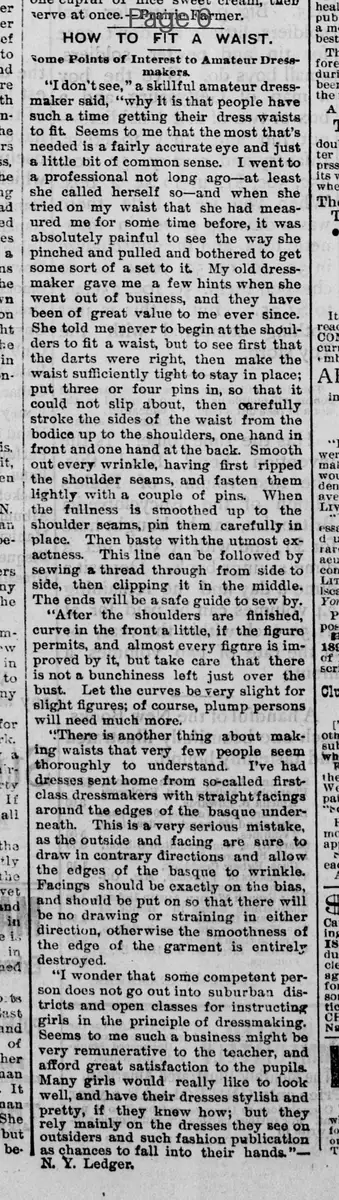
HOW TO FIT A WAIST.
Some Points of Interest to Amateur Dressmakers.
"I don't see," a skillful amateur dressmaker said, "why it is that people have such a time getting their dress waists to fit. Seems to me that the most that's needed is a fairly accurate eye and just a little bit of common sense. I went to a professional not long ago-at least she called herself so-and when she tried on my waist that she had measured me for some time before, it was absolutely painful to see the way she pinched and pulled and bothered to get some sort of a set to it. My old dressmaker gave me a few hints when she went out of business, and they have been of great value to me ever since. She told me never to begin at the shoulders to fit a waist, but to see first that the darts were right, then make the waist sufficiently tight to stay in place; put three or four pins in, so that it could not slip about, then carefully stroke the sides of the waist from the bodice up to the shoulders, one hand in front and one hand at the back. Smooth out every wrinkle, having first ripped the shoulder seams, and fasten them lightly with a couple of pins. When the fullness is smoothed up to the shoulder seams, pin them carefully in place. Then baste with the utmost exactness. This line can be followed by sewing a thread through from side to side, then clipping it in the middle. The ends will be a safe guide to sew by.
"After the shoulders are finished, curve in the front a little, if the figure permits, and almost every figure is improved by it, but take care that there is not a bunchiness left just over the bust. Let the curves be very slight for slight figures; of course, plump persons will need much more.
"There is another thing about making waists that very few people seem thoroughly to understand. I've had dresses sent home from so-called first-class dressmakers with straight facings around the edges of the basque underneath. This is a very serious mistake, as the outside and facing are sure to draw in contrary directions and allow the edges of the basque to wrinkle. Facings should be exactly on the bias, and should be put on so that there will be no drawing or straining in either direction, otherwise the smoothness of the edge of the garment is entirely destroyed.
"I wonder that some competent person does not go out into suburban districts and open classes for instructing girls in the principle of dressmaking. Seems to me such a business might be very remunerative to the teacher, and afford great satisfaction to the pupils. Many girls would really like to look well, and have their dresses stylish and pretty, if they knew how; but they rely mainly on the dresses they see on outsiders and such fashion publications as chance to fall into their hands."
N. Y. Ledger.
Some Points of Interest to Amateur Dressmakers.
"I don't see," a skillful amateur dressmaker said, "why it is that people have such a time getting their dress waists to fit. Seems to me that the most that's needed is a fairly accurate eye and just a little bit of common sense. I went to a professional not long ago-at least she called herself so-and when she tried on my waist that she had measured me for some time before, it was absolutely painful to see the way she pinched and pulled and bothered to get some sort of a set to it. My old dressmaker gave me a few hints when she went out of business, and they have been of great value to me ever since. She told me never to begin at the shoulders to fit a waist, but to see first that the darts were right, then make the waist sufficiently tight to stay in place; put three or four pins in, so that it could not slip about, then carefully stroke the sides of the waist from the bodice up to the shoulders, one hand in front and one hand at the back. Smooth out every wrinkle, having first ripped the shoulder seams, and fasten them lightly with a couple of pins. When the fullness is smoothed up to the shoulder seams, pin them carefully in place. Then baste with the utmost exactness. This line can be followed by sewing a thread through from side to side, then clipping it in the middle. The ends will be a safe guide to sew by.
"After the shoulders are finished, curve in the front a little, if the figure permits, and almost every figure is improved by it, but take care that there is not a bunchiness left just over the bust. Let the curves be very slight for slight figures; of course, plump persons will need much more.
"There is another thing about making waists that very few people seem thoroughly to understand. I've had dresses sent home from so-called first-class dressmakers with straight facings around the edges of the basque underneath. This is a very serious mistake, as the outside and facing are sure to draw in contrary directions and allow the edges of the basque to wrinkle. Facings should be exactly on the bias, and should be put on so that there will be no drawing or straining in either direction, otherwise the smoothness of the edge of the garment is entirely destroyed.
"I wonder that some competent person does not go out into suburban districts and open classes for instructing girls in the principle of dressmaking. Seems to me such a business might be very remunerative to the teacher, and afford great satisfaction to the pupils. Many girls would really like to look well, and have their dresses stylish and pretty, if they knew how; but they rely mainly on the dresses they see on outsiders and such fashion publications as chance to fall into their hands."
N. Y. Ledger.
What sub-type of article is it?
Instructional Guide
Personal Anecdote
What keywords are associated?
Waist Fitting
Dressmaking Tips
Amateur Sewing
Bias Facings
Suburban Classes
What entities or persons were involved?
Amateur Dressmaker
Old Dressmaker
Professional Dressmaker
Where did it happen?
Suburban Districts
Story Details
Key Persons
Amateur Dressmaker
Old Dressmaker
Professional Dressmaker
Location
Suburban Districts
Story Details
An amateur dressmaker explains fitting techniques for dress waists: start with darts, smooth fabric to shoulders, use bias facings; criticizes professionals and suggests classes for girls.