Thank you for visiting SNEWPapers!
Sign up free
Literary
July 10, 1840
The Spirit Of The Age
Woodstock, Windsor County, Vermont
What is this article about?
In Constantinople's slave market, Spanish knight Don Ferdinand de Lopez rescues beautiful Circassian slave Cedora from sale to the Sultan's harem, sparking a chase across the Bosphorus. They hide, fall in love, and later seek and receive the Sultan's pardon for their union.
Clipping
OCR Quality
92%
Excellent
Full Text
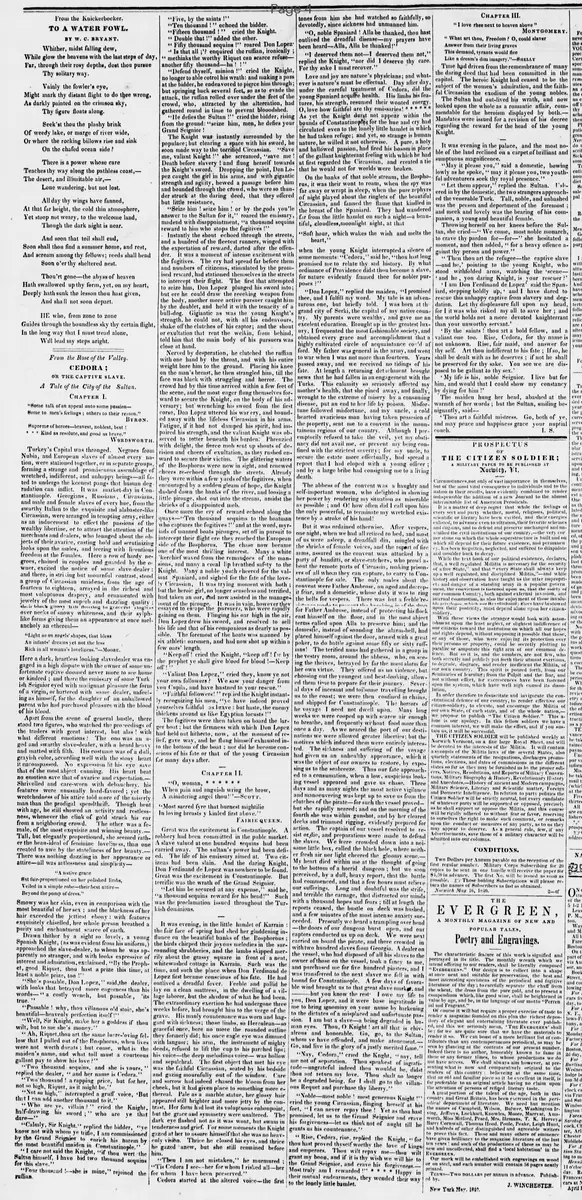
From the Rose of the Valley
CEDORA;
OR THE CAPTIVE SLAVE.
A
Tale of the City of the Sultan.
CHAPTER I.
"Some talk of an appeal unto some passion—
Some to men's feelings; others to their reason."
BYRON.
Supreme of heroes—bravest, noblest, best!
"Kind as resolute, and good as brave."
WORDSWORTH
Turkey's Capital was thronged. Negroes from
Nubia, and European slaves of almost every na-
tion, were stationed together, or in separate groups,
forming a strange and promiscuous assemblage of
wretched, indifferent, and unhappy beings—all fa-
ted to undergo the keenest pangs that human deg-
radation can inflict. It was market-day in Con-
stantinople. Georgians, Russians, Circassians,
and male and female slaves of every hue, from the
swarthy Italian to the exquisite and alabaster-like
Circassian, were arranged in tempting array, either
as an inducement to effect the passions of the
wealthy libertine, or to attract the attention of the
merchants and dealers, who lounged about the ob-
jects of their avarice, casting bold and scrutinizing
looks upon the males, and leering with licentious
freedom at the females. Here a row of hardy ne-
groes, chained in couples and guarded by the o.
wner, excited the notice of some slave-dealer:
and there, in striking but mournful contrast, stood
a group of Circassian maidens, from the age of
fourteen to eighteen, arrayed in the richest and
most voluptuous drapery, and ornamented with
jewelry of the most superb and dazzling quality:
choir black glossy hair floating in graceful ringlets
over necks of snowy whiteness, and their sylph-
like forms giving them an appearance at once mel-
ancholy and ethereal—
"Light as an angel's shapes, that bless
An infant's dreams, yet not the less
Rich in all woman's loveliness."—Moore.
Here a dark, heartless looking slave-dealer was en-
gaged in a high dispute with the owner of some un-
fortunate captive doomed never more to see home
or kindred; and there the emissary of some Turk-
ish Seignior eyed with malignant pleasure the form
of a virgin, or bartered with some dealer, unfeel-
ing as himself, for the daughter of an unhallowed
parent who had purchased pleasure with the blood
of his blood.
Apart from the scene of general bustle, there
stood two figures, who watched the proceedings of
the traders with great interest, but alas! with
what different emotions? The one was an a-
ged and swarthy slave-dealer, with a beard heavy
and matted with filth. His costume was of a dull
grayish color, according well with the stony heart
it encompassed. No expression lit his eye save
that of the most abject cunning. His heart beat
no emotion save that of avarice and expectation.—
Shrivelled and care-worn with debauchery, his
features were unusually hard-favored; yet the
wretchedness of his attire told more of the miserly
man than the prodigal spendthrift. Though bent
with age, he still showed an activity and restless-
ness, whenever the clink of gold struck his ear
from a neighboring crowd. The other was a fe-
male, of the most exquisite and winning beauty.—
Tall, but elegantly proportioned, she seemed rath-
er the beau-ideal of feminine loveliness, than one
created to awe by the stateliness of her beauty.—
There was nothing dazzling in her appearance or
attire—all was artlessness and simplicity—
"A native grace
Sat fair-proportioned on her polished limbs.
Veiled in a simple robe—their best attire—
Beyond the pomp of dress."
Snowy was her skin, even in comparison with the
most beautiful of her sex; and the blackness of her
hair exceeded the jettiest ebony: with features
exquisitely chiselled, her whole person breathed a
purity and enchantment scarce of earth.
Drawn thither by a sight so lovely, a young
Spanish Knight, (as was evident from his uniform,)
approached the slave-dealer, to whom he was ap-
parently no stranger, and with looks expressive of
interest and admiration, exclaimed, "By the Proph-
et, good Riquet, thou hast a prize this time, at
least a noble prize, too!"
"She's passable, Don Lopez," said the dealer,
with looks that betrayed more eagerness than his
words—"a costly wench, but passable, 'tis
true."
"Passable! why, thou villainous old stoic, she's
beautiful—heavenly perfection itself!"
"Well. Sir Knight, make her a goddess if thou
wilt, but to me she's money."
"Ah, Riquet, thou art the same lucre-loving fel-
low that I pulled out of the Bosphorus, when lives
were not worth ducats: but come, what is the
maiden's name, and what toll must a courteous
gallant pay to show his love's?"
"Two thousand sequins, and she is yours,"
replied the dealer, "and her name is Cedora."
"Two thousand! a rapping price, but for her,
not so high, Riquet, as it might be."
"Not so high," interrupted a gruff voice, "But
that I can add another thousand to it."
"Who are ye, villain?" cried the Knight,
half-drawing his sword; "who are ye that
dare—"
"Calmly, Sir Knight." replied the bidder, "ye
know not with whom ye trifle, I am commissioned
by the Grand Seignior to enrich his harem by
the most beautiful maiden in Constantinople."
"I care not," said the Knight, "if thou wert the
Sultan himself, I have bid two thousand sequins
for this slave."
"Four thousand!—she is mine," rejoined the
ruffian.
"Ten thousand!" echoed the bidder.
"Fifteen thousand!" cried the Knight.
"Double that!" added the other.
"Fifty thousand sequins!" roared Don Lopez
"Is that all?" enquired the ruffian, ironically
"methinks the worthy Riquet can scarce refuse
another fifty thousand—ha!!"
"Defend thyself, minion!" cried the Knight,
no longer able to control his wrath: and making a pass
at the bidder, he endeavored to pierce him through;
but springing back several feet, so as to evade the
attack, the ruffian rolled over under the feet of the
crowd, who, attracted by the altercation, had
gathered round in time to prevent bloodshed.
"He defies the Sultan!" cried the bidder, rising
from the ground: "seize him, men, he defies your
Grand Seignior!"
The Knight was instantly surrounded by the
populace; but clearing a space with his sword, he
soon made way to the terrified Circassian. "Save
me, valiant Knight!" she screamed, "save me!
Death before slavery!" and flung herself towards
the Knight's sword. Dropping the point, Don Lo-
pez caught the girl in his arms, and with gigantic
strength and agility, hewed a passage before him
and bounded through the crowd, who were so thun-
der struck at the daring deed, that they offered
but little resistance.
"Seize him! seize him! or by the gods you'll
answer to the Sultan for it," roared the emissary,
maddened with disappointment, "a thousand sequins
reward to him who stops the fugitives!"
Instantly the shout echoed through the streets,
and a hundred of the fleetest runners, winged with
the expectation of reward, darted after the offen-
der. It was a moment of intense excitement with
the fugitives. The cry had spread far before them
and numbers of citizens, stimulated by the prom-
ised reward, had stationed themselves in the streets
to intercept their flight. The first that attempted
to seize him, Don Lopez plunged his sword into;
but ere he could draw the reeking weapon from
the body, another more active pursuer caught him
by the doublet, and held it with the tenacity of a
bull-dog. Gigantic as was the young Knight's
strength, he could not, with all his endeavours,
shake off the clutches of his captor; and the shout
of exultation that rent the welkin, from behind,
told him that the main body of his pursuers was
close at hand.
Nerved by desperation, he clutched the ruffian
with one hand by the throat, and with his entire
weight bore him to the ground. Placing his knee
on the man's breast, he then strangled him, till the
face was black with struggling and horror. The
crowd had by this time arrived within a few feet of
the scene, and the most eager flung themselves for-
ward to secure the Knight, on the body of his ad-
versary; but wrenching his sword from the first
corse, Don Lopez uttered his war cry, and bound-
ed away with the lifeless Circassian in his arms.
Fatigue, if it had not damped his spirit, had im-
paired his strength, and the valiant Knight was ob-
served to totter beneath his burden: Frantic
with delight, the fierce mob sent up shouts of de-
rision and cheers of exultation, as they rushed on-
ward to secure their victim. The glittering waters
of the Bosphorus were now in sight, and renewed
cheers re-echoed through the streets. Already
they were within a few yards of the fugitives, when
encouraged by a sudden gleam of hope, the Knight
dashed down the banks of the river, and loosing a
little pirogue, shot out into the stream, amidst the
shrieks of a disappointed mob.
Once more the cry of reward echoed along the
quays—"Ten thousand sequins to the boatman
who captures the fugitives!" and at the word, myr-
iads of manned boats and pirogues, set off in pursuit to
intercept their flight ere they reached the European
side of the Bosphorus. The chase now became
one of the most thrilling interest. Many a white
kerchief waved from the remandoes of the man-
sions, and many a coral lip breathed safety to the
Knight. Many a noble youth cheered for the val-
iant Spaniard, and sighed for the fate of the love-
ly Circassian. It was a trying moment with both
but the heroic girl, no longer senseless and terrified,
had taken an oar, and now assisted in the manage-
ment of the pirogue. It was in vain, however they
essayed to escape the pursuers, who were rapidly
gaining on them. Flinging his oar high in the air,
Don Lopez drew his sword, and resolved to sell
his life and that of his companions as dearly as pos-
sible. The foremost of the boats was manned by
six athletic oarsmen, and had now shot up within a
few oars' length.
"Keep off!" cried the Knight, "keep off! for by
the prophet ye shall give blood for blood!—Keep
off!"
"Valiant Don Lopez," cried they, "know ye not
your own followers? We saw your danger from
you Galila, and have hastened to your rescue."
"Faithful followers!" replied the Knight instant-
ly recognizing his men, "ye have indeed proved
yourselves faithful as brave: but haste, the enemy
thickens around us like Egyptian locusts!!!"
The fugitives were then taken on board the lar-
ger boat; but the firmness with which Don Lopez
had held out hitherto, now, at the moment of re-
lief, gave way, and he flung himself exhausted in-
to the bottom of the boat; nor did he become con-
scious of his fate or that of the young Circassian
for many days after.
CHAPTER II.
"O, woman,
When pain and anguish wring the brow,
A ministering angel thou!"—SCOTT.
"Most sacred fire that burnest mightily
In loving breasts y kindled first above."
FAERIE QUEEN.
Great was the excitement in Constantinople. A
robbery had been committed in the public market.
A slave valued at one hundred sequins had been
carried away. The sultan's power had been defi-
ed. The life of his emissary aimed at. Two cit-
izens had been slain. And the daring Knight,
Don Ferdinand de Lopez, was nowhere to be found.
Great was the excitement in Constantinople. But
terrific was the wrath of the Grand Seignior.
"Let him be secured at any expense," said he,
"a thousand sequins reward for his head!" Such
was the proclamation issued throughout the Tur-
kish dominions.
It was evening, in the little hamlet of Karrain:
the fair face of spring had shed her gladdening in-
fluence on the beautiful banks of the Bosphorus;
the birds chirped their joyous melodies in the sur-
rounding shrubberies, and the lambs skipped mer-
rily about the grassy square in front of a neat,
whitewashed cottage in Karrain. Such was the
time, and such the place when Don Ferdinand de
Lopez first became conscious of his fate. He had
outlived a dreadful fever. Feeble and pallid he
lay on a clean mattress, in the dwelling of a vil-
lage laborer, but the shadow of what he had been.
The extraordinary exertion he had undergone three
weeks before, had brought him to the verge of the
grave. His manly countenance was worn and hag-
gard with sickness; those limbs, so Herculean—so
graceful once, bore no more the rounded outline
they formerly did; his once eagle eye was dimmed
with languor; his arm, the instrument of mighty
deed, refused to lift the cup to his parched lips;
his voice—the deep melodious voice—was hollow
and sepulchral. The first object that met his eye
was the faithful Circassian, seated by his bedside
and gazing mournfully out of the window. Care
and sorrow had indeed chased the bloom from her
cheek, but it had given place to something more e-
thereal. Pale as a marble statue, her glossy hair
appeared still brighter and more jetty by the con-
trast. Her form had lost its voluptuous embonpoint,
but the grace and symmetry were unaltered. "The
dark eye flashed not as it was wont, but swam in
tenderness and grief. For some moments the Knight
gazed at her to assure himself that she was no heav-
enly vision. Thrice he closed his eyes, and thrice
he gazed anew, but she still remained before
him.
"Then I am not mistaken," he murmured
"Tis Cedora I see—her for whom I risked all—her
for whom I have been preserved.
Cedora started at the altered voice—the first
tones from him she had watched so faithfully, so
devotedly, since sickness had unmanned him.
"O, noble Spaniard! Alla be thanked, thou hast
outlived the dreadful disease—my prayers have
been heard—Alla, Alla be thanked!
"I deserved them not—I deserved them not,"
replied the Knight, "nor did I deserve thy care.
For thy sake I must recover."
Love and joy are nature's physicians; and what-
ever is nature's must be effectual. Day after day,
under the careful treatment of Cedora, did the
young Spaniard acquire health. His limbs, his fea-
tures, his strength, resumed their wonted energy.
O, love how faithful are thy emissaries! * * * *
As yet the Knight durst not appear within the
bounds of Constantinople for the hue and cry had
circulated even to the lonely little hamlet in which
he had taken refuge; and yet, so strange is human
nature, he willed it not otherwise. A pure, a holy
and hallowed passion, had fired his bosom in place
of the gallant knight-errant feeling with which he had
at first regarded the Circassian, and created a tie
that he would not for worlds were broken.
On the banks of that noble stream, the Bospho-
rus, it was their wont to roam, when the spy was
far away or wrapt in sleep, when the pure zephyrs
of night played about the ringlets of the beautiful
Circassian, and fanned the flame that kindled in
the breast of the Spaniard. They had wandered
far from the little hamlet on such a night—a beau-
tiful, cloudless, moonlight night, at that
"Soft hour, which wakes the wish and melts the
heart,"
when the young Knight interrupted a silence of
some moments: "Cedora," said he, "thou hast long
promised me to relate thy sad history. By what
ordinance of Providence didst thou become a slave,
for nature evidently framed thee for nobler pur-
poses?"
"Don Lopez," replied the maiden, "I promised
thee, and I fulfill my word. My tale is an adven-
turous one, but briefly told. I was born at the
grand city of Serki, the capital of my native coun-
try. My parents were wealthy, and gave me an
excellent education. Brought up in the greatest lux-
ury, I frequented the most fashionable society, and
obtained every grace and accomplishment that a
highly cultivated circle of acquaintance could af-
ford. My father was general in the army, and went
to war when I was not more than fourteen. Years
passed away, and we received no tidings of his
fate. At length a returning detachment brought
news that he had fallen in an engagement with the
Turks. This calamity so seriously affected my
mother's health, that she pined away, and finally,
wrought to the extreme of misery by a consuming
disease, put an end to her life by poison. Misfor-
tune followed misfortune, and my uncle, a cold
hearted avaricious man having taken possession of
the property, sent me to a convent in the moun-
tainous regions of our country. Although I per-
emptorily refused to take the veil, yet my obsti-
nacy did not avail me, or prevent my being con-
fined with the strictest severity; for my uncle, to
secure the estate more effectually, had spread a
report that I had eloped with a young officer;
and by a large bribe had consigned me to a living
death.
The abbess of the convent was a haughty and
self-important woman, who delighted in showing
her power by rendering my situation as miserable
as possible; and O! how often did I call upon him
the only powerful, to terminate my wretched exis-
tence by a stroke of his hand!
But it was ordained otherwise. After vespers,
one night, when we had all retired to bed, and most
of us were asleep, a dreadful din, mingled with
the shrieks of female voices, and the report of fire-
arms, assured us the convent was attacked by a
party of banditti, or slave-catchers, who prowl a-
bout the remote parts of Circassia, making prison-
ers of all whom they can capture, to carry to Con-
stantinople for sale. The only males about the
convent were Father Ambrose, an aged and decrep-
it friar, and a domestic, whose duty it was to ring
the bells for vespers. There was but a feeble re-
sistance to prevent the bolting in of the doors
for Father Ambrose, instead of protecting his flock
cast himself on the floor, and in the most abject
terms called upon Alla to preserve him; and the
domestic, instead of sounding the alarm-bell, had
placed himself against the door, armed with a great
poker, to do battle against some fifty or sixty ruf-
fiants! The terrified nuns had gathered in a group in
the vestry room, around the abbess, who, on see-
ing the thieves, betrayed by far the most alarm for
her own virtue. They offered us no violence, but
choosing out the youngest and best-looking, allow-
ed them time to prepare for their journey. Sever-
al days of incessant and toilsome travelling brought
us to the coast; we were then confined in chains.
and shipped for Constantinople. The horrors of
the voyage I need not dwell upon. Many long
weeks we were cooped up with scarce air enough
to breathe, and frequently without food more than
once a day. As we neared the port of our desti-
nations we were allowed greater liberties; but the
motives which induced them were entirely interes-
ted. The sickness and suffering of the voyage
had given us an unhealthy appearance, which it
was the object of our owners to restore, by expo-
sing us to the seabreeze. Thus our fate approach-
ed to a consummation, when a low, suspicious look-
ing vessel appeared and gave us chase. Three
days and as many nights the most active vigilance
and manoeuvering was kept up to save us from the
clutches of the pirate—for such the vessel proved—
but she rapidly neared; and on the morning of the
fourth she was within gunshot, and by her cleared
decks and trimmed rigging, evidently prepared for
action. The captain of our vessel resolved to re-
sist or die, and preparations were made to defend
the slaves. We were crowded down into a noi-
some little box, called the black hole, where neith-
er fresh air nor light cheered the gloomy scene.—
My heart died within me at the thought of going
to the bottom of a horrid dungeon; but we soon
perceived, by a dull, heavy report, that the battle
had commenced, and that a few hours must relieve
our sufferings. Long and doubtful was the strife,
and terrible the carnage, that distracted our minds
with a thousand hopes and fears; till at length the
reports ceased, the bustle on deck was hushed,
and a few minutes of the most intense anxiety suc-
ceeded. Presently we heard a trampling over head
—the doors of our dungeon burst open, and our
captors conducted us up on deck. We were next
carried on board the pirate, and there crowded in
with two hundred slaves from Georgia. A dealer on
the vessel, who had disposed of all his slaves to the
owner of those on the vessel, took a fancy to me.
and purchased me for five hundred piasters, and I
was transferred to the next slaver we fell in with
bound for Constantinople. A few days of favora-
ble wind
but you know the rest: I owe my life to
you, Don Lopez, and it were base ingratitude in
me to bring ignominy on your name by harkening
to the dictates of a misplaced and unfortunate pas-
sion. I am but a slave—a being degraded in hu-
man eyes. Thou, O Knight! art all that is chiv-
alrous and honorable. Go, go, to the Sultan.
whom we have offended, and make atonement.—
Go, and live in the glory of a justly merited fame."
"Nay, Cedora," cried the Knight, "nay, tell
me not of separation. Thou speakest of ingrati-
tude—ungrateful indeed thou wouldst be, didst
thou not return my love. Thou shalt no longer
be a degraded being, for I shall go to the villan-
ous Riquet and purchase thy liberty."
"Noble—most noble! most generous Knight!"
cried the young Circassian, flinging herself at his
feet, "I can never repay thee! Yet as thou hast
promised, let us to the Grand Seignior and crave
his forgiveness—let us think not of aught till he
grants us his countenance."
"Rise, Cedora, rise," replied the Knight, "for
thou hast proved thyself worthy the love of kings
and emperors. Thou wilt repay me—thou wilt
grant my boon, and if it is thy wish we will hie to
the Grand Seignior, and crave his forgiveness.—
Most truly am I rewarded!" * * * *
Happy in
their mutual endearments, they wended their way
to the lonely little hamlet.
"I love thee next to heaven above"
MONTGOMERY.
"What art thou, Freedom? O, could slaves
Answer from their living graves
This demand, tyrants would flee
Like a dream's dim imagery."
—SHELLY
Time had driven from the remembrance of many
the daring deed that had been committed in the
capitol. The heroic Knight had ceased to be the
subject of the women's admiration, and the faith-
ful Circassian the enigma of the young nobles.
The Sultan had outlived his wrath, and now
looked upon the whole as a romantic affair, com-
mendable for the heroism displayed by both.—
Mandates were issued for a revision of his decree
regarding the reward for the head of the young
Knight.
It was evening in the palace, and the most no-
ble of the land reclined on a carpet of brilliant and
sumptuous magnificence.
"May it please you," said a domestic, bowing
lowly as he spoke, "may it please you, two youth-
ful adventurers seek thy royal presence."
"Let them appear," replied the Sultan.
Ush-
ered in by the domestic, the two strangers approach-
ed the venerable Turk. Tall, noble, and unabashed
was the person and deportment of the foremost;
and meek and lovely was the bearing of his com-
panion, a young and beautiful female.
Throwing herself on her knees before the Sul-
tan, she cried—"We come, most noble monarch,
to crave thy pardon for—for—" she hesitated a
moment, and then added, "for a heavy offence a-
gainst thy person and power.
"Then thou art the refugee—the captive slave
—and he," pointing to the young Knight, who
stood with folded arms, watching the scene—
"and he, yon daring Knight, is your rescuer?"
"I am Don Ferdinand de Lopez," said the Span-
iard, stepping boldly up, "and I have dared to
rescue this unhappy captive from slavery and deg-
dation. Let thy displeasure fall upon my head,
for I it was who risked my all to save her; and
the world holds not a more devoted knight-errant
than your unworthy servant."
"By the saints! thou art a bold fellow, and a
valiant one too. Rise, Cedora, for thy name is
not unknown. Rise, fair maid, and answer for
thy self. Art thou indifferent to his fate; If so, he
shall be dealt with as he deserves; if not he shall
be preserved for thy sake. You see we are dis-
posed to be gallant to thy sex.
"My life is his, noble Seignior. I live but for
him, and would that I could show my constancy
by dying for him!"
The maiden hung her head, abashed at the
warmth of her words; but the Sultan, smiling be-
nignantly, said—
"Thou art a faithful mistress. Go, both of ye,
and may peace and happiness grace your nuptial
couch."
I. S.
CEDORA;
OR THE CAPTIVE SLAVE.
A
Tale of the City of the Sultan.
CHAPTER I.
"Some talk of an appeal unto some passion—
Some to men's feelings; others to their reason."
BYRON.
Supreme of heroes—bravest, noblest, best!
"Kind as resolute, and good as brave."
WORDSWORTH
Turkey's Capital was thronged. Negroes from
Nubia, and European slaves of almost every na-
tion, were stationed together, or in separate groups,
forming a strange and promiscuous assemblage of
wretched, indifferent, and unhappy beings—all fa-
ted to undergo the keenest pangs that human deg-
radation can inflict. It was market-day in Con-
stantinople. Georgians, Russians, Circassians,
and male and female slaves of every hue, from the
swarthy Italian to the exquisite and alabaster-like
Circassian, were arranged in tempting array, either
as an inducement to effect the passions of the
wealthy libertine, or to attract the attention of the
merchants and dealers, who lounged about the ob-
jects of their avarice, casting bold and scrutinizing
looks upon the males, and leering with licentious
freedom at the females. Here a row of hardy ne-
groes, chained in couples and guarded by the o.
wner, excited the notice of some slave-dealer:
and there, in striking but mournful contrast, stood
a group of Circassian maidens, from the age of
fourteen to eighteen, arrayed in the richest and
most voluptuous drapery, and ornamented with
jewelry of the most superb and dazzling quality:
choir black glossy hair floating in graceful ringlets
over necks of snowy whiteness, and their sylph-
like forms giving them an appearance at once mel-
ancholy and ethereal—
"Light as an angel's shapes, that bless
An infant's dreams, yet not the less
Rich in all woman's loveliness."—Moore.
Here a dark, heartless looking slave-dealer was en-
gaged in a high dispute with the owner of some un-
fortunate captive doomed never more to see home
or kindred; and there the emissary of some Turk-
ish Seignior eyed with malignant pleasure the form
of a virgin, or bartered with some dealer, unfeel-
ing as himself, for the daughter of an unhallowed
parent who had purchased pleasure with the blood
of his blood.
Apart from the scene of general bustle, there
stood two figures, who watched the proceedings of
the traders with great interest, but alas! with
what different emotions? The one was an a-
ged and swarthy slave-dealer, with a beard heavy
and matted with filth. His costume was of a dull
grayish color, according well with the stony heart
it encompassed. No expression lit his eye save
that of the most abject cunning. His heart beat
no emotion save that of avarice and expectation.—
Shrivelled and care-worn with debauchery, his
features were unusually hard-favored; yet the
wretchedness of his attire told more of the miserly
man than the prodigal spendthrift. Though bent
with age, he still showed an activity and restless-
ness, whenever the clink of gold struck his ear
from a neighboring crowd. The other was a fe-
male, of the most exquisite and winning beauty.—
Tall, but elegantly proportioned, she seemed rath-
er the beau-ideal of feminine loveliness, than one
created to awe by the stateliness of her beauty.—
There was nothing dazzling in her appearance or
attire—all was artlessness and simplicity—
"A native grace
Sat fair-proportioned on her polished limbs.
Veiled in a simple robe—their best attire—
Beyond the pomp of dress."
Snowy was her skin, even in comparison with the
most beautiful of her sex; and the blackness of her
hair exceeded the jettiest ebony: with features
exquisitely chiselled, her whole person breathed a
purity and enchantment scarce of earth.
Drawn thither by a sight so lovely, a young
Spanish Knight, (as was evident from his uniform,)
approached the slave-dealer, to whom he was ap-
parently no stranger, and with looks expressive of
interest and admiration, exclaimed, "By the Proph-
et, good Riquet, thou hast a prize this time, at
least a noble prize, too!"
"She's passable, Don Lopez," said the dealer,
with looks that betrayed more eagerness than his
words—"a costly wench, but passable, 'tis
true."
"Passable! why, thou villainous old stoic, she's
beautiful—heavenly perfection itself!"
"Well. Sir Knight, make her a goddess if thou
wilt, but to me she's money."
"Ah, Riquet, thou art the same lucre-loving fel-
low that I pulled out of the Bosphorus, when lives
were not worth ducats: but come, what is the
maiden's name, and what toll must a courteous
gallant pay to show his love's?"
"Two thousand sequins, and she is yours,"
replied the dealer, "and her name is Cedora."
"Two thousand! a rapping price, but for her,
not so high, Riquet, as it might be."
"Not so high," interrupted a gruff voice, "But
that I can add another thousand to it."
"Who are ye, villain?" cried the Knight,
half-drawing his sword; "who are ye that
dare—"
"Calmly, Sir Knight." replied the bidder, "ye
know not with whom ye trifle, I am commissioned
by the Grand Seignior to enrich his harem by
the most beautiful maiden in Constantinople."
"I care not," said the Knight, "if thou wert the
Sultan himself, I have bid two thousand sequins
for this slave."
"Four thousand!—she is mine," rejoined the
ruffian.
"Ten thousand!" echoed the bidder.
"Fifteen thousand!" cried the Knight.
"Double that!" added the other.
"Fifty thousand sequins!" roared Don Lopez
"Is that all?" enquired the ruffian, ironically
"methinks the worthy Riquet can scarce refuse
another fifty thousand—ha!!"
"Defend thyself, minion!" cried the Knight,
no longer able to control his wrath: and making a pass
at the bidder, he endeavored to pierce him through;
but springing back several feet, so as to evade the
attack, the ruffian rolled over under the feet of the
crowd, who, attracted by the altercation, had
gathered round in time to prevent bloodshed.
"He defies the Sultan!" cried the bidder, rising
from the ground: "seize him, men, he defies your
Grand Seignior!"
The Knight was instantly surrounded by the
populace; but clearing a space with his sword, he
soon made way to the terrified Circassian. "Save
me, valiant Knight!" she screamed, "save me!
Death before slavery!" and flung herself towards
the Knight's sword. Dropping the point, Don Lo-
pez caught the girl in his arms, and with gigantic
strength and agility, hewed a passage before him
and bounded through the crowd, who were so thun-
der struck at the daring deed, that they offered
but little resistance.
"Seize him! seize him! or by the gods you'll
answer to the Sultan for it," roared the emissary,
maddened with disappointment, "a thousand sequins
reward to him who stops the fugitives!"
Instantly the shout echoed through the streets,
and a hundred of the fleetest runners, winged with
the expectation of reward, darted after the offen-
der. It was a moment of intense excitement with
the fugitives. The cry had spread far before them
and numbers of citizens, stimulated by the prom-
ised reward, had stationed themselves in the streets
to intercept their flight. The first that attempted
to seize him, Don Lopez plunged his sword into;
but ere he could draw the reeking weapon from
the body, another more active pursuer caught him
by the doublet, and held it with the tenacity of a
bull-dog. Gigantic as was the young Knight's
strength, he could not, with all his endeavours,
shake off the clutches of his captor; and the shout
of exultation that rent the welkin, from behind,
told him that the main body of his pursuers was
close at hand.
Nerved by desperation, he clutched the ruffian
with one hand by the throat, and with his entire
weight bore him to the ground. Placing his knee
on the man's breast, he then strangled him, till the
face was black with struggling and horror. The
crowd had by this time arrived within a few feet of
the scene, and the most eager flung themselves for-
ward to secure the Knight, on the body of his ad-
versary; but wrenching his sword from the first
corse, Don Lopez uttered his war cry, and bound-
ed away with the lifeless Circassian in his arms.
Fatigue, if it had not damped his spirit, had im-
paired his strength, and the valiant Knight was ob-
served to totter beneath his burden: Frantic
with delight, the fierce mob sent up shouts of de-
rision and cheers of exultation, as they rushed on-
ward to secure their victim. The glittering waters
of the Bosphorus were now in sight, and renewed
cheers re-echoed through the streets. Already
they were within a few yards of the fugitives, when
encouraged by a sudden gleam of hope, the Knight
dashed down the banks of the river, and loosing a
little pirogue, shot out into the stream, amidst the
shrieks of a disappointed mob.
Once more the cry of reward echoed along the
quays—"Ten thousand sequins to the boatman
who captures the fugitives!" and at the word, myr-
iads of manned boats and pirogues, set off in pursuit to
intercept their flight ere they reached the European
side of the Bosphorus. The chase now became
one of the most thrilling interest. Many a white
kerchief waved from the remandoes of the man-
sions, and many a coral lip breathed safety to the
Knight. Many a noble youth cheered for the val-
iant Spaniard, and sighed for the fate of the love-
ly Circassian. It was a trying moment with both
but the heroic girl, no longer senseless and terrified,
had taken an oar, and now assisted in the manage-
ment of the pirogue. It was in vain, however they
essayed to escape the pursuers, who were rapidly
gaining on them. Flinging his oar high in the air,
Don Lopez drew his sword, and resolved to sell
his life and that of his companions as dearly as pos-
sible. The foremost of the boats was manned by
six athletic oarsmen, and had now shot up within a
few oars' length.
"Keep off!" cried the Knight, "keep off! for by
the prophet ye shall give blood for blood!—Keep
off!"
"Valiant Don Lopez," cried they, "know ye not
your own followers? We saw your danger from
you Galila, and have hastened to your rescue."
"Faithful followers!" replied the Knight instant-
ly recognizing his men, "ye have indeed proved
yourselves faithful as brave: but haste, the enemy
thickens around us like Egyptian locusts!!!"
The fugitives were then taken on board the lar-
ger boat; but the firmness with which Don Lopez
had held out hitherto, now, at the moment of re-
lief, gave way, and he flung himself exhausted in-
to the bottom of the boat; nor did he become con-
scious of his fate or that of the young Circassian
for many days after.
CHAPTER II.
"O, woman,
When pain and anguish wring the brow,
A ministering angel thou!"—SCOTT.
"Most sacred fire that burnest mightily
In loving breasts y kindled first above."
FAERIE QUEEN.
Great was the excitement in Constantinople. A
robbery had been committed in the public market.
A slave valued at one hundred sequins had been
carried away. The sultan's power had been defi-
ed. The life of his emissary aimed at. Two cit-
izens had been slain. And the daring Knight,
Don Ferdinand de Lopez, was nowhere to be found.
Great was the excitement in Constantinople. But
terrific was the wrath of the Grand Seignior.
"Let him be secured at any expense," said he,
"a thousand sequins reward for his head!" Such
was the proclamation issued throughout the Tur-
kish dominions.
It was evening, in the little hamlet of Karrain:
the fair face of spring had shed her gladdening in-
fluence on the beautiful banks of the Bosphorus;
the birds chirped their joyous melodies in the sur-
rounding shrubberies, and the lambs skipped mer-
rily about the grassy square in front of a neat,
whitewashed cottage in Karrain. Such was the
time, and such the place when Don Ferdinand de
Lopez first became conscious of his fate. He had
outlived a dreadful fever. Feeble and pallid he
lay on a clean mattress, in the dwelling of a vil-
lage laborer, but the shadow of what he had been.
The extraordinary exertion he had undergone three
weeks before, had brought him to the verge of the
grave. His manly countenance was worn and hag-
gard with sickness; those limbs, so Herculean—so
graceful once, bore no more the rounded outline
they formerly did; his once eagle eye was dimmed
with languor; his arm, the instrument of mighty
deed, refused to lift the cup to his parched lips;
his voice—the deep melodious voice—was hollow
and sepulchral. The first object that met his eye
was the faithful Circassian, seated by his bedside
and gazing mournfully out of the window. Care
and sorrow had indeed chased the bloom from her
cheek, but it had given place to something more e-
thereal. Pale as a marble statue, her glossy hair
appeared still brighter and more jetty by the con-
trast. Her form had lost its voluptuous embonpoint,
but the grace and symmetry were unaltered. "The
dark eye flashed not as it was wont, but swam in
tenderness and grief. For some moments the Knight
gazed at her to assure himself that she was no heav-
enly vision. Thrice he closed his eyes, and thrice
he gazed anew, but she still remained before
him.
"Then I am not mistaken," he murmured
"Tis Cedora I see—her for whom I risked all—her
for whom I have been preserved.
Cedora started at the altered voice—the first
tones from him she had watched so faithfully, so
devotedly, since sickness had unmanned him.
"O, noble Spaniard! Alla be thanked, thou hast
outlived the dreadful disease—my prayers have
been heard—Alla, Alla be thanked!
"I deserved them not—I deserved them not,"
replied the Knight, "nor did I deserve thy care.
For thy sake I must recover."
Love and joy are nature's physicians; and what-
ever is nature's must be effectual. Day after day,
under the careful treatment of Cedora, did the
young Spaniard acquire health. His limbs, his fea-
tures, his strength, resumed their wonted energy.
O, love how faithful are thy emissaries! * * * *
As yet the Knight durst not appear within the
bounds of Constantinople for the hue and cry had
circulated even to the lonely little hamlet in which
he had taken refuge; and yet, so strange is human
nature, he willed it not otherwise. A pure, a holy
and hallowed passion, had fired his bosom in place
of the gallant knight-errant feeling with which he had
at first regarded the Circassian, and created a tie
that he would not for worlds were broken.
On the banks of that noble stream, the Bospho-
rus, it was their wont to roam, when the spy was
far away or wrapt in sleep, when the pure zephyrs
of night played about the ringlets of the beautiful
Circassian, and fanned the flame that kindled in
the breast of the Spaniard. They had wandered
far from the little hamlet on such a night—a beau-
tiful, cloudless, moonlight night, at that
"Soft hour, which wakes the wish and melts the
heart,"
when the young Knight interrupted a silence of
some moments: "Cedora," said he, "thou hast long
promised me to relate thy sad history. By what
ordinance of Providence didst thou become a slave,
for nature evidently framed thee for nobler pur-
poses?"
"Don Lopez," replied the maiden, "I promised
thee, and I fulfill my word. My tale is an adven-
turous one, but briefly told. I was born at the
grand city of Serki, the capital of my native coun-
try. My parents were wealthy, and gave me an
excellent education. Brought up in the greatest lux-
ury, I frequented the most fashionable society, and
obtained every grace and accomplishment that a
highly cultivated circle of acquaintance could af-
ford. My father was general in the army, and went
to war when I was not more than fourteen. Years
passed away, and we received no tidings of his
fate. At length a returning detachment brought
news that he had fallen in an engagement with the
Turks. This calamity so seriously affected my
mother's health, that she pined away, and finally,
wrought to the extreme of misery by a consuming
disease, put an end to her life by poison. Misfor-
tune followed misfortune, and my uncle, a cold
hearted avaricious man having taken possession of
the property, sent me to a convent in the moun-
tainous regions of our country. Although I per-
emptorily refused to take the veil, yet my obsti-
nacy did not avail me, or prevent my being con-
fined with the strictest severity; for my uncle, to
secure the estate more effectually, had spread a
report that I had eloped with a young officer;
and by a large bribe had consigned me to a living
death.
The abbess of the convent was a haughty and
self-important woman, who delighted in showing
her power by rendering my situation as miserable
as possible; and O! how often did I call upon him
the only powerful, to terminate my wretched exis-
tence by a stroke of his hand!
But it was ordained otherwise. After vespers,
one night, when we had all retired to bed, and most
of us were asleep, a dreadful din, mingled with
the shrieks of female voices, and the report of fire-
arms, assured us the convent was attacked by a
party of banditti, or slave-catchers, who prowl a-
bout the remote parts of Circassia, making prison-
ers of all whom they can capture, to carry to Con-
stantinople for sale. The only males about the
convent were Father Ambrose, an aged and decrep-
it friar, and a domestic, whose duty it was to ring
the bells for vespers. There was but a feeble re-
sistance to prevent the bolting in of the doors
for Father Ambrose, instead of protecting his flock
cast himself on the floor, and in the most abject
terms called upon Alla to preserve him; and the
domestic, instead of sounding the alarm-bell, had
placed himself against the door, armed with a great
poker, to do battle against some fifty or sixty ruf-
fiants! The terrified nuns had gathered in a group in
the vestry room, around the abbess, who, on see-
ing the thieves, betrayed by far the most alarm for
her own virtue. They offered us no violence, but
choosing out the youngest and best-looking, allow-
ed them time to prepare for their journey. Sever-
al days of incessant and toilsome travelling brought
us to the coast; we were then confined in chains.
and shipped for Constantinople. The horrors of
the voyage I need not dwell upon. Many long
weeks we were cooped up with scarce air enough
to breathe, and frequently without food more than
once a day. As we neared the port of our desti-
nations we were allowed greater liberties; but the
motives which induced them were entirely interes-
ted. The sickness and suffering of the voyage
had given us an unhealthy appearance, which it
was the object of our owners to restore, by expo-
sing us to the seabreeze. Thus our fate approach-
ed to a consummation, when a low, suspicious look-
ing vessel appeared and gave us chase. Three
days and as many nights the most active vigilance
and manoeuvering was kept up to save us from the
clutches of the pirate—for such the vessel proved—
but she rapidly neared; and on the morning of the
fourth she was within gunshot, and by her cleared
decks and trimmed rigging, evidently prepared for
action. The captain of our vessel resolved to re-
sist or die, and preparations were made to defend
the slaves. We were crowded down into a noi-
some little box, called the black hole, where neith-
er fresh air nor light cheered the gloomy scene.—
My heart died within me at the thought of going
to the bottom of a horrid dungeon; but we soon
perceived, by a dull, heavy report, that the battle
had commenced, and that a few hours must relieve
our sufferings. Long and doubtful was the strife,
and terrible the carnage, that distracted our minds
with a thousand hopes and fears; till at length the
reports ceased, the bustle on deck was hushed,
and a few minutes of the most intense anxiety suc-
ceeded. Presently we heard a trampling over head
—the doors of our dungeon burst open, and our
captors conducted us up on deck. We were next
carried on board the pirate, and there crowded in
with two hundred slaves from Georgia. A dealer on
the vessel, who had disposed of all his slaves to the
owner of those on the vessel, took a fancy to me.
and purchased me for five hundred piasters, and I
was transferred to the next slaver we fell in with
bound for Constantinople. A few days of favora-
ble wind
but you know the rest: I owe my life to
you, Don Lopez, and it were base ingratitude in
me to bring ignominy on your name by harkening
to the dictates of a misplaced and unfortunate pas-
sion. I am but a slave—a being degraded in hu-
man eyes. Thou, O Knight! art all that is chiv-
alrous and honorable. Go, go, to the Sultan.
whom we have offended, and make atonement.—
Go, and live in the glory of a justly merited fame."
"Nay, Cedora," cried the Knight, "nay, tell
me not of separation. Thou speakest of ingrati-
tude—ungrateful indeed thou wouldst be, didst
thou not return my love. Thou shalt no longer
be a degraded being, for I shall go to the villan-
ous Riquet and purchase thy liberty."
"Noble—most noble! most generous Knight!"
cried the young Circassian, flinging herself at his
feet, "I can never repay thee! Yet as thou hast
promised, let us to the Grand Seignior and crave
his forgiveness—let us think not of aught till he
grants us his countenance."
"Rise, Cedora, rise," replied the Knight, "for
thou hast proved thyself worthy the love of kings
and emperors. Thou wilt repay me—thou wilt
grant my boon, and if it is thy wish we will hie to
the Grand Seignior, and crave his forgiveness.—
Most truly am I rewarded!" * * * *
Happy in
their mutual endearments, they wended their way
to the lonely little hamlet.
"I love thee next to heaven above"
MONTGOMERY.
"What art thou, Freedom? O, could slaves
Answer from their living graves
This demand, tyrants would flee
Like a dream's dim imagery."
—SHELLY
Time had driven from the remembrance of many
the daring deed that had been committed in the
capitol. The heroic Knight had ceased to be the
subject of the women's admiration, and the faith-
ful Circassian the enigma of the young nobles.
The Sultan had outlived his wrath, and now
looked upon the whole as a romantic affair, com-
mendable for the heroism displayed by both.—
Mandates were issued for a revision of his decree
regarding the reward for the head of the young
Knight.
It was evening in the palace, and the most no-
ble of the land reclined on a carpet of brilliant and
sumptuous magnificence.
"May it please you," said a domestic, bowing
lowly as he spoke, "may it please you, two youth-
ful adventurers seek thy royal presence."
"Let them appear," replied the Sultan.
Ush-
ered in by the domestic, the two strangers approach-
ed the venerable Turk. Tall, noble, and unabashed
was the person and deportment of the foremost;
and meek and lovely was the bearing of his com-
panion, a young and beautiful female.
Throwing herself on her knees before the Sul-
tan, she cried—"We come, most noble monarch,
to crave thy pardon for—for—" she hesitated a
moment, and then added, "for a heavy offence a-
gainst thy person and power.
"Then thou art the refugee—the captive slave
—and he," pointing to the young Knight, who
stood with folded arms, watching the scene—
"and he, yon daring Knight, is your rescuer?"
"I am Don Ferdinand de Lopez," said the Span-
iard, stepping boldly up, "and I have dared to
rescue this unhappy captive from slavery and deg-
dation. Let thy displeasure fall upon my head,
for I it was who risked my all to save her; and
the world holds not a more devoted knight-errant
than your unworthy servant."
"By the saints! thou art a bold fellow, and a
valiant one too. Rise, Cedora, for thy name is
not unknown. Rise, fair maid, and answer for
thy self. Art thou indifferent to his fate; If so, he
shall be dealt with as he deserves; if not he shall
be preserved for thy sake. You see we are dis-
posed to be gallant to thy sex.
"My life is his, noble Seignior. I live but for
him, and would that I could show my constancy
by dying for him!"
The maiden hung her head, abashed at the
warmth of her words; but the Sultan, smiling be-
nignantly, said—
"Thou art a faithful mistress. Go, both of ye,
and may peace and happiness grace your nuptial
couch."
I. S.
What sub-type of article is it?
Prose Fiction
What themes does it cover?
Slavery Abolition
Love Romance
Liberty Freedom
What keywords are associated?
Slave Market
Circassian Maiden
Spanish Knight
Rescue
Constantinople
Sultan
Bosphorus Chase
Romantic Union
What entities or persons were involved?
I. S.
Literary Details
Title
Cedora; Or The Captive Slave. A Tale Of The City Of The Sultan.
Author
I. S.
Subject
Rescue Of A Circassian Slave From Constantinople's Market
Form / Style
Romantic Adventure Narrative In Prose
Key Lines
"Save Me, Valiant Knight!" She Screamed, "Save Me! Death Before Slavery!"
"What Art Thou, Freedom? O, Could Slaves Answer From Their Living Graves This Demand, Tyrants Would Flee Like A Dream's Dim Imagery." —Shelly
"My Life Is His, Noble Seignior. I Live But For Him, And Would That I Could Show My Constancy By Dying For Him!"
"Thou Art A Faithful Mistress. Go, Both Of Ye, And May Peace And Happiness Grace Your Nuptial Couch."
"O, Woman, When Pain And Anguish Wring The Brow, A Ministering Angel Thou!" —Scott.