Thank you for visiting SNEWPapers!
Sign up free
Story
August 5, 1875
Independent Statesman
Concord, Merrimack County, New Hampshire
What is this article about?
Advocacy article promoting the adoption of the metric system in the US after July 4, 1876, by scientific professionals. Highlights its legalization in 1866, familiarity via currency, international adoption, and lists of signatory architects from Boston.
Clipping
OCR Quality
98%
Excellent
Full Text
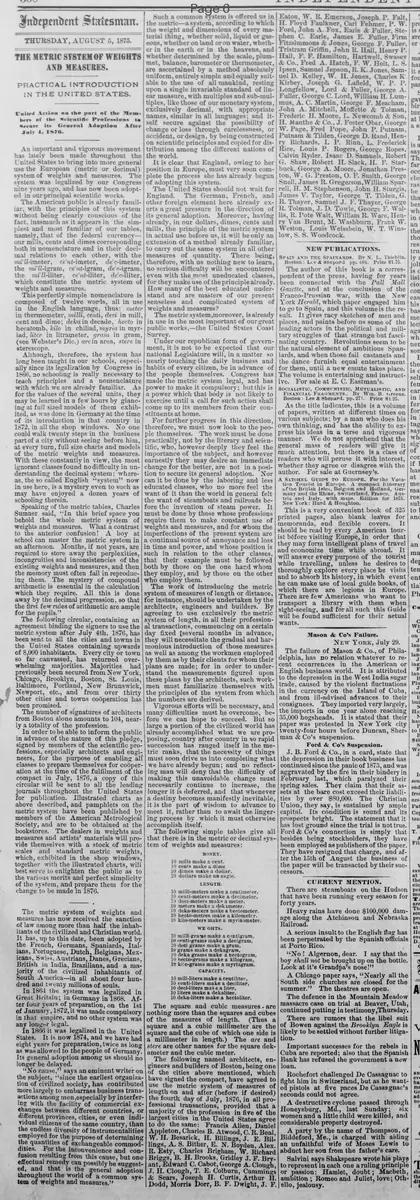
THE METRIC SYSTEM OF WEIGHTS AND MEASURES.
PRACTICAL INTRODUCTION IN THE UNITED STATES.
United Action on the part of the Members of the Scientific Professions to Secure its General Adoption After July 4, 1876.
An important and vigorous movement has lately been made throughout the United States to bring into more general use the European (metric or decimal) system of weights and measures. The system was legalized by our Congress nine years ago, and has now been adopted in our principal scientific works.
The American public is already familiar with the principles of this system without being clearly conscious of the fact, inasmuch as it appears in the simplest and most familiar of our tables, namely, that of the federal currency—our mills, cents and dimes corresponding both in nomenclature and in their decimal relations to each other, with the milli-meter, centi-meter, deci-meter, the milli-gram, centi-gram, deci-gram, the milli-liter, centi-liter, deci-liter, which constitute the metric system of weights and measures.
This perfectly simple nomenclature is composed of twelve words, all in use in the English language, thus: meter in thermometer, milli, centi, deci in mill, cent and dime; deka in decade, hecto in hecatomb, kilo in chiliad, myria in myriad, liter in litrameter, gram in gram. (see Webster's Dic.) are in area, stere in stereoscope.
Although, therefore, the system has long been taught in our schools, especially since its legalization by Congress in 1866, no schooling is really necessary to teach principles and a nomenclature with which we are already familiar. As for the values of the several units, they may be learned in a few hours by glancing at full sized models of them exhibited, as was done in Germany at the time of its introduction in that country in 1872, in all the shop windows. No one could walk twenty steps in the business part of a city without seeing before him, at every turn, full size charts and models of the metric weights and measures.
With these constantly in view, the most ignorant classes found no difficulty in understanding the decimal system; whereas, the so called English "system" now in use here, is a mystery even to such as may have enjoyed a dozen years of schooling therein.
Speaking of the metric tables, Charles Sumner said, "In this brief space you behold the whole metric system of weights and measures. What a contrast to the anterior confusion! A boy at school can master the metric system in an afternoon. Months, if not years, are required to store away the perplexities, incongruities and inconsistencies of the existing weights and measures, and then the memory must often fail in reproducing them. The mystery of compound arithmetic is essential in the calculation which they require. All this is done away by the decimal progression, so that the first few rules of arithmetic are ample for the pupils."
The following circular, containing an agreement binding the signers to use the metric system after July 4th, 1876, has been sent to all the cities and towns in the United States containing upwards of 8,000 inhabitants. Every city or town so far canvassed, has returned overwhelming majorities. Majorities had previously been secured from New York, Chicago, Brooklyn, Boston, St. Louis, Baltimore, Portland, New Brunswick, Newport, etc., and from over thirty other cities and towns co-operation has been promised.
The number of signatures of architects from Boston alone amounts to 104, nearly a totality of the profession.
In order to be able to inform the public in advance of the nature of this pledge, signed by members of the scientific professions, especially architects and engineers, for the purpose of enabling all classes to prepare themselves for co-operation at the time of the fulfilment of the compact in July, 1876, a copy of this circular will be sent to all the leading journals throughout the United States for publication. Illustrated charts as above described, and pamphlets on the metric system have been published by members of the American Metrological Society, and are to be obtained at the bookstores. The dealers in weights and measures and artists' materials will provide themselves with a stock of metric scales and standard metric weights, which, exhibited in the shop windows, together with the illustrated charts, will best serve to enlighten the public as to the various merits and perfect simplicity of the system, and prepare them for the change to be made in 1876.
The metric system of weights and measures has now received the sanction of law among more than half the inhabitants of the civilized and Christian world. It has, up to this date, been adopted by the French, Germans, Spaniards, Italians, Portuguese, Dutch, Belgians, Mexicans, Swiss, Austrians, Danes, Grecians, British in India, Brazilians, and a majority of the civilized inhabitants of South America—in all about four hundred and twenty millions of souls.
In 1864 the system was legalized in Great Britain; in Germany in 1868. After four years of preparation, on the 1st of January, 1872, it was made compulsory in that empire, and no other system was any longer legal.
In 1866 it was legalized in the United States. It is now 1875, and we have had nine years for preparation, twice as long as was allowed to the people of Germany. Its general adoption among us should no longer be delayed.
"No cause," says an eminent writer on the subject, "since the earliest organization of civilized society, has contributed more largely to embarrass business transactions among men, especially by interfering with the facility of commercial exchanges between different countries, or different provinces, cities, or even individual citizens of the same country, than the endless diversity of instrumentalities employed for the purpose of determining the quantities of exchangeable commodities. For the inconvenience and confusion resulting from this cause, but one effectual remedy can possibly be suggested, and that is the general adoption throughout the world of a common system of weights and measures."
Such a common system is offered us in the metric—a system, according to which the weight and dimensions of every material thing, whether solid, liquid or gaseous, whether on land or on water, whether in the earth or in the heavens, and whether determined by the scale, plummet, balance, barometer or thermometer, are ascertained by a method absolutely uniform, entirely simple and equally suitable to the use of all mankind, resting upon a single invariable standard of linear measure, with multiples and sub-multiples, like those of our monetary system, exclusively decimal, with appropriate names, similar in all languages; and itself secure against the possibility of change or loss through carelessness, or accident, or design, by being constructed on scientific principles and copied for distribution among the different nations of the world.
It is clear that England, owing to her position in Europe, must very soon complete the process she has already begun of adopting this system.
The United States should not wait for England. The German, French, and other foreign element here already exerts a great pressure in the direction of its general adoption. Moreover, having already, in our dollars, dimes, cents and mills, the principle of the metric system in actual use before us, it will be only an extension of a method already familiar, to carry out the same system in all other measures of quantity. There being, therefore, with us nothing new to learn, no serious difficulty will be encountered even with the most uneducated classes, for they make use of the principle already.
How many of the best educated understand and are masters of our present senseless and complicated system of weights and measures?
The metric system, moreover, is already in use in the most important of our great public works,—the United States Coast Survey.
Under our republican form of government, it is not to be expected that our national Legislature will, in a matter so nearly touching the daily business and habits of every citizen, be in advance of the people themselves. Congress has made the metric system legal, and has power to make it compulsory: but this is a power which that body is not likely to exercise until a call for such action shall come up to its members from their constituents at home.
For further progress in this direction, therefore, we must now look to the people themselves. The work must be done practically, not by the literary and scientific, who, however deeply they feel the importance of the subject, and however earnestly they may desire an immediate change for the better, are not in a position to secure its general adoption. Nor can it be done by the laboring and less educated classes, who no more feel the want of it than the world in general felt the want of steamboats and railroads before the invention of steam power. It must be done by those whose professions require them to make constant use of weights and measures, and for whom the imperfections of the present system are a continual source of annoyance and loss in time and power, and whose position is such in relation to the other classes, that their example must be followed both by those on the one hand whom they employ, and by those on the other who employ them.
The work of introducing the metric system of measures of length or distance, for instance, should be undertaken by the architects, engineers and builders. By agreeing to use exclusively the metric system of length, in all their professional transactions, commencing on a certain day fixed (several months in advance), they will necessitate the gradual and harmonious introduction of those measures as well as among the workmen employed by them as by their clients for whom their plans are made: for in order to understand the measurements figured upon these plans by the architects, such workmen must familiarize themselves with the principles of the system from which the numbers are derived.
Vigorous efforts will be necessary, and many difficulties must be overcome, before we can hope to succeed. But so large a portion of the civilized world has already accomplished what we are proposing, country after country in so rapid succession has ranged itself in the metric ranks, that the necessity of things must soon drive us into completing what we have already begun; and no reflecting man will deny that the difficulty of making this unavoidable change must necessarily continue to increase, the longer it is deferred, and that whenever a destiny becomes manifestly inevitable, it is the part of wisdom to advance to meet it, rather than to await the lingering process by which it must otherwise accomplish itself.
The following simple tables give all that there is in the metric or decimal system of weights and measures:
MONEY.
10 mills make a cent.
10 cents make a dime
10 dimes make a dollar.
10 dollars make an eagle.
LENGTH.
10 milli-meters make a centimeter.
10 centi-meters make a decimeter.
10 deci-meters make a meter.
10 meters make a dekameter.
10 deka-meters make a hectometer.
10 hecto-metres make a kilometer.
10 kilo-meters make a myriaometer.
WEIGHTS.
10 milli-grams make a centigram
10 centi-grams make a decigram,
10 deci-grams make a gram,
10 grams make a dekagram,
10 deka-grams make a hectogram,
10 hecto-grams make a kilogram,
10 kilo-grams make a myriagram.
CAPACITY.
10 milli-liters make a centiliter,
10 centi-liters make a deciliter,
10 deci-liters make a liter,
10 liters make a dekaliter.
10 deka-liters make a hectoliter.
The square and cubic measures are nothing more than the squares and cubes of the measures of length. (Thus a square and a cubic millimeter are the square and the cube of which one side is a millimeter in length. The are and stere are other names for the square dekameter and the cubic meter.)
The following named architects, engineers and builders of Boston, being one of the cities above mentioned, which have signed the compact, have agreed to use the metric system of measures of length on and after (before if desired) the fourth day of July, 1876, in all professional transactions, provided that a majority of the profession in five of the largest cities in the United States agree to do the same: Francis Allen, Daniel Appleton, Charles B. Atwood, C.R. Beal, W. H. Besarick, H. Billings, J. E. Billings, A. S. Bither, E. N. Boyden, Alex. R. Esty, Charles Brigham, W. Richard Briggs, B. H. Brooks, Gridley J. F. Bryant, Edward C. Cabot, George A. Clough, J. H. Clough, T. E. Colburn, Cummings & Sears, Joseph H. Curtis, Arthur H. Dodd, Morris Dorr, B. F. Dwight, J. F. Eaton, W. R. Emerson, Joseph P. Falt, H. Floyd Faulkner, Carl Fehmer, P. W. Ford, John A. Fox, Earle & Fuller, Stephen C. Earle, James E. Fuller, Firm Fitzsimmons & Jones, George F. Fuller, Tristram Griffin, John R. Hall, Henry P. Hall, F. F. Hamilton, Hartwell, Swasey & Co., Fred A. Hatch, F. W. Holt, L. S. Ipsen, Samuel Jepson, R. K. Jones, Samuel D. Kelley, W. H. Jones, Charles K. Kirby, Joseph G. Lafield, W. P. P. Longfellow, Lord & Fuller, George A. Fuller, George C. Lord, William H. Lummus, A. C. Martin, George F. Meacham, John A. Mitchell, Moffette & Tolman, Frederic H. Moore, L. Newcomb & Son, H. Mauthe & Co., J. Foster Ober, George W. Page, Fred Pope, John P. Putnam, Putnam & Tilden, George D. Rand, Henry Richards, I. P. Rinn, L. Frederick Rice, Louis P. Rogers, George Ropes, Calvin Ryder, Isaac D. Samuels, Robert G. Shaw, Robert H. Slack, H. F. Starbuck, George A. Moore, Jonathan Preston, W. G. Preston, O. F. Smith, George Snell, James R. Gregerson, William Sparrow, H. M. Stephenson, John H. Sturgis, James V. Taylor, George T. Tilden, G. B. Thayer, Samuel J. F. Thayer, George R. Tolman, J. D. Towle, George F. Wallis, R. Pote Wait, William R. Ware, Henry Van Brunt, M. Washburn, Frank W. Weston, Louis Weissbein, W. T. Winslow, S. S. Woodcock.
PRACTICAL INTRODUCTION IN THE UNITED STATES.
United Action on the part of the Members of the Scientific Professions to Secure its General Adoption After July 4, 1876.
An important and vigorous movement has lately been made throughout the United States to bring into more general use the European (metric or decimal) system of weights and measures. The system was legalized by our Congress nine years ago, and has now been adopted in our principal scientific works.
The American public is already familiar with the principles of this system without being clearly conscious of the fact, inasmuch as it appears in the simplest and most familiar of our tables, namely, that of the federal currency—our mills, cents and dimes corresponding both in nomenclature and in their decimal relations to each other, with the milli-meter, centi-meter, deci-meter, the milli-gram, centi-gram, deci-gram, the milli-liter, centi-liter, deci-liter, which constitute the metric system of weights and measures.
This perfectly simple nomenclature is composed of twelve words, all in use in the English language, thus: meter in thermometer, milli, centi, deci in mill, cent and dime; deka in decade, hecto in hecatomb, kilo in chiliad, myria in myriad, liter in litrameter, gram in gram. (see Webster's Dic.) are in area, stere in stereoscope.
Although, therefore, the system has long been taught in our schools, especially since its legalization by Congress in 1866, no schooling is really necessary to teach principles and a nomenclature with which we are already familiar. As for the values of the several units, they may be learned in a few hours by glancing at full sized models of them exhibited, as was done in Germany at the time of its introduction in that country in 1872, in all the shop windows. No one could walk twenty steps in the business part of a city without seeing before him, at every turn, full size charts and models of the metric weights and measures.
With these constantly in view, the most ignorant classes found no difficulty in understanding the decimal system; whereas, the so called English "system" now in use here, is a mystery even to such as may have enjoyed a dozen years of schooling therein.
Speaking of the metric tables, Charles Sumner said, "In this brief space you behold the whole metric system of weights and measures. What a contrast to the anterior confusion! A boy at school can master the metric system in an afternoon. Months, if not years, are required to store away the perplexities, incongruities and inconsistencies of the existing weights and measures, and then the memory must often fail in reproducing them. The mystery of compound arithmetic is essential in the calculation which they require. All this is done away by the decimal progression, so that the first few rules of arithmetic are ample for the pupils."
The following circular, containing an agreement binding the signers to use the metric system after July 4th, 1876, has been sent to all the cities and towns in the United States containing upwards of 8,000 inhabitants. Every city or town so far canvassed, has returned overwhelming majorities. Majorities had previously been secured from New York, Chicago, Brooklyn, Boston, St. Louis, Baltimore, Portland, New Brunswick, Newport, etc., and from over thirty other cities and towns co-operation has been promised.
The number of signatures of architects from Boston alone amounts to 104, nearly a totality of the profession.
In order to be able to inform the public in advance of the nature of this pledge, signed by members of the scientific professions, especially architects and engineers, for the purpose of enabling all classes to prepare themselves for co-operation at the time of the fulfilment of the compact in July, 1876, a copy of this circular will be sent to all the leading journals throughout the United States for publication. Illustrated charts as above described, and pamphlets on the metric system have been published by members of the American Metrological Society, and are to be obtained at the bookstores. The dealers in weights and measures and artists' materials will provide themselves with a stock of metric scales and standard metric weights, which, exhibited in the shop windows, together with the illustrated charts, will best serve to enlighten the public as to the various merits and perfect simplicity of the system, and prepare them for the change to be made in 1876.
The metric system of weights and measures has now received the sanction of law among more than half the inhabitants of the civilized and Christian world. It has, up to this date, been adopted by the French, Germans, Spaniards, Italians, Portuguese, Dutch, Belgians, Mexicans, Swiss, Austrians, Danes, Grecians, British in India, Brazilians, and a majority of the civilized inhabitants of South America—in all about four hundred and twenty millions of souls.
In 1864 the system was legalized in Great Britain; in Germany in 1868. After four years of preparation, on the 1st of January, 1872, it was made compulsory in that empire, and no other system was any longer legal.
In 1866 it was legalized in the United States. It is now 1875, and we have had nine years for preparation, twice as long as was allowed to the people of Germany. Its general adoption among us should no longer be delayed.
"No cause," says an eminent writer on the subject, "since the earliest organization of civilized society, has contributed more largely to embarrass business transactions among men, especially by interfering with the facility of commercial exchanges between different countries, or different provinces, cities, or even individual citizens of the same country, than the endless diversity of instrumentalities employed for the purpose of determining the quantities of exchangeable commodities. For the inconvenience and confusion resulting from this cause, but one effectual remedy can possibly be suggested, and that is the general adoption throughout the world of a common system of weights and measures."
Such a common system is offered us in the metric—a system, according to which the weight and dimensions of every material thing, whether solid, liquid or gaseous, whether on land or on water, whether in the earth or in the heavens, and whether determined by the scale, plummet, balance, barometer or thermometer, are ascertained by a method absolutely uniform, entirely simple and equally suitable to the use of all mankind, resting upon a single invariable standard of linear measure, with multiples and sub-multiples, like those of our monetary system, exclusively decimal, with appropriate names, similar in all languages; and itself secure against the possibility of change or loss through carelessness, or accident, or design, by being constructed on scientific principles and copied for distribution among the different nations of the world.
It is clear that England, owing to her position in Europe, must very soon complete the process she has already begun of adopting this system.
The United States should not wait for England. The German, French, and other foreign element here already exerts a great pressure in the direction of its general adoption. Moreover, having already, in our dollars, dimes, cents and mills, the principle of the metric system in actual use before us, it will be only an extension of a method already familiar, to carry out the same system in all other measures of quantity. There being, therefore, with us nothing new to learn, no serious difficulty will be encountered even with the most uneducated classes, for they make use of the principle already.
How many of the best educated understand and are masters of our present senseless and complicated system of weights and measures?
The metric system, moreover, is already in use in the most important of our great public works,—the United States Coast Survey.
Under our republican form of government, it is not to be expected that our national Legislature will, in a matter so nearly touching the daily business and habits of every citizen, be in advance of the people themselves. Congress has made the metric system legal, and has power to make it compulsory: but this is a power which that body is not likely to exercise until a call for such action shall come up to its members from their constituents at home.
For further progress in this direction, therefore, we must now look to the people themselves. The work must be done practically, not by the literary and scientific, who, however deeply they feel the importance of the subject, and however earnestly they may desire an immediate change for the better, are not in a position to secure its general adoption. Nor can it be done by the laboring and less educated classes, who no more feel the want of it than the world in general felt the want of steamboats and railroads before the invention of steam power. It must be done by those whose professions require them to make constant use of weights and measures, and for whom the imperfections of the present system are a continual source of annoyance and loss in time and power, and whose position is such in relation to the other classes, that their example must be followed both by those on the one hand whom they employ, and by those on the other who employ them.
The work of introducing the metric system of measures of length or distance, for instance, should be undertaken by the architects, engineers and builders. By agreeing to use exclusively the metric system of length, in all their professional transactions, commencing on a certain day fixed (several months in advance), they will necessitate the gradual and harmonious introduction of those measures as well as among the workmen employed by them as by their clients for whom their plans are made: for in order to understand the measurements figured upon these plans by the architects, such workmen must familiarize themselves with the principles of the system from which the numbers are derived.
Vigorous efforts will be necessary, and many difficulties must be overcome, before we can hope to succeed. But so large a portion of the civilized world has already accomplished what we are proposing, country after country in so rapid succession has ranged itself in the metric ranks, that the necessity of things must soon drive us into completing what we have already begun; and no reflecting man will deny that the difficulty of making this unavoidable change must necessarily continue to increase, the longer it is deferred, and that whenever a destiny becomes manifestly inevitable, it is the part of wisdom to advance to meet it, rather than to await the lingering process by which it must otherwise accomplish itself.
The following simple tables give all that there is in the metric or decimal system of weights and measures:
MONEY.
10 mills make a cent.
10 cents make a dime
10 dimes make a dollar.
10 dollars make an eagle.
LENGTH.
10 milli-meters make a centimeter.
10 centi-meters make a decimeter.
10 deci-meters make a meter.
10 meters make a dekameter.
10 deka-meters make a hectometer.
10 hecto-metres make a kilometer.
10 kilo-meters make a myriaometer.
WEIGHTS.
10 milli-grams make a centigram
10 centi-grams make a decigram,
10 deci-grams make a gram,
10 grams make a dekagram,
10 deka-grams make a hectogram,
10 hecto-grams make a kilogram,
10 kilo-grams make a myriagram.
CAPACITY.
10 milli-liters make a centiliter,
10 centi-liters make a deciliter,
10 deci-liters make a liter,
10 liters make a dekaliter.
10 deka-liters make a hectoliter.
The square and cubic measures are nothing more than the squares and cubes of the measures of length. (Thus a square and a cubic millimeter are the square and the cube of which one side is a millimeter in length. The are and stere are other names for the square dekameter and the cubic meter.)
The following named architects, engineers and builders of Boston, being one of the cities above mentioned, which have signed the compact, have agreed to use the metric system of measures of length on and after (before if desired) the fourth day of July, 1876, in all professional transactions, provided that a majority of the profession in five of the largest cities in the United States agree to do the same: Francis Allen, Daniel Appleton, Charles B. Atwood, C.R. Beal, W. H. Besarick, H. Billings, J. E. Billings, A. S. Bither, E. N. Boyden, Alex. R. Esty, Charles Brigham, W. Richard Briggs, B. H. Brooks, Gridley J. F. Bryant, Edward C. Cabot, George A. Clough, J. H. Clough, T. E. Colburn, Cummings & Sears, Joseph H. Curtis, Arthur H. Dodd, Morris Dorr, B. F. Dwight, J. F. Eaton, W. R. Emerson, Joseph P. Falt, H. Floyd Faulkner, Carl Fehmer, P. W. Ford, John A. Fox, Earle & Fuller, Stephen C. Earle, James E. Fuller, Firm Fitzsimmons & Jones, George F. Fuller, Tristram Griffin, John R. Hall, Henry P. Hall, F. F. Hamilton, Hartwell, Swasey & Co., Fred A. Hatch, F. W. Holt, L. S. Ipsen, Samuel Jepson, R. K. Jones, Samuel D. Kelley, W. H. Jones, Charles K. Kirby, Joseph G. Lafield, W. P. P. Longfellow, Lord & Fuller, George A. Fuller, George C. Lord, William H. Lummus, A. C. Martin, George F. Meacham, John A. Mitchell, Moffette & Tolman, Frederic H. Moore, L. Newcomb & Son, H. Mauthe & Co., J. Foster Ober, George W. Page, Fred Pope, John P. Putnam, Putnam & Tilden, George D. Rand, Henry Richards, I. P. Rinn, L. Frederick Rice, Louis P. Rogers, George Ropes, Calvin Ryder, Isaac D. Samuels, Robert G. Shaw, Robert H. Slack, H. F. Starbuck, George A. Moore, Jonathan Preston, W. G. Preston, O. F. Smith, George Snell, James R. Gregerson, William Sparrow, H. M. Stephenson, John H. Sturgis, James V. Taylor, George T. Tilden, G. B. Thayer, Samuel J. F. Thayer, George R. Tolman, J. D. Towle, George F. Wallis, R. Pote Wait, William R. Ware, Henry Van Brunt, M. Washburn, Frank W. Weston, Louis Weissbein, W. T. Winslow, S. S. Woodcock.
What sub-type of article is it?
Historical Event
Curiosity
What themes does it cover?
Triumph
Justice
Moral Virtue
What keywords are associated?
Metric System
Adoption
United States
1876
Scientific Professions
Architects
Decimal Measures
Charles Sumner
What entities or persons were involved?
Charles Sumner
Francis Allen
Daniel Appleton
Charles B. Atwood
Gridley J. F. Bryant
Edward C. Cabot
William R. Ware
Henry Van Brunt
Where did it happen?
United States
Story Details
Key Persons
Charles Sumner
Francis Allen
Daniel Appleton
Charles B. Atwood
Gridley J. F. Bryant
Edward C. Cabot
William R. Ware
Henry Van Brunt
Location
United States
Event Date
After July 4, 1876
Story Details
Movement by scientific professionals, especially architects and engineers, to adopt the metric system in professional transactions starting July 4, 1876, following its legalization in 1866. Includes quotes from Charles Sumner, international adoption examples, and lists of metric tables and Boston signatories.