Thank you for visiting SNEWPapers!
Sign up free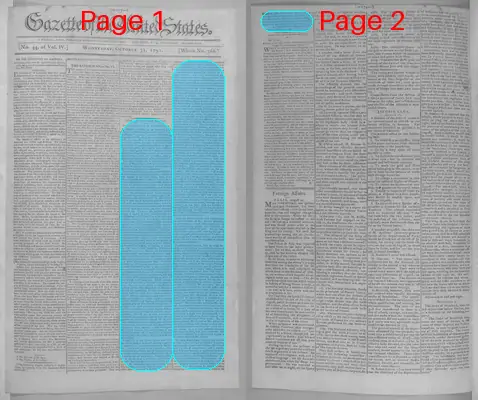
Gazette Of The United States
New York, New York County, New York
What is this article about?
An editorial from Annapolis, October 19, 1792, defends Vice President John Adams against anti-federalist attacks, praises his patriotic services in diplomacy and support for the U.S. Constitution, and warns against replacing him with Charles Carroll of Carrollton, arguing it would aid opponents of the government.
Merged-components note: Continuation of the same editorial defending Mr. Adams against replacement as Vice-President, split across pages with sequential reading order.
Clippings
1 of 2
OCR Quality
Full Text
TO THE PEOPLE OF MARYLAND.
PUBLICATION, in the Maryland Journal and Baltimore Advertiser, of last Tuesday, signed "A Citizen," contains the following paragraph: "We all, as men of gratitude, are, I doubt not, interested in the re-appointment of the present worthy President; but as men, who have a sense of equality and a disgust of supercilious superiority, are, I am in hopes, linked as a strong chain against the Vice-President. In fact, taking such for granted, permit me to recommend Charles Carroll, of Carrollton, Esq. as meriting the appointment of Vice-President."
To a recommendation so pointed and unexpected, in Maryland, as that to turn out the Vice-President, it may not be thought unseasonable to offer a few remarks for consideration.
I observe, my fellow-citizens, in the first place, that those men in the several states, who have been opposed to our constitution, have, ever since its establishment, incessantly applied themselves to depreciate the character of Mr. ADAMS; because his abilities and principles were formidable to their views and ambition; and because to prevent his re-election would be a point gained over the constitution itself. Little sagacity is requisite to perceive, that every man of ability, who can be turned out of the administration, or kept out of Congress, adds strength to their cause and vigour to their hopes; and that against the most eminent of those their heaviest batteries have been raised, and their principal mines sprung. To prove the justice of this charge, I appeal to your recollection for the miscellaneous publications you have read, and travelling whispers you have heard, calculated to destroy the well-earned fame of Mr. ADAMS. Some of you are also acquainted with what virulence an anti-government faction have treated a HAMILTON, whose attachment to the constitution is unquestionable, and whose virtue and integrity are equaled only by his great capacity and extraordinary powers. From the master-workman in this craft, down to the meanest of his laborers, each in his way, or in his district, has something to object, to surmise, to insinuate, that may irritate sensibility, and lead to resignation; or that, floating on the popular gale, may infect that general esteem and confidence he possesses, which no patriot has ever acquired with greater purity of conduct, or held by a more unexceptionable title. From the same quarter also you see sometimes to descend, upon the President himself, a thin and subtle mist, which would soon increase to the solidity of absolute censure, was not the radiance of the character too powerful to be obscured, and the veneration of the people too strong to bear an open attack with impunity. These circumstances are notorious; they are to be found in print; they are in the mouth of almost every antifederal from New-Hampshire to Georgia; they are the ingredients of their incantations, and the spells by which they would transform our best patriots into our greatest enemies!—These circumstances, taken together, prove, beyond a possibility of doubt, a systematic and organized plan to drive from the administration of our affairs all those who have rescued us from anarchy, and restored us to the dignity of men, and the various advantages of an efficient government. It will not be said, that known friends to the constitution and the laws are engaged in the combination against Mr. Adams. I deny that any such are engaged, and call upon the opposition to name a single individual of that description, save, perhaps, a few who know Mr. Adams through the medium only of the misrepresentations of his enemies; a delusion which, in men of candour, must yield to better information.
I observe, in the second place, that Mr. Adams has been as firm and uniform a patriot as America can boast to have reared in her bosom. In the first years of our revolution, when the colonies stood alone against Great Britain, he acted a bold and distinguished part in favor of the liberties of the people. Congress, sensible of his merit as a politician and patriot, created him Minister to the United Netherlands. His celebrated memorial to their High Mightinesses, the large loans of money he procured under the eye of a British Ambassador, and their treaty with us and acknowledgment of our independence, which cost the capture of St. Eustatius and a war with England, form a pyramid of services far more interesting to mankind than those built of stone by the Kings of Egypt. View him next as joint Minister to the court of France, and you see him conspicuously eminent for watchfulness, industry and talents, especially in negotiating and bringing to a close the treaty of peace with England, which gained from her commissioners a greater extent of territory for the United States, than had ever entered into the mind of the most sanguine American to expect. Having finished these high trusts, he was appointed Minister to the court of London, where, finding that he could not induce them to listen to a commercial treaty, on terms of equal privileges, like an honest citizen, true to the dignity and interests of his country, he requested of Congress leave to return; previous to which, he suggested measures, since adopted by our government, that have drawn from England a Minister, to treat formally here of subjects she would not there condescend to discuss. The knowledge he acquired, in these several missions, of the interests and views of the courts of Europe, fit him in a peculiar manner to fill, to the greatest advantage, the station he now occupies, where these interests and views, as they respect the United States, come so often under deliberation. To these facts may be added, that in his letters from England, and on his return to America, he expressed not an equivocal, but decided, approbation of the constitution of the United States; and that in his writings he is liberal in praise of those state-constitutions formed like ours with checks and branches, and divisions of power; those real barriers against encroachments upon liberty, hasty projects, and dangerous ebullitions of popular bodies. Take for example his introduction to Abbé de Mably's observations on the government and laws of America. "If human wisdom (says Mr. Adams) can ensure the duration of these only forms of government which are consistent with the dignity of human nature, the American constitutions bid fair to be lasting; nor can any thing, except an excessive partiality to the ancients, prevent our discerning their infinite superiority to the boasted republics of Sparta and Rome." Again, "it is possible that some few additional regulations, arising from local and other accidental circumstances, might be made with advantage; but of the exact propriety of these, it is impossible for any to judge, who are not immediately on the spot: And the principles of these constitutions are so obviously excellent, that every one who understands the nature, and loves the enjoyment of liberty, will acknowledge them to surpass every thing the world has hitherto seen."
Such, my fellow-citizens and countrymen, are the Sentiments of Mr. ADAMS respecting our governments, where reign superiority of rights with personal equality, and distinction of office without nobility of birth. Where, then, would be American gratitude, were the friends of order and good government to be "linked as a strong chain against him," whose principles, or political creed, is no more than the expression or picture of our own constitution?
I would further remark, that to bring forward, at this late hour (unconsulted too) one of the best and worthiest of our citizens as his competitor, wears rather a doubtful and invidious aspect. Is it done, it may be asked, in order to deprive Mr. ADAMS of ten votes, and thereby defeat his election; or from a sincere desire to have Mr. Carroll elected? If the latter, "Citizen" ought to be convinced himself, and be possessed of facts to convince others, that a sufficient number of electors, in the different states, will vote to place Mr. Carroll in the Vice-President's chair; for on no other ground could any rational Marylander hazard a vote against Mr. Adams, or venture to risk losing his election without a certainty of carrying Mr. Carroll's. But can any of you think it likely, or even possible, that the antifederalists of New-York, Pennsylvania, Virginia, &c. would desert, for example, Governor Clinton, their favourite, to give their votes for so distinguished, so decided, so unshaken and incorruptible a federalist as Mr. Carroll? To change Mr. Adams for Mr. Carroll, would neither promote their views nor increase their numbers in the Senate; who then among you so credulous as to imagine that they would give a single vote to accomplish it? Whoever can believe so, knows little of their temper, and still less of their tricks. No, my fellow-citizens, Mr. Carroll or Mr. Adams suit not their purposes, and are not to their taste: nor will they ever vote for either with a view to their election. It is a very different character they mean to carry, and your esteem for Mr. Carroll is used only as a convenient engine to withdraw you from Mr. Adams.
To these observations I think I may venture to subjoin, that it is not to disgrace a worthy and patriotic citizen that will draw Mr. Carroll into the lists of competition; and to predict, that if he ever becomes a candidate for continental favour, his merit and high qualifications will raise him to a more dignified station. But who can look forward to that moment, when we shall stand in need of all his merits and all our courage; when the United States will be convulsed to their centre by embryo Caesars, struggling for empire, and scarcely stayed by the Friends of order and virtue: Who, I say, can anticipate that solemn crisis, of which this is only the prelude, without devoutly wishing to the present beloved Incumbent the years of the Patriarchs who lived before the flood?
A CONSISTENT FEDERALIST.
Annapolis, October 19, 1792.
What sub-type of article is it?
What keywords are associated?
What entities or persons were involved?
Editorial Details
Primary Topic
Defense Of John Adams For Re Election As Vice President
Stance / Tone
Strongly Pro Federalist And Pro Adams
Key Figures
Key Arguments