Thank you for visiting SNEWPapers!
Sign up free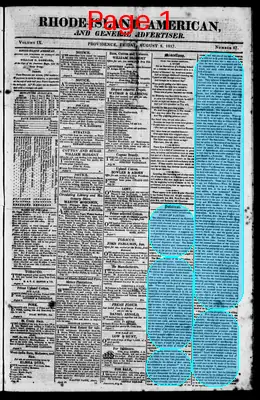
Editorial
August 8, 1817
The Rhode Island American, And General Advertiser
Providence, Providence County, Rhode Island
What is this article about?
Editorial from Albany Daily Advertiser refutes Republican claims that Federalists failed to support War of 1812, emphasizing their principled opposition but active military defense, citing Federalist heroes in battles like Queenstown and Plattsburgh.
Merged-components note: Sequential components form a single continuous political editorial on the union of parties.
Clipping
OCR Quality
95%
Excellent
Full Text
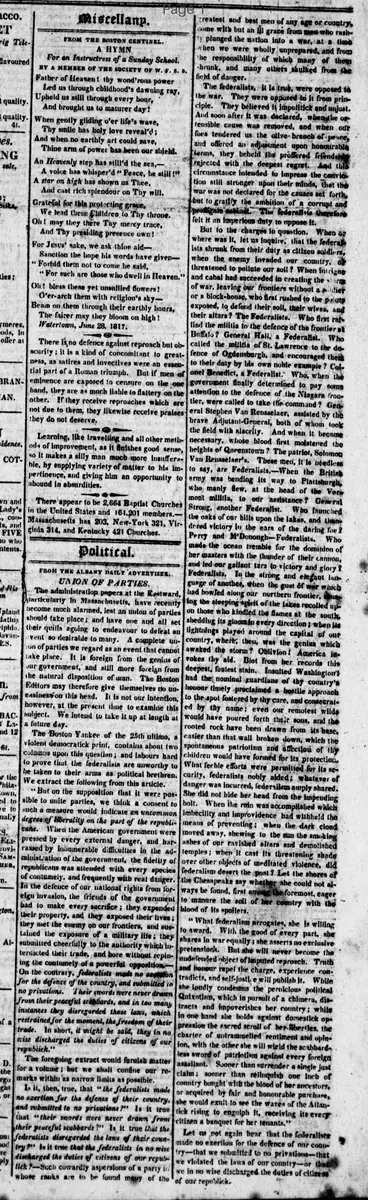
Political.
FROM THE ALBANY DAILY ADVERTISER.
UNION OF PARTIES
The administration papers at the Eastward,
particularly in Massachusetts, have recently
become much alarmed, lest an union of parties
should take place; and have one and all set
their quills agoing to endeavour to defeat an
event so desirable to many. A complete un-
ion of parties we regard as an event that cannot
take place. It is foreign from the genius of
our government, and still more foreign from
the natural disposition of man. The Boston
Editors may therefore give themselves to un-
easiness on this head. It is not our intention,
however, at the present time to examine this
subject. We intend to take it up at length at
a future day.
The Boston Yankee of the 25th ultimo, a
violent democratical print, contains about two
columns upon this question; and labours hard
to prove that the federalists are unworthy to
be taken to their arms as political brethren.
We extract the following from this article.
"But on the supposition that it were pos-
sible to unite parties, we think a consent to
such a measure would indicate an uncommon
degree of liberality on the part of the republi-
cans. When the American government were
pressed by every external danger. and bar-
rassed by innumerable difficulties in the ad-
ministr ation of the government, the fidelity of
republicans was attended with every species
of contumely. and frequently with real danger.
In the defence of our national rights from for-
eign invasion, the friends of the government
had to make every sacrifice; they expended
their property, and they exposed their lives;
they met the enemy on our frontiers, and sus-
tained the exposure of a military life; they
submitted cheerfully to the authority which in-
terdicted their trade. and bore without repin-
ing the contumely of a powerful opposition--
On the contrary, federalists made no exertion
for the defence of the country, and submitted to
no privations. Their swords were never drawn
from their peaceful scabbards, and in too many
instances they disregarded those laws, which
restrained for the moment, the freedom of their
trade. In short, it might be said, they in no
wise discharged the duties of citizens of our
republick."
"What federalism arrogates, she is willing
to award. With the good of every part, she
shares in war equally; she asserts no exclusive
pretension. But she will never become the
undefended object of imputed reproach. Truth
and honour repel the charge, experience con-
tradicts, and self-justice will publish it. While
she loudly condemns the pernicious political
Quixotism, which in pursuit of a chimera, dis-
tracts and impoverishes her country; while
in one hand she holds against domestic op-
pression the sacred scroll of her liberties, the
charter of untrammelled sentiment and opin-
ion, with the other she will wield the scabbard-
less sword of patriotism against every foreign
assailant. Sooner than surrender a single just
claim; sooner than relinquish one inch of
country bought'with the blood of her ancestors,
or acquired by fair and honourable purchase,
she would exult-to see the waves of the Atlan-
tick rising to engulph it, receiving its every
citizen a banquet for her tenants."
Let us not again hear that the federalists
made no exertion for the defence of our coun-
try--that we submitted to no privations-that
we violated the laws of our country-or that
we in no wise discharged the duties of citizens
of our republick.
The foregoing extract would furnish matter
for a volume; but we shall confine our re-
marks within as narrow limits as possible.
Is it, then, true, that "the federalists made
no exertion for the defence of their country.
and submitted to no privations?" Is it true
that "their swords were never drawn from
their peaceful scabbards?" Is it true that the
federalists disregarded the laws of their coun-
try?" Is it true that the federalists in no wise
discharged the duties of citizens of our repub-
lic? -Such cowardly aspersions of a party in
whose ranks are to be found many of the
greatest and best men of any age or country.
come with but an ill grace from men who rash-
ly plunged the nation into'a war, at a time
when we were wholly unprepared, and from
the responsibility of which many of them
shrunk, and many others skulked from the
field of danger.
The federalists, it is true, were opposed to
the war. They were opposed to it from prin-
ciple. They believed it impolitic and unjust.
And soon after it was declared, when the os
tensible cause was removed, and when .our
o es tendered us the olive-branch of peace
and offered an adjustment upon honourable
terms, they beheld the proffered friendship
rejected with the deepest regret. And this
circumstance tended to impress the convic-
tion still stronger upon their minds, that the
war was not declared for the causes set forth
but to gratify the ambition of a corrupt and
profligate cabinet. The federalists therefore
felt it an imperious duty to oppose it.
But to the charges in question. When or
where was it, let us inquire, that the federal
ists shrunk from their duty as citizen soldiers,
when the enemy invaded our country, or
threatened to pollute our soil? When intrigue
and cabal had succeeded in creating the storm
of war. leaving our frontiers without a soldier
or a block-house, who first rushed to the points
exposed, to defend their soil, their wives, and
their altars? The Federalists. Who first ral-
lied the militia to the defence of the frontier at
Buffalo? General Hall, a Federalist. Who
called the militia of St. Lawrence to the de-
fence of Ogdensburgh, and encouraged them
to their duty by his own noble example? Col-
onel Benedict, a Federalist." Who, when the
government finally determined to pay some
attention to the defence of the Niagara fron-
tier, were called to take the command? Gen
eral Stephen Van Rensselaer, assisted by the
brave Adjutant-General, both of whom took
the field with alacrity. And when it became
necessary. whose blood first moistened the
heights of Queenstown? The patriot, Solomon
Van Rensselaer's. These men, it is needless
to say, are Federalists.-When the British
army was bending its way to Plattsburgh,
who manfully flew, at the head of the Ver-
mont militia, to our assistance? General
Strong.another Federalist. Who launched
the oaks of our hills upon the lakes, and thun-
dered victory in the ears of the daring foe?
Perry and M'Donough--Federalists. Who
made the ocean tremble for the dominion of
her wasters with the thunder of their cannon,
and led our gallant tars to victory and glory?
Federalists, In the strong and elegant lan-
guage of another, when the gust of war which
had howled along our northern frontier, bus-
ing the sleeping spirits of the lakes recoiled un-
on those who kindled the flames at the south.
shedding its gloom to every direction ; when its
lightnings played around the capital of our
country, where.then, was the Genius which
awaked the storm? Oblivion! America in-
vokes thy' aid. Blot from her records this
deepest, foulest stain. Insulted Washington
had the nominal guardians of thy country's
honour timely proclaimed a hostile approach
to the spot offered by thy care, and consecrat-
ed by thy name; "even our remotest wilds
would have poured forth their sons, and the
rooted rock have been drawn from its base,
easier than that wall broken down, which the
spontaneous patriotism and affection of thy
children would have formed for its protection.
What feeble efforts were permitted or its se-
curity. federalists nobly aided; whatever of
danger was incurred, federalism amply shared.
She did not hide her head from the impending
bolt. When the ruin was accomplished which
imbecility and improvidence had withheld the
means of preventing; when the dark cloud
moved away, shewing to the sun the smoking
ashes of our ravished altars and demolished
temples; when it cast its threatening shade
over other objects of meditated violence, did
federalism desert the post? Let the shores of
the Chesapeake say whether she could not al-
ways be found, first among the foremost, eager
to manure the soil of her country with the
blood of its spoilers.
FROM THE ALBANY DAILY ADVERTISER.
UNION OF PARTIES
The administration papers at the Eastward,
particularly in Massachusetts, have recently
become much alarmed, lest an union of parties
should take place; and have one and all set
their quills agoing to endeavour to defeat an
event so desirable to many. A complete un-
ion of parties we regard as an event that cannot
take place. It is foreign from the genius of
our government, and still more foreign from
the natural disposition of man. The Boston
Editors may therefore give themselves to un-
easiness on this head. It is not our intention,
however, at the present time to examine this
subject. We intend to take it up at length at
a future day.
The Boston Yankee of the 25th ultimo, a
violent democratical print, contains about two
columns upon this question; and labours hard
to prove that the federalists are unworthy to
be taken to their arms as political brethren.
We extract the following from this article.
"But on the supposition that it were pos-
sible to unite parties, we think a consent to
such a measure would indicate an uncommon
degree of liberality on the part of the republi-
cans. When the American government were
pressed by every external danger. and bar-
rassed by innumerable difficulties in the ad-
ministr ation of the government, the fidelity of
republicans was attended with every species
of contumely. and frequently with real danger.
In the defence of our national rights from for-
eign invasion, the friends of the government
had to make every sacrifice; they expended
their property, and they exposed their lives;
they met the enemy on our frontiers, and sus-
tained the exposure of a military life; they
submitted cheerfully to the authority which in-
terdicted their trade. and bore without repin-
ing the contumely of a powerful opposition--
On the contrary, federalists made no exertion
for the defence of the country, and submitted to
no privations. Their swords were never drawn
from their peaceful scabbards, and in too many
instances they disregarded those laws, which
restrained for the moment, the freedom of their
trade. In short, it might be said, they in no
wise discharged the duties of citizens of our
republick."
"What federalism arrogates, she is willing
to award. With the good of every part, she
shares in war equally; she asserts no exclusive
pretension. But she will never become the
undefended object of imputed reproach. Truth
and honour repel the charge, experience con-
tradicts, and self-justice will publish it. While
she loudly condemns the pernicious political
Quixotism, which in pursuit of a chimera, dis-
tracts and impoverishes her country; while
in one hand she holds against domestic op-
pression the sacred scroll of her liberties, the
charter of untrammelled sentiment and opin-
ion, with the other she will wield the scabbard-
less sword of patriotism against every foreign
assailant. Sooner than surrender a single just
claim; sooner than relinquish one inch of
country bought'with the blood of her ancestors,
or acquired by fair and honourable purchase,
she would exult-to see the waves of the Atlan-
tick rising to engulph it, receiving its every
citizen a banquet for her tenants."
Let us not again hear that the federalists
made no exertion for the defence of our coun-
try--that we submitted to no privations-that
we violated the laws of our country-or that
we in no wise discharged the duties of citizens
of our republick.
The foregoing extract would furnish matter
for a volume; but we shall confine our re-
marks within as narrow limits as possible.
Is it, then, true, that "the federalists made
no exertion for the defence of their country.
and submitted to no privations?" Is it true
that "their swords were never drawn from
their peaceful scabbards?" Is it true that the
federalists disregarded the laws of their coun-
try?" Is it true that the federalists in no wise
discharged the duties of citizens of our repub-
lic? -Such cowardly aspersions of a party in
whose ranks are to be found many of the
greatest and best men of any age or country.
come with but an ill grace from men who rash-
ly plunged the nation into'a war, at a time
when we were wholly unprepared, and from
the responsibility of which many of them
shrunk, and many others skulked from the
field of danger.
The federalists, it is true, were opposed to
the war. They were opposed to it from prin-
ciple. They believed it impolitic and unjust.
And soon after it was declared, when the os
tensible cause was removed, and when .our
o es tendered us the olive-branch of peace
and offered an adjustment upon honourable
terms, they beheld the proffered friendship
rejected with the deepest regret. And this
circumstance tended to impress the convic-
tion still stronger upon their minds, that the
war was not declared for the causes set forth
but to gratify the ambition of a corrupt and
profligate cabinet. The federalists therefore
felt it an imperious duty to oppose it.
But to the charges in question. When or
where was it, let us inquire, that the federal
ists shrunk from their duty as citizen soldiers,
when the enemy invaded our country, or
threatened to pollute our soil? When intrigue
and cabal had succeeded in creating the storm
of war. leaving our frontiers without a soldier
or a block-house, who first rushed to the points
exposed, to defend their soil, their wives, and
their altars? The Federalists. Who first ral-
lied the militia to the defence of the frontier at
Buffalo? General Hall, a Federalist. Who
called the militia of St. Lawrence to the de-
fence of Ogdensburgh, and encouraged them
to their duty by his own noble example? Col-
onel Benedict, a Federalist." Who, when the
government finally determined to pay some
attention to the defence of the Niagara fron-
tier, were called to take the command? Gen
eral Stephen Van Rensselaer, assisted by the
brave Adjutant-General, both of whom took
the field with alacrity. And when it became
necessary. whose blood first moistened the
heights of Queenstown? The patriot, Solomon
Van Rensselaer's. These men, it is needless
to say, are Federalists.-When the British
army was bending its way to Plattsburgh,
who manfully flew, at the head of the Ver-
mont militia, to our assistance? General
Strong.another Federalist. Who launched
the oaks of our hills upon the lakes, and thun-
dered victory in the ears of the daring foe?
Perry and M'Donough--Federalists. Who
made the ocean tremble for the dominion of
her wasters with the thunder of their cannon,
and led our gallant tars to victory and glory?
Federalists, In the strong and elegant lan-
guage of another, when the gust of war which
had howled along our northern frontier, bus-
ing the sleeping spirits of the lakes recoiled un-
on those who kindled the flames at the south.
shedding its gloom to every direction ; when its
lightnings played around the capital of our
country, where.then, was the Genius which
awaked the storm? Oblivion! America in-
vokes thy' aid. Blot from her records this
deepest, foulest stain. Insulted Washington
had the nominal guardians of thy country's
honour timely proclaimed a hostile approach
to the spot offered by thy care, and consecrat-
ed by thy name; "even our remotest wilds
would have poured forth their sons, and the
rooted rock have been drawn from its base,
easier than that wall broken down, which the
spontaneous patriotism and affection of thy
children would have formed for its protection.
What feeble efforts were permitted or its se-
curity. federalists nobly aided; whatever of
danger was incurred, federalism amply shared.
She did not hide her head from the impending
bolt. When the ruin was accomplished which
imbecility and improvidence had withheld the
means of preventing; when the dark cloud
moved away, shewing to the sun the smoking
ashes of our ravished altars and demolished
temples; when it cast its threatening shade
over other objects of meditated violence, did
federalism desert the post? Let the shores of
the Chesapeake say whether she could not al-
ways be found, first among the foremost, eager
to manure the soil of her country with the
blood of its spoilers.
What sub-type of article is it?
Partisan Politics
War Or Peace
Military Affairs
What keywords are associated?
Federalists
War Of 1812
Partisan Union
Patriotism
Defense
Niagara Frontier
Plattsburgh
Queenstown
What entities or persons were involved?
Federalists
Republicans
Boston Yankee
General Hall
Colonel Benedict
General Stephen Van Rensselaer
Solomon Van Rensselaer
General Strong
Perry
M'donough
Washington
Editorial Details
Primary Topic
Defense Of Federalists Patriotism In War Of 1812
Stance / Tone
Strongly Pro Federalist Defending Patriotism
Key Figures
Federalists
Republicans
Boston Yankee
General Hall
Colonel Benedict
General Stephen Van Rensselaer
Solomon Van Rensselaer
General Strong
Perry
M'donough
Washington
Key Arguments
Federalists Opposed War On Principle But Defended Country When Invaded
Federalists Made Exertions And Sacrifices In Defense
Specific Federalist Leaders Rallied Militia And Fought In Key Battles Like Queenstown, Plattsburgh, Niagara
Republicans Plunged Nation Into Unprepared War
Federalists Did Not Shirk Duties As Citizens