Thank you for visiting SNEWPapers!
Sign up free
The Silver State
Unionville, Winnemucca, Humboldt County, Nevada
What is this article about?
Washington Times praises Nevada Congressman Francis G. Newlands for authoring the irrigation bill, now law, which uses public land sale proceeds to reclaim 60 million acres of arid U.S. land over 30 years, transforming desert into fertile areas for settlers without direct Treasury funds.
Merged-components note: Continuation of the irrigation bill story across two components on page 1, as the first ends mid-sentence and the second picks up seamlessly, ending with '(To be concluded tomorrow.)'.
Clipping
OCR Quality
Full Text
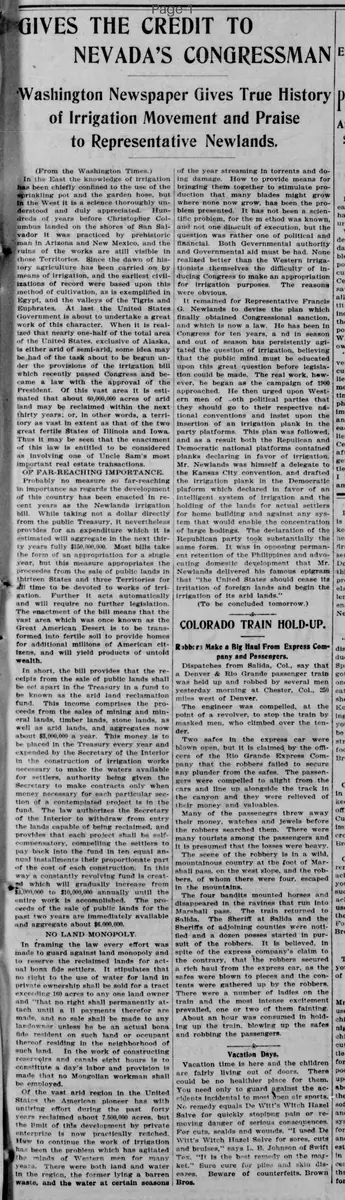
Washington Newspaper Gives True History of Irrigation Movement and Praise to Representative Newlands.
(From the Washington Times.)
In the East the knowledge of irrigation has been chiefly confined to the use of the sprinkling pot and the garden hose, but in the West it is a science thoroughly understood and duly appreciated. Hundreds of years before Christopher Columbus landed on the shores of San Salvador it was practiced by prehistoric man in Arizona and New Mexico, and the ruins of the works are still visible in those Territories. Since the dawn of history agriculture has been carried on by means of irrigation, and the earliest civilizations of record were based upon this method of cultivation, as is exemplified in Egypt, and the valleys of the Tigris and Euphrates. At last the United States Government is about to undertake a great work of this character. When it is realized that nearly one-half of the total area of the United States, exclusive of Alaska, is either arid of semi-arid, some idea may be had of the task about to be begun under the provisions of the irrigation bill which recently passed Congress and became a law with the approval of the President. Of this vast area it is estimated that about 60,000,000 acres of arid land may be reclaimed within the next thirty years; or, in other words, a territory as vast in extent as that of the two great fertile States of Illinois and Iowa. Thus it may be seen that the enactment of this law is entitled to be considered as involving one of Uncle Sam's most important real estate transactions.
OF FAR-REACHING IMPORTANCE.
Probably no measure so far-reaching in importance as regards the development of this country has been enacted in recent years as the Newlands irrigation bill. While taking not a dollar directly from the public Treasury, it nevertheless provides for an expenditure which it is estimated will aggregate in the next thirty years fully $150,000,000. Most bills take the form of an appropriation for a single year, but this measure appropriates the proceeds from the sale of public lands in thirteen States and three Territories for all time to be devoted to works of irrigation. Further it acts automatically and will require no further legislation. The enactment of the bill means that the vast area which was once known as the Great American Desert is to be transformed into fertile soil to provide homes for additional millions of American citizens, and will yield products of untold wealth.
In short, the bill provides that the receipts from the sale of public lands shall be set apart in the Treasury in a fund to be known as the arid land reclamation fund. This income comprises the proceeds from the sales of mining and mineral lands, timber lands, stone lands, as well as arid lands, and aggregates now about $3,000,000 a year. This money is to be placed in the Treasury every year and expended by the Secretary of the Interior in the construction of irrigation works necessary to make the waters available for settlers, authority being given the Secretary to make contracts only when money necessary for each particular section of a contemplated project is in the fund. The law authorizes the Secretary of the Interior to withdraw from entry the lands capable of being reclaimed, and provides that each project shall be self-compensatory, compelling the settlers to pay back into the fund in ten equal annual installments their proportionate part of the cost of each construction. In this way a constantly revolving fund is created which will gradually increase from $3,000,000 to $10,000,000 annually until the entire work is accomplished. The proceeds of the sale of public lands for the past two years are immediately available and aggregate about $6,000,000.
NO LAND MONOPOLY.
In framing the law every effort was made to guard against land monopoly and to reserve the reclaimed lands for actual bona fide settlers. It stipulates that no right to the use of water for land in private ownership shall be sold for a tract exceeding 160 acres to any one land owner and "that no right shall permanently attach until all payments therefor are made, and no sale shall be made to any landowner unless he be an actual bona fide resident on such land or occupant thereof residing in the neighborhood of such land. In the work of constructing reservoirs and canals eight hours is to constitute a day's labor and provision is made that no Mongolian workman shall be employed.
Of the vast arid region in the United States the American pioneer has with untiring effort during the past forty years reclaimed about 7,500,000 acres, but the limit of this development by private enterprise is now practically reached. How to continue the work of irrigation has been the problem which has agitated the minds of Western men for many years. There were both land and water in the region, the former lying a barren waste, and the water at certain seasons
of the year streaming in torrents and doing damage. How to provide means for bringing them together to stimulate production that many blades might grow where none now grow, has been the problem presented. It has not been a scientific problem, for the method was known, and not one difficult of execution, but the question was rather one of political and financial. Both Governmental authority and Governmental aid must be had. None realized better than the Western irrigationists themselves the difficulty of inducing Congress to make an appropriation for irrigation purposes. The reasons were obvious.
It remained for Representative Francis G. Newlands to devise the plan which finally obtained Congressional sanction, and which is now a law. He has been in Congress for ten years, and in season and out of season has persistently agitated the question of irrigation, believing that the public mind must be educated upon this great question before legislation could be made. The real work, however, he began as the campaign of 1900 approached. He then urged upon Western men of both political parties that they should go to their respective national conventions and insist upon the insertion of an irrigation plank in the party platforms. This plan was followed, and as a result both the Republican and Democratic national platforms contained planks declaring in favor of irrigation. Mr. Newlands was himself a delegate to the Kansas City convention, and drafted the irrigation plank in the Democratic platform which declared in favor of an intelligent system of irrigation and the holding of the lands for actual settlers for home building and against any system that would enable the concentration of large holdings. The declaration of the Republican party took substantially the same form. It was in opposing permanent retention of the Philippines and advocating domestic development that Mr. Newlands delivered his famous epigram that "the United States should cease its irritation of foreign lands and begin the irrigation of its arid lands."
(To be concluded tomorrow.)
What sub-type of article is it?
What themes does it cover?
What keywords are associated?
What entities or persons were involved?
Where did it happen?
Story Details
Key Persons
Location
Arid Regions Of The United States
Event Date
Recently Passed Congress
Story Details
Congressman Francis G. Newlands devises and champions the irrigation bill, passed into law, funding reclamation of arid lands via public land sales proceeds to create a self-sustaining fund for transforming desert into fertile settler homes.