Thank you for visiting SNEWPapers!
Sign up free
Story
March 26, 1909
The Daily Missoulian
Missoula, Missoula County, Montana
What is this article about?
At Roosevelt Hospital in New York, Dr. W. S. Swan experiments with bee stings as a rheumatism treatment, inspired by folklore. Early results show temporary improvements in some patients, possibly due to counter-irritant effects or neutralizing uric acid.
Clipping
OCR Quality
98%
Excellent
Full Text
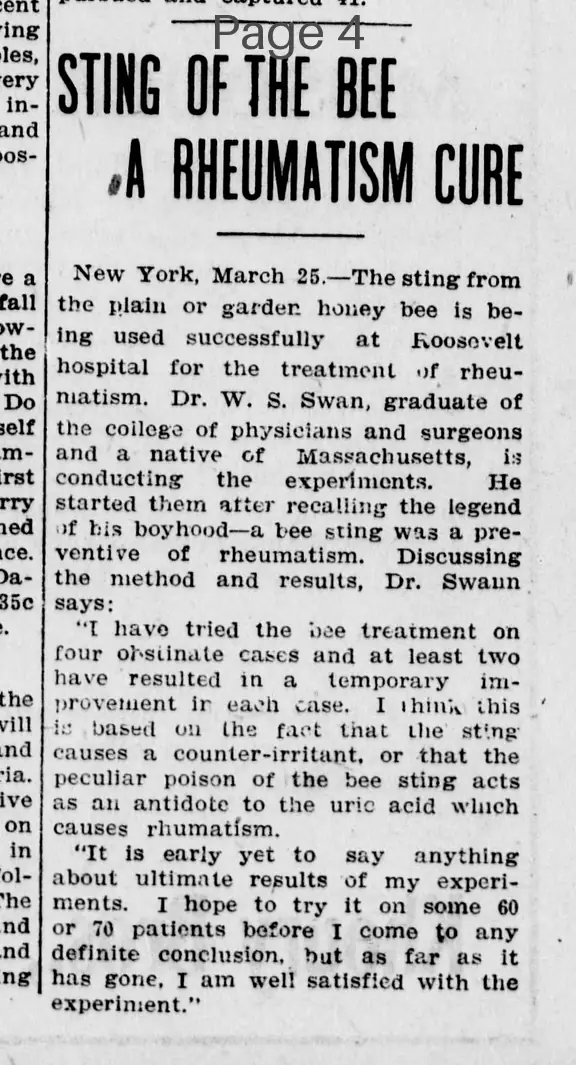
STING OF THE BEE A RHEUMATISM CURE
New York, March 25.—The sting from the plain or garden honey bee is being used successfully at Roosevelt hospital for the treatment of rheumatism. Dr. W. S. Swan, graduate of the college of physicians and surgeons and a native of Massachusetts, is conducting the experiments. He started them after recalling the legend of his boyhood—a bee sting was a preventive of rheumatism. Discussing the method and results, Dr. Swan says: "I have tried the bee treatment on four obstinate cases and at least two have resulted in a temporary improvement in each case. I think this is based on the fact that the sting causes a counter-irritant, or that the peculiar poison of the bee sting acts as an antidote to the uric acid which causes rheumatism. "It is early yet to say anything about ultimate results of my experiments. I hope to try it on some 60 or 70 patients before I come to any definite conclusion, but as far as it has gone, I am well satisfied with the experiment."
New York, March 25.—The sting from the plain or garden honey bee is being used successfully at Roosevelt hospital for the treatment of rheumatism. Dr. W. S. Swan, graduate of the college of physicians and surgeons and a native of Massachusetts, is conducting the experiments. He started them after recalling the legend of his boyhood—a bee sting was a preventive of rheumatism. Discussing the method and results, Dr. Swan says: "I have tried the bee treatment on four obstinate cases and at least two have resulted in a temporary improvement in each case. I think this is based on the fact that the sting causes a counter-irritant, or that the peculiar poison of the bee sting acts as an antidote to the uric acid which causes rheumatism. "It is early yet to say anything about ultimate results of my experiments. I hope to try it on some 60 or 70 patients before I come to any definite conclusion, but as far as it has gone, I am well satisfied with the experiment."
What sub-type of article is it?
Medical Curiosity
What themes does it cover?
Recovery
What keywords are associated?
Bee Sting Treatment
Rheumatism Cure
Dr. Swan Experiments
Roosevelt Hospital
What entities or persons were involved?
Dr. W. S. Swan
Where did it happen?
Roosevelt Hospital, New York
Story Details
Key Persons
Dr. W. S. Swan
Location
Roosevelt Hospital, New York
Event Date
March 25
Story Details
Dr. W. S. Swan conducts experiments using bee stings to treat rheumatism at Roosevelt Hospital, inspired by a childhood legend, with temporary improvements in two of four cases, attributing effects to counter-irritant or antidote to uric acid.