Thank you for visiting SNEWPapers!
Sign up free
Morning Star
Limerick, York County, Maine
What is this article about?
S. Beede defends the Free Will Baptist General Conference's actions against an article by 'No Bigot' in the Christian Herald, arguing that their motion to address members denying Christ's divinity promotes scriptural liberty and consistency, while critiquing the opponent's inconsistent principle of Christian fellowship based on holiness alone.
Clipping
OCR Quality
Full Text
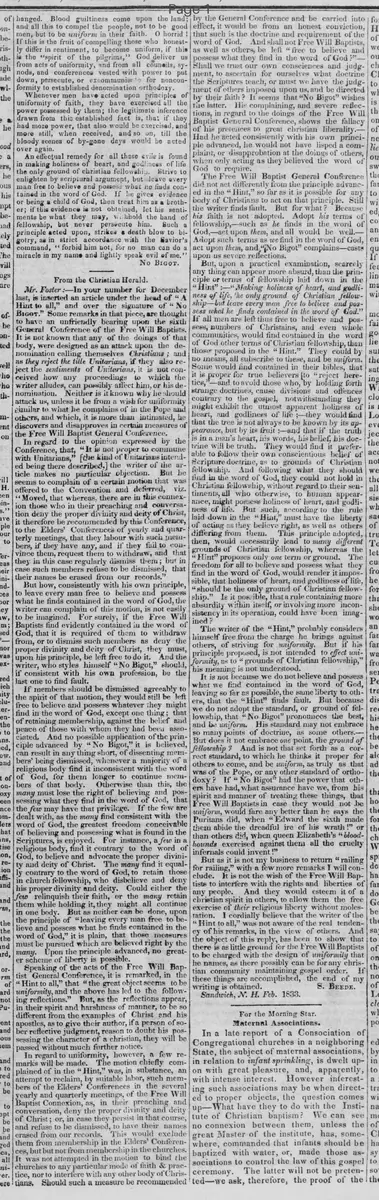
Mr. Foster:—In your number of December last, is inserted an article under the head of "A Hint to all," and over the signature of "No Bigot." Some remarks in that piece, are thought to have an unfriendly bearing upon the sixth General Conference of the Free Will Baptists.
It is not known that any of the doings of that body, were designed as an attack upon the denomination calling themselves Christians: and as they reject the title Unitarians, if they also reject the sentiments of Unitarians, it is not conceived how any proceedings to which the writer alludes, can possibly affect him, or his denomination. Neither is it known why he should attack us, unless it be from a wish for uniformity similar to what he complains of in the Pope and others, and which, it is more than intimated, he discovers and disapproves in certain measures of the Free Will Baptist General Conference.
In regard to the opinion expressed by the Conference, that, "It is not proper to commune with Unitarians." [the kind of Unitarians intended being there described.] the writer of the article makes no particular objection. But he seems to complain of a certain motion that was offered to the Convention and deferred, viz.
"Moved, that whereas, there are in this connexion those who in their preaching and conversation deny the proper divinity and deity of Christ, it therefore be recommended by this Conference, to the Elders' Conferences of yearly and quarterly meetings, that they labour with such members, if they have any, and if they fail to convince them, request them to withdraw, and that they in this case regularly dismiss them; but in case such members refuse to be dismissed, that their names be erased from our records."
But how, consistently with his own principle, to leave every man free to believe and possess what he finds contained in the word of God, the writer can complain of this motion, is not easily to be imagined. For surely, if the Free Will Baptists find evidently contained in the word of God, that it is required of them to withdraw from, or to dismiss such members as deny the proper divinity and deity of Christ, they must, upon his principle, be left free to do it. And the writer, who styles himself "No Bigot," should, if consistent with his own profession, be the last one to find fault.
If members should be dismissed agreeably to the spirit of that motion, they would still be left free to believe and possess whatever they might find in the word of God, except one thing: that of retaining membership, against the belief and peace of those with whom they had been associated. And no possible application of the principle advanced by "No Bigot," it is believed, can result in any thing short, of dissenting members' being dismissed, whenever a majority of a religious body find it inconsistent with the word of God, for them longer to continue members of that body. Otherwise than this, the many must lose the right of believing and possessing what they find in the word of God, that the few may have that privilege. If the few are dealt with, as the many find consistent with the word of God, the greatest freedom conceivable of believing and possessing what is found in the Scriptures, is enjoyed. For instance, a few in a religious body, find it contrary to the word of God, to believe and advocate the proper divinity and deity of Christ. The many find it equally contrary to the word of God, to retain those in church fellowship, who disbelieve and deny his proper divinity and deity. Could either the few relinquish their faith, or the many retain them while holding it, they might all continue in one body. But as neither can be done, upon the principle of "leaving every man free to believe and possess what he finds contained in the word of God," it is plain, that those measures must be pursued which are believed right by the many. Upon the principle advanced, no greater scheme of liberty is possible.
Speaking of the acts of the Free Will Baptist General Conference, it is remarked, in the "Hint to all," that "the great object seems to be uniformity, and the above has led to the following reflections." But, as the reflections appear, in their spirit and harshness of manner, to be so different from the examples of Christ and his apostles, as to give their author, if a person of sober reflective judgment, reason to doubt his possessing the character of a christian, they will be passed without much further notice.
In regard to uniformity, however, a few remarks will be made. The motion chiefly complained of in the "Hint," was, in substance, an attempt to reclaim, by suitable labor, such members of the Elders' Conferences in the several yearly and quarterly meetings, of the Free Will Baptist Connexion, as, in their preaching and conversation, deny the proper divinity and deity of Christ; or, in case they persist in that course, and refuse to be dismissed, to have their names erased from our records. This would exclude them from membership in the Elders' Conferences, but not from membership in the churches.
It was not attempted in the motion to bind the churches to any particular mode of faith & practice, nor to interfere with any other body of Christians. Should such a measure be recommended by the General Conference and be carried into effect, it would be from an honest conviction, that such is the doctrine and requirement of the word of God. And shall not Free Will Baptists, as well as others, be left "free to believe and possess what they find in the word of God?"
Shall we trust our own consciences and judgment, to ascertain for ourselves what doctrine the Scriptures teach, or must we have the judgment of others imposed upon us, and be directed by their faith? It seems that "No Bigot" wishes the latter. His complaining, and severe reflections, in regard to the doings of the Free Will Baptist General Conference, shows the fallacy of his pretences to great christian liberality.
Had he acted consistently with his own principle advanced, he would not have lisped a complaint, or disapprobation at the doings of others, when only acting as they believed the word of God to require.
The Free Will Baptist General Conference did not act differently from the principle advanced in the "Hint," so far as it is possible for any body of Christians to act on that principle. Still the writer finds fault. But for what? "Because his faith is not adopted. Adopt his terms of fellowship,—such as he finds in the word of God,—act upon them, and all would be well.—Adopt such terms as we find in the word of God, act upon them, and "No Bigot" complains and casts upon us severe reflections.
But, upon a practical examination, scarcely any thing can appear more absurd, than the principle or terms of fellowship laid down in the "Hint": "Making holiness of heart, and godliness of life, the only ground of Christian fellowship—but leave every man free to believe and possess what he finds contained in the word of God."
If all men are left thus free to believe and possess, numbers of Christians, and even whole communities, would find contained in the word of God other terms of Christian fellowship, than those proposed in the "Hint." They could by no means, all subscribe to these, and be uniform.
Some would find contained in their bibles, that it is proper for true believers to "reject heretics,"—and to avoid those who, by holding forth strange doctrines, cause divisions and offences contrary to the gospel, notwithstanding they might exhibit the utmost apparent holiness of heart, and godliness of life;—they would find that the tree is not always to be known by its appearance, but by its fruit;—and that if the truth is in a man's heart, his words, his belief, his doctrine will be truth. They would find it preferable to follow their own conscientious belief of Scripture doctrine, as to grounds of Christian fellowship. And following what they should find in the word of God, they could not hold in Christian fellowship, without regard to their sentiments, all who otherwise, to human appearance, might possess holiness of heart, and godliness of life. But such, according to the rule laid down in the "Hint," must have the liberty of acting as they believe right, as well as others differing from them. This principle adopted, then, would necessarily lead to many different grounds of Christian fellowship, whereas the "Hint" proposes only one term or ground. The freedom for all to believe and possess what they find in the word of God, would render it impossible, that holiness of heart, and godliness of life, "should be the only ground of Christian fellowship." Is it possible, that a rule containing more absurdity within itself, or involving more inconsistency in its operation, could have been imagined?
The writer of the "Hint," probably considers himself free from the charge he brings against others, of striving for uniformity. But if his principle proposed, is not intended to effect uniformity, as to "grounds of Christian fellowship," his meaning is not understood.
It is not because we do not believe and possess what we find contained in the word of God, leaving so far as possible, the same liberty to others, that the "Hint" finds fault. But because we do not adopt the standard, or ground of fellowship, that "No Bigot" pronounces the best, and be uniform. His standard may not embrace so many points of doctrine, as some others.—But does it not embrace one point, the ground of fellowship? And is not that set forth as a correct standard, to which he thinks it proper for others to come, and be uniform, as truly as that was of the Pope, or any other standard of orthodoxy? If "No Bigot" had the power that others have had, what assurance have we, from his spirit and manner of treating these things, that Free Will Baptists in case they would not be uniform, would fare any better than he says the Puritans did, when "Edward the sixth made them abide the dreadful ire of his wrath!" or than others did, when queen Elizabeth's "blood-hounds exercised against them all the cruelty infernals could invent!"
But as it is not my business to return "railing for railing," with a few more remarks I will conclude. It is not the wish of the Free Will Baptists to interfere with the rights and liberties of any people. And they would esteem it of a christian spirit in others, to allow them the free exercise of their religious liberty without molestation. I cordially believe that the writer of the "Hint to all," was not aware of the real tendency of his remarks, in the view of others. And the object of this reply, has been to show that there is as little ground for the Free Will Baptists to be charged with the design of uniformity that he names, as there possibly can be for any christian community maintaining gospel order. If these things are accomplished, the end of my writing is obtained.
S. BEEDE.
Sandwich, N. H. Feb. 1833.
What sub-type of article is it?
What themes does it cover?
What keywords are associated?
What entities or persons were involved?
Letter to Editor Details
Author
S. Beede
Recipient
Mr. Foster
Main Argument
the free will baptist general conference's motion to address members denying christ's divinity is consistent with scriptural liberty, allowing the majority to act on their beliefs without imposing on others, and exposes the inconsistency in 'no bigot's' principle of fellowship based solely on holiness of heart and life.
Notable Details