Thank you for visiting SNEWPapers!
Sign up free
The Union Times
New Haven, New Haven County, Connecticut
What is this article about?
Debate in the 80th Congress over health legislation: AMA-backed Taft bill for indigent aid vs. broader Murray national health insurance plan supported by labor and Democrats, aiming to cover most Americans via social security deductions.
Clipping
OCR Quality
Full Text
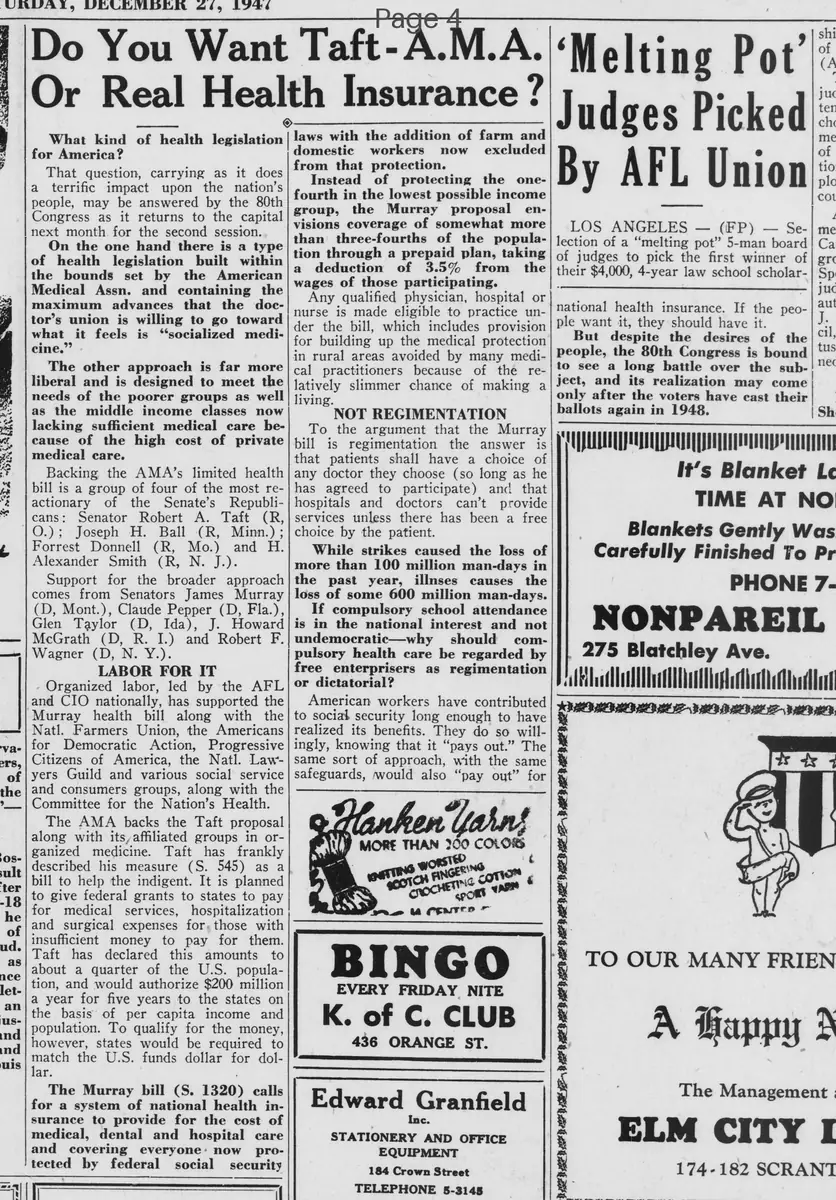
You Want Taft-A.M.A.
Or
Real
Health
Insurance?
What kind of health legislation for America?
That question, carrying as it does a terrific impact upon the nation's people, may be answered by the 80th Congress as it returns to the capital next month for the second session.
On the one hand there is a type of health legislation built within the bounds set by the American Medical Assn. and containing the maximum advances that the doctor's union is willing to go toward what it feels is "socialized medicine."
The other approach is far more liberal and is designed to meet the needs of the poorer groups as well as the middle income classes now lacking sufficient medical care because of the high cost of private medical care.
Backing the AMA's limited health bill is a group of four of the most reactionary of the Senate's Republicans: Senator Robert A. Taft (R, O.); Joseph H. Ball (R, Minn.); Forrest Donnell (R, Mo.) and H. Alexander Smith (R, N. J.).
Support for the broader approach comes from Senators James Murray (D. Mont.). Claude Pepper (D, Fla.), Glen Taylor (D, Ida), J. Howard McGrath (D, R. I.) and Robert F. Wagner (D, N. Y.).
LABOR FOR IT
Organized labor, led by the AFL and CIO nationally, has supported the Murray health bill along with the Natl. Farmers Union, the Americans for Democratic Action, Progressive Citizens of America, the Natl. Lawyers Guild and various social service and consumers groups, along with the Committee for the Nation's Health.
The AMA backs the Taft proposal along with its affiliated groups in organized medicine. Taft has frankly described his measure (S. 545) as a bill to help the indigent. It is planned to give federal grants to states to pay for medical services, hospitalization and surgical expenses for those with insufficient money to pay for them.
Taft has declared this amounts to about a quarter of the U.S. population, and would authorize $200 million a year for five years to the states on the basis of per capita income and population. To qualify for the money, however, states would be required to match the U.S. funds dollar for dollar.
The Murray bill (S. 1320) calls for a system of national health insurance to provide for the cost of medical, dental and hospital care and covering everyone now protected by federal social security
laws with the addition of farm and domestic workers now excluded from that protection.
Instead of protecting the one-fourth in the lowest possible income group, the Murray proposal envisions coverage of somewhat more than three-fourths of the population through a prepaid plan, taking a deduction of 3.5% from the wages of those participating.
Any qualified physician, hospital or nurse is made eligible to practice under the bill, which includes provision for building up the medical protection in rural areas avoided by many medical practitioners because of the relatively slimmer chance of making a living.
NOT REGIMENTATION
To the argument that the Murray bill is regimentation the answer is that patients shall have a choice of any doctor they choose (so long as he has agreed to participate and that hospitals and doctors can't provide services unless there has been a free choice by the patient.
While strikes caused the loss of more than 100 million man-days in the past year, illnesses causes the loss of some 600 million man-days.
If compulsory school attendance is in the national interest and not undemocratic-why should compulsory health care be regarded by free enterprisers as regimentation or dictatorial?
American workers have contributed to social security long enough to have realized its benefits. They do so willingly, knowing that it "pays out." The same sort of approach, with the same safeguards, would also "pay out" for national health insurance. If the people want it, they should have it.
But despite the desires of the people, the 80th Congress is bound to see a long battle over the subject, and its realization may come only after the voters have cast their ballots again in 1948.
national health insurance. If the peo-
What sub-type of article is it?
What themes does it cover?
What keywords are associated?
What entities or persons were involved?
Where did it happen?
Story Details
Key Persons
Location
Washington
Event Date
80th Congress Second Session
Story Details
The article contrasts the limited Taft health bill (S. 545), backed by AMA and conservative Republicans, providing federal grants for the indigent, with the comprehensive Murray bill (S. 1320), supported by Democrats and labor groups, establishing national health insurance covering most Americans via payroll deductions, emphasizing free choice and addressing medical access issues.