Thank you for visiting SNEWPapers!
Sign up free
The People's Defender
West Union, Adams County, Ohio
What is this article about?
In Portsmouth, Ohio, Joseph B. Locke, 53, is convicted of first-degree murder for shooting his mother-in-law Mary Galloway on February 6, 1929, receiving life imprisonment after a second trial. Emotional defense by Judge Blair sways jury to recommend mercy despite strong prosecution evidence, including testimony from grandson Clay Galloway.
Clipping
OCR Quality
Full Text
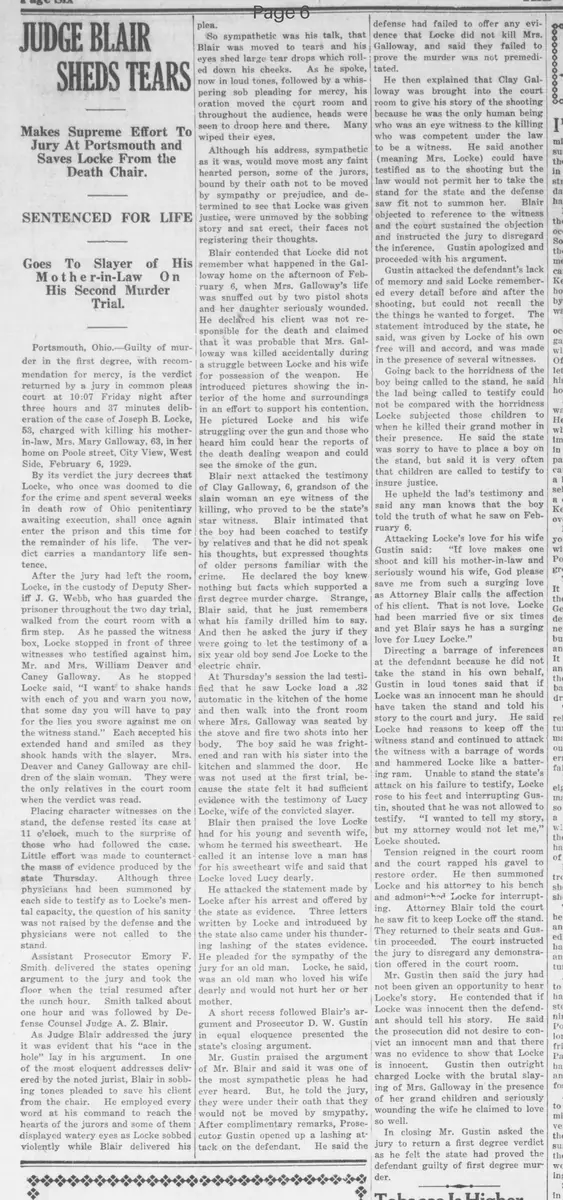
Makes Supreme Effort To Jury At Portsmouth and Saves Locke From the Death Chair.
SENTENCED FOR LIFE
Goes To Slayer of His Mother-in-Law On His Second Murder Trial.
Portsmouth, Ohio.-Guilty of murder in the first degree, with recommendation for mercy, is the verdict returned by a jury in common pleas court at 10:07 Friday night after three hours and 37 minutes deliberation of the case of Joseph B. Locke, 53, charged with killing his mother-in-law, Mrs. Mary Galloway, 63, in her home on Poole street, City View, West Side, February 6, 1929.
By its verdict the jury decrees that Locke, who once was doomed to die for the crime and spent several weeks in death row of Ohio penitentiary awaiting execution, shall once again enter the prison and this time for the remainder of his life. The verdict carries a mandatory life sentence.
After the jury had left the room, Locke, in the custody of Deputy Sheriff J. G. Webb, who has guarded the prisoner throughout the two day trial, walked from the court room with a firm step. As he passed the witness box, Locke stopped in front of three witnesses who testified against him, Mr. and Mrs. William Deaver and Caney Galloway. As he stopped Locke said, "I want to shake hands with each of you and warn you now, that some day you will have to pay for the lies you swore against me on the witness stand." Each accepted his extended hand and smiled as they shook hands with the slayer. Mrs. Deaver and Caney Galloway are children of the slain woman. They were the only relatives in the court room when the verdict was read.
Placing character witnesses on the stand, the defense rested its case at 11 o'clock, much to the surprise of those who had followed the case. Little effort was made to counteract the mass of evidence produced by the state Thursday. Although three physicians had been summoned by each side to testify as to Locke's mental capacity, the question of his sanity was not raised by the defense and the physicians were not called to the stand.
Assistant Prosecutor Emory F. Smith delivered the state's opening argument to the jury and took the floor when the trial resumed after the lunch hour. Smith talked about one hour and was followed by Defense Counsel Judge A. Z. Blair.
As Judge Blair addressed the jury it was evident that his "ace in the hole" lay in his argument. In one of the most eloquent addresses delivered by the noted jurist, Blair in sobbing tones pleaded to save his client from the chair. He employed every word at his command to reach the hearts of the jurors and some of them displayed watery eyes as Locke sobbed violently while Blair delivered his plea.
So sympathetic was his talk, that Blair was moved to tears and his eyes shed large tear drops which rolled down his cheeks. As he spoke, now in loud tones, followed by a whispering sob pleading for mercy, his oration moved the court room and throughout the audience, heads were seen to droop here and there. Many wiped their eyes.
Although his address, sympathetic as it was, would move most any faint hearted person, some of the jurors, bound by their oath not to be moved by sympathy or prejudice, and determined to see that Locke was given justice, were unmoved by the sobbing story and sat erect, their faces not registering their thoughts.
Blair contended that Locke did not remember what happened in the Galloway home on the afternoon of February 6, when Mrs. Galloway's life was snuffed out by two pistol shots and her daughter seriously wounded. He declared his client was not responsible for the death and claimed that it was probable that Mrs. Galloway was killed accidentally during a struggle between Locke and his wife for possession of the weapon. He introduced pictures showing the interior of the home and surroundings in an effort to support his contention. He pictured Locke and his wife struggling over the gun and those who heard him could hear the reports of the death dealing weapon and could see the smoke of the gun.
Blair next attacked the testimony of Clay Galloway, 6, grandson of the slain woman an eye witness of the killing, who proved to be the state's star witness. Blair intimated that the boy had been coached to testify by relatives and that he did not speak his thoughts, but expressed thoughts of older persons familiar with the crime. He declared the boy knew nothing but facts which supported a first degree murder charge. Strange, Blair said, that he just remembers what his family drilled him to say. And then he asked the jury if they were going to let the testimony of a six year old boy send Joe Locke to the electric chair.
At Thursday's session the lad testified that he saw Locke load a .32 automatic in the kitchen of the home and then walk into the front room where Mrs. Galloway was seated by the stove and fire two shots into her body. The boy said he was frightened and ran with his sister into the kitchen and slammed the door. He was not used at the first trial, because the state felt it had sufficient evidence with the testimony of Lucy Locke, wife of the convicted slayer.
Blair then praised the love Locke had for his young and seventh wife, whom he termed his sweetheart. He called it an intense love a man has for his sweetheart wife and said that Locke loved Lucy dearly. He attacked the statement made by Locke after his arrest and offered by the state as evidence. Three letters written by Locke and introduced by the state also came under his thundering lashing of the state's evidence. He pleaded for the sympathy of the jury for an old man. Locke, he said, was an old man who loved his wife dearly and would not hurt her or her mother.
A short recess followed Blair's argument and Prosecutor D. W. Gustin in equal eloquence presented the state's closing argument. Mr. Gustin praised the argument of Mr. Blair and said it was one of the most sympathetic pleas he had ever heard. But, he told the jury, they were under their oath that they would not be moved by sympathy. After complimentary remarks, Prosecutor Gustin opened up a lashing attack on the defendant. He said the defense had failed to offer any evidence that Locke did not kill Mrs. Galloway, and said they failed to prove the murder was not premeditated.
He then explained that Clay Galloway was brought into the court room to give his story of the shooting because he was the only human being who was an eye witness to the killing who was competent under the law to be a witness. He said another (meaning Mrs. Locke) could have testified as to the shooting but the law would not permit her to take the stand for the state and the defense saw fit not to summon her. Blair objected to reference to the witness and the court sustained the objection and instructed the jury to disregard the inference. Gustin apologized and proceeded with his argument.
Gustin attacked the defendant's lack of memory and said Locke remembered every detail before and after the shooting, but could not recall the things he wanted to forget. The statement introduced by the state, he said, was given by Locke of his own free will and accord, and was made in the presence of several witnesses.
Going back to the horridness of the boy being called to the stand, he said the lad being called to testify could not be compared with the horridness Locke subjected those children to when he killed their grandmother in their presence. He said the state was sorry to have to place a boy on the stand, but said it is very often that children are called to testify to insure justice. He upheld the lad's testimony and said any man knows that the boy told the truth of what he saw on February 6.
Attacking Locke's love for his wife Gustin said: "If love makes one shoot and kill his mother-in-law and seriously wound his wife, God please save me from such a surging love as Attorney Blair calls the affection of his client. That is not love. Locke had been married five or six times and yet Blair says he has a surging love for Lucy Locke."
Directing a barrage of inferences at the defendant because he did not take the stand in his own behalf Gustin in loud tones said that if Locke was an innocent man he should have taken the stand and told his story to the court and jury. He said Locke had reasons to keep off the witness stand and continued to attack the witness with a barrage of words and hammered Locke like a battering ram. Unable to stand the state's attack on his failure to testify, Locke rose to his feet and interrupting Gustin, shouted that he was not allowed to testify. "I wanted to tell my story, but my attorney would not let me," Locke shouted.
Tension reigned in the court room and the court rapped his gavel to restore order. He then summoned Locke and his attorney to his bench and admonished Locke for interrupting. Attorney Blair told the court he saw fit to keep Locke off the stand. They returned to their seats and Gustin proceeded. The court instructed the jury to disregard any demonstration offered in the court room.
Mr. Gustin then said the jury had not been given an opportunity to hear Locke's story. He contended that if Locke was innocent then the defendant should tell his story. He said the prosecution did not desire to convict an innocent man and that there was no evidence to show that Locke is innocent. Gustin then outright charged Locke with the brutal slaying of Mrs. Galloway in the presence of her grandchildren and seriously wounding the wife he claimed to love so well.
In closing Mr. Gustin asked the jury to return a first degree verdict as he felt the state had proved the defendant guilty of first degree murder.
What sub-type of article is it?
What themes does it cover?
What keywords are associated?
What entities or persons were involved?
Where did it happen?
Story Details
Key Persons
Location
Portsmouth, Ohio
Event Date
February 6, 1929
Story Details
Joseph B. Locke is convicted of first-degree murder with mercy recommendation for killing his mother-in-law Mary Galloway, receiving a life sentence after a second trial. Defense attorney Judge Blair delivers an emotional plea arguing accident and lack of memory, attacking child witness testimony. Prosecution counters with evidence including eyewitness account from grandson Clay Galloway, leading to the verdict after deliberations.