Thank you for visiting SNEWPapers!
Sign up free
Gazette Of The United States And Daily Evening Advertiser
Philadelphia, Philadelphia County, Pennsylvania
What is this article about?
Discourse on public instruction in revolutionary France, denouncing Jacobin persecution of intellectuals and scientists, listing victims like Desault and Bitaubé, and praising legislative efforts to revive arts, sciences, and education amid political tempests.
Merged-components note: These components form a single continued article on public instruction and the arts in France, translated for the Minerva, spanning pages 2 and 3 with explicit 'Continued from Friday' and 'To be continued' indicators, and sequential reading orders.
Clippings
1 of 2
OCR Quality
Full Text
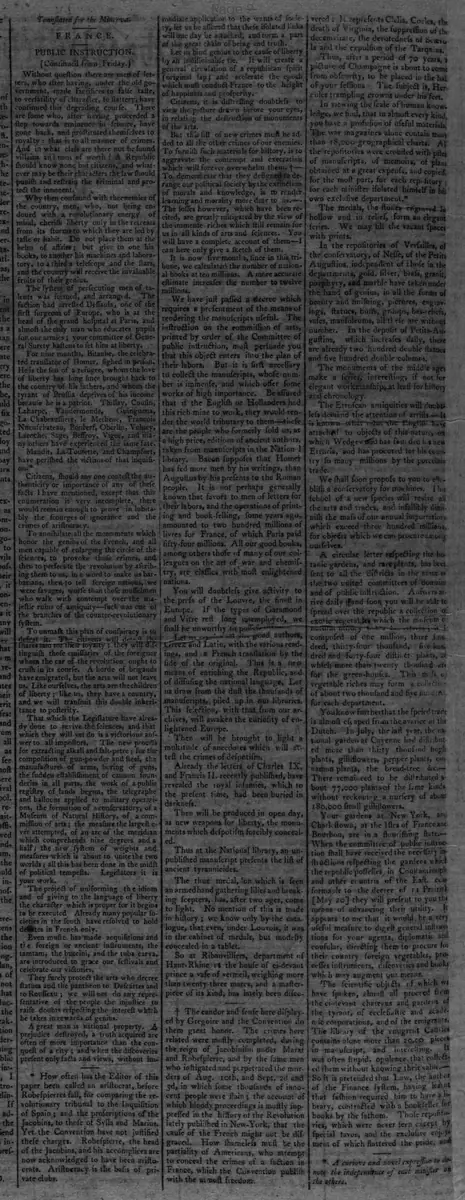
FRANCE.
PUBLIC INSTRUCTION.
(Continued from Friday.)
Without question there are men of letters, who after having, under the old government, made sacrifices to false taste, to versatility of character, to flattery, have continued this degrading course. There are some who, after having proceeded a step towards eminence in science, have gone back, and prostituted themselves to royalty: that is to all manner of crimes. And in what class are there not be found villains and men of worth? A Republic should know none but citizens, and whatever may be their characters the law should punish and restrain the criminal and protect the innocent.
Why then confound with the enemies of the country, men, who, not being endowed with a revolutionary energy of mind, cherish liberty only in the retreats from its storms to which they are led by taste or habit. Do not place them at the helm of affairs; but give to one his books, to another his machines and laboratory, to a third a telescope and the stars, and the country will receive the invaluable fruits of their genius.
The system of persecuting men of talents was formed, and arranged. The faction had arrested Dehaulx, one of the first surgeons of Europe, who is at the head of the grand hospital at Paris, and almost the only man who educates pupils for our armies; your committee of General Surety hastens to set him at liberty.
For nine months, Bitaubé, the celebrated translator of Homer, sighed in prison. He is the son of a refugee, whom the love of liberty has long since brought back to the country of his fathers, and whom the tyrant of Prussia deprives of his income because he is a patriot. Thillaye, Couin, Laharpe, Vandermonde, Guinguene, La Chaume, le Metherie, Francois Necker de Saussure, Bomberet, Oberlin, Volney, Laroche, Sage, Bertoy, Vigée, and many others have experienced the same fate.
Mauduit, La Tourette, and Chamfort, have perished the victims of that inquisition.*
Citizens, should any one contest the authenticity or importance of any of these facts I have mentioned, except that this enumeration is very incomplete, there would remain enough to prove in substantiation the scourges of ignorance and the crimes of aristocracy.
To annihilate all the monuments which honor the genius of the French, and all men capable of enlarging the circle of the sciences, to provoke those crimes, and then to persecute the revolution by ascribing them to us, in a word to make us barbarians, then to tell foreign nations, we were savages, worse than those Musselmen who walk with contempt over the majestic ruins of antiquity—such was one of the branches of the counter-revolutionary system.
To unmask this plan of conspiracy is to defeat it. The citizens will detect the snares laid for their loyalty; they will distinguish those emissaries of the foreigner whom the car of the revolution ought to crush in its course. A horde of brigands have emigrated, but the arts will not leave us. Like ourselves, the arts are the children of liberty; like us, they have a country, and we will transmit this double inheritance to posterity.
That which the Legislature have already done to revive the sciences, and that which they will yet do is a victorious answer to all impostors. The new process for extracting alkali and salt-petre; for the composition of gun-powder and steel, the manufactures of arms, boring of guns, the sudden establishment of cannon founderies in all parts, the work of a public registry of lands begun, the telegraphes and balloons applied to military operations, the formation of a conservatory, of a Museum of Natural History, of a commission of arts; the measure the largest ever attempted, of an arc of the meridian which comprehends nine degrees and a half; the new system of weights and measures which is about to unite the two worlds; all this has been done in the midst of political tempests. Legislators it is your work.
The project of uniforming the idiom and of giving to the language of liberty the character which is proper for it begins to be executed Already many popular societies in the south have resolved to hold debates in French only.
Even music has made acquisitions and three foreign or ancient instruments, the tamtam, the buccini, and the tuba curva, are introduced to grace our festivals and celebrate our victories.
They surely protect the arts who decree statues and the pantheon to Descartes and to Rousseau; we will not do any representative of the people the injustice to raise doubts respecting the interest which he takes in rewards of genius.
A great man is national property. A prejudice destroyed, a truth acquired are often of more importance than the conquest of a city; and when the discoveries present only facts and views, without im-
* How often has the Editor of this paper been called an aristocrat, before Robespierre's fall, for comparing the revolutionary tribunal to the Inquisition of Spain; and the proscriptions of the Jacobins, to those of Sylla and Marius. Yet the Convention have not justified these charges. Robespierre, the head of the Jacobins, and his accomplices are now acknowledged to have been aristocrats. Aristocracy is the basis of private clubs.
mediate application to the wants of society, let us be assured that these isolated links will one day be attached, and form a part of the great chain of being and truth.
Let us bind genius to the cause of liberty by an indissoluble tie. It will create a general circulation of a republican spirit (original sap) and accelerate the epoch which must conduct France to the height of happiness and prosperity.
Citizens, it is distressing doubtless to view the picture drawn before your eyes, in relating the destruction of monuments of the arts.
But this list of new crimes must be added to all the other crimes of our enemies. To furnish such materials for history, is to aggravate the contempt and execration which will forever overwhelm them.
To demonstrate that they designed to derange our political society by the extinction of morals and knowledge, is to render learning and morality more dear to us.
The losses however, which have been recited, are greatly mitigated by the view of the immense riches which still remain for us in all kinds of arts and sciences. You will have a complete account of them—I can here only give a sketch of them.
It is now five months, since in this tribune, we calculated the number of national books at ten millions. A more accurate estimate increases the number to twelve millions.
We have just passed a decree which requires a presentment of the means of rendering the manuscripts useful. The instructions on the commission of arts, printed by order of the Committee of public instruction, must persuade you that this object enters into the plan of their labors. But it is first necessary to collect the manuscripts, whose number is immense, and which offer some works of high importance. Be assured that if the English or Hollanders had this rich mine to work, they would render the world tributary to them these are the people who formerly sold us, at a high price, editions of ancient authors, taken from manuscripts in the National library. Bacon supposes that Homer has fed more men by his writings, than Augustus by his presents to the Roman people. It is not perhaps generally known that favors to men of letters for their labors, and the operations of printing and book-selling, some years ago, amounted to two hundred millions of livres for France, of which Paris paid fifty-four millions. All our good books, among others those of many of our colleagues on the art of war and chemistry, are classics with most enlightened nations.
You will doubtless give activity to the press of the Louvre, the finest in Europe. If the types of Garamond and Vitré let long unemployed, we shall be unworthy to possess
Let us republish all the good authors, Greek and Latin, with the various readings, and a French translation by the side of the original. This is a new means of enriching the Republic, and of diffusing the national language. Let us draw from the dust the thousands of manuscripts, piled up in our libraries. This selection, with that from our archives, will awaken the curiosity of enlightened Europe.
Then will be brought to light a multitude of anecdotes which will attest the crimes of despotism,
Already the letters of Charles IX. and Francis II. recently published, have revealed the royal infamies, which to the present time, had been buried in darkness.
Then will be produced in open day, as new weapons for liberty, the monuments which despotism forcibly concealed.
Thus at the National library, an unpublished manuscript presents the list of ancient tyrannicides,
The thus medial, on which is seen an armed hand gathering lilies and breaking scepters, has, after two ages, come to light, No mention of this is made in history; we know only by the catalogue, that even, under Louvois, it was in the cabinet of medals, but modesty concealed it in a tablet.
So at Ribauvilliers, department of Haut-Rhin at the house of ci-devant prince a vase of vermeil, weighing more than twenty-three marcs, and a master-piece of its kind, has lately been dis-
The candor and zeal here displayed by Gregoire and the Convention do them great honor. The crimes here related were mostly committed, during the reign of Jacobinism under Marat and Robespierre, and by the same men who instigated and perpetrated the murders of Aug. 10th, and Sept. 2d and 3d, in which some thousands of innocent people were slain; the account of which bloody proceedings is mostly suppressed in the history of the Revolution lately published in New-York, that the cause of the French might not be disgraced. How shameless must be the partiality of Americans, who attempt to conceal the crimes of a faction in France, which the Convention publish with the utmost freedom.
vered : It represents Cecilia, Cœles, the death of Virginia, the suppression of the decemvirate, the devotedness of Scævola and the expulsion of the Tarquins.
Thus, after a period of 70 years, picture of Champagne is about to come from obscurity, to be placed in the hall of your sessions. The subject is, Hercules trampling crowns under his feet.
In viewing the scale of human knowledge, we find, that in almost every kind, you have a profusion of useful materials. The war magazines alone contain more than 18,000 geographical charts! All the repositories were crowded with piles of manuscripts, of memoirs, of plants obtained at a great expense, and copied, for the most part, for each repository; for each minister isolated himself in his own exclusive department. *
The medals, the stones engraved in hollow and in relief, form an elegant series. We may fill the vacant places with prints.
In the repositories of Versailles, of the conservatory, of Nevers, of the Petits Augustins, independent of those in the departments, gold, silver, brass, granite porphyry, and marble have taken under the hand of genius, in all the forms of beauty and finishing, pictures, engravings, statues, busts, groups, bas-reliefs, vases, mausoleums, all these are without number. In the deposit of Petits-Augustins, which increases daily, there are already two hundred double statues and five hundred double columns.
The monuments of the middle ages make a series, interesting, if not for elegant workmanship at least for history and chronology.
The Etruscan antiquities will doubtless demand the attention of artists.—It is known what value the English have attached to objects of this nature, on which Wedgwood has founded his new Etruria, and has procured for his country so many millions by the porcelain trade.
We shall soon propose to you to establish a conservatory for machines. This school of a new species will revive all the arts and trades, and infallibly diminish the mass of our annual importations which exceed three hundred millions, for objects which we can procure among ourselves.
circular letter respecting the botanic gardens, and rare plants, has been sent to all the districts in the name of the two united committees of domains and of public instruction. Flowers arrive daily : land soon you will be able to spread over the republic a collection of exotic vegetables which the museum or natural history teddo in relses it i composed of one million, three hundred, thirty-four thousand, five hundred and forty-four distinct plants, of which more than twenty thousand are for the green-houses. This mass of vegetable riches may form a collection of about two thousand and five hundred for each department.
You know further that the pied trade is almost escaped from the avarice of the Dutch. In July, the last year, the national garden at Cayenne had distributed more than thirty thousand hugk plants, gilliflowers, pepper-plants, cinnamon plants, the bread-tree &c.— There remained to be distributed about 77,000 plants of the same kinds without reckoning a nursery of about 180,000 small gilliflowers.
Your gardens at New York, and Charleston, at the Isles of France and Bourbon, are in a flourishing state.— When the committee of public instruction shall have received the necessary in-tinctions respecting the gardens which the republic possesses, in Conk antineple and other et untris of the East. conr formagle to the decree of 11 Prairial [May 20] they will present to you the means of advancing their utility. It appears to me that it would be a very useful measure to digest general instruc-tions or your agents, diplomatic and consular, directing them io procure fon their country foreign vegetables, pro-cess instruments, discoveries and books which may augment our means.
The scientific objects of which we have spoken, almost all proceed from the ci-devant charters and gardens of the tyrant, of ecclesiastic and academic corporations, and of the emigrants. The library of the emigrant Calonne contains alone more than 20,000 pieces in manuscript, and interesting. It was often stupid. opulence that collected them without knowing their value.— So it is pretended that Law, the author of the Finance system, having learnt that fashion required him to have a li-brary, contracted with a bookseller or books by' the fathom. Those repaito-ries, which were never seen except by special favor, and the exclusive enjoy-ment of which flattered the pride, and
A curious and novel expression to de-note the independence of each minister on the others.
Exhibition of a few individuals immediately open for commerce. The wealth of the people was converted into books, into statutes and laws; the people again take possession of their property.
The Romans, when masters of Sparta, carried off at Peloponnesus the cement on which was fixed a Twelburnt fresco. This was transported to Rome without being damaged by this violent operation.
We have a better right than the Romans in that Demetrius Poliocerte, to protect the arts. We collect monuments of the arts, even in countries where our various armies penetrate.
Belisarius the shelves of the famous repository of Kerian, twenty-two chests of works, and five loads of scientific articles, are detached from Belgium. We find among them, the manuscripts taken from Brussels in the war of 1742, and which were restored by express stipulation in the treaty of peace in 1763.
In one night it acquires by courage, what with incessant sums, Louis XVI could never obtain. Cravel, Vandyke and Rubens are on their way to Paris, and the Flemish School rises in a day to come and adorn our Museums.
Generals not making new presents to the Republic. During their captivity, Connoisseurs, Thillaye, and many others had composed very useful works.
We seize the experience of ages they unite, their discoveries, new voyages open to us, and enrich us with foreign spoils: such are those of Peyrouse Vaubant, Desfontaines, Faujas, and Dumasi. After a residence of ten years at sea, the last has returned under the auspices of government, to the continent of America, to reap a new harvest. Your committee of public instruction had transmitted to him a rational series of questions proper to give a direction to his observations and the answers will doubtless bring back valuable relations.
France is truly a new world. Its new reorganization presents a phenomenon, singular in the extent of ages, and in maps, it has not yet been written, that besides the materials of human knowledge, by the effect of the revolution, it possesses exclusively a stock of elements of new combinations, taken from nature, and inexhaustible oceans for making advantage of her plastic fecundation.
To be continued.
What sub-type of article is it?
What keywords are associated?
What entities or persons were involved?
Where did it happen?
Foreign News Details
Primary Location
France
Key Persons
Outcome
persecution and deaths of intellectuals like mauduit, la tourette, and chamfort; legislative revival of sciences through decrees on manuscripts, museums, botanic gardens, and arts protection.
Event Details
Article condemns Jacobin faction's persecution of men of letters and scientists, lists imprisoned and deceased victims, highlights counter-revolutionary aims to destroy French genius, praises Convention's achievements in sciences, arts, education, and cultural preservation amid Revolution.