Thank you for visiting SNEWPapers!
Sign up free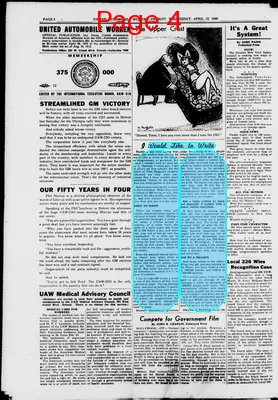
Letter to Editor
April 10, 1940
United Automobile Worker
Detroit, Wayne County, Michigan
What is this article about?
Frank B. Tuttle, from Local 140, advises auto workers on effectively writing letters to editors and congressmen to sway opinion and policy, stressing brevity, timing between crises, and genuine handwritten notes for maximum impact.
Clipping
OCR Quality
95%
Excellent
Full Text
Would Like to Write
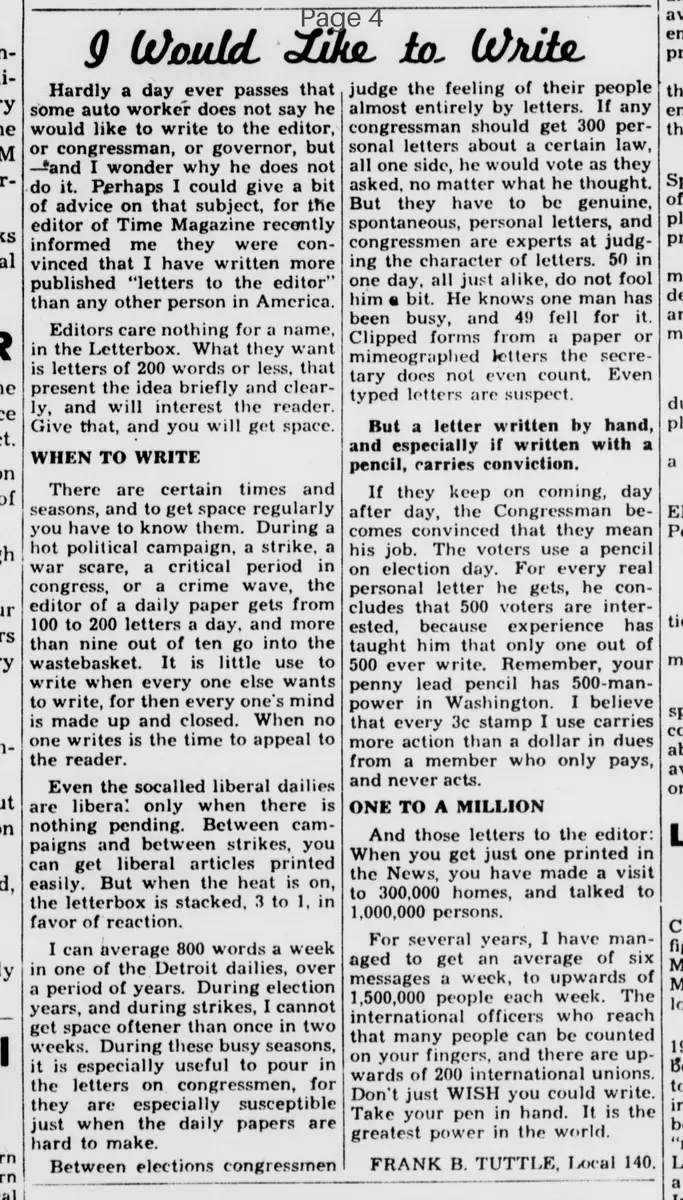
Hardly a day ever passes that some auto worker does not say he would like to write to the editor, or congressman, or governor, but 'and I wonder why he does not do it. Perhaps I could give a bit of advice on that subject, for the editor of Time Magazine recently informed me they were convinced that I have written more published "letters to the editor" than any other person in America.
Editors care nothing for a name, in the Letterbox. What they want is letters of 200 words or less. that present the idea briefly and clearly, and will interest the reader.
Give that, and you will get space.
WHEN TO WRITE
There are certain times and seasons, and to get space regularly you have to know them. During a hot political campaign, a strike, a war scare, a critical period in congress, or a crime wave, the editor of a daily paper gets from 100 to 200 letters a day, and more than nine out of ten go into the wastebasket. It is little use to write when every one else wants to write, for then every one's mind is made up and closed. When no one writes is the time to appeal to the reader.
Even the so-called liberal dailies are liberal only when there is nothing pending. Between campaigns and between strikes. you can get liberal articles printed easily. But when the heat is on, the letterbox is stacked, 3 to 1. in favor of reaction.
I can average 800 words a week in one of the Detroit dailies, over a period of years. During election years, and during strikes, I cannot get space oftener than once in two weeks. During these busy seasons, it is especially useful to pour in the letters on congressmen, for they are especially susceptible just when the daily papers are hard to make.
Between elections congressmen judge the feeling of their people almost entirely by letters. If any congressman should get 300 personal letters about a certain law, all one side, he would vote as they asked. no matter what he thought.
But they have to be genuine, spontaneous, personal letters, and congressmen are experts at judging the character of letters. 50 in one day. all just alike, do not fool him a bit. He knows one man has been busy, and 49 fell for it.
Clipped forms from a paper or mimeographed letters the secretary does not even count.
Even typed letters are suspect.
But a letter written by hand, and especially if written with a pencil, carries conviction.
If they keep on coming, day after day, the Congressman becomes convinced that they mean his job. The voters use a pencil on election day. For every real personal letter he gets, he concludes that 500 voters are interested, because experience has taught him that only one out of 500 ever write.
Remember, your penny lead pencil has 500-man-power in Washington. I believe that every 3c stamp I use carries more action than a dollar in dues from a member who only pays, and never acts.
ONE TO A MILLION
And those letters to the editor:
When you get just one printed in the News. you have made a visit to 300,000 homes, and talked to 1,000,000 persons.
For several years, I have managed to get an average of six messages a week, to upwards of 1,500,000 people each week. The international officers who reach that many people can be counted on your fingers, and there are upwards of 200 international unions.
Don't just WISH you could write.
Take your pen in hand. It is the greatest power in the world.
FRANK B. TUTTLE. Local 140.
Hardly a day ever passes that some auto worker does not say he would like to write to the editor, or congressman, or governor, but 'and I wonder why he does not do it. Perhaps I could give a bit of advice on that subject, for the editor of Time Magazine recently informed me they were convinced that I have written more published "letters to the editor" than any other person in America.
Editors care nothing for a name, in the Letterbox. What they want is letters of 200 words or less. that present the idea briefly and clearly, and will interest the reader.
Give that, and you will get space.
WHEN TO WRITE
There are certain times and seasons, and to get space regularly you have to know them. During a hot political campaign, a strike, a war scare, a critical period in congress, or a crime wave, the editor of a daily paper gets from 100 to 200 letters a day, and more than nine out of ten go into the wastebasket. It is little use to write when every one else wants to write, for then every one's mind is made up and closed. When no one writes is the time to appeal to the reader.
Even the so-called liberal dailies are liberal only when there is nothing pending. Between campaigns and between strikes. you can get liberal articles printed easily. But when the heat is on, the letterbox is stacked, 3 to 1. in favor of reaction.
I can average 800 words a week in one of the Detroit dailies, over a period of years. During election years, and during strikes, I cannot get space oftener than once in two weeks. During these busy seasons, it is especially useful to pour in the letters on congressmen, for they are especially susceptible just when the daily papers are hard to make.
Between elections congressmen judge the feeling of their people almost entirely by letters. If any congressman should get 300 personal letters about a certain law, all one side, he would vote as they asked. no matter what he thought.
But they have to be genuine, spontaneous, personal letters, and congressmen are experts at judging the character of letters. 50 in one day. all just alike, do not fool him a bit. He knows one man has been busy, and 49 fell for it.
Clipped forms from a paper or mimeographed letters the secretary does not even count.
Even typed letters are suspect.
But a letter written by hand, and especially if written with a pencil, carries conviction.
If they keep on coming, day after day, the Congressman becomes convinced that they mean his job. The voters use a pencil on election day. For every real personal letter he gets, he concludes that 500 voters are interested, because experience has taught him that only one out of 500 ever write.
Remember, your penny lead pencil has 500-man-power in Washington. I believe that every 3c stamp I use carries more action than a dollar in dues from a member who only pays, and never acts.
ONE TO A MILLION
And those letters to the editor:
When you get just one printed in the News. you have made a visit to 300,000 homes, and talked to 1,000,000 persons.
For several years, I have managed to get an average of six messages a week, to upwards of 1,500,000 people each week. The international officers who reach that many people can be counted on your fingers, and there are upwards of 200 international unions.
Don't just WISH you could write.
Take your pen in hand. It is the greatest power in the world.
FRANK B. TUTTLE. Local 140.
What sub-type of article is it?
Informative
Persuasive
Political
What themes does it cover?
Politics
Press Freedom
Social Issues
What keywords are associated?
Letter Writing
Political Influence
Congressmen
Editors
Union Activism
Personal Letters
Timing Letters
Handwritten Letters
What entities or persons were involved?
Frank B. Tuttle. Local 140
Letter to Editor Details
Author
Frank B. Tuttle. Local 140
Main Argument
encourages auto workers to write brief, clear letters to editors (200 words or less) and congressmen to influence public opinion and policy, advising on optimal timing (between crises) and the power of genuine, handwritten personal letters over form letters.
Notable Details
Claims To Have Written More Published Letters To The Editor Than Any Other Person In America, As Per Time Magazine.
Averages 800 Words A Week In Detroit Dailies Outside Election/Strike Periods.
Handwritten Pencil Letters Carry Most Conviction With Congressmen, Equating One Letter To 500 Voters' Interest.
One Printed Letter In The News Reaches 300,000 Homes And 1,000,000 Persons.