Thank you for visiting SNEWPapers!
Sign up free
Editorial
October 25, 1933
The Key West Citizen
Key West, Monroe County, Florida
What is this article about?
Editorial argues for fair transportation regulation, highlighting how in Wisconsin from 1918-1930, highway users paid only 23.3% of $613M road costs via taxes, with railroads subsidizing competitors through general taxes. Cites A.R. McDonald on need for equal treatment of carriers.
Clipping
OCR Quality
95%
Excellent
Full Text
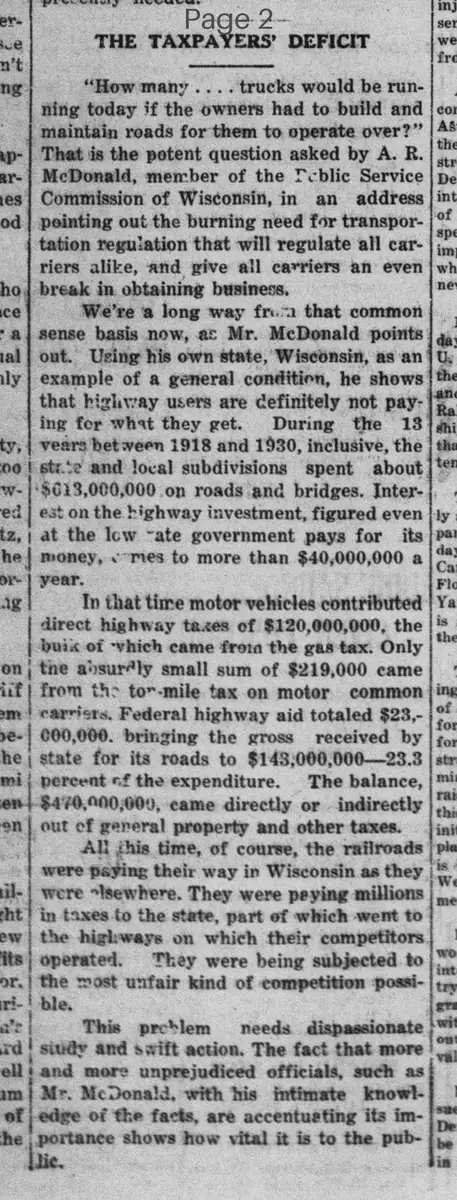
THE TAXPAYERS' DEFICIT
"How many . . . trucks would be running today if the owners had to build and maintain roads for them to operate over?"
That is the potent question asked by A. R. McDonald, member of the Public Service Commission of Wisconsin, in an address pointing out the burning need for transportation regulation that will regulate all carriers alike, and give all carriers an even break in obtaining business.
We're a long way from that common sense basis now, as Mr. McDonald points out. Using his own state, Wisconsin, as an example of a general condition, he shows that highway users are definitely not paying for what they get. During the 13 years between 1918 and 1930, inclusive, the state and local subdivisions spent about $613,000,000 on roads and bridges. Interest on the highway investment, figured even at the low rate government pays for its money, runs to more than $40,000,000 a year.
In that time motor vehicles contributed direct highway taxes of $120,000,000, the bulk of which came from the gas tax. Only the absurdly small sum of $219,000 came from the ton-mile tax on motor common carriers. Federal highway aid totaled $23,000,000, bringing the gross received by state for its roads to $143,000,000—23.3 percent of the expenditure. The balance, $470,000,000, came directly or indirectly out of general property and other taxes.
All this time, of course, the railroads were paying their way in Wisconsin as they were elsewhere. They were paying millions in taxes to the state, part of which went to the highways on which their competitors operated. They were being subjected to the most unfair kind of competition possible.
This problem needs dispassionate study and swift action. The fact that more and more unprejudiced officials, such as Mr. McDonald, with his intimate knowledge of the facts, are accentuating its importance shows how vital it is to the public.
"How many . . . trucks would be running today if the owners had to build and maintain roads for them to operate over?"
That is the potent question asked by A. R. McDonald, member of the Public Service Commission of Wisconsin, in an address pointing out the burning need for transportation regulation that will regulate all carriers alike, and give all carriers an even break in obtaining business.
We're a long way from that common sense basis now, as Mr. McDonald points out. Using his own state, Wisconsin, as an example of a general condition, he shows that highway users are definitely not paying for what they get. During the 13 years between 1918 and 1930, inclusive, the state and local subdivisions spent about $613,000,000 on roads and bridges. Interest on the highway investment, figured even at the low rate government pays for its money, runs to more than $40,000,000 a year.
In that time motor vehicles contributed direct highway taxes of $120,000,000, the bulk of which came from the gas tax. Only the absurdly small sum of $219,000 came from the ton-mile tax on motor common carriers. Federal highway aid totaled $23,000,000, bringing the gross received by state for its roads to $143,000,000—23.3 percent of the expenditure. The balance, $470,000,000, came directly or indirectly out of general property and other taxes.
All this time, of course, the railroads were paying their way in Wisconsin as they were elsewhere. They were paying millions in taxes to the state, part of which went to the highways on which their competitors operated. They were being subjected to the most unfair kind of competition possible.
This problem needs dispassionate study and swift action. The fact that more and more unprejudiced officials, such as Mr. McDonald, with his intimate knowledge of the facts, are accentuating its importance shows how vital it is to the public.
What sub-type of article is it?
Infrastructure
Economic Policy
Taxation
What keywords are associated?
Highway Taxes
Transportation Regulation
Railroad Competition
Road Maintenance Costs
Wisconsin Highways
Ton Mile Tax
Gas Tax
What entities or persons were involved?
A. R. Mcdonald
Public Service Commission Of Wisconsin
Railroads
Motor Vehicles
Wisconsin State Government
Editorial Details
Primary Topic
Need For Fair Transportation Regulation And Highway User Taxation
Stance / Tone
Advocacy For Equal Regulation Of Carriers And Increased Highway Funding From Users
Key Figures
A. R. Mcdonald
Public Service Commission Of Wisconsin
Railroads
Motor Vehicles
Wisconsin State Government
Key Arguments
Highway Users Contribute Only 23.3% Of Road Costs Via Direct Taxes From 1918 1930
Railroads Pay General Taxes That Subsidize Highways Used By Truck Competitors
Need For Regulation Treating All Carriers Equally To Ensure Fair Competition
Wisconsin Spent $613m On Roads, With $470m From General Taxes
Interest On Highway Investment Exceeds $40m Annually