Thank you for visiting SNEWPapers!
Sign up free
Literary
July 2, 1793
The New Hampshire Gazette
Portsmouth, Rockingham County, New Hampshire
What is this article about?
The Farmer, No. I introduces agriculture as vital for wealth in new settlements like Columbia, with the Gazette offering space for improvements. It extracts from Vattel's Law of Nations, stressing tillage's necessity, government's role in promoting cultivation, and harms from taxes, church land ownership, and urban contempt for farmers.
Clipping
OCR Quality
98%
Excellent
Full Text
The FARMER, No. I.
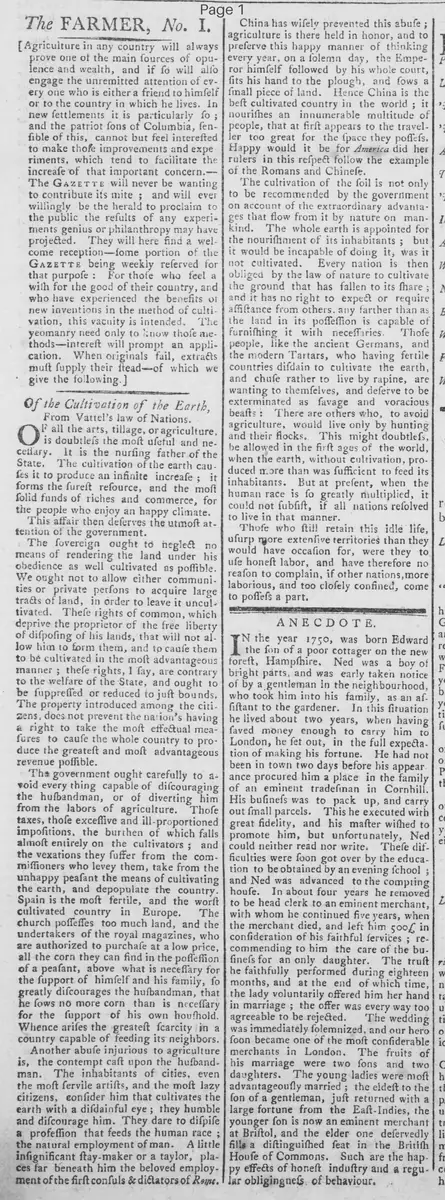
[Agriculture in any country will always prove one of the main sources of opulence and wealth, and if so will also engage the unremitted attention of every one who is either a friend to himself or to the country in which he lives. In new settlements it is particularly so; and the patriot sons of Columbia, sensible of this, cannot but feel interested to make those improvements and experiments, which tend to facilitate the increase of that important concern.-- The Gazette will never be wanting to contribute its mite: and will ever willingly be the herald to proclaim to the public the results of any experiments genius or philanthropy may have projected. They will here find a welcome reception--some portion of the Gazette being weekly reserved for that purpose: For those who feel a wish for the good of their country, and who have experienced the benefits of new inventions in the method of cultivation, this vacancy is intended. The yeomanry need only to know those methods--interest will prompt an application. When originals fail, extracts must supply their stead--of which we give the following.]
Of the Cultivation of the Earth.
From Vattel's Law of Nations.
Of all the arts, tillage, or agriculture, is doubtless the most useful and necessary. It is the nursing father of the State. The cultivation of the earth causes it to produce an infinite increase; it forms the surest resource, and the most solid funds of riches and commerce, for the people who enjoy a happy climate. This affair then deserves the utmost attention of the government. The sovereign ought to neglect no means of rendering the land under his obedience as well cultivated as possible. We ought not to allow either communities or private persons to acquire large tracts of land, in order to leave it uncultivated. These rights of common, which deprive the proprietor of the free liberty of disposing of his lands, that will not allow him to form them, and to cause them to be cultivated in the most advantageous manner; these rights, I say, are contrary to the welfare of the State, and ought to be suppressed or reduced to just bounds. The property introduced among the citizens, does not prevent the nation's having a right to take the most effectual measures to cause the whole country to produce the greatest and most advantageous revenue possible. The government ought carefully to avoid every thing capable of discouraging the husbandman, or of diverting him from the labors of agriculture. Those taxes, those excessive and ill-proportioned impositions, the burden of which falls almost entirely on the cultivators; and the vexations they suffer from the commissioners who levy them, take from the unhappy peasant the means of cultivating the earth, and depopulate the country. Spain is the most fertile, and the worst cultivated country in Europe. The church possesses too much land, and the undertakers of the royal magazines, who are authorized to purchase at a low price, all the corn they can find in the possession of a peasant, above what is necessary for the support of himself and his family, so greatly discourages the husbandman, that he sows no more corn than is necessary for the support of his own household. Whence arises the greatest scarcity in a country capable of feeding its neighbors. Another abuse injurious to agriculture is, the contempt cast upon the husbandman. The inhabitants of cities, even the most servile artists, and the most lazy citizens, consider him that cultivates the earth with a disdainful eye; they humble and discourage him. They dare to despise a profession that feeds the human race; the natural employment of man. A little insignificant stay-maker or a tailor, places far beneath him the beloved employment of the first consuls & dictators of Rome.
[Agriculture in any country will always prove one of the main sources of opulence and wealth, and if so will also engage the unremitted attention of every one who is either a friend to himself or to the country in which he lives. In new settlements it is particularly so; and the patriot sons of Columbia, sensible of this, cannot but feel interested to make those improvements and experiments, which tend to facilitate the increase of that important concern.-- The Gazette will never be wanting to contribute its mite: and will ever willingly be the herald to proclaim to the public the results of any experiments genius or philanthropy may have projected. They will here find a welcome reception--some portion of the Gazette being weekly reserved for that purpose: For those who feel a wish for the good of their country, and who have experienced the benefits of new inventions in the method of cultivation, this vacancy is intended. The yeomanry need only to know those methods--interest will prompt an application. When originals fail, extracts must supply their stead--of which we give the following.]
Of the Cultivation of the Earth.
From Vattel's Law of Nations.
Of all the arts, tillage, or agriculture, is doubtless the most useful and necessary. It is the nursing father of the State. The cultivation of the earth causes it to produce an infinite increase; it forms the surest resource, and the most solid funds of riches and commerce, for the people who enjoy a happy climate. This affair then deserves the utmost attention of the government. The sovereign ought to neglect no means of rendering the land under his obedience as well cultivated as possible. We ought not to allow either communities or private persons to acquire large tracts of land, in order to leave it uncultivated. These rights of common, which deprive the proprietor of the free liberty of disposing of his lands, that will not allow him to form them, and to cause them to be cultivated in the most advantageous manner; these rights, I say, are contrary to the welfare of the State, and ought to be suppressed or reduced to just bounds. The property introduced among the citizens, does not prevent the nation's having a right to take the most effectual measures to cause the whole country to produce the greatest and most advantageous revenue possible. The government ought carefully to avoid every thing capable of discouraging the husbandman, or of diverting him from the labors of agriculture. Those taxes, those excessive and ill-proportioned impositions, the burden of which falls almost entirely on the cultivators; and the vexations they suffer from the commissioners who levy them, take from the unhappy peasant the means of cultivating the earth, and depopulate the country. Spain is the most fertile, and the worst cultivated country in Europe. The church possesses too much land, and the undertakers of the royal magazines, who are authorized to purchase at a low price, all the corn they can find in the possession of a peasant, above what is necessary for the support of himself and his family, so greatly discourages the husbandman, that he sows no more corn than is necessary for the support of his own household. Whence arises the greatest scarcity in a country capable of feeding its neighbors. Another abuse injurious to agriculture is, the contempt cast upon the husbandman. The inhabitants of cities, even the most servile artists, and the most lazy citizens, consider him that cultivates the earth with a disdainful eye; they humble and discourage him. They dare to despise a profession that feeds the human race; the natural employment of man. A little insignificant stay-maker or a tailor, places far beneath him the beloved employment of the first consuls & dictators of Rome.
What sub-type of article is it?
Essay
What themes does it cover?
Agriculture Rural
Political
Taxation Oppression
What keywords are associated?
Agriculture
Cultivation
Government Policy
Taxation
Husbandman
Columbia
Vattel
What entities or persons were involved?
From Vattel's Law Of Nations
Literary Details
Title
The Farmer, No. I.
Author
From Vattel's Law Of Nations
Subject
On The Cultivation Of The Earth And Agriculture's Importance
Key Lines
Of All The Arts, Tillage, Or Agriculture, Is Doubtless The Most Useful And Necessary. It Is The Nursing Father Of The State.
The Government Ought Carefully To Avoid Every Thing Capable Of Discouraging The Husbandman, Or Of Diverting Him From The Labors Of Agriculture.
They Dare To Despise A Profession That Feeds The Human Race; The Natural Employment Of Man.