Thank you for visiting SNEWPapers!
Sign up free
Daily National Intelligencer
Washington, District Of Columbia
What is this article about?
In the U.S. House of Representatives in Philadelphia on December 6, debate occurred on resolutions by Mr. Forsyth requesting information on the Commissioner appointed under the act for paying military property losses, suspending its execution, and inquiring about payments. The first and third resolutions passed; the second was tabled. Mr. Williams's resolution for a committee inquiry into the Commissioner's decisions was also adopted.
Clipping
OCR Quality
Full Text
HOUSE OF REPRESENTATIVES
"Philadelphia, December 6."
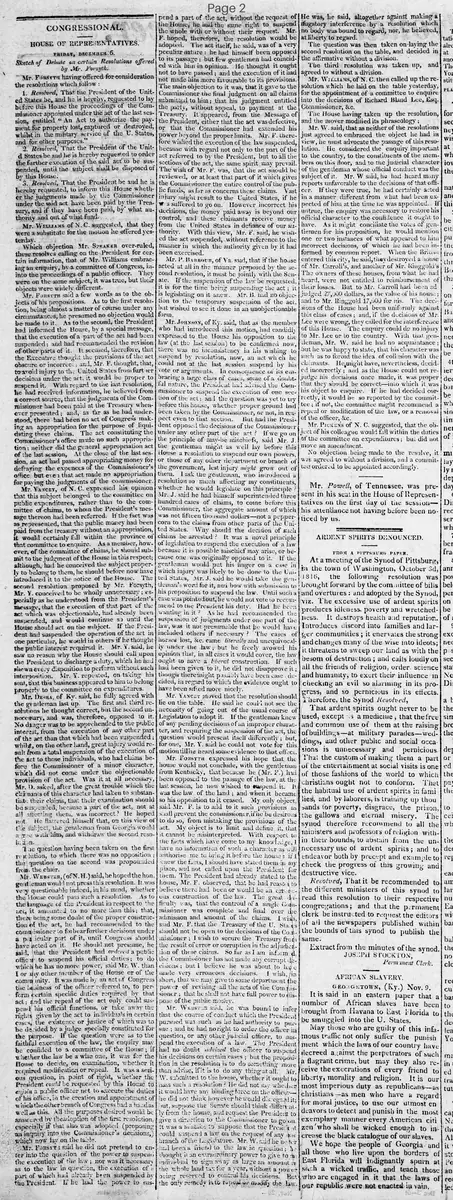
Sketch of Debate on certain Resolutions offered by Mr. Forsyth.
Mr. FORSYTH having offered for consideration the resolutions which follow:
1. Resolved, That the President of the United States be, and he is hereby, requested to lay before this House the proceedings of the Commissioner appointed under the act of the last session, entitled "An Act to authorize the payment for property lost, captured or destroyed, whilst in the military service of the U. States, and for other purposes."
2. Resolved, That the President of the United States be and he is hereby requested to order the further execution of the said act to be suspended, until the subject shall be disposed of by this House.
3. Resolved, That the President be and he is hereby requested, to inform this House whether the judgments made by the Commissioner under the said act have been paid by the Treasury, and if they have been paid, by what authority and out of what fund.
Mr. Williams of N. C. suggested, that they were a substitute for the motion he offered yesterday.
Which objection Mr. Speaker over-ruled.
These resolves calling on the President for certain information, that of Mr. Williams embracing an enquiry, by a committee of Congress, into the proceedings of a public officer. They were on the same subject, it was true, but their objects were widely different.
Mr. Forsyth said a few words as to the objects of his propositions. As to the first resolution, being almost a matter of course under any circumstances, he presumed no objection would be made to it. As to the second, the President had informed the House, by a special message, that the execution of a part of the act had been suspended; and had recommended the revision of other parts of it. It seemed, therefore, that the Executive thought the provisions of the act obscure or incorrect; and, Mr. F. thought, that, to avoid injury to the United States from further decisions under the act, it would be proper to suspend it. With regard to the last resolution, he had received information, he believed from a correct source, that the judgments of the Commissioner had been paid at the Treasury whenever presented; and, as far as he had understood, there had been no act of Congress making an appropriation for the purpose of liquidating these claims. The act constituting the Commissioner's office made no such appropriation; neither did the general appropriation act of the last session. At the close of the last session, an act had passed appropriating money for defraying the expences of the Commissioner's office, but even that act made no appropriation for paying the judgments of the commissioner.
Mr. Yancey, of N. C. expressed his opinion that this subject belonged to the committee on public expenditures, rather than to the committee of claims, to whom the President's message thereon had been referred. If the fact was as represented, that the public money had been paid from the treasury without an appropriation, it would certainly fall within the province of that committee to enquire. As a member, however, of the committee of claims, he should submit to the judgment of the House in this respect; although, had he conceived the subject properly to belong to them, he should before now have introduced it to the notice of the House. The second resolution proposed by Mr. Forsyth, Mr. Y. conceived to be wholly unnecessary; especially as he understood from the President's message, that the execution of that part of the act which was objectionable, had already been suspended, and would continue so until the House should act on the subject. If the President had suspended the operation of the act in one particular, he would in others if he thought the public interest required it. Mr. Y. said, he saw no reason why the House should call upon the President to discharge a duty, which he had shewn every disposition to perform without such interposition. Mr. Y. repeated, on taking his seat, that this business appeared to him to belong properly to the committee on expenditures.
Mr. Desha, of Ky. said, he fully agreed with the gentleman last up. The first and third resolutions he thought correct, but the second unnecessary, and was, therefore, opposed to it. No danger was to be apprehended to the public interest, from the execution of any other part of the act than that which had been suspended; whilst, on the other hand, great injury would result from a total suspension of the execution of the act to those individuals, who had claims before the Commissioner of a minor character, which did not come under the objectionable provision of the act. Was it at all necessary, Mr. D. asked, after the great trouble which the claimants of this character had taken to substantiate their claims, that their examination should be suspended, because a part of the act, not at all affecting them, was incorrect? He hoped not. He flattered himself that, on this view of the subject, the gentleman from Georgia would agree with him, and withdraw the second resolution.
The question having been taken on the first resolution, to which there was no opposition; the question on the second was propounded from the chair.
Mr. Webster, (of N.H.) said, he hoped the hon. gentleman would not press this resolution. It was very questionable indeed, in his mind, whether the House could pass such a resolution. As to the language of the President in respect to the act, it amounted to no more than this; that, there being some doubt of the proper construction of the act, he had recommended to the commissioner to forbear further decisions under a particular part of it, until Congress should have acted on it. He should not presume, he said, that the President had ordered a public officer to suspend his official duties; to do which he has no more power, said Mr. W. than I or any other member of the House or of the community. It was made by an act of Congress the business of the officer referred to, to perform certain specific duties required by that act; and the repeal of the act only could suspend his official functions, or take away the rights given by the act to individuals in certain cases, the existence or justice of which was to be decided by a judge specially constituted for the purpose. If the question were as to the faithful execution of the law, the enquiry may be confided to a committee of the House; if whether the law be a wise one, it was for the House to decide, on examination, whether it required modification or repeal. It was a serious question, in point of right, whether the President could be requested by this House to enjoin a public officer not to execute the duties of his office, in the creation and appointment of which the other branch of Congress had a hand as well as this. All the purposes desired would be answered by the adoption of the first resolution, especially if that also was adopted (proposing an inquiry into the Commissioner's decisions, which now lay on the table.)
Mr. FORSYTH said he did not pretend to enter into the question of the power to suspend the execution of the law; nor was it necessary as to the law in question, the execution of part of which had already been suspended by the President. If he had the power to suspend a part of the act: without the request of the House, he had the same right to suspend the whole with or without their request. Mr. F. hoped, therefore, the resolution would be adopted. The act itself, he said, was of a very peculiar nature: he had himself been opposed to its passage; but few gentlemen had coincided with him in opinion. He thought it ought not to have passed; and the execution of it had not made him more favourable to its provisions. The main objection to it was, that it gave to the Commissioner the final judgment on all claims submitted to him; that his judgment entitled the party, without appeal, to payment at the Treasury. It appeared, from the Message of the President, either that the act was defective, or that the Commissioner had extended his power beyond the proper limits. Mr. F. therefore wished the execution of the law suspended, because with regard not only to the part of the act referred to by the President, but to all the sections of the act, the same spirit may prevail. The wish of Mr. F. was, that the act should be reviewed, or at least that part of it which gives the Commissioner the entire control of the public funds, as far as concerns these claims. Vast injury might result to the United States, if he was suffered to go on. However incorrect his decisions, the money paid away is beyond our control, and these claimants receive money from the United States in defiance of our authority. With this view, Mr. F. said, he wished the act suspended, without reference to the manner in which the authority given by it had been exercised.
Mr. P. Barbour, of Va. said, that if the house acted at all in the manner proposed by the second resolution, it must be jointly with the Senate. If the suspension of the law be requested, it is for the time being suspending the act; it is legislating on it anew. Mr. B. had no objection to the temporary suspension of the act, but wished to see it done in an unobjectionable form.
Mr. Johnson, of Ky. said, that as the member who had introduced this motion, had candidly expressed to the House his opposition to the law (at the last session) to be confirmed now, there was no inconsistency in his wishing to suspend by resolution, now, an act which he could not at the last session suspend by his vote or arguments. In consequence of its embracing a large class of cases, some of a doubtful nature, the President had advised the Commissioner to suspend the execution of one section of the act; and the question was yet to try before this house, whether proper ground had been taken by the Commissioner, or not, in respect even to that section. But had the President opposed the decisions of the Commissioner under any other part of the act? If we go on the principle of may-be mischiefs, said Mr. J. the gentleman might as well lay before this House a resolution to suspend our own powers, or those of any other department or branch of the government, lest injury might grow out of them. I ask the gentleman, who introduced a resolution so much affecting my constituents, whether he would legislate on this principle. Mr. J. said he had himself superintended three hundred cases of claims, to come before this Commissioner, the aggregate amount of which was not fifteen thousand dollars--not a pepper corn to the claims from other parts of the United States. Why should the decision of such claims be arrested? It was a novel principle of legislation to suspend the execution of a law because it is possible mischief may arise, or because one was originally opposed to it. If the gentleman would put his finger on a case in which injury was likely to be done to the United States, Mr. J. said he would take the gentleman's word for it, and bow with submission to his proposition to suspend the law. Until such a case was pointed out, he would not vote to recommend to the President his duty. Had he been wanting in it? As he had recommended the suspension of judgments under one part of the law, was it not presumable that he would have included others if necessary? The cases of horses lost, &c. came literally and unequivocally under the law: but he freely avowed his opinion that, in all cases it would cover, the law ought to have a liberal construction. If such had been given to it, he did not disapprove it; though there might possibly have been cases, decided, in regard to which the evidence ought to have been sifted more nicely.
Mr. Yancey moved that the resolution should lie on the table. He said he could not see the necessity of going out of the usual course of Legislation to adopt it. If the gentleman knew of any pending decisions of an improper character, and requiring the suspension of the act, the question would present itself differently; but, for one, Mr. Y. said he could not vote for this motion till he heard some evidence to that effect.
Mr. Forsyth expressed his hope that the house would not conclude, with the gentleman from Kentucky, that because he (Mr. F.) had been opposed to the passage of the law, at the last session, he now wished to suspend it. It was the law of the land; and when it became so his opposition to it ceased. My only object, said Mr. F. is to add to it such provisions as shall prevent the commissioner, if he be desirous to do so, from mistaking the provisions of the act. My object is to limit and define it, that it cannot be misinterpreted. With respect to the facts which have come to my knowledge, I have no information of such a character as will authorise me to bring it before the house if I knew the facts, I should have stated them in my place, and not called upon the President for them. The President had already stated to the house, Mr. F. observed, that he had reason to believe there had been or would be an erroneous construction of the law. The great difficulty was, that the controul of a single Commissioner was complete and final over the admission and amount of the claims. I wish, said Mr. F. that the Treasury of the U. States should not be open to the decisions of the Commissioner; I wish to secure the Treasury from the result of error or corruption in the adjudication of these claims. So far as I am informed, the Commissioner has not made any corrupt decisions; but I believe he was about to have made very erroneous decisions. I wish, in short, that we may give to some department the power of revising all the acts of the Commissioner; that he shall not have full power to dispose of the public money.
Mr. Webster said, he was bound to infer that the course of conduct which the President pursued was such as he had authority to pursue; and he had no right to order the officer in question, or any other judicial officer, to suspend the execution of a law. The President had no doubt advised the officer to suspend his decisions on certain cases; but the proposition in the resolution is to do something more than advise, if it is to do any thing at all. Mr. W. submitted to the house, whether it ought to pass such a resolution? He did not say whether it would have any binding force on the officer--he did not think however he would disregard it; but, suppose the Senate should think differently from the house, and request the President to give a direction to the Commissioner to go on. It was a mistake to suppose that the President could suspend a law on the request of any one branch of the Legislature. Mr. W. said he never had been a friend to the law in question; he thought it an extraordinary power to give to an individual to sign away as large an amount the whole land tax for a year, without a power being reserved to control his decisions. But the only remedy is to repeal or modify the law.
He was, he said, altogether against making a nugatory interference by a resolution which no body was bound to regard, nor, he believed, at liberty to regard.
The question was then taken on laying the second resolution on the table, and decided in the affirmative without a division.
The third resolution was taken up, and agreed to without a division.
Mr. Williams, of N. C. then called up the resolution which he laid on the table yesterday, for the appointment of a committee to enquire into the decisions of Richard Bland Lee, Esq. Commissioner, &c.
The House having taken up the resolution, and the mover modified its phraseology; Mr. W. said, that as neither of the resolutions just agreed to embraced the object he had in view, he must advocate the passage of this resolution. He considered the enquiry important to the country, to the constituents of the members on this floor, and to the judicial character of the gentleman whose official conduct was the subject of it. Mr. W said, he had heard many reports unfavorable to the decisions of that officer. If they were true, he had certainly acted in a manner different from what had been expected of him at the time he was appointed. If untrue, the enquiry was necessary to restore his official character to the confidence it ought to have. As it might conciliate the votes of gentlemen for his proposition, he would mention one or two instances of what appeared to him incorrect decisions, of which he had been informed by common report. When the British entered this city, he said, they destroyed a house of Mr. Carroll's, and another of Mr. Ringgold's. The owners of these houses, from what he had heard, were not entitled to reimbursement of their losses. But to Mr. Carroll had been adjudged 27,000 dollars, as the value of his house; and to Mr. Ringgold 17,000 for his. The decisions of the House had been uniformly against this class of cases: and, if the decisions of Mr. Lee were wrong, they called for the interference of this House. The enquiry could do no injury to Mr. Lee or to the country. With that gentleman, Mr. W. said he had no acquaintance; but he was happy to state, that his character was such as to forbid the idea of collusion with the claimants. He might have, nevertheless, decided incorrectly; and as the House could not review his decisions once made, it was proper that they should be correct--into which it was his object to enquire. If he had decided correctly, it would be so reported by the committee; if not, the committee might recommend a repeal or modification of the law, or a removal of the officer, &c.
Mr. Pickens of N. C. suggested, that the object of his colleague would fall within the duties of the committee on expenditures; but did not move an amendment.
No objection being made to the resolve, it was agreed to without a division, and a committee ordered to be appointed accordingly.
What sub-type of article is it?
What keywords are associated?
What entities or persons were involved?
Where did it happen?
Domestic News Details
Primary Location
Philadelphia
Event Date
December 6
Key Persons
Outcome
first resolution passed without opposition; second resolution laid on the table without division; third resolution agreed to without division; mr. williams's resolution for committee inquiry adopted without division.
Event Details
Debate in the House of Representatives on resolutions by Mr. Forsyth requesting presidential information on the Commissioner's proceedings under the act for military property losses, suspension of the act's execution, and details on payments from the Treasury without appropriation. Objections raised on necessity and constitutionality of suspension; concerns about erroneous decisions and public funds. Mr. Williams's resolution for committee to inquire into Commissioner's decisions, citing examples like awards to Mr. Carroll and Mr. Ringgold, also passed.