Thank you for visiting SNEWPapers!
Sign up free
Editorial
January 4, 1800
Gazette Of The United States, & Philadelphia Daily Advertiser
Philadelphia, Philadelphia County, Pennsylvania
What is this article about?
This editorial sharply criticizes Pennsylvania Secretary Alexander J. Dallas for delaying repayment of $22,000 in state funds from the 1794 Whiskey Rebellion expedition, questions his financial diligence and motives, and accuses him of political opportunism influenced by French interests as described in Fauchet's letters.
Clipping
OCR Quality
95%
Excellent
Full Text
letters, and widely obtains from making any answer to the queries of Cerberus, although they relate to the same subject; enable him if he is really innocent at once to exculpate himself, and abash his accusers, and obviously afford a clue to all the charges preferred against him by Manlius.
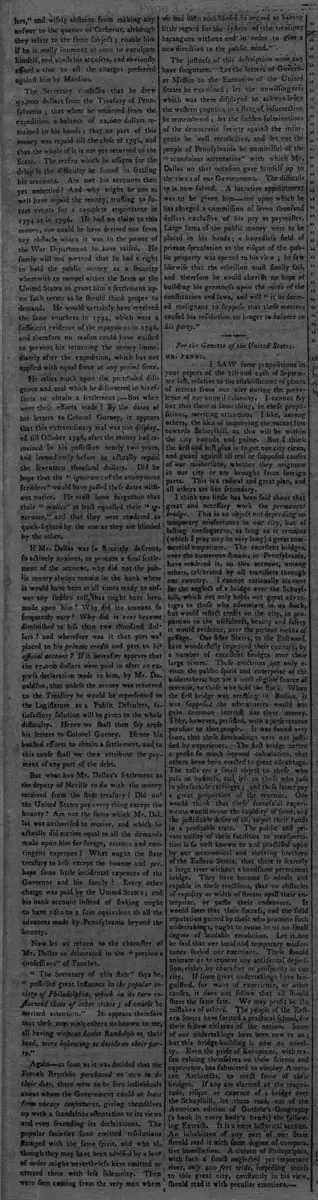
The Secretary confesses that he drew 92,000 dollars from the Treasury of Pennsylvania; that when he returned from the expedition a balance of 22,000 dollars remained in his hands; that no part of this money was repaid till the close of 1796, and that the whole of it is not yet returned to the State. The reason which he assigns for the delay is the difficulty he found in settling his accounts. Are not his accounts then yet unsettled? And why might he not as well have repaid the money, trusting to future events for a complete acquittance in 1794 as in 1796. He had no claim to this money, nor could he have derived one from any obstacle which it was in the power of the War Department to have raised. He surely will not pretend that he had a right to hold the public money as a security wherewith to compel either the State or the United States to grant him a settlement upon such terms as he should think proper to demand. He would certainly have received the same vouchers in 1794, which were a sufficient evidence of the repayment in 1796, and therefore no reason could have existed to prevent his returning the money immediately after the expedition, which has not applied with equal force at any period since.
He relies much upon the pretended diligence and zeal which he discovered in his efforts to obtain a settlement;—But when were these efforts made? By the dates of his letters to Colonel Gurney, it appears that this extraordinary zeal was not displayed till October 1796, after the money had remained in his possession nearly two years, and immediately before he actually repaid the seventeen thousand dollars. Did he hope that the "ignorance of the anonymous scribblers" would have passed these dates without notice. He must have forgotten that their "malice" at least equalled their "ignorance," and that they were rendered as quick-sighted by the one as they are blinded by the other.
If Mr. Dallas was so sincerely desirous, so actively anxious, to procure a final settlement of the account, why did not the public money always remain in the bank where it would have been at all times ready to answer any sudden call, that might have been made upon him? Why did its amount so frequently vary? Why did it ever become diminished to less than two thousand dollars? and wherefore was it that part was placed to his private credit and part to his official account? If it hereafter appears that the 17,000 dollars were paid in after an express declaration made to him, by Mr. Donaldson, that unless the money was returned to the Treasury he would be represented to the Legislature as a Public Defaulter, satisfactory solution will be given to the whole difficulty. Hence we shall then say arose his letters to Colonel Gurney. Hence his boasted efforts to obtain a settlement, and to this cause shall we then attribute the payment of any part of the debt.
But what has Mr. Dallas's settlement as the deputy of Neville to do with the money received from the state treasury? Did not the United States pay every thing except the bounty? Are not the sums which Mr. Dallas was authorized to receive, and which he actually did receive equal to all the demands made upon him for forage, rations and contingent expenses? What ought the state treasury to lose except the bounty and perhaps some little incidental expenses of the Governor and his family? Every other charge was paid by the United States; and his bank account instead of sinking ought to have risen to a sum equivalent to all the advances made by Pennsylvania beyond the bounty.
Now let us return to the character of Mr. Dallas as delineated in the "precious confessions" of Fauchet.
"The Secretary of this state" says he, "possessed great influence in the popular society of Philadelphia, which in its turn influenced those of other states; of course he merited attention." It appears therefore that these men with others unknown to me, all having without doubt Randolph at their head, were balancing to decide on their party."
Again as soon as it was decided that the French Republic purchased no men to do their duty, there were to be seen individuals about whom the Government could at least form uneasy conjectures, giving themselves up with a scandalous ostentation to its views and even seconding its declarations. The popular societies soon emitted resolutions tempered with the same spirit, and who although they may have been advised by a love of order might nevertheless have omitted or uttered them with less solemnity. Then were seen coming from the very men whom we had been accustomed to regard as having little regard for the system of the treasurer harangues without end in order to give a new direction to the public mind.":
The justness of this description none can have forgotten. "Let the letters of Governor Mifflin to the Executive of the United States be examined; let the unwillingness which was there displayed to acknowledge the western counties in a state of insurrection be remembered; let the sudden fulminations of the democratic society against the insurgents be well recollected, and let not the people of Pennsylvania be unmindful of the "scandalous ostentation" with which Mr. Dallas on that occasion gave himself up to the views of our Government. The difficulty is now solved. A lucrative appointment was to be given him one upon which he has charged a commission of seven thousand dollars exclusive of his pay as paymaster. Large sums of the public money were to be placed in his hands: a boundless field of private peculation at the risque of the public property was opened to his view; he saw likewise that the rebellion must finally fail, and therefore he could cherish no hope of building his greatness upon the ruins of the constitution and laws, and will it be deemed malignant to suppose that these motives caused his resolution no longer to balance on his party."
The Secretary confesses that he drew 92,000 dollars from the Treasury of Pennsylvania; that when he returned from the expedition a balance of 22,000 dollars remained in his hands; that no part of this money was repaid till the close of 1796, and that the whole of it is not yet returned to the State. The reason which he assigns for the delay is the difficulty he found in settling his accounts. Are not his accounts then yet unsettled? And why might he not as well have repaid the money, trusting to future events for a complete acquittance in 1794 as in 1796. He had no claim to this money, nor could he have derived one from any obstacle which it was in the power of the War Department to have raised. He surely will not pretend that he had a right to hold the public money as a security wherewith to compel either the State or the United States to grant him a settlement upon such terms as he should think proper to demand. He would certainly have received the same vouchers in 1794, which were a sufficient evidence of the repayment in 1796, and therefore no reason could have existed to prevent his returning the money immediately after the expedition, which has not applied with equal force at any period since.
He relies much upon the pretended diligence and zeal which he discovered in his efforts to obtain a settlement;—But when were these efforts made? By the dates of his letters to Colonel Gurney, it appears that this extraordinary zeal was not displayed till October 1796, after the money had remained in his possession nearly two years, and immediately before he actually repaid the seventeen thousand dollars. Did he hope that the "ignorance of the anonymous scribblers" would have passed these dates without notice. He must have forgotten that their "malice" at least equalled their "ignorance," and that they were rendered as quick-sighted by the one as they are blinded by the other.
If Mr. Dallas was so sincerely desirous, so actively anxious, to procure a final settlement of the account, why did not the public money always remain in the bank where it would have been at all times ready to answer any sudden call, that might have been made upon him? Why did its amount so frequently vary? Why did it ever become diminished to less than two thousand dollars? and wherefore was it that part was placed to his private credit and part to his official account? If it hereafter appears that the 17,000 dollars were paid in after an express declaration made to him, by Mr. Donaldson, that unless the money was returned to the Treasury he would be represented to the Legislature as a Public Defaulter, satisfactory solution will be given to the whole difficulty. Hence we shall then say arose his letters to Colonel Gurney. Hence his boasted efforts to obtain a settlement, and to this cause shall we then attribute the payment of any part of the debt.
But what has Mr. Dallas's settlement as the deputy of Neville to do with the money received from the state treasury? Did not the United States pay every thing except the bounty? Are not the sums which Mr. Dallas was authorized to receive, and which he actually did receive equal to all the demands made upon him for forage, rations and contingent expenses? What ought the state treasury to lose except the bounty and perhaps some little incidental expenses of the Governor and his family? Every other charge was paid by the United States; and his bank account instead of sinking ought to have risen to a sum equivalent to all the advances made by Pennsylvania beyond the bounty.
Now let us return to the character of Mr. Dallas as delineated in the "precious confessions" of Fauchet.
"The Secretary of this state" says he, "possessed great influence in the popular society of Philadelphia, which in its turn influenced those of other states; of course he merited attention." It appears therefore that these men with others unknown to me, all having without doubt Randolph at their head, were balancing to decide on their party."
Again as soon as it was decided that the French Republic purchased no men to do their duty, there were to be seen individuals about whom the Government could at least form uneasy conjectures, giving themselves up with a scandalous ostentation to its views and even seconding its declarations. The popular societies soon emitted resolutions tempered with the same spirit, and who although they may have been advised by a love of order might nevertheless have omitted or uttered them with less solemnity. Then were seen coming from the very men whom we had been accustomed to regard as having little regard for the system of the treasurer harangues without end in order to give a new direction to the public mind.":
The justness of this description none can have forgotten. "Let the letters of Governor Mifflin to the Executive of the United States be examined; let the unwillingness which was there displayed to acknowledge the western counties in a state of insurrection be remembered; let the sudden fulminations of the democratic society against the insurgents be well recollected, and let not the people of Pennsylvania be unmindful of the "scandalous ostentation" with which Mr. Dallas on that occasion gave himself up to the views of our Government. The difficulty is now solved. A lucrative appointment was to be given him one upon which he has charged a commission of seven thousand dollars exclusive of his pay as paymaster. Large sums of the public money were to be placed in his hands: a boundless field of private peculation at the risque of the public property was opened to his view; he saw likewise that the rebellion must finally fail, and therefore he could cherish no hope of building his greatness upon the ruins of the constitution and laws, and will it be deemed malignant to suppose that these motives caused his resolution no longer to balance on his party."
What sub-type of article is it?
Partisan Politics
Economic Policy
Foreign Affairs
What keywords are associated?
Dallas Criticism
Public Funds Delay
Whiskey Rebellion
Fauchet Letters
Political Opportunism
Pennsylvania Treasury
French Influence
What entities or persons were involved?
Mr. Dallas
Governor Mifflin
Fauchet
Randolph
Neville
Manlius
Cerberus
Colonel Gurney
Mr. Donaldson
Editorial Details
Primary Topic
Criticism Of Mr. Dallas's Financial Misconduct And Political Opportunism During The Whiskey Rebellion
Stance / Tone
Strongly Critical And Accusatory
Key Figures
Mr. Dallas
Governor Mifflin
Fauchet
Randolph
Neville
Manlius
Cerberus
Colonel Gurney
Mr. Donaldson
Key Arguments
Dallas Delayed Repaying $22,000 State Funds From 1794 Expedition Until 1796 Without Justification
His Zeal For Settlement Only Shown In Late 1796 After Holding Funds For Nearly Two Years
Funds Were Mismanaged, Varying In Amount And Placed In Private Accounts
Dallas's Actions Tied To Pro French Influences And Political Balancing As Per Fauchet's Letters
Shift In Loyalty Due To Lucrative Appointment And Failure Of Rebellion
United States Covered Most Expenses, So State Should Not Lose Beyond Bounty