Thank you for visiting SNEWPapers!
Sign up free
Gazette Of The United States, & Philadelphia Daily Advertiser
Philadelphia, Philadelphia County, Pennsylvania
What is this article about?
U.S. House of Representatives proceedings on February 23, 1798: Passed bill for widows and orphans of deceased officers; received Treasury report; considered petitions on postage and compensation; debated and rejected expulsion of Reps. Griswold and Lyon, censuring Lyon for disorderly conduct; referred President's message on Washington, D.C. development; included committee report and witness testimonies on the incident.
Merged-components note: These components form a single coherent report on congressional proceedings regarding the Lyon-Griswold incident, including debate, committee report, and testimonies. Original labels were 'domestic_news' for the first and 'story' for the others; unified under 'domestic_news' as it fits local/national non-story news from Congress. Sequential reading orders (49-52) and continuous text flow.
Clippings
1 of 2
OCR Quality
Full Text
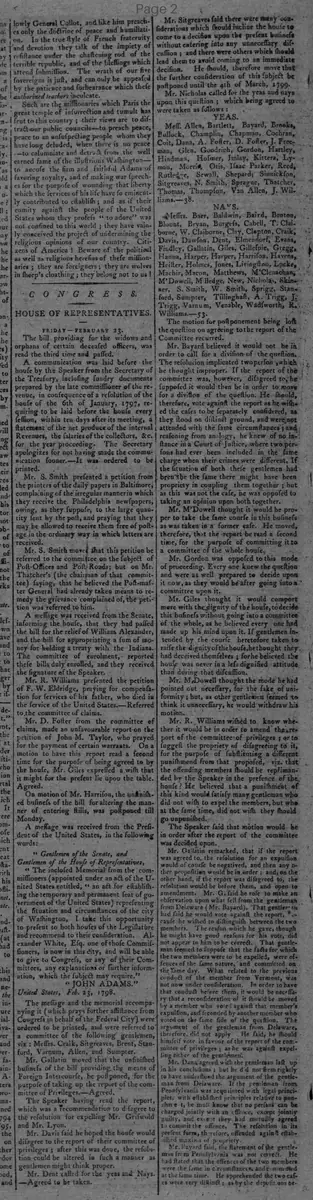
HOUSE OF REPRESENTATIVES.
FRIDAY, FEBRUARY 23.
The bill providing for the widows and orphans of certain deceased officers, was read the third time and passed.
A communication was laid before the house by the Speaker from the Secretary of the Treasury, enclosing sundry documents prepared by the late commissioner of the revenue, in consequence of a resolution of the house of the 6th of January, 1797, requiring to be laid before the house every session, within ten days after its meeting, a statement of the net produce of the internal Revenues, the salaries of the collectors, &c. for the year preceding- The Secretary apologizes for not having made the communication sooner.--It was ordered to be printed.
Mr. S. Smith presented a petition from the printers of the daily papers in Baltimore, complaining of the irregular manner in which they receive the Philadelphia newspapers, owing, as they suppose, to the large quantity sent by the post, and praying that they may be allowed to receive them free of postage in the ordinary way in which letters are received.
Mr. S. Smith moved that this petition be referred to the committee on the subject of Post-Offices and Post Roads; but on Mr. Thatcher's (the chairman of that committee) saying, that he believed the Post-master General had already taken means to remedy the grievance complained of, the petition was referred to him.
A message was received from the Senate, informing the house, that they had passed the bill for the relief of William Alexander, and the bill for appropriating a sum of money for holding a treaty with the Indians.
The committee of enrolment, reported these bills duly enrolled, and they received the signature of the Speaker.
Mr. R. Williams presented the petition of F. W. Eldridge, praying for compensation for services of his father, who died in the service of the United States.-Referred to the committee of claims.
Mr. D. Foster from the committee of claims, made an unfavourable report on the petition of John M. Taylor, who prayed for the payment of certain warrants. On a motion to have this report read a second time for the purpose of being agreed to by the house, Mr. Giles expressed a wish that it might for the present lie upon the table. Agreed.
On motion of Mr. Harrison, the unfinished business of the bill for altering the manner of entering stills, was postponed till Monday.
A message was received from the President of the United States, in the following words:
"Gentlemen of the Senate, and Gentlemen of the House of Representatives.
"The enclosed Memorial from the commissioners (appointed under an act of the U. nited States entitled, "an act for establishing the temporary and permanent seat of government of the United States) representing the situation and circumstances of the city of Washington, I take this opportunity to present to both houses of the Legislature and recommend to their consideration. Alexander White, Esq. one of those Commissioners, is now in this city, and will be able to give to Congress, or any of their Committees, any explanations or further information, which the subject may require."
"JOHN ADAMS."
United States, Feb. 23, 1798.
The message and the memorial accompanying it (which prays further assistance from Congress in behalf of the Federal City) were ordered to be printed, and were referred to a committee of the following gentlemen, viz: Messrs. Craik, Sitgreaves, Brent, Stanford, Varnum, Allen, and Sumpter.
Mr. Gallatin moved that the unfinished business of the bill providing the means of Foreign Intercourse, be postponed, for the purpose of taking up the report of the committee of Privileges.-Agreed.
The Speaker having read the report, which was a recommendation to disagree to the resolution for expelling Mr. Griswold and Mr. Lyon.
Mr. Davis said he hoped the house would disagree to the report of their committee of privileges; after this was done, the resolution could be altered in such a manner as gentlemen might think proper.
Mr. Dent called for the yeas and Nays. -Agreed to be taken.
Mr. Sitgreaves said there were many considerations which should incline the house to come to a decision upon the present business without entering into any unnecessary discussion; and there were others which should lead them to avoid coming to an immediate decision. He should, therefore move that the further consideration of this subject be postponed until the 4th of March, 1799.
Mr. Nicholas called for the yeas and nays upon this question; which being agreed to were taken as follows:
YEAS.
Mess. Allen, Bartlett, Bayard, Brooks Bullock, Champlin, Chapman, Cochran, Coit, Dana, A. Foster, D. Foster, J. Freeman, Glen, Goodrich, Gordon, Hartley, Hindman, Homer, Imlay, Kittera, Lyman, Morris, Otis, Isaac Parker, Reed, Rutledge, Sewall, Shepard, Sinnickson, Sitgreaves, N. Smith, Sprague, Thatcher, Thomas, Thompson, Van Allen, J. Williams.38.
NAYS.
Mess. Baer, Baldwin, Baird, Benton. Blount, Bryan, Burgess, Cabell, T. Claiborne, W. Claiborne, Clay, Clopton, Craik, Davis, Dawson, Dent, Elmendorf, Evans, Findley, Gallatin, Giles, Gillespie, Gregg, Hanna, Harper, Harper, Harrison, Havens, Heister, Holmes, Jones, Livingston, Locke, Machir, Macon, Matthews, M'Clenachan, M'Dowell, M'Iledge, New, Nicholas, Skinner, S. Smith, W. Smith, Sprigg, Stanford, Sumpter, Tillinghast, A. Trigg, J Trigg, Varnum, Venable, Wadsworth, R. Williams.53.
The motion for postponement being lost the question on agreeing to the report of the Committee recurred.
Mr. Bayard believed it would not be in order to call for a division of the question. The resolution implicated two persons, which he thought improper. If the report of the committee was, however, disagreed to, he supposed it would then be in order to move for a division of the question. He should, therefore, vote against the report as he wished the cases to be separately considered, as they stood on distinct ground, and were not attended with the same circumstances; and reasoning from analogy, he knew of no instance in a Court of Justice, where two persons had ever been included in the same charge when their crimes were different. If the situation of both these gentlemen had been the same there might have been propriety in coupling them together; but as this was not the case, he was opposed to taking an opinion upon both together.
Mr. M'Dowell thought it would be proper to take the same course in this business as was taken in a former case. He moved, therefore, that the report be read a second time, for the purpose of committing it to a committee of the whole house.
Mr. Gordon was opposed to this mode of proceeding. Every one knew the question and were as well prepared to decide upon it now, as they would be after going into a committee upon it.
Mr. Giles thought it would comport more with the dignity of the house, to decide this business without going into a committee of the whole, as he believed every one had made up his mind upon it. If gentlemen intended by the course heretofore taken to raise the dignity of the house, he thought they had deceived themselves; for he believed the house was never in a less dignified attitude than during that discussion.
Mr. M. Dowell thought the mode he had pointed out necessary, for the sake of uniformity; but, as other gentlemen seemed to think it unnecessary, he would withdraw his motion.
Mr. R. Williams wished to know whether it would be in order to amend the report of the committee of privileges; or to suggest the propriety of disagreeing to it, for the purpose of substituting a different punishment from that proposed, viz. that the offending members should be reprimanded by the Speaker in the presence of the house? He believed that a punishment of this kind would satisfy many gentlemen who did not wish to expel the members, but who at the same time, did not wish they should go unpunished.
The Speaker said that motion would be in order after the report of the committee was decided upon.
Mr. Gallatin remarked, that if the report was agreed to, the resolution for an expulsion would of course be negatived, and then any other proposition would be in order; and; on the other hand, if the report was disagreed to, the resolution would be before them, and open to amendment. Mr. G. said he rose to make an observation upon what fell from the gentleman from Delaware (Mr. Bayard). That gentleman had said he would vote against the report, because he wished to distinguish between the two members. The reason which he gave, though he might have good reasons for his vote, did not appear to him to be correct. That gentleman seemed to suppose that the facts for which the two members were to be expelled, were offences of the same nature, and committed on the same day. What related to the previous conduct of the member from Vermont, was not now under consideration. In order to have that conduct before them, it would be necessary that a reconsideration of it should be moved by a member who voted against that member's expulsion, and seconded by another member who voted on the same side of the question. The argument of the gentleman from Delaware, therefore, did not apply He said, he should himself vote in favour of the report of the committee of privileges; as he was against expelling either of the gentlemen.
Mr. Dana agreed with the gentleman last up in his conclusions: but he did not seem rightly to have understood the argument of the gentleman from Delaware. If the gentleman from Pennsylvania was acquainted with legal principles, with established principles relative to punishment, he must know that no person can be charged jointly with an offence, except jointly guilty, and except they had mutually agreed to commit the offence. The resolution in its present form, therefore, offended against established maxims of propriety.
Mr. Bayard said, the statement of the gentleman from Pennsylvania was not correct. He had stated that the offences of the two members were the same in circumstance, and committed at the same time. He apprehended the two cases were very distinct; as by the depositions before them, the conduct of the member from Connecticut was not implicated in the affair of the 30th of January; and the resolution now before the house related solely to that affair. The previous conduct of the member from Vermont was not now the subject of discussion; and if it were intended to bring it forward, it must be done in a parliamentary way, by a motion for reconsideration, which could only be made by a member who voted on the prevailing side of the question on that occasion. The resolution, therefore did not charge the two members jointly with the same offence; but each with a breach of the privileges of the house, committed on the 30th of January; and the only question was, whether their cases should be taken up together or separately. He was in favour of taking them up separately, because he believed there was a material difference between them; and he did not wish to vote under the responsibility of punishing both, when he thought one less culpable than the other. He was in favour of dividing the question, because he wished to vote for the punishment of one, and against that of the other; and he trusted the house would divide it, that every member might be at liberty to vote according to the opinion he entertained of the conduct of each.
The question being then called for, and the yeas and nays, on motion of Mr. Claiborne, the house divided; and there appeared
YEAS
for agreeing to the report
Messrs. Allen, Ames, Bartlett, Bayard, Brooks, Bullock, Champlin, Chapman, Cochran, Coit, Dana, A. Foster, D. Foster, J. Freeman, Glen, Goodrich, Gordon, Grout, Hartley, Hindman, Homer, Imlay, Kittera, Lyman, Morris, Otis, Isaac Parker, Reed, Rutledge, Sewall, Shepard, Sinnickson, Sitgreaves, N. Smith, Southard, Sprague, Thatcher, Thomas, Thompson, Van Allen, Wadsworth, J. Williams— 43.
NAYS
for disagreeing to the report
Messrs. Baldwin, Baird, Benton, Blount, Bryan, Burgess, Cabell, T. Claiborne, W. Claiborne, Clay, Clopton, Craik, Davis, Dawson, Dent, Elmendorf, Evans, Findley, Gallatin, Giles, Gillespie, Gregg, Hanna, Harper, Harper, Harrison, Hart, Haven, Heister, Holmes, Jones, Livingston, Locke, Machir, Macon, Matthews, M'Clenachan, M'Dowell, Mitchell, M'Iledge, New, Nicholas, Skinner, S. Smith, W. Smith, Sprigg, Stanford, Sumpter, Tillinghast, A. Trigg, J. Trigg, Varnum, Venable, R. Williams— 54.
So the report was disagreed to.
Mr. Bayard then moved for a division of the question on the resolution, which being agreed to, the question was first taken on so much of the resolution as related to Mr. Lyon, and passed in the affirmative— yeas 52, nays 44.
The question was then taken on so much as related to Mr. Griswold, and passed in the negative— yeas 45, nays 52.
Mr. Bayard then moved to amend the resolution, by striking out the word "expel" and inserting "censure"— which was agreed to— yeas 52, nays 44.
The resolution as amended was then agreed to— yeas 52, nays 44.
Mr. Lyon then rose and addressed the chair, stating that he had acted from the best of motives, and that he was sorry for what had happened, but that he did not regret having done what he had done, as he believed it was his duty.
The Speaker then reprimanded Mr. Lyon in the following words:
"Mr. Lyon, the house has determined that you be censured for a breach of the privileges of this house, and for conduct highly indecorous and unbecoming a member of this house. You will take notice of this censure, and govern yourself accordingly."
Before the house, it appeared that the member from Connecticut was committed before the house was called to order, and that the offence of the member from Vermont was committed after the house was called to order. The argument most depended upon in a former case, against the expulsion of the member from Vermont, was that which insisted that the act of violence complained of, being committed when the house was not in session, was not a cause of expulsion. If this argument had weight at that time, it ought also to have weight in the present case. It would therefore, be the height of injustice to blend the two cases together; since there might be cause for expelling one member, and not the other.
The Speaker observed that every thing which had been said with respect to a division of the question was out of order, as it could not be divided. He would also remark, in order to shorten the debate, that the house was not called to order when the stroke was made by the member from Vermont, upon the member from Connecticut without the bar of the house.
Mr. Harper asked if the report of the committee should not be agreed to, whether the resolution might not then be agreed to?
The Speaker replied, it could not be divided; but a separate resolution might be brought forward.
The question on agreeing to the report of the committee, which recommended a disagreement to the resolution, for an expulsion of the two members, was then taken by yeas and nays as follows:
YEAS.
Messrs. Allen, Baldwin, Bartlett, Brent, Brooke, Bullock, Cabell, Champlin, Chapman, T. Claiborne, W. C. Claiborne, Clay, Clopton, Cochran, Coit, Dana, Dawson, Elmendorf, Findley, A. Foster, D. Foster, Fowler, J. Freeman, Gallatin, Giles, Gillespie, Glen, Goodrich, Gordon, Gregg, Hanna, Harrison, Hartley, Havens, Hindman, Homer, Imlay, Jones, Livingston, Locke, Lyman, Macon, M'Clenachan, M'Dowell, Milledge, Morris, New, Nicholas, Otis, Isaac Parker, Read, Rutledge, Sewall, Shepard, Sinnickson, Sitgreaves, Skinner, N. Smith, S. Smith, W. Smith, Sprague, Sprigg, Stanford, Sumter, Thatcher, Thomas, Thompson, A. Trigg, Van Allen, Varnum, Venable, J. Williams, R. Williams—73.
NAYS.
Messrs. Baer, Bard, Bayard, Benton, Blount, Bryan, Burgess, Craik, Dent, Davis, Evans, Grove, Harper, Heister, Holmes, Kittera, Machir, Matthews, Tillinghast, J. Trigg, Wadsworth—21.
The resolution for an expulsion having been disagreed to,
Mr. R. Williams proposed a resolution in the following words:
"Resolved, That Roger Griswold and Matthew Lyon, for riotous and disorderly behaviour in this house, are highly censurable, and that they be reprimanded by the Speaker in the presence of the house."
Mr. Harper moved the previous question upon this resolution. He did it, he said, upon this ground. The house had just decided, and they had lately decided in another instance, that disorderly conduct shall not be punished by expulsion; and it was his opinion that no less punishment than expulsion ought to be inflicted, as he was unwilling to diminish the repressive power of the house, by inflicting what he thought inadequate punishment for the offence. If there were any gentlemen who thought this conduct excusable, and that it ought not to be punished, they would, of course, vote in favour of the previous question; and those who thought with him, that both ought to be expelled, would also vote in favour of it.
Mr. Nicholas called for the yeas and nays upon this question. Agreed to be taken.
Mr. Gallatin said, by the gentleman from S. Carolina's having moved the previous question, he had excluded any discussion upon the merits of the main question. Mr. G. wished some reasons might be given why the main question ought not to be put. Those given by the gentleman from S. Carolina were applicable to the resolution itself; they were reasons why he should vote against the resolution, but they did not strike him as reasons why the question should not at all be taken.
The previous question was then put in this form, "Shall the main question (viz. the resolution for reprimanding the offending members) now be put?" And the yeas and nays were taken as follow:
YEAS.
Messrs. Baldwin, Bard, Benton, Blount, Brent, Bryan, Burgess, Cabell, T. Claiborne, W. C. Claiborne, Clay, Clopton, Davis, Dawson, Elmendorf, Findley, Fowler, N. Freeman, Gallatin, Giles, Gillespie, Gregg, Hanna, Harrison, Havens, Heister, Holmes, Jones, Livingston, Locke, Macon, M'Clenachan, M'Dowell, Milledge, New, Nicholas, Skinner, S. Smith, W. Smith, Sprigg, Stanford, Sumter, A. Trigg, J. Trigg, Varnum, Venable, R. Williams—47.
NAYS.
Messrs. Allen, Baer, Bartlett, Bayard, Brookes, Bullock, Champlin, Chapman, Cochran, Coit, Craik, Dana, Dent, Evans, A. Foster, D. Foster, J. Freeman, Glen, Goodrich, Gordon, Grove, Harper, Hartley, Hindman, Homer, Imlay, Kittera, Lyman, Machir, Matthews, Morris, Otis, Isaac Parker, Reed, Rutledge, Sewall, Shepard, Sinnickson, Sitgreaves, N. Smith, Sprague, Thatcher, Thomas, Thompson, Tillinghast, Van Allen, Wadsworth, J. Williams—48.
On motion of Mr. Harper, the unfinished business, of the bill providing the means of Foreign Intercourse, was postponed till Monday.
Mr. Livingston then moved the order of the day on the report of the committee of the whole on the bill for the relief and protection of American Seamen; when the amendment requiring masters of vessels to give bond for the return of their seamen, or to render a proper account of them, came again under discussion, but some difference of opinion arising upon the propriety of the clause, a motion was made to recommit the bill to a committee of the whole, which was carried, and it was made the order of the day for Monday.
Report of the Committee of Privileges, to whom was referred, on the 19th instant, a Motion for the Expulsion of Roger Griswold and Matthew Lyon, Members of this House, for riotous and disorderly behaviour, committed in the House. Ordered to lie on the table the 20th February, 1798.
Published by order of the House of Representatives
(Continued from yesterday's Gazette.)
Mr. Imlay's Testimony.
James H. Imlay being requested by the committee of privileges to communicate his recollection of the affair between Mr. Lyon and Mr. Griswold, says, that he came to the hall on Thursday morning the 19th instant, a few minutes after eleven o'clock; found Mr. Griswold in the hall, sitting in the chair usually occupied by Mr. Hindman, apparently engaged in reading a letter. Mr. Lyon came into the hall about three minutes after this deponent, with a cane in his hand, and took the seat he usually occupies, or the one next to it on the north side. After casting his eyes around the hall for a few seconds, he appeared to be employed in looking over some papers lying on his desk. During this time, which might have been the space of between three or four minutes, Mr. Griswold continued reading his letter. At length he appeared to have finished the reading, and was about folding it up, when he discovered Mr. Lyon. At this time this deponent was standing within a yard, or thereabouts, of Mr. Griswold, who immediately on observing Mr. Lyon, walked to the recess under the window on the north side of the speaker's chair, where he had placed his cane; taking this in his hand, he walked to the opposite side of the hall, directly in front of the speaker's seat, to the place where the member from Vermont was sitting, and when in front of Mr. Lyon struck him with the cane. Mr. Lyon appeared to discover Mr. Griswold about the instant his arm was raised to strike, and at the utterance of some expression by Mr. Griswold, which this deponent did not exactly hear, but supposed to be "You rascal." Mr. Lyon, when he received the blow, appeared to be in the act of rising. Mr. Griswold repeated his blow. Mr. Lyon rose, came out from his seat without his cane, advanced towards Mr. Griswold, as if with an endeavour to close in with him, which Mr. Griswold avoided by striking him or pushing him off with his left hand, and repeated his blows with his cane, as often as ten or eleven times, sometimes striking on his head, and sometimes over the shoulders. Mr. Lyon appeared now to desist from attempting to close in with Mr. Griswold, and endeavoured to gain the north-west side or corner of the speaker's seat. This he did, Mr. Griswold repeating his blows. Mr. Lyon being now near the stove, on the same side of the chair as just mentioned, seized the tongs standing by the stove. Mr. Griswold then immediately closed with him, and after a short struggle or contest, Mr. Lyon was thrown by Mr. Griswold, who fell with him, and with one hand endeavoured to prevent Mr. Lyon from using the tongs to his injury, and with the other struck him once or twice in the face. They were then separated by the interference of several members. What happened without the bar at the west end of the hall, this deponent did not see.
J. H. IMLAY.
Mr. James Gillespie's Testimony.
James Gillespie being sworn, saith, that on Thursday morning the 19th instant, he came into the house of representatives after prayers, and the speaker had taken the chair: that whilst he was warming himself at the fire next on the right of the door, he saw Matthew Lyon, the member from Vermont, come to the letter bag, and was putting in some letters, as he this deponent, passed him going into the house; that he saw also Roger Griswold sitting in a chair a small distance from the speaker's seat, with a large walking-stick standing near him; that he went immediately to the alphabet and made search for my letters and as I returned to my seat to read them, I heard a noise of blows, &c. on looking that way, I saw Roger Griswold strike Matthew Lyon, who was in his place near the centre of the front desk opposite to the speaker's seat, where he was then sitting; that as Mr. Lyon was getting round the desk he received two or three blows, and on attempting to close in with Mr. Griswold, he, Mr. Lyon received several severe strokes with the stick from Mr. Griswold. That the deponent conceiving, from the complexion of the affair, that it was a preconcerted plan, did not interfere, but asked the Speaker to call to order, which he declined, although the call was loud from different parts of the house. That as Mr. Lyon advanced on Mr. Griswold, he retreated back towards the window near the speaker's seat, by which Mr. Lyon became possessed of a pair of tongs and struck at Mr. Griswold, on which Mr. Griswold closed in with him, and they fell, and in a little time were parted. That Mr. Lyon expressed a disapprobation at being parted, and said as he was rising, I wish I had been let alone awhile. That the deponent recollects that, as he turned to his seat, he saw Mr. Sewall, from Massachusetts: and on he, the deponent, expressing his disapprobation of such conduct, Mr. Sewall replied it was right, for we ought to have done them justice, and expelled Mr. Lyon; to which I answered, take to yourselves all the justice that appertains to it, and went and read my letters, and heard no more for some time, when looking up, I saw Mr. Sitgreaves going out of the south passage, with a walking stick, I believe, for Mr. Griswold; and then, and not before, the house was called to order, when this deponent thinks it was more than half past eleven o'clock.
JAMES GILLISPIE.
Sworn and subscribed the 17th February, 1798.
Coram, Reynold Keen.
Questions by Mr. Sewall.
Q. Did not the conversation you suppose to have happened with me, take place when you was, and I appeared to be, agitated with the confusion of the scene?
A. It was I returned to my desk to read my letters from the first scene, and I presume somewhat agitated.
Q. Are you in any degree positive of the words you state to have heard from me?
A. To the best of my recollection, these were the words used, or they were words to the same effect.
[To be Continued.]
What sub-type of article is it?
What keywords are associated?
What entities or persons were involved?
Domestic News Details
Event Date
Friday, February 23, 1798
Key Persons
Outcome
house rejected expulsion of reps. griswold and lyon; censured and reprimanded rep. lyon for breach of privileges and disorderly conduct; passed bills for widows/orphans and others; referred petitions and presidential message on washington, d.c.
Event Details
House of Representatives session included passing legislation, receiving communications and petitions, Senate messages, and extended debate on committee report recommending against expelling members Lyon and Griswold for riotous behavior on January 30; house disagreed with report, divided question, voted to censure Lyon but not Griswold; Speaker reprimanded Lyon; included testimonies from Imlay and Gillespie on the incident.