Thank you for visiting SNEWPapers!
Sign up free
The Wheeling Intelligencer
Wheeling, Ohio County, West Virginia
What is this article about?
In 1920, baseball columnist Hugh S. Fullerton highlights the New York Giants' surge in the National League under McGraw, from last to contenders, amid player gripes on rule changes boosting hitting, slow fields, and rare multi-run fly outs in Pittsburgh and a historical Chicago game.
Clipping
OCR Quality
Full Text
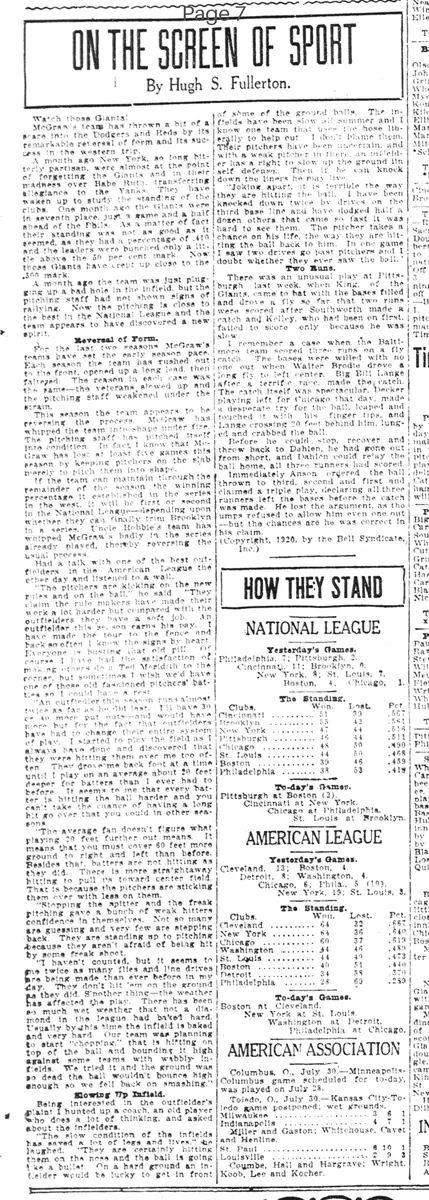
By Hugh S. Fullerton.
Watch those Giants:
McGraw's team has thrown a bit of a scare into the Dodgers and Reds by its remarkable reversal of form and its success in the western trip.
A month ago New York, so long bitterly partisan, were almost at the point of madness over Babe Ruth, transferring allegiance to the Yanks. They have waken up to study the standing of the clubs. One month ago the Giants were in seventh place, just a game and a half ahead of the Phils. As a matter of fact their standing was not as good as it seemed, as they had a percentage of .510 and the leaders were bunched only a little above the .500 mark. Now those Giants have crept up close to the leaders.
A month ago the team was just plugging along up a bad hole in the infield, but the pitching staff had not shown signs of rallying. Now the pitching is close to the best in the National League and the team appears to have discovered a new spirit.
For the last two seasons McGraw's teams have set the early season pace. Each season the team has rushed out to the front, opened up a long lead, then the veterans slowed up and the pitching staff weakened under the strain. This season the team appears to be reversing the process. McGraw has whipped the team into shape under fire. The pitching staff has pitched itself into condition. In fact I know that McGraw has lost at least five games this season by keeping pitchers on the slab merely to pitch them into shape.
If the team can maintain through the remainder of the season the winning percentage it established in the series in the west, it will be first or second in the National League--depending upon whether they can finally trim Brooklyn in a series. Uncle Robbie's team has whipped McGraw's badly in the series already played, thereby reversing the usual process.
Had a talk with one of the best outfielders in the American League the other day and listened to a wail.
"The pitchers are kicking on the new rules and on the ball," he said. "They claim the rule makers have made their job too easy. Outfielders they have a soft job. An outfielder this season earns his pay. I have made the tour to the fence and back so often I know the signals by heart. Everyone is busting that old ball. Of course I have had the satisfaction of nailing one of those old fashioned pitchers' battings so I could have a rest. An outfielder this season runs almost twice as far as he did last. I'll have to do more put outs--and would hate more but for the fact that outfielders have had to change their entire system of play. I started to play the field as I always have done and discovered that they were hitting them over me too often. That drove me back foot by foot until I play on an average about 20 feet deeper for batters than I ever had to before. It seems to me that every batter is hitting the ball harder and you can't take the chance of having a long hit go over that you could in other seasons.
"The average fan doesn't figure what playing 20 feet further out means. It means that you must cover 60 feet more ground to right and left than before. Besides that, batters are not hitting as they did. There is more straightaway hitting to pull us toward center field. That is because the pitchers are sticking them over with less on them.
"Stopping the spitter and the freak pitching gave a bunch of weak hitters confidence in themselves. Not so many are guessing and very few are stepping back. They are standing up to pitching because they aren't afraid of being hit by some freak shot.
"I haven't counted, but it seems to me twice as many flies and line drives are being made than ever before in my day. They don't hit 'em on the ground as they did. Another thing--the weather has affected the play. There has been so much wet weather that not a diamond in the league had baked hard. Usually by this time the infield is baked and very hard. Our team was planning to start "chopping," that is hitting on top of the ball and bounding it high against some teams with wobbly infields. We tried it and the ground was so dead the ball wouldn't bounce high enough so we fell back on smashing."
Sowing Up Infield.
Being interested in the outfielder's plaint I hunted up a coach, an old player who does a lot of thinking, and asked about the infielders.
"The slow condition of the infields has saved a lot of legs and lives," he laughed. "They are certainly hitting them on the nose and the ball is going like a bullet. On a hard ground an infielder would be lucky to get in front of some of the ground balls. The infields have been slow all summer and I know one team that uses the hose liberally to help out. I don't blame them. Their pitchers have been uncertain, and with a weak pitcher in there, an infielder has a right to slow up the ground in self defense. Then it has knocked down the liners he may live.
"Joking apart, it is terrible the way they are hitting the ball. I have been knocked down twice by drives on the third base line and have dodged half a dozen others that came so fast it was hard to see them. The pitcher takes a chance on his life, the way they are hitting the ball back to him. In one game I saw two drives go past pitchers and I doubt whether they ever saw the ball."
Two Runs.
There was an unusual play at Pittsburgh last week, when King, of the Giants, came to bat with the bases filled and drove a fly so far that two runs were scored after Southworth made a catch and Kelley, who had been on first, failed to score only because he was slow.
I remember a case when the Baltimore team scored three runs on a fly catch. The bases were filled with no one out when Walter Brodie drove a long fly to left center. Big Bill Lange after a terrific race, made the catch. The catch itself was spectacular. Decker playing left for Chicago that day, made a desperate try for the ball, leaped and touched it with his finger tips, and Lange crossing 20 feet behind him, lunged and grabbed the ball.
Before he could stop, recover and throw back to Dahlen, he had gone out from short, and Dahlen could relay the ball home, all three runners had scored. Immediately Anson ordered the ball thrown to third, second and first and claimed a triple play, declaring all three runners left the bases before the catch was made. He lost the argument, as the umps refused to allow him even one out --but the chances are he was correct in his claim.
(Copyright, 1920, by the Bell Syndicate, Inc.)
What sub-type of article is it?
What themes does it cover?
What keywords are associated?
What entities or persons were involved?
Where did it happen?
Story Details
Key Persons
Location
New York, Western Trip, Pittsburgh, Baltimore, Chicago
Event Date
1920
Story Details
Hugh S. Fullerton discusses the New York Giants' remarkable turnaround in the 1920 National League season, from seventh place to contending for the lead, crediting McGraw's strategy and improved pitching. Includes complaints from an outfielder on new rules making outfield play harder, a coach's view on slow infields benefiting infielders amid hard hitting, and anecdotes of unusual scoring plays on fly balls.