Thank you for visiting SNEWPapers!
Sign up free
Story
April 3, 1883
The Weekly Floridian
Tallahassee, Leon County, Florida
What is this article about?
The New York Mercantile Journal predicts rapid development in the Southern U.S., surpassing the West in agriculture, land availability, minerals, and manufacturing. February's Agriculture Department report details the cotton crop at 6.8 million bales, with production figures by state including Texas (1.326M), Mississippi (1.042M), and others.
Clipping
OCR Quality
95%
Excellent
Full Text
Southward! The March of Empire, Etc.
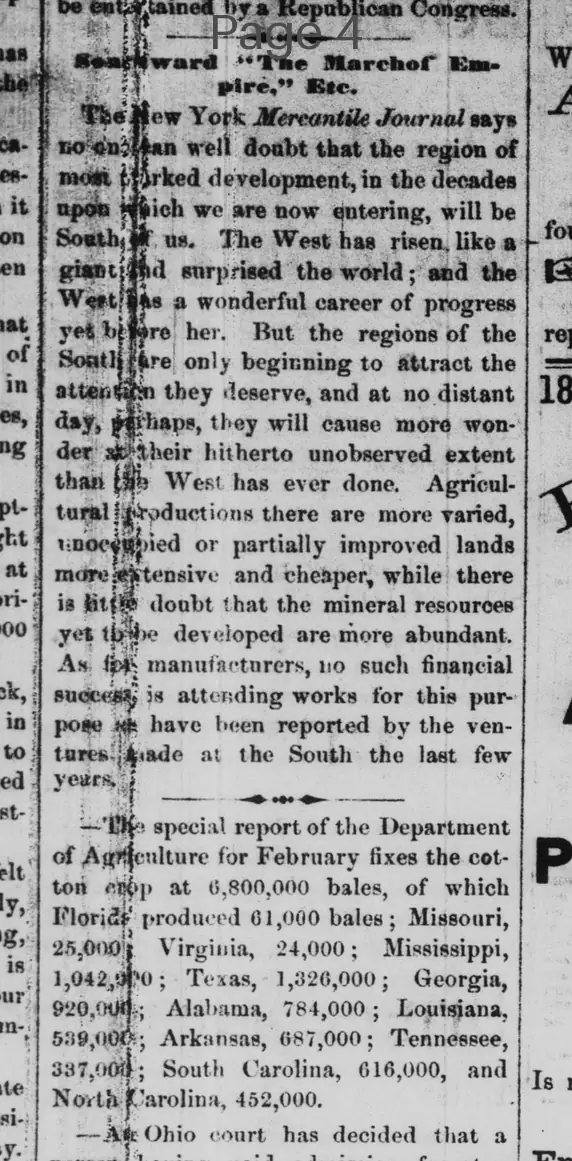
The New York Mercantile Journal says no one can well doubt that the region of most rapid development, in the decades upon which we are now entering, will be the South. The West has risen, like a giant and surprised the world; and the West has a wonderful career of progress yet before her. But the regions of the South are only beginning to attract the attention they deserve, and at no distant day, perhaps, they will cause more wonder by their hitherto unobserved extent than the West has ever done. Agricultural productions there are more varied, unoccupied or partially improved lands more extensive and cheaper, while there is little doubt that the mineral resources yet to be developed are more abundant. As for manufacturers, no such financial success is attending works for this purpose have been reported by the ventures made at the South the last few years.
Special report of the Department of Agriculture for February fixes the cotton crop at 6,800,000 bales, of which Florida produced 61,000 bales; Missouri, 25,000; Virginia, 24,000; Mississippi, 1,042,000; Texas, 1,326,000; Georgia, 920,000; Alabama, 784,000; Louisiana, 539,000; Arkansas, 687,000; Tennessee, 337,000; South Carolina, 616,000, and North Carolina, 452,000.
The New York Mercantile Journal says no one can well doubt that the region of most rapid development, in the decades upon which we are now entering, will be the South. The West has risen, like a giant and surprised the world; and the West has a wonderful career of progress yet before her. But the regions of the South are only beginning to attract the attention they deserve, and at no distant day, perhaps, they will cause more wonder by their hitherto unobserved extent than the West has ever done. Agricultural productions there are more varied, unoccupied or partially improved lands more extensive and cheaper, while there is little doubt that the mineral resources yet to be developed are more abundant. As for manufacturers, no such financial success is attending works for this purpose have been reported by the ventures made at the South the last few years.
Special report of the Department of Agriculture for February fixes the cotton crop at 6,800,000 bales, of which Florida produced 61,000 bales; Missouri, 25,000; Virginia, 24,000; Mississippi, 1,042,000; Texas, 1,326,000; Georgia, 920,000; Alabama, 784,000; Louisiana, 539,000; Arkansas, 687,000; Tennessee, 337,000; South Carolina, 616,000, and North Carolina, 452,000.
What sub-type of article is it?
Economic Commentary
Agricultural Report
What themes does it cover?
Exploration
Triumph
What keywords are associated?
Southern Development
Cotton Crop
Agricultural Production
Economic Growth
Mineral Resources
Where did it happen?
Southern United States
Story Details
Location
Southern United States
Event Date
February
Story Details
Commentary on the anticipated rapid economic development of the South, highlighting varied agriculture, cheap lands, minerals, and manufacturing success, supported by cotton production statistics from the Department of Agriculture report.