Thank you for visiting SNEWPapers!
Sign up free
Wilmington Journal
Wilmington, New Hanover County, North Carolina
What is this article about?
The new steamship Tennessee burned at sea off South Carolina while carrying passengers and cargo from Charleston to New York. All aboard were safely rescued after beaching the ship near Cape Fear, aided by the U.S. revenue cutter W.H. Seward, which brought survivors to Wilmington.
Clipping
OCR Quality
Full Text
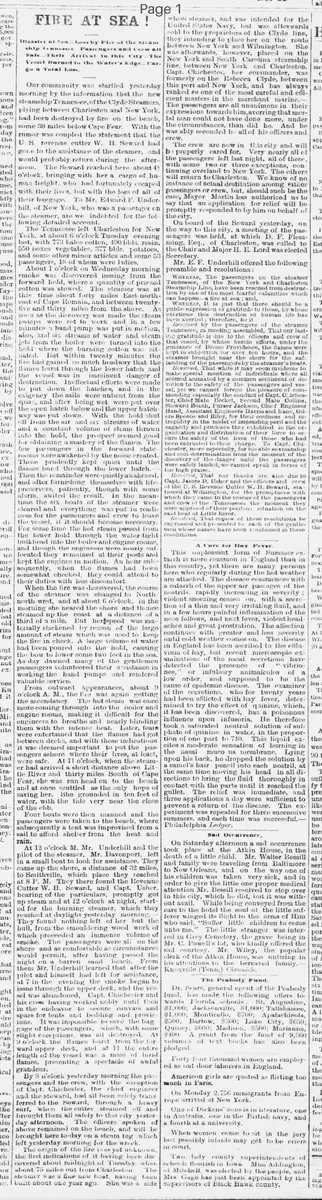
Disaster at sea -Loss by Fire of the Steamship Tennessee Passengers and Crew all Safe -Their Arrival in this City-The Vessel Burned to The Water's Edge-Cargo a Total Loss
Our community was startled yesterday morning by the information that the new steamship Tennessee, of the Clyde Steamers plying between Charleston and New York, had been destroyed by fire on the beach some 30 miles below Cape Fear. With the rumor was coupled the statement that the U. S. revenue cutter W. H. Seward had gone to the assistance of the steamer, and would probably return during the afternoon. The Seward reached here about 4 o'clock, bringing with her a cargo of human freight, who had fortunately escaped with their lives, but with the loss of all of their baggage. To Mr. Edward F. Underhill, of New York, who was a passenger on the steamer, are we indebted for the following detailed account.
The Tennessee left Charleston for New York, at about 6 o'clock Tuesday evening last, with 773 bales cotton, 490 bbls. rosin, 550 boxes vegetables, 377 bbls. potatoes, and some other minor articles and some 53 passengers, 18 of whom were ladies.
About 1 o'clock on Wednesday morning smoke was discovered issuing from the forward hold, where a quantity of pressed cotton was stowed. The steamer was at this time about forty miles East-northeast of Cape Romain, and between twenty-five and thirty miles from the shore. As soon as the discovery was made the steam pumps were set to work and in a few minutes a hand pump was put in motion, also, and six streams of water and steam jets from the boiler were turned into the hold where the burning cotton was situated. But within twenty minutes the fire had gained so much headway that the flames burst through the lower hatch and the vessel was in imminent danger of destruction. Ineffectual efforts were made to put down the hatches, and in the exigency the sails were unbent from the spars, and after being wet were put over the open hatch below and the upper hatchway was put down. With the hold shut off from the air and six streams of water and a constant volume of steam thrown into the hold, the prospect seemed good for obtaining a mastery of the flames. The few passengers in the forward staterooms were awakened by the noise created. These prudently kept quiet until the flames burst through the lower hatch, -Then the remainder were quietly awakened. and after furnishing themselves with life-preservers, patiently, though with some alarm, awaited the result. In the meantime the six boats of the steamer were cleared and everything was put in readiness for the passengers and crew to leave the vessel, if it should become necessary.
For some time the hot steam passed from the lower hold through the water-tight bulkhead into the boiler and engine rooms, and though the engineers were nearly suffocated they remained at their posts and kept the engines in motion. An hour subsequently, when the flames had been somewhat checked, they could attend to their duties with less discomfort.
When the fire was discovered, the course of the steamer was changed to North-northwest, and at about 6 o'clock, in the morning she neared the shore and thence steamed up the coast at a distance of a third of a mile. But her speed was materially slackened by reason of the large amount of steam which was used to keep the fire in check. A large volume of water had been poured into the hold, causing the bow to lower some two feet in the sea.
As day dawned many of the gentlemen passengers volunteered their assistance in working the hand pumps and rendered valuable service.
From outward appearances, about 9 o'clock A. M., the fire was again getting the ascendancy. The hot steam was once more coming through into the boiler and engine rooms, making it difficult for the engineers to breathe and nearly blinding them with the intense heat. Later, fears were entertained that the flames had got between decks, and with these indications it was deemed important to put the passengers ashore where their lives, at least, were safe. At 11 o'clock, when the steamer had arrived a short distance above Little River and thirty miles South of Cape Fear, she was run head on to the beach and at once scuttled as the only hope of saving her. She grounded in ten feet of water, with the tide very near the close of the ebb.
Four boats were then manned and the passengers were taken to the beach, where subsequently a tent was improvised from a sail to afford shelter from the heat and rain.
At 12 o'clock M. Mr. Underhill and the pilot of the steamer, Mr. Davenport, left in a small boat to look for assistance. They came up the shore, a distance of 32 miles, to Smithville, which place they reached at 8 P. M. They there found the Revenue Cutter W. H. Seward, and Capt. Usher, hearing of the particulars, promptly got up steam and at 12 o'clock at night, started for the burning steamer, which they reached at daylight yesterday morning.
They found nothing left of her but the hull, from the smouldering wood work of which proceeded an immense volume of smoke. The passengers were all on the shore and as comfortable as circumstances would permit, after having passed the night on a barren sand beach. From the passengers Mr. Underhill learned that after the pilot and himself had left for assistance, at 7 in the evening the smoke began to issue through the upper deck, and the vessel was abandoned. Capt. Chester and his crew having worked nobly until then in the endeavor to secure canvas and spars for tents and bedding and provisions. It was impossible to save the baggage of the passengers, which, with some slight exceptions, was all destroyed. At 9 o'clock the flames burst from the forward upper deck, and at 11 the entire length of the vessel was a mass of lurid flames, presenting a spectacle of awful grandeur.
By 8 o'clock yesterday morning the passengers and the crew, with the exception of Capt. Chichester, the chief engineer and the steward, had all been safely transferred to the Seward, through a heavy surf, when the cutter steamed off and brought them all safely to this city yesterday afternoon. The officers spoken of above remained on the beach, and will be brought here to-day on a steam tug which left yesterday morning for the wreck.
The origin of the fire is as yet unknown, the first indications of it having been discovered about midnight of Tuesday when about 75 miles out from Charleston. The steamer was a fine new boat, having been built about one year ago. She was a side wheel steamer, and was intended for the United States Navy, but was afterwards sold to the proprietors of the Clyde line, they intending to place her on the route between New York and Wilmington. She was afterwards, however, placed on the New York and South Carolina steamship line, between New York and Charleston.
Capt. Chichester, her commander, was formerly on the Rebecca Clyde, between this port and New York, and has always ranked as one of the most careful and efficient masters in the merchant marine. The passengers are all unanimous in their expressions towards him, averring that mortal man could not have done more, under the circumstances, than did he. And he was ably seconded by all of his officers and crew.
The crew are now in this city and will be properly cared for. Very nearly all of the passengers left last night, all of those, with some two or three exceptions, continuing overland to New York. The others will return to Charleston. We know of no instance of actual destitution among either passengers or crew, but, should such be the case, Mayor Martin has authorized us to say that an application for relief will be promptly responded to by him on behalf of the city.
On board of the Seward yesterday, on the way to this city, a meeting of the passengers was held, at which D. F. Fleming, Esq., of Charleston, was called to the Chair and Major H. E. Lord was elected Secretary.
Mr. E. F. Underhill offered the following preamble and resolutions:
WHEREAS, The passengers on the steamer Tennessee, of the New York and Charleston Steamship Line, have been rescued from destruction by one of the most fearful calamities which can happen-a fire at sea: and,
WHEREAS, It is just that there should be a public expression of gratitude to those, by whose exertions the destruction of human life has been averted; therefore, be it
Resolved by the passengers of the steamer Tennessee, in meeting assembled, That our lasting gratitude is due to the officers and crew of that vessel, by whose heroic efforts, under the guidance of Divine Providence, the flames were kept in subjection for over ten hours, and the steamer brought near the shore for the safe landing of the passengers by the steamer's boats.
Resolved, That while it may seem invidious to make special mention of individuals where all seemed animated by a common sentiment of devotion to the safety of the passengers and vessel, yet we cannot forego the pleasure of commending especially the conduct of Capt. Chichester, Chief Mate Becket, Second Mate Collins, Steward Booth, Purser Jackson, Chief Engineer Hand, Assistant Engineers Morris and Kane, Oilers Spence and Riley, for their coolness and intrepidity in the midst of impending peril and the sagacity and prudence they exhibited in the organization and distribution of their force to secure the safety of the lives of those who had been entrusted to their charge. To Capt. Chichester, more especially, for his able seamanship and cool determination from the moment of the discovery of the danger until the passengers were safely landed, we cannot speak in terms of too high praise.
Resolved, That our thanks are also due to Capt. James D. Usher and the officers and crew of the U. S. Revenue Cutter W. H. Seward, stationed at Wilmington, for the promptness with which they came to the rescue of the passengers and crew of the Tennessee, the moment they were apprised of their perilous situation on the said boat at Little River.
Resolved, That copies of these resolutions be engrossed and presented to each of the gentlemen whose names have been mentioned in these resolutions.
What sub-type of article is it?
What themes does it cover?
What keywords are associated?
What entities or persons were involved?
Where did it happen?
Story Details
Key Persons
Location
At Sea Off The Coast Of South Carolina, Near Cape Romain And Cape Fear, Beached Near Little River
Event Date
Tuesday Evening Last To Wednesday Morning
Story Details
The steamship Tennessee caught fire in the forward hold from burning cotton while en route from Charleston to New York. The crew fought the flames for over ten hours using water and steam, beached the vessel near Cape Fear, and safely evacuated all 53 passengers and crew to shore. The U.S. revenue cutter W.H. Seward rescued them and brought them to Wilmington.