Thank you for visiting SNEWPapers!
Sign up free
Jenks's Portland Gazette
Portland, Cumberland County, Maine
What is this article about?
British forces under Sir Ralph Abercromby repulsed a French-Dutch attack near Schagen, Holland on September 10, 1799, during the Anglo-Russian invasion. Enemy losses estimated at 800-1000, British under 200. Duke of York arrived with Russian reinforcements; preparations to advance on Amsterdam amid fears of inundation.
Merged-components note: Merged continuation of the Holland expedition news, which includes related fleet movements; relabeled the shipping-labeled part to foreign_news as the content pertains to military and naval aspects of the foreign conflict.
Clipping
OCR Quality
Full Text
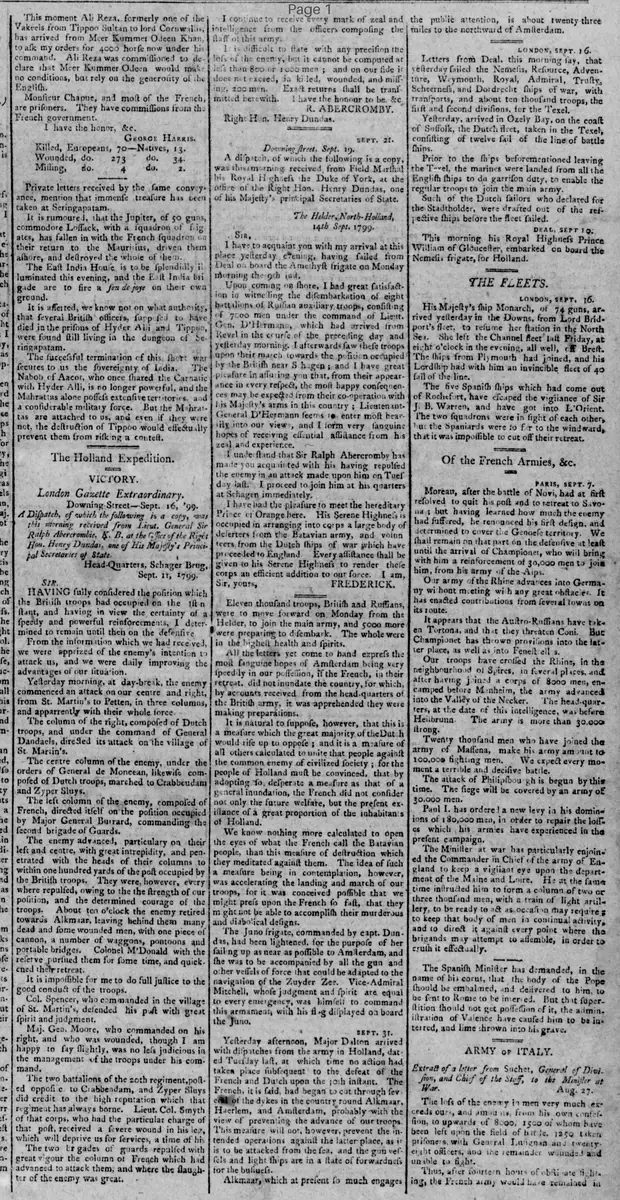
VICTORY.
London Gazette Extraordinary.
Downing-Street—Sept. 16, '99.
A Dispatch, of which the following is a copy, was this morning received from Lieut. General Sir Ralph Abercromby, K. B. at the Office of the Right Hon. Henry Dundas, one of His Majesty's Principal Secretaries of State.
Head-Quarters, Schagen Broek,
Sept. 11, 1799.
SIR,
HAVING fully considered the position which the British troops had occupied on the 10th instant, and having in view the certainty of a speedy and powerful reinforcement, I determined to remain until their arrival on the defensive.
From the information which we had received, we were apprised of the enemy's intention to attack us, and we were daily improving the advantages of our situation.
Yesterday morning, at day-break, the enemy commenced an attack on our centre and right, from St. Martin's to Petten, in three columns, and apparently with their whole force.
The column of the right, composed of Dutch troops, and under the command of General Daendels, directed its attack on the village of St. Martin's.
The centre column of the enemy, under the orders of General de Moncean, likewise composed of Dutch troops, marched to Crabbendam and Zyper Sluys.
The left column of the enemy, composed of French, directed itself on the position occupied by Major General Burrard, commanding the second brigade of Guards.
The enemy advanced, particularly on their left and centre, with great intrepidity, and penetrated with the heads of their columns to within one hundred yards of the post occupied by the British troops. They were, however, everywhere repulsed, owing to the strength of our position, and the determined courage of the troops. About ten o'clock the enemy retired towards Alkmaar, leaving behind them many dead and some wounded men, with one piece of cannon, a number of waggons, pontoons and portable bridges. Colonel M'Donald with the reserve pursued them for some time, and quickened their retreat.
It is impossible for me to do full justice to the good conduct of the troops.
Col. Spencer, who commanded in the village of St. Martin's, defended his post with great spirit and judgment.
Maj. Gen. Moore, who commanded on his right, and who was wounded, though I am happy to say lightly, was no less judicious in the management of the troops under his command.
The two battalions of the 20th regiment, posted opposite to Crabbendam, and Zyper Sluys did credit to the high reputation which that regiment has always borne. Lieut. Col. Smyth of that corps, who had the particular charge of that post, received a severe wound in his leg, which will deprive us for some time of his services.
The two brigades of guards repulsed with great vigour the column of French which had advanced to attack them, and where the slaughter of the enemy was great.
I continue to receive every mark of zeal and intelligence from the officers composing the staff of this army.
It is difficult to state with any precision the loss of the enemy, but it cannot be computed at less than 800 or 1000 men: and on our side it does not exceed, in killed, wounded, and missing, 200 men. Exact returns shall be transmitted herewith.
I have the honour to be, &c.
R. ABERCROMBY.
Right Hon. Henry Dundas.
SEPT. 21.
Downing Street, Sept. 19.
A dispatch, of which the following is a copy, was this morning received from Field Marshall his Royal Highness the Duke of York, at the office of the Right Hon. Henry Dundas, one of his Majesty's principal Secretaries of State.
The Helder, North-Holland,
14th Sept. 1799.
SIR,
I have to acquaint you with my arrival at this place yesterday evening, having sailed from Deal on board the Amethyst frigate on Monday morning the 9th inst.
Upon coming on shore, I had great satisfaction in witnessing the disembarkation of eight battalions of Russian auxiliary troops, consisting of 8000 men under the command of Lieut. Gen. D'Hermand, which had arrived from Revel in the course of the preceding day and yesterday morning. I afterwards saw these troops upon their march towards the position occupied by the British near Schagen; and I have great pleasure in assuring you that, from their appearance in every respect, the most happy consequences may be expected from their co-operation with his Majesty's arms in this country; Lieutenant-General D'Hermand seems to enter most heartily into our views, and I form very sanguine hopes of receiving essential assistance from his zeal and experience.
I understand that Sir Ralph Abercromby has made you acquainted with his having repulsed the enemy in an attack made upon him on Tuesday last. I proceed to join him at his quarters at Schagen immediately.
I have had the pleasure to meet the hereditary Prince of Orange here. His Serene Highness is occupied in arranging into corps a large body of deserters from the Batavian army, and volunteers from the Dutch ships of war which have proceeded to England. Every assistance shall be given to his Serene Highness to render these corps an efficient addition to our force. I am,
Sir, yours,
FREDERICK.
Eleven thousand troops, British and Russians, were to move forward on Monday from the Helder, to join the main army, and 5000 more were preparing to disembark. The whole were in the highest health and spirits.
All the letters yet come to hand express the most sanguine hopes of Amsterdam being very speedily in our possession, if the French, in their retreat, did not inundate the country, for which, by accounts received from the head-quarters of the British army, it was apprehended they were making preparations.
It is natural to suppose, however, that this is a measure which the great majority of the Dutch would rise up to oppose; and it is a measure of all others calculated to unite that people against the common enemy of civilized society; for the people of Holland must be convinced, that by adopting so desperate a measure as that of a general inundation, the French did not consider not only the future welfare, but the present existence of a great proportion of the inhabitants of Holland.
We know nothing more calculated to open the eyes of what the French call the Batavian people, than this measure of destruction which they meditated against them. The idea of such a measure being in contemplation, however, was accelerating the landing and march of our troops, for it was conceived possible that we might press upon the French so fast, that they might not be able to accomplish their murderous and diabolical designs.
The Juno frigate, commanded by Capt. Dundas, had been lightened, for the purpose of her sailing up as near as possible to Amsterdam, and she was to be accompanied by all the gun and other vessels of force that could be adapted to the navigation of the Zuyder Zee. Vice-Admiral Mitchell, whose judgment and spirit are equal to every emergency, was himself to command this armament, with his flag displayed on board the Juno.
SEPT. 31.
Yesterday afternoon, Major Dalton arrived with dispatches from the army in Holland, dated Tuesday last, at which time no action had taken place subsequent to the defeat of the French and Dutch upon the 10th instant. The French, it is said, had began to cut through several of the dykes in the country round Alkmaar, Haerlem, and Amsterdam, probably—with the view of preventing the advance of our troops.
This measure will not, however, prevent the intended operations against the latter place, as it is to be attacked from the sea, and the gun vessels and light ships are in a state of forwardness for the business.
Alkmaar, which at present so much engages
the public attention, is about twenty three miles to the northward of Amsterdam.
LONDON, SEPT. 16.
Letters from Deal, this morning say, that yesterday sailed the Nemesis, Resource, Adventure, Weymouth, Royal, Admiral, Trusty, Scheerness, and Dordrecht ships of war, with transports, and about ten thousand troops, the first and second divisions, for the Texel.
Yesterday, arrived in Orford Bay, on the coast of Suffolk, the Dutch fleet, taken in the Texel, consisting of twelve sail of the line of battle ships.
Prior to the ships beforementioned leaving the Texel, the marines were landed from all the English ships to do garrison duty, to enable the regular troops to join the main army.
Such of the Dutch sailors who declared for the Stadtholder, were drafted out of the respective ships before the fleet sailed.
DEAL, SEPT. 10:
This morning his Royal Highness Prince William of Gloucester, embarked on board the Nemesis frigate, for Holland.
THE FLEETS.
LONDON, SEPT, 16.
His Majesty's ship Monarch, of 74 guns, arrived yesterday in the Downs, from Lord Bridport's fleet, to resume her station in the North Sea. She left the Channel fleet last Friday, at eight o'clock in the evening, all well, off Brest.
The ships from Plymouth had joined, and his Lordship had with him an invincible fleet of 40 sail of the line.
The five Spanish ships which had come out of Rochefort, have escaped the vigilance of Sir J. B. Warren, and have got into L'Orient.
The two squadrons were in sight of each other, but the Spaniards were so far to the windward, that it was impossible to cut off their retreat.
What sub-type of article is it?
What keywords are associated?
What entities or persons were involved?
Where did it happen?
Foreign News Details
Primary Location
Holland
Event Date
Sept. 10 11, 1799
Key Persons
Outcome
enemy losses: 800-1000 killed/wounded; british: under 200 killed, wounded, missing. enemy left behind cannon, waggons, pontoons. british repulsed attack and pursued.
Event Details
British troops under Abercromby defended positions near Schagen Broek against a three-column French-Dutch attack from St. Martin's to Petten on September 10, 1799. Enemy advanced intrepidly but was repulsed by 10 AM, retreating to Alkmaar. Duke of York arrived with 8000 Russian troops; further reinforcements and naval preparations to advance on Amsterdam despite French dyke-cutting threats.