Thank you for visiting SNEWPapers!
Sign up free
Phenix Gazette
Alexandria, Virginia
What is this article about?
Detailed account from officers of the Buenos Ayrean privateer schooner Federal, captured by U.S. ship Erie at St. Bartholomews in December 1828. Describes Federal's commission, captures including Boston brig Nymph off Bahia in October, and disputes over cargo; includes correspondence and eyewitness testimony defending actions.
Clipping
OCR Quality
Full Text
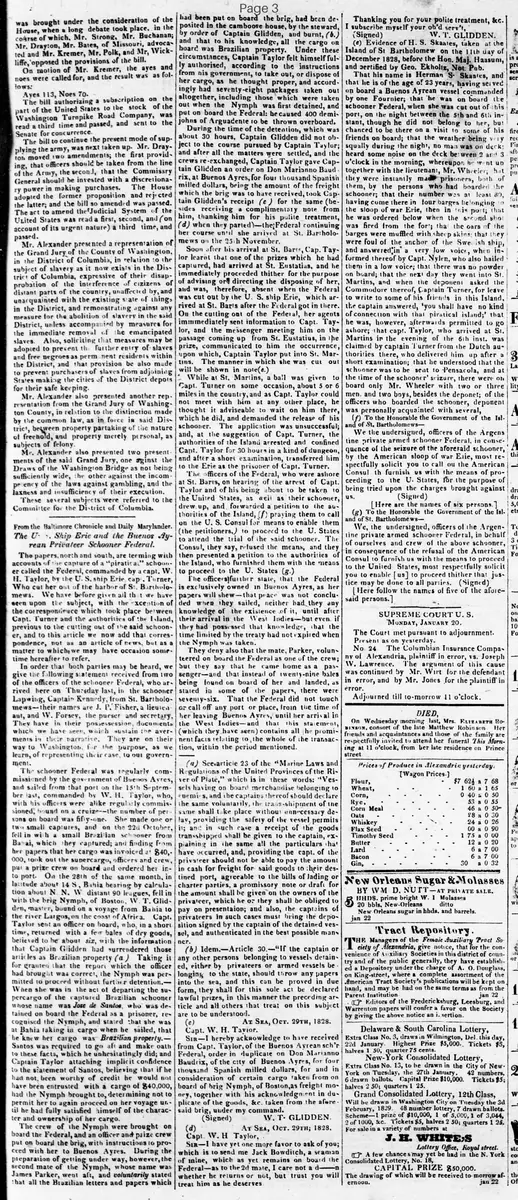
The U. S. Ship Erie and the Buenos Ayrean Privateer Schooner Federal.
The papers north and south, are teeming with accounts of the capture of a "piratical" schooner called the Federal, commanded by a Capt. W. H. Taylor, by the U. S. ship Erie, Capt. Turner, who cut her out of the harbor of St. Bartholomews.
We have before given all that we have seen upon the subject, with the exception of the correspondence which took place between Capt. Turner and the authorities of the Island, previous to the cutting out of the said schooner, and to this article we now add that correspondence, not as an article of news, but as a matter to which we may have occasion some time hereafter to refer.
In order that both parties may be heard, we give the following statement received from two of the officers of the schooner Federal, who arrived here on Thursday last, in the schooner Lapwing, Captain Kennedy, from St. Bartholomews—their names are J. P. Fisher, a lieutenant, and J. Forsey, the purser and secretary.
They have in their possession, documents which we have seen, which sustain the averments in their narrative. They are on their way to Washington, for the purpose, as we learn, of representing their case, to our government.
The schooner Federal was regularly commissioned by the government of Buenos Ayres, and sailed from that port on the 15th September last, commanded by W. H. Taylor, who, with his officers were alike regularly commissioned, bound on a cruise—the number of persons on board was fifty-one. She made one or two small captures, and on the 22d October, fell in with a small Brazilian schooner from Bahia, which they captured; and finding from her papers that her cargo was invoiced as $40,000, took out the supercargo, officers and crew, put a prize crew on board and ordered her into port. On the 28th of the same month, in latitude about 14 S. Bahia bearing by calculation about N. N. W distant 90 leagues, fell in with the brig Nymph, of Boston, I. T. Glidden, master, bound on a voyage from Bahia to the river Largos, on the coast of Africa. Capt. Taylor sent an officer on board, who, in a short time, returned with a few bales of dry goods, believed to be about six, with the information that Captain Glidden had surrendered those articles as Brazilian property (a.) Taking it for granted that the report which the officer had brought was correct, the Nymph was permitted to proceed without further detention.
When she was in the act of departing the supercargo of the captured Brazilian schooner whose name was Jose de Santos, who was detained on board the Federal as a prisoner, recognised the Nymph, and stated that she was at Bahia taking in cargo when he sailed, that he knew her cargo was Brazilian property. Santos was required to go aft and make oath to these facts, which he unhesitatingly did; and Captain Taylor attaching implicit confidence to the statement of Santos, believing that if he had not been worthy of credit he would not have been entrusted with a cargo of $40,000, had the Nymph brought to, determining not to permit her to again proceed on her voyage until he had fully satisfied himself of the character and ownership of her cargo.
The crew of the Nymph were brought on board the Federal, and an officer and prize crew put on board the brig, with instructions to proceed with her to Buenos Ayres. During the preparation of getting under way, however, the second mate of the Nymph, whose name was James Parker, went aft, and voluntarily stated that all the Brazilian letters and papers which had been put on board the brig, had been deposited in the camboose house, by the steward, by order of Captain Glidden, and burnt, (b.) and that to his knowledge, all the cargo on board was Brazilian property. Under these circumstances, Captain Taylor felt himself fully authorised, according to the instructions from his government, to take out, or dispose of her cargo, as he thought proper, and accordingly had seventy-eight packages taken out altogether, including those which were taken out when the Nymph was first detained, and put on board the Federal: because 400 demijohns of aguardiente to be thrown overboard.
During the time of the detention, which was about 30 hours, Captain Glidden did not object to the course pursued by Captain Taylor; and after all the matters were settled, and the crews re-exchanged, Captain Taylor gave Captain Glidden an order on Don Mariano Baudrix, at Buenos Ayres, for four thousand Spanish milled dollars, being the amount of the freight which the brig was to have received, took Captain Glidden's receipt (c) for the same (besides receiving a complimentary note from him, thanking him for his polite treatment, (d) when they parted)—the Federal continuing her course until she arrived at St. Bartholomews on the 25th November.
Soon after his arrival at St. Barts, Capt. Taylor learnt that one of the prizes which he had captured, had arrived at St. Eustatias, and he immediately proceeded thither for the purpose of advising or directing the disposing of her, and was, therefore, absent when the Federal was cut out by the U. S. ship Erie, which arrived at St. Barts after the Federal got in there.
On the cutting out of the Federal, her agents immediately sent information to Capt. Taylor, and the messenger meeting him on the passage coming up from St. Eustatius, in the prize, communicated to him the occurrence, upon which, Captain Taylor put into St. Martins. The manner in which she was cut out will be shown in note (e.)
While at St. Martins, a ball was given to Capt. Turner on some occasion, about 5 or 6 miles in the country, and as Capt. Taylor could not meet with him at any other place, he thought it advisable to wait on him there, which he did, and demanded the release of his schooner. The application was unsuccessful and, at the suggestion of Capt. Turner, the authorities of the Island arrested and confined Capt. Taylor for 30 hours in a kind of dungeon, and after a short examination, transferred him to the Erie as the prisoner of Capt. Turner.
The officers of the Federal, who were ashore at St. Barts, on hearing of the arrest of Capt. Taylor and of his being about to be taken to the United States, as well as their schooner, drew up, and, forwarded a petition to the authorities of the Island, (f) praying them to call on the U. S. Consul for means to enable them (the petitioners,) to proceed to the U. States to attend the trial of the said schooner. The Consul, they say, refused the means, and they then presented a petition to the authorities of the Island, who furnished them with the means to proceed to the U. States (g.)
The officers further state, that the Federal is exclusively owned in Buenos Ayres, as her papers will show—that peace was not concluded when they sailed, neither had they any knowledge of the existence of it, until after their arrival in the West Indies—but even, if they had possessed that knowledge, that the time limited by the treaty had not expired when the Nymph was taken.
They deny also that the mate, Parker, volunteered on board the Federal as one of the crew; but they say that he came home as a passenger—and that instead of twenty-nine bales being found on board of her and landed, as stated in some of the papers, there were seventy-six. That the Federal did not touch or call off any port or place, from the time of her leaving Buenos Ayres, until her arrival in the West Indies—and that this statement, (which they have seen) contains all the prominent facts relating to the whole of the transaction, within the period mentioned.
(a) See article 23 of the "Marine Laws and Regulations of the United Provinces of the River of Plate," which is in these words: "Vessels having on board merchandise belonging to enemies, and the captains thereof should declare the same voluntarily, the trans-shipment of the same shall take place without unnecessary delay, providing the safety of the vessel permits it; and in such case a receipt of the goods transshipped shall be given to the captain, explaining in the same all the particulars that have occurred, and, providing the capt. of the privateer should not be able to pay the amount in cash for freight for said goods to their destined port, agreeable to the bills of lading or charter parties, a promissory note or draft for the amount shall be given on the owners of the privateer, which he or they shall be obliged to pay on presentation; and also, the captains of privateers in such cases must bring the deposition signed by the captain of the detained vessel, and authenticated in the best possible manner."
(b) Idem. Article 30. "If the captain or any other persons belonging to vessels detained, either by privateers or armed vessels belonging to the state, should throw any papers into the sea, and this can be proved in due form, they shall for this sole act be declared lawful prizes, in this manner the preceding article and all others that treat on this subject are to be understood."
(c)
At Sea, Oct. 29th, 1828.
Capt. W. H. Taylor.
Sir—I hereby acknowledge to have received from Capt. Taylor, of the Buenos Ayrean sch'r Federal, order in duplicate on Don Mariano Baudrix, of the city of Buenos Ayres, for four thousand Spanish milled dollars, for and in consideration of certain cargo taken from on board of brig Nymph, of Boston, as freight money, together with his acknowledgment in duplicate of the goods, &c. taken from the aforesaid brig, under my command.
(Signed)
W. T. GLIDDEN.
(d)
At Sea, Oct. 29th, 1828.
Capt. W. H. Taylor,
Sir—I have yet one more favor to ask of you; which is to send me Jack Bowditch, a seaman of mine, which as yet remains on board the Federal—as to the 2d mate, I care not a d--n whether he returns or not, but trust you will treat him as he deserves.
Thanking you for your polite treatment, &c.
I subscribe myself your ob'd serv't.
(Signed)
W. T. GLIDDEN.
(e) Evidence of H. S. Skaates, taken at the Island of St. Bartholomew on the 11th day of December 1828, before the Hon. Maj. Hassum, and certified by Geo. Ekholiz, Not. Pub.
That his name is Herman S. Skaates, and that he is of the age of 23 years, having served on board a Buenos Ayrean vessel commanded by one Fournier; that he was on board the schooner Federal, when she was cut out of this port, on the night between the 5th and 6th instant, though he did not belong to her, but chanced to be there on a visit to some of his friends on board; that the weather being very squally during the night, no man was on deck; heard some noise on the deck between 2 and 3 o'clock in the morning, whereupon he went up together with the lieutenant, Mr. Wheeler; that they were instantly made prisoners, both of them, by the persons who had boarded the schooner; that their number was at least 80, having come there in four barges belonging to the sloop of war Erie, then in this port; that he was ordered below when the second shot was fired from the fort; that the oars of the barges were muffled with sheep skins; that they were foul of the anchor of the Swedish ship, and answered in a very low voice, when informed thereof by Capt. Nylen, who also hailed them in a low voice; that there was no powder on board; that the next day they went into St. Martins, and when the deponent asked the Commodore thereof, Captain Turner, for leave to write to some of his friends in this Island, the captain answered, you shall have no kind of connection with that piratical island; that he was, however, afterwards permitted to go ashore; that Capt. Taylor, who arrived at St. Martins in the evening of the 6th inst. was claimed by captain Turner from the Dutch authorities there, who delivered him up after a short examination; that he understood that the schooner was to be sent to Pensacola, and at the time of the schooner's seizure, there were on board only Mr. Wheeler with two or three men, and two boys, besides the deponent; of the officers who boarded the schooner, deponent was personally acquainted with several.
(f) To the Honorable the Government of the Island of St. Bartholomews—
We the undersigned, officers of the Argentine private armed schooner Federal, in consequence of the seizure of the aforesaid schooner, by the American sloop of war Erie, most respectfully solicit you to call on the American Consul to furnish us with the means of proceeding to the U. States, for the purpose of being tried upon the charges brought against us.
(Signed)
[Here are the names of six persons.]
(g) To the Honorable the Government of the Island of St. Bartholomews—
We, the undersigned, officers of the Argentine private armed schooner Federal, in behalf of ourselves and crew of the above schooner, in consequence of the refusal of the American Consul to furnish us with the means to proceed to the United States, most respectfully solicit you to enable [us] to proceed thither that justice may be done to all parties.
(Signed)
[Here follow the names of five of the aforesaid persons.]
What sub-type of article is it?
What keywords are associated?
What entities or persons were involved?
Where did it happen?
Foreign News Details
Primary Location
St. Bartholomews
Event Date
September 15 To December 1828
Key Persons
Outcome
schooner federal captured by u.s. ship erie; capt. taylor arrested and confined; 78 packages of cargo taken from brig nymph; officers petition for means to travel to u.s. for trial.
Event Details
Buenos Ayrean privateer schooner Federal, commanded by Capt. W. H. Taylor, sailed from Buenos Ayres on September 15, 1828, captured a Brazilian schooner on October 22 and the Boston brig Nymph on October 28 off Bahia, removing Brazilian cargo after evidence of ownership and destruction of papers. Arrived St. Bartholomews November 25; cut out of harbor by U.S. ship Erie under Capt. Turner on night of December 5-6. Taylor arrested at St. Martins. Officers Fisher and Forsey provide defense narrative and documents en route to Washington.