Thank you for visiting SNEWPapers!
Sign up free
Gazette Of The United States And Daily Evening Advertiser
Philadelphia, Philadelphia County, Pennsylvania
What is this article about?
In August 1794, the Baltimore County Grand Jury presents grievances against Chief Judge Samuel Chase for censuring the Sheriff over jury selection and holding dual judicial offices in violation of Maryland's Bill of Rights, and against the state Executive for the appointment. Chase replies, defending his authority and denying the jury's jurisdiction over such matters.
Clipping
OCR Quality
Full Text
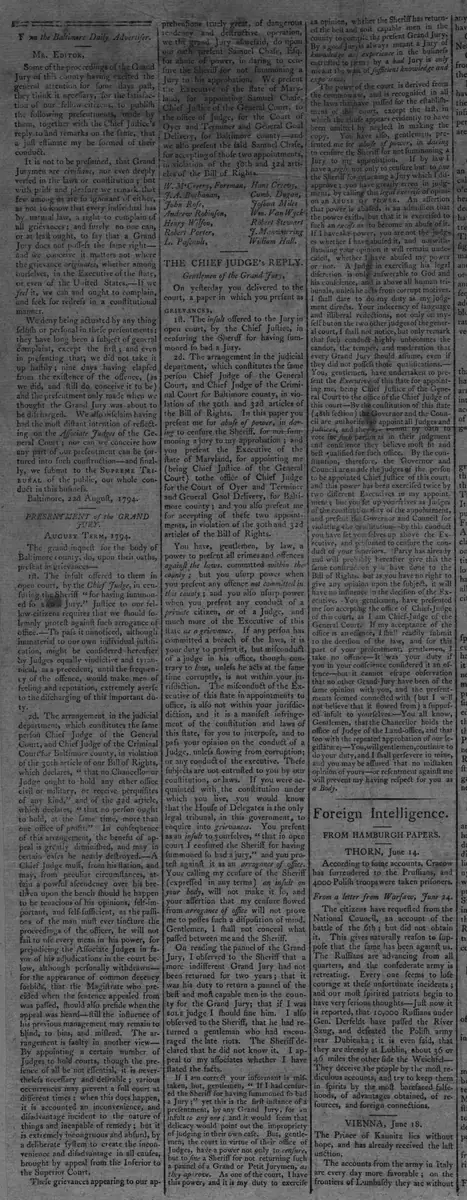
It is not to be presumed, that Grand Jurymen are civilians, nor even deeply versed in the laws or constitution; but with peace and pleasure we remark that few among us are so ignorant of either, as not to know that every individual has by natural law, a right to complain of all grievances; and surely no one can, or at least ought, to say that a Grand Jury does not possess the same right-- and we conceive it matters not where the grievance originates, whether among ourselves, in the Executive of the state, or even of the United States.--If we feel it, we can and ought to complain, and seek for redress in a constitutional manner,
We deny being actuated by any thing selfish or personal in these presentments; they have long been a subject of general complaint, except the first; and even in presenting that; we did not take it up hastily; nine days having elapsed from the existence of the offence, (as we did, and still do conceive it so to be) and the presentment only made when we thought the Grand Jury was about to be discharged. We also disclaim having had the most distant intention of reflecting on the Associate Judges of the General Court ; nor can we conceive how any part of our presentment can be tortured into such construction--and finally, we submit to the SUPREME TRIBUNAL of the public, our whole conduct in this business.
Baltimore, 22d August, 1794.
PRESENTMENT of the GRAND JURY.
August Term, 1794.
The grand inquest for the body of Baltimore county, do, upon their oaths, present as grievances--
1st. The insult offered to them in open court, by the Chief Judge, in censuring the Sheriff "for having summoned so BAD a Jury." Justice to our fellow-citizens requires that we should solemnly protest against such arrogance of office.--To pass it unnoticed, although immaterial to our own individual justification, might be considered hereafter by Judges equally vindictive and tyrannical, as a precedent; until the frequency of the offence, would make men of feeling and reputation, extremely averse to the discharging of this important duty.
2d. The arrangement in the judicial department, which constitutes the same person Chief Judge of the General Court, and Chief Judge of the Criminal Court for Baltimore county, in violation of the 30th article of our Bill of Rights, which declares, "that no Chancellor or Judge ought to hold any other office civil or military, or receive perquisites of any kind," and of the 32d article, which declares, "that no person ought to hold, at the same time, more than one office of profit." In consequence of this arrangement, the benefit of appeal is greatly diminished, and may in certain cases be nearly destroyed.--A Chief Judge must, from his station, and may, from peculiar circumstances, attain a powerful ascendency over his brethren upon the bench should he happen to be tenacious of his opinions, self-important, and self-sufficient, as the passions of the man must ever tincture the proceedings of the officer, he will not fail to use every means in his power, for prejudicing the Associate Judges in favor of his adjudications in the court below, although personally withdrawn-- for the appearance of common decency forbids, that the Magistrate who presided when the sentence appealed from was passed, should also preside when the appeal was heard--still the influence of his previous management may remain to blind, to bias, and mislead. The arrangement is faulty in another view-- By appointing a certain number of Judges to hold courts, though the presence of all be not essential, it is nevertheless necessary and desirable ; various occurrences may prevent a full court at different times : when this does happen, it is accounted an inconvenience, and disadvantage incident to the nature of things and incapable of remedy; but it is extremely incongruous and absurd, by a deliberate system to create the inconvenience and disadvantage in all causes, brought by appeal from this Inferior to the Superior Court.
These grievances appearing to our apprehensions truly great, of dangerous tendency and destructive operation, we the grand Jury aforesaid, do upon our oath present Samuel Chase, Esq. for abuse of power, in daring to censure the Sheriff for not summoning a Jury to his approbation. We present the Executive of the state of Maryland, for appointing Samuel Chase, Chief Justice of the General Court, to the office of Judge, for the Court of Oyer and Terminer and General Goal Delivery, for Baltimore county--and we also present the said Samuel Chase, for accepting of those two appointments, in violation of the 30th and 32d articles of the Bill of Rights.
W. M'Creery, Foreman
Hans Creevy,
F.A. Buchanan, Cumb. Dugan,
John Ross, Joshua Miles
Andrew Robinson, Wm. Van Wyck
Henry Wilson, Robert Stewart
Robert Porter, J. Manwarring
L. Pacault, William Hall.
THE CHIEF JUDGE's REPLY.
Gentlemen of the Grand Jury,
On yesterday you delivered to the court, a paper in which you present as GRIEVANCES,
1st. The insult offered to the Jury in open court, by the Chief Justice, in censuring the Sheriff for having summoned so bad a Jury.
2d. The arrangement in the judicial department, which constitutes the same person Chief Judge of the General Court, and Chief Judge of the Criminal Court for Baltimore county, in violation of the 30th and 32d articles of the Bill of Rights. In this paper you present me for abuse of power, in daring to censure the Sheriff, for not summoning a jury to my approbation ; and you present the Executive of the state of Maryland, for appointing me (being Chief Justice of the General Court) to the office of Chief Judge for the Court of Oyer and Terminer and General Gaol Delivery, for Baltimore county; and you also present me for accepting of these two appointments, in violation of the 30th and 32d articles of the Bill of Rights.
You have, gentlemen, by law, a power to present all crimes and offences against the laws, committed within the county ; but you usurp power when you present any offence not committed in this county ; and you also usurp power when you present any conduct of a private citizen, or of a Judge, and much more of the Executive of this state as a grievance. If any person has committed a breach of the laws, it is your duty to present it, but misconduct of a judge in his office, though contrary to law, unless he acts at the same time corruptly, is not within your jurisdiction. The misconduct of the Executive of this state in appointments to office, is also not within your jurisdiction, and it is a manifest infringement of the constitution and laws of this state, for you to interpose, and to pass your opinion on the conduct of a Judge,, unless flowing from corruption; or any conduct of the executive. These subjects are not entrusted to you by our constitution, or laws.' If you were acquainted with the constitution under which you live, you would know that the House of Delegates is the only legal tribunal, in this government, to enquire into grievances. You present as an insult to yourselves, "that in open court I censured the Sheriff for having summoned so bad a jury," and you protest against it as an arrogance of office. Your calling my censure of the Sheriff (expressed in any terms) an insult on your body, will not make it so, and your assertion that my censure flowed from arrogance of office will not prove me to possess such a disposition of mind.
Gentlemen, I shall not conceal what passed between me and the Sheriff. On reading the panel of the Grand Jury, I observed to the Sheriff that a more indifferent Grand Jury had not been returned for two years; that it was his duty to return a panel of the best and most capable men in the county for the Grand Jury; that if I was sole judge I should fine him. I also observed to the Sheriff, that he had returned a gentleman who had encouraged the late riots. The Sheriff declared that he did not know it. I appeal to my associates whether I have stated the facts. If I am correct your informant is mistaken, but, gentlemen, "If I had censured the Sheriff for having summoned so bad a Jury;" yet this is the first instance of a presentment, by any Grand Jury, for an insult to any one ; and it would seem that delicacy would point out the impropriety of judging in their own case. But, gentlemen, the court in virtue of their office of Judges, have a power not only to censure, but to fine a Sheriff for not returning such a panel of a Grand or Petit Jurymen, as they approve. As one of the court, I have this power, and it is my duty to exercise it as opinion, whether the Sheriff has returned the best and most capable men in the county to compose this present Grand Jury. By a good Jury is always meant a Jury of knowledge and experience in the business entrusted to them: by a bad Jury is only meant the want of sufficient knowledge and experience. The power of the court is derived from the common law, and is recognized in all the laws that have passed for the establishment of this court, except the last, in which the clause appears evidently to have been omitted by neglect in making the copy. You have also, gentlemen, presented me for abuse of power, in daring to censure the Sheriff for not summoning a Jury to my approbation. If by law I have a right, not only to censure but to fine the Sheriff for returning a Jury which I disapprove; you have greatly erred in judgment, by calling this legal exercise of opinion an ABUSE OF POWER. An assertion that power is abused, is an admission that the power exists, but that it is exercised to such an excess as to become an abuse of it. If I have the power, you are not the judges whether I have abused it, and notwithstanding your opinion it will remain undecided, whether I have abused my power or not. A Judge in exercising his legal discretion is only answerable to God and his conscience, and is above all human tribunals, unless he acts from corrupt motives. I shall dare to do my duty as my judgment directs. Your indecency of language and illiberal reflections. not only on myself but on the two other judges of the general court, I shall not notice, but only remark that such conduct highly unbecomes the candor, the temper, and moderation that every Grand Jury should assume, even if they did not possess those qualifications.-- You, gentlemen, have undertaken to present the Executive of this state for appointing me, being Chief Justice of the General Court to the office of the Chief Judge of this court--By the constitution of this state (48th section) the Governor and the Council are authorized to appoint all Judges and Justices, and they "are bound by oath to vote for such person as in their judgment and conscience they believe most fit and best qualified for such office. By the constitution, therefore, the Governor and Council are made the judges of the person to be appointed Chief justice of this court; and this power has been exercised twice by two different Executives in my appointment; but you set up yourselves as Judges of the constitutional legality of the appointment, and present the Governor and Council for violating the constitution--by this conduct you have set yourselves up above the Executive, and presumed to censure the conduct of your superiors. Party has already and will probably hereafter give this the same construction you have done to the Bill of Rights. but as you have no right to give any opinion upon the subject, it will have no influence in the decision of the Executive. You gentlemen, have presented me for accepting the office of Chief-Judge of this court, as I am Chief-Judge of the General Court. If my acceptance of the office is an offence, I shall readily submit to the decision of the law, and for this part of your presentment; gentlemen, I take no offence--It was your duty if you in your conscience considered it an offence -but it cannot escape observation that no other Grand-Jury have been of the same opinion with you, and the presentments seemed connected with (but I will not believe that it flowed from) a supposed insult to yourselves.-You all know, Gentlemen, that the Chancellor holds the office of Judge of the Land-office, and that too with the repeated approbation of our legislature;-You, will gentlemen, continue to do your duty, and I shall persevere in mine, and you may be assured that no mistaken opinion of yours--or resentment against me will prevent my having respect for you as a Body.
What sub-type of article is it?
What keywords are associated?
What entities or persons were involved?
Where did it happen?
Domestic News Details
Primary Location
Baltimore County
Event Date
August Term, 1794
Key Persons
Outcome
grand jury issues presentments against chief judge samuel chase and maryland executive; chase defends his actions, asserts jury overstepped jurisdiction, no further resolutions mentioned.
Event Details
The Grand Jury of Baltimore County presents two grievances: Chief Judge Samuel Chase's censure of the Sheriff for summoning a 'bad' jury as an insult and abuse of power; and the dual judicial appointments of Chase violating Maryland Bill of Rights articles 30 and 32, diminishing appeal benefits. They present Chase and the Executive accordingly. Chase replies, justifying his censure as legal duty, denying violation of Bill of Rights, and stating the jury lacks jurisdiction over such matters, which belong to the House of Delegates.