Thank you for visiting SNEWPapers!
Sign up free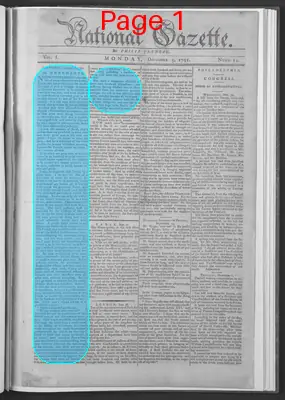
Literary
December 5, 1791
National Gazette
Philadelphia, Philadelphia County, Pennsylvania
What is this article about?
An essay reflecting on the rarity of true greatness, exemplified by Mirabeau's role in the French Revolution and liberty. It satirizes England's proliferation of monuments in Westminster Abbey and St. Paul's, which dilute the honor, contrasting with France's restraint in bestowing the title 'great.'
Clipping
OCR Quality
98%
Excellent
Full Text
From Woodfall's (London) Register
On MONUMENTS.
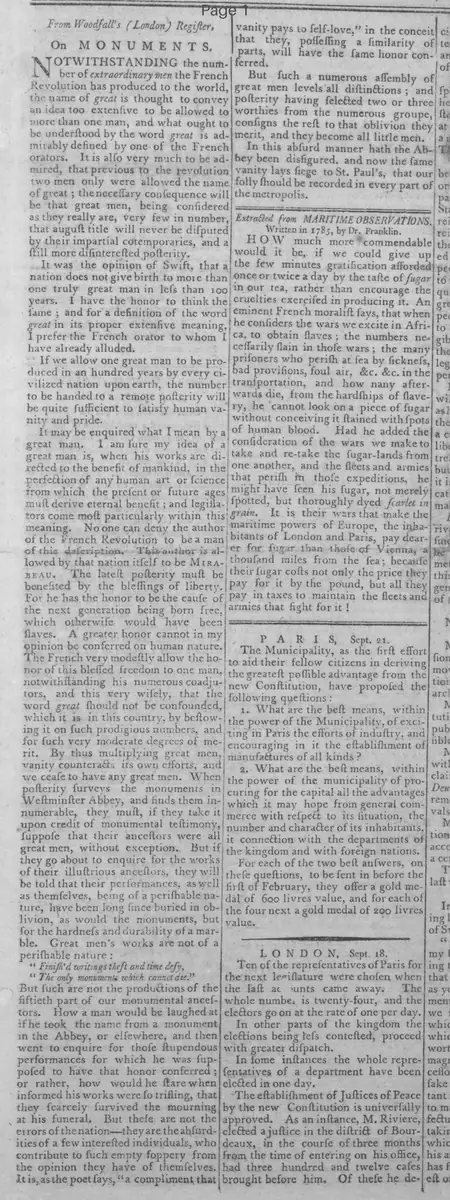
Notwithstanding the number of extraordinary men the French Revolution has produced to the world, the name of great is thought to convey an idea too extensive to be allowed to more than one man, and what ought to be understood by the word great is admirably defined by one of the French orators. It is also very much to be admired, that previous to the revolution two men only were allowed the name of great; the necessary consequence will be that great men, being considered as they really are, very few in number, that august title will never be disputed by their impartial contemporaries, and a still more disinterested posterity.
It was the opinion of Swift, that a nation does not give birth to more than one truly great man in less than 100 years. I have the honor to think the same; and for a definition of the word great in its proper extensive meaning, I prefer the French orator to whom I have already alluded.
If we allow one great man to be produced in an hundred years by every civilized nation upon earth, the number to be handed to a remote posterity will be quite sufficient to satisfy human vanity and pride.
It may be enquired what I mean by a great man. I am sure my idea of a great man is, when his works are directed to the benefit of mankind, in the perfection of any human art or science from which the present or future ages must derive eternal benefit; and legislators come most particularly within this meaning. No one can deny the author of the French Revolution to be a man of this description. This author is allowed by that nation itself to be MIRABEAU. The latest posterity must be benefited by the blessings of liberty. For he has the honor to be the cause of the next generation being born free, which otherwise would have been slaves. A greater honor cannot in my opinion be conferred on human nature.
The French very modestly allow the honor of this blessed freedom to one man, notwithstanding his numerous coadjutors, and this very wisely, that the word great should not be confounded, which it is in this country, by bestowing it on such prodigious numbers, and for such very moderate degrees of merit. By thus multiplying great men, vanity counteracts its own efforts, and we cease to have any great men. When posterity surveys the monuments in Westminster Abbey, and finds them innumerable, they must, if they take it upon credit of monumental testimony, suppose that their ancestors were all great men, without exception. But if they go about to enquire for the works of their illustrious ancestors, they will be told that their performances, as well as themselves, being of a perishable nature, have been long since buried in oblivion, as would the monuments, but for the hardness and durability of marble. Great men's works are not of a perishable nature:
"Finish'd writings that time defy:
The only monuments which cannot die."
But such are not the productions of the fiftieth part of our monumental ancestors. How a man would be laughed at if he took the name from a monument in the Abbey, or elsewhere, and then went to enquire for those stupendous performances for which he was supposed to have that honor conferred; or rather, how would he stare when informed his works were so trifling, that they scarcely survived the mourning at his funeral. But these are not the errors of the nation—they are the absurdities of a few interested individuals, who contribute to such empty foppery from the opinion they have of themselves.
It is, as the poet says, "a compliment that vanity pays to self-love," in the conceit that they, possessing a similarity of parts, will have the same honor conferred.
But such a numerous assembly of great men levels all distinctions; and posterity having elected two or three worthies from the numerous groupe, consigns the rest to that oblivion they merit, and they become all little men.
In this absurd manner hath the Abbey been disfigured, and now the same vanity lays siege to St. Paul's, that our folly should be recorded in every part of the metropolis.
On MONUMENTS.
Notwithstanding the number of extraordinary men the French Revolution has produced to the world, the name of great is thought to convey an idea too extensive to be allowed to more than one man, and what ought to be understood by the word great is admirably defined by one of the French orators. It is also very much to be admired, that previous to the revolution two men only were allowed the name of great; the necessary consequence will be that great men, being considered as they really are, very few in number, that august title will never be disputed by their impartial contemporaries, and a still more disinterested posterity.
It was the opinion of Swift, that a nation does not give birth to more than one truly great man in less than 100 years. I have the honor to think the same; and for a definition of the word great in its proper extensive meaning, I prefer the French orator to whom I have already alluded.
If we allow one great man to be produced in an hundred years by every civilized nation upon earth, the number to be handed to a remote posterity will be quite sufficient to satisfy human vanity and pride.
It may be enquired what I mean by a great man. I am sure my idea of a great man is, when his works are directed to the benefit of mankind, in the perfection of any human art or science from which the present or future ages must derive eternal benefit; and legislators come most particularly within this meaning. No one can deny the author of the French Revolution to be a man of this description. This author is allowed by that nation itself to be MIRABEAU. The latest posterity must be benefited by the blessings of liberty. For he has the honor to be the cause of the next generation being born free, which otherwise would have been slaves. A greater honor cannot in my opinion be conferred on human nature.
The French very modestly allow the honor of this blessed freedom to one man, notwithstanding his numerous coadjutors, and this very wisely, that the word great should not be confounded, which it is in this country, by bestowing it on such prodigious numbers, and for such very moderate degrees of merit. By thus multiplying great men, vanity counteracts its own efforts, and we cease to have any great men. When posterity surveys the monuments in Westminster Abbey, and finds them innumerable, they must, if they take it upon credit of monumental testimony, suppose that their ancestors were all great men, without exception. But if they go about to enquire for the works of their illustrious ancestors, they will be told that their performances, as well as themselves, being of a perishable nature, have been long since buried in oblivion, as would the monuments, but for the hardness and durability of marble. Great men's works are not of a perishable nature:
"Finish'd writings that time defy:
The only monuments which cannot die."
But such are not the productions of the fiftieth part of our monumental ancestors. How a man would be laughed at if he took the name from a monument in the Abbey, or elsewhere, and then went to enquire for those stupendous performances for which he was supposed to have that honor conferred; or rather, how would he stare when informed his works were so trifling, that they scarcely survived the mourning at his funeral. But these are not the errors of the nation—they are the absurdities of a few interested individuals, who contribute to such empty foppery from the opinion they have of themselves.
It is, as the poet says, "a compliment that vanity pays to self-love," in the conceit that they, possessing a similarity of parts, will have the same honor conferred.
But such a numerous assembly of great men levels all distinctions; and posterity having elected two or three worthies from the numerous groupe, consigns the rest to that oblivion they merit, and they become all little men.
In this absurd manner hath the Abbey been disfigured, and now the same vanity lays siege to St. Paul's, that our folly should be recorded in every part of the metropolis.
What sub-type of article is it?
Essay
Satire
What themes does it cover?
Political
Liberty Freedom
Moral Virtue
What keywords are associated?
Monuments
Great Men
French Revolution
Mirabeau
Liberty
Westminster Abbey
Vanity
Posterity
Literary Details
Title
On Monuments.
Key Lines
Notwithstanding The Number Of Extraordinary Men The French Revolution Has Produced To The World, The Name Of Great Is Thought To Convey An Idea Too Extensive To Be Allowed To More Than One Man...
No One Can Deny The Author Of The French Revolution To Be A Man Of This Description. This Author Is Allowed By That Nation Itself To Be Mirabeau.
"Finish'd Writings That Time Defy: The Only Monuments Which Cannot Die."
It Is, As The Poet Says, "A Compliment That Vanity Pays To Self Love,"