Thank you for visiting SNEWPapers!
Sign up free
The Union Times
New Haven, New Haven County, Connecticut
What is this article about?
At the 1945 San Francisco UN conference, US delegates proposed an international bill of rights aligned with organized labor's program. Secretary Stettinius emphasized its link to Roosevelt's Four Freedoms and labor's inclusion, aiming to restore US democratic prestige amid prior setbacks.
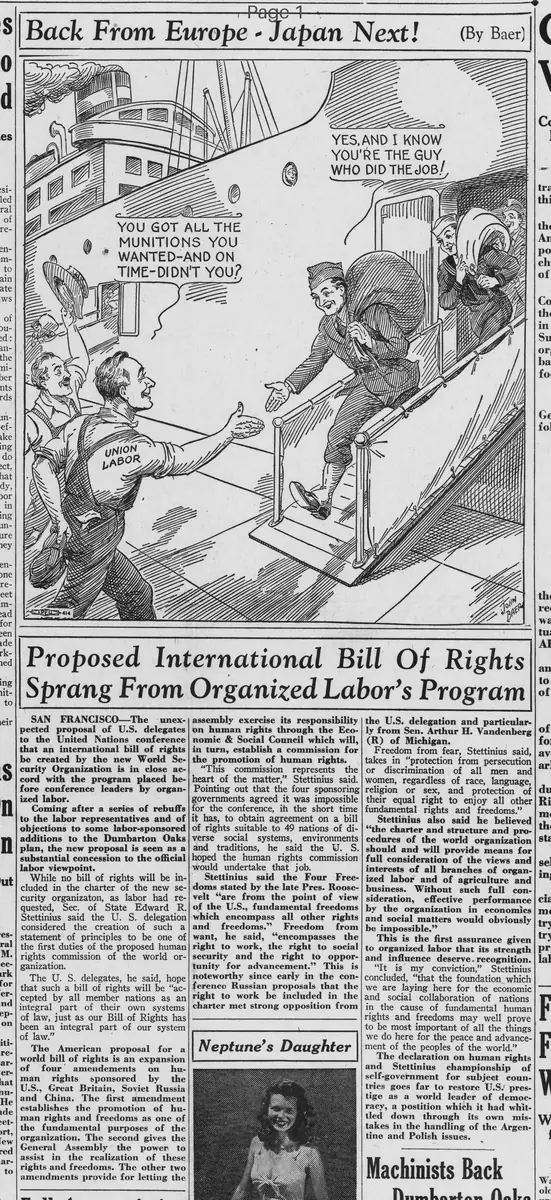
Merged-components note: Image (likely cartoon by Baer) overlaps with title component, and the following story continues the topic on the international bill of rights; merged into single coherent article.
Clipping
OCR Quality
Full Text
From
Europe - Japan Next!
(By Baer)
Proposed International Bill Of Rights
Sprang From Organized Labor's Program
SAN FRANCISCO--The unexpected proposal of U.S. delegates
to the United Nations conference
that an international bill of rights
be created by the new World Security Organization is in close accord with the program placed before conference leaders by organized labor.
Coming after a series of rebuffs
to the labor representatives and of
objections to some labor-sponsored
additions to the Dumbarton Oaks
plan, the new proposal is seen as a
substantial concession to the official
labor viewpoint.
While no bill of rights will be included in the charter of the new security organization, as labor had requested, Sec. of State Edward R.
Stettinius said the U. S. delegation
considered the creation of such a
statement of principles to be one of
the first duties of the proposed human
rights commission of the world organization.
The U. S. delegates. he said. hope
that such a bill of rights will be "accepted by all member nations as an
integral part of their own systems
of law, just as our Bill. of Rights has
been an integral part of our system
of law."
The American proposal for
a
world bill of rights is an expansion
of four amendments on human
rights sponsored by the
U.S., Great Britain, Soviet Russia
and China. The first amendment
establishes the promotion of human
rights and freedoms as one of
the fundamental purposes of the
organization. The second gives the
General Assembly the power to
assist in the realization of these
rights and freedoms. The other two
amendments provide for letting the
assembly exercise its responsibility
on human rights through the Economic & Social Council which will.
in turn, establish a commission for
the promotion of human rights.
"This commission represents the
heart of the matter." Stettinius said.
Pointing out that the four sponsoring
governments agreed it was impossible
for the conference, in the short time
it has, to obtain agreement on a bill
of rights suitable to 49 nations of diverse social systems, environments
and traditions, he said the U. S.
hoped the human rights commission
would undertake that job.
Stettinius said the Four
Freedoms stated by the late Pres. Roosevelt "are from the point of view
of the U.S., fundamental freedoms
which encompass all other rights
and freedoms."
Freedom from
want, he said, "encompasses the
right to work, the right to social
security and the right to opportunity for advancement." This is
noteworthy since early in the conference Russian proposals that the
right to work be included in the
charter met strong opposition from
the U.S. delegation and particularly from Sen. Arthur H. Vandenberg
(R., of Michigan).
Freedom from fear. Stettinius said,
takes in "protection from persecution
or discrimination of all men and
women, regardless of race, language,
religion or sex, and protection of
their equal right to enjoy all other
fundamental rights and freedoms."
Stettinius also said he believed
"the charter and structure and procedures of the world organization
should and will provide means for
full consideration of the views and
interests of all branches of organized labor and of agriculture and
business. Without such full consideration, effective performance
by the organization in economics
and social matters would obviously
be impossible."
This is the first assurance given
to organized labor that its strength
and influence deserve recognition.
It is my conviction," Stettinius
concluded, "that the foundation which
we are laying here for the economic
and social collaboration of nations
in the cause of fundamental human
rights and freedoms may well prove
to be most important of all the things
we do here for the peace and advancement of the peoples of the world."
The declaration on human rights
and Stettinius championship of
self-government for subject countries goes far to restore U.S. prestige as a world leader of democracy, a position which it had whittled down through its own mistakes in the handling of the Argentine and Polish issues.
What sub-type of article is it?
What themes does it cover?
What keywords are associated?
What entities or persons were involved?
Where did it happen?
Story Details
Key Persons
Location
San Francisco
Story Details
US delegates at the UN conference proposed an international bill of rights expanding on human rights amendments by major powers, to be developed by a human rights commission, aligning with organized labor's demands and Roosevelt's Four Freedoms, while assuring labor's role and restoring US prestige.