Thank you for visiting SNEWPapers!
Sign up free
Editorial
October 25, 1804
Norfolk Gazette And Publick Ledger
Norfolk, Virginia
What is this article about?
This editorial critiques the indifference of American merchants to commercial laws and highlights the excessive liability of ship owners under common law for losses due to masters' or mariners' embezzlement, contrasting it with limiting English statutes from 1734 and 1786. It urges Virginia merchants to seek legislative reform through their representative.
Clipping
OCR Quality
98%
Excellent
Full Text
COMMERCIAL.
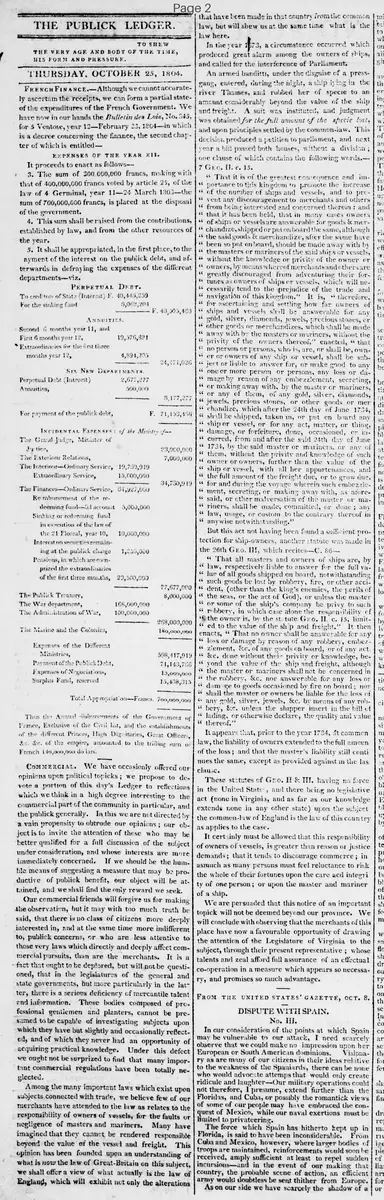
We have occasionally offered our opinions upon political topicks; we propose to devote a portion of this day's Ledger to reflections which we think in a high degree interesting to the commercial part of the community in particular, and the publick generally. In this we are not directed by a vain propensity to obtrude our opinions; our object is to invite the attention of those who may be better qualified for a full discussion of the subject under consideration, and whose interests are more immediately concerned. If we should be the humble means of suggesting a measure that may be productive of publick benefit, our object will be attained, and we shall find the only reward we seek.
Our commercial friends will forgive us for making the observation, but it may with too much truth be said, that there is no class of citizens more deeply interested in, and at the same time more indifferent to, publick concerns, or who are less attentive to those very laws which directly and deeply affect commercial pursuits, than are the merchants. It is a fact that ought to be deplored, but will not be questioned, that in the legislatures of the general and state governments, but more particularly in the latter, there is a serious deficiency of mercantile talent and information. Those bodies composed of professional gentlemen and planters, cannot be presumed to be capable of investigating subjects upon which they have but slightly and occasionally reflected, and of which they never had an opportunity of acquiring practical knowledge. Under this defect we ought not be surprized to find that many important commercial regulations have been totally neglected.
Among the many important laws which exist upon subjects connected with trade, we believe few of our merchants have attended to the law as relates to the responsibility of owners of vessels, for the faults or negligence of masters and mariners. Many have imagined that they cannot be rendered responsible beyond the value of the vessel and freight. This opinion has been founded upon an understanding of what is not the law of Great-Britain on this subject, we shall offer a view of what actually is the law of England, which will exhibit not only the alterations that have been made in that country from the common law, but will shew us at the same time what is the law here.
In the year 1733, a circumstance occurred which produced great alarm among the owners of ships, and called for the interference of Parliament. An armed banditti, under the disguise of a press-gang, entered, during the night, a ship lying in the river Thames, and robbed her of specie to an amount considerably beyond the value of the ship and freight. A suit was instituted, and judgment was obtained for the full amount of the specie lost, and upon principles settled by the common-law. This decision produced a petition to parliament, and next year a bill passed both houses, without a division; one clause of which contains the following words:
7 GEO. II. c. 15.
"That it is of the greatest consequence and importance to this kingdom to promote the increase of the number of ships and vessels, and to prevent any discouragement to merchants and others from being interested and concerned therein: and that it has been held, that in many cases owners of ships or vessels are answerable for goods & merchandize, shipped or put on board the same, although the said goods & merchandize, after the same have been so put onboard, should be made away with by the masters or mariners of the said ships or vessels, without the knowledge or privity of the owner or owners, by means whereof merchants and others are greatly discouraged from adventuring their fortunes as owners of ships or vessels, which will necessarily tend to the prejudice of the trade and navigation of this kingdom." It is, therefore, for ascertaining and settling how far owners of ships and vessels shall be answerable for any gold, silver, diamonds, jewels, precious stones, or other goods or merchandizes, which shall be made away with by the masters or mariners, without the privity of the owners thereof, enacted, "that no person or persons, who is, are, or shall be, owner or owners of any ship or vessel, shall be subject or liable to answer for, or make good to any one or more person or persons, any loss or damage by reason of any embezzlement, secreting or making away with, by the master or mariners, or any of them, of any gold, silver, diamonds, jewels, precious stones, or other goods or merchandize, which after the 24th day of June 1734, shall be shipped, taken in, or put on board any ship or vessel, or for any act, matter, or thing, damage, or forfeiture, done, occasioned, or incurred, from and after the said 24th day of June 1734, by the said master or mariners, or any of them, without the privity and knowledge of such owner or owners, further than the value of the ship or vessel, with all her appurtenances, and the full amount of the freight due, or to grow due, for and during the voyage wherein such embezzlement, secreting, or making away with, as aforesaid, or other malversation of the master or mariners, shall be made, committed, or done; any law, usage, or custom to the contrary thereof in anywise notwithstanding."
But this act not having been found a sufficient protection for ship-owners, another statute was made in the 26th GEO. III, which recites—C. 86—
"That all masters and owners of ships are, by law, respectively liable to answer for the full value of all goods shipped on board, notwithstanding such goods be lost by robbery, fire, or other accident, (other than the king's enemies, the perils of the seas, or the act of God), or unless the master or some of the ship's company be privy to such robbery, in which case alone the responsibility of the owner is, by the statute Geo. II. c. 15, limited to the value of the ship and freight." It then enacts, "That no owner shall be answerable for any loss or damage by reason of any robbery, embezzlement, &c. of any goods on board, or of any act &c. done without their privity or knowledge, beyond the value of the ship and freight, although the master or mariners shall not be concerned in the robbery, &c. nor answerable for any loss or damage to goods occasioned by fire on board; nor shall the master or owners be liable for the loss of any gold, silver, jewels, &c. by means of any robbery, &c. unless the shipper insert in the bill of lading, or otherwise declare, the quality and value thereof."
It appears that, prior to the year 1734, at common law, the liability of owners extended to the full amount of the loss; and that the master's liability still continues the same, except as provided against in the last clause.
These statutes of Geo. II & III. having no force in the United States, and there being no legislative act (none in Virginia, and as far as our knowledge extends none in any other state) upon the subject the common-law of England is the law of this country as it applies to the case.
It certainly must be allowed that this responsibility of owners of vessels, is greater than reason or justice demands; that it tends to discourage commerce; inasmuch as many persons must feel reluctance to risk the whole of their fortunes upon the care and integrity of one person; or upon the master and mariners of a ship.
We are persuaded that this notice of an important topick will not be deemed beyond our province. We will conclude with observing that the merchants of this place have now a favourable opportunity of drawing the attention of the Legislature of Virginia to the subject, through their present representative; whose talents and zeal afford full assurance of an effectual co-operation in a measure which appears so necessary, and promises so much advantage.
AN AMERICAN.
We have occasionally offered our opinions upon political topicks; we propose to devote a portion of this day's Ledger to reflections which we think in a high degree interesting to the commercial part of the community in particular, and the publick generally. In this we are not directed by a vain propensity to obtrude our opinions; our object is to invite the attention of those who may be better qualified for a full discussion of the subject under consideration, and whose interests are more immediately concerned. If we should be the humble means of suggesting a measure that may be productive of publick benefit, our object will be attained, and we shall find the only reward we seek.
Our commercial friends will forgive us for making the observation, but it may with too much truth be said, that there is no class of citizens more deeply interested in, and at the same time more indifferent to, publick concerns, or who are less attentive to those very laws which directly and deeply affect commercial pursuits, than are the merchants. It is a fact that ought to be deplored, but will not be questioned, that in the legislatures of the general and state governments, but more particularly in the latter, there is a serious deficiency of mercantile talent and information. Those bodies composed of professional gentlemen and planters, cannot be presumed to be capable of investigating subjects upon which they have but slightly and occasionally reflected, and of which they never had an opportunity of acquiring practical knowledge. Under this defect we ought not be surprized to find that many important commercial regulations have been totally neglected.
Among the many important laws which exist upon subjects connected with trade, we believe few of our merchants have attended to the law as relates to the responsibility of owners of vessels, for the faults or negligence of masters and mariners. Many have imagined that they cannot be rendered responsible beyond the value of the vessel and freight. This opinion has been founded upon an understanding of what is not the law of Great-Britain on this subject, we shall offer a view of what actually is the law of England, which will exhibit not only the alterations that have been made in that country from the common law, but will shew us at the same time what is the law here.
In the year 1733, a circumstance occurred which produced great alarm among the owners of ships, and called for the interference of Parliament. An armed banditti, under the disguise of a press-gang, entered, during the night, a ship lying in the river Thames, and robbed her of specie to an amount considerably beyond the value of the ship and freight. A suit was instituted, and judgment was obtained for the full amount of the specie lost, and upon principles settled by the common-law. This decision produced a petition to parliament, and next year a bill passed both houses, without a division; one clause of which contains the following words:
7 GEO. II. c. 15.
"That it is of the greatest consequence and importance to this kingdom to promote the increase of the number of ships and vessels, and to prevent any discouragement to merchants and others from being interested and concerned therein: and that it has been held, that in many cases owners of ships or vessels are answerable for goods & merchandize, shipped or put on board the same, although the said goods & merchandize, after the same have been so put onboard, should be made away with by the masters or mariners of the said ships or vessels, without the knowledge or privity of the owner or owners, by means whereof merchants and others are greatly discouraged from adventuring their fortunes as owners of ships or vessels, which will necessarily tend to the prejudice of the trade and navigation of this kingdom." It is, therefore, for ascertaining and settling how far owners of ships and vessels shall be answerable for any gold, silver, diamonds, jewels, precious stones, or other goods or merchandizes, which shall be made away with by the masters or mariners, without the privity of the owners thereof, enacted, "that no person or persons, who is, are, or shall be, owner or owners of any ship or vessel, shall be subject or liable to answer for, or make good to any one or more person or persons, any loss or damage by reason of any embezzlement, secreting or making away with, by the master or mariners, or any of them, of any gold, silver, diamonds, jewels, precious stones, or other goods or merchandize, which after the 24th day of June 1734, shall be shipped, taken in, or put on board any ship or vessel, or for any act, matter, or thing, damage, or forfeiture, done, occasioned, or incurred, from and after the said 24th day of June 1734, by the said master or mariners, or any of them, without the privity and knowledge of such owner or owners, further than the value of the ship or vessel, with all her appurtenances, and the full amount of the freight due, or to grow due, for and during the voyage wherein such embezzlement, secreting, or making away with, as aforesaid, or other malversation of the master or mariners, shall be made, committed, or done; any law, usage, or custom to the contrary thereof in anywise notwithstanding."
But this act not having been found a sufficient protection for ship-owners, another statute was made in the 26th GEO. III, which recites—C. 86—
"That all masters and owners of ships are, by law, respectively liable to answer for the full value of all goods shipped on board, notwithstanding such goods be lost by robbery, fire, or other accident, (other than the king's enemies, the perils of the seas, or the act of God), or unless the master or some of the ship's company be privy to such robbery, in which case alone the responsibility of the owner is, by the statute Geo. II. c. 15, limited to the value of the ship and freight." It then enacts, "That no owner shall be answerable for any loss or damage by reason of any robbery, embezzlement, &c. of any goods on board, or of any act &c. done without their privity or knowledge, beyond the value of the ship and freight, although the master or mariners shall not be concerned in the robbery, &c. nor answerable for any loss or damage to goods occasioned by fire on board; nor shall the master or owners be liable for the loss of any gold, silver, jewels, &c. by means of any robbery, &c. unless the shipper insert in the bill of lading, or otherwise declare, the quality and value thereof."
It appears that, prior to the year 1734, at common law, the liability of owners extended to the full amount of the loss; and that the master's liability still continues the same, except as provided against in the last clause.
These statutes of Geo. II & III. having no force in the United States, and there being no legislative act (none in Virginia, and as far as our knowledge extends none in any other state) upon the subject the common-law of England is the law of this country as it applies to the case.
It certainly must be allowed that this responsibility of owners of vessels, is greater than reason or justice demands; that it tends to discourage commerce; inasmuch as many persons must feel reluctance to risk the whole of their fortunes upon the care and integrity of one person; or upon the master and mariners of a ship.
We are persuaded that this notice of an important topick will not be deemed beyond our province. We will conclude with observing that the merchants of this place have now a favourable opportunity of drawing the attention of the Legislature of Virginia to the subject, through their present representative; whose talents and zeal afford full assurance of an effectual co-operation in a measure which appears so necessary, and promises so much advantage.
AN AMERICAN.
What sub-type of article is it?
Trade Or Commerce
Legal Reform
What keywords are associated?
Ship Owners Liability
Commercial Regulations
Mercantile Indifference
English Statutes
Virginia Legislature
Embezzlement
Masters Mariners
What entities or persons were involved?
Merchants
Parliament
Legislature Of Virginia
An American
Editorial Details
Primary Topic
Responsibility Of Ship Owners For Faults Of Masters And Mariners
Stance / Tone
Advocating Legislative Limitation Of Ship Owners' Liability To Promote Commerce
Key Figures
Merchants
Parliament
Legislature Of Virginia
An American
Key Arguments
Merchants Are Indifferent To Laws Affecting Commerce Despite Deep Interest.
Legislatures Lack Mercantile Talent, Leading To Neglected Commercial Regulations.
Common Law Holds Ship Owners Liable For Full Value Of Embezzled Goods Beyond Ship And Freight.
English Statute 7 Geo. Ii C. 15 (1734) Limits Owner Liability To Ship Value And Freight For Post 1734 Shipments.
English Statute 26 Geo. Iii C. 86 Extends Protections Against Liability For Robbery, Fire, Etc.
No Us Or State Laws Limit Liability, So Common Law Applies And Discourages Commerce.
Virginia Merchants Should Petition Legislature For Reform Via Their Representative.