Thank you for visiting SNEWPapers!
Sign up free
Portland Gazette, And Maine Advertiser
Portland, Cumberland County, Maine
What is this article about?
On February 14, 1812, in Boston, Massachusetts House Speaker Eleazer Wheelock Ripley left the chair to present a memorial seeking a committee to review documents related to a Supreme Judicial Court Justice, causing procedural chaos and heated debate. A motion to reconsider the committee's appointment failed 216-228.
Clipping
OCR Quality
Full Text
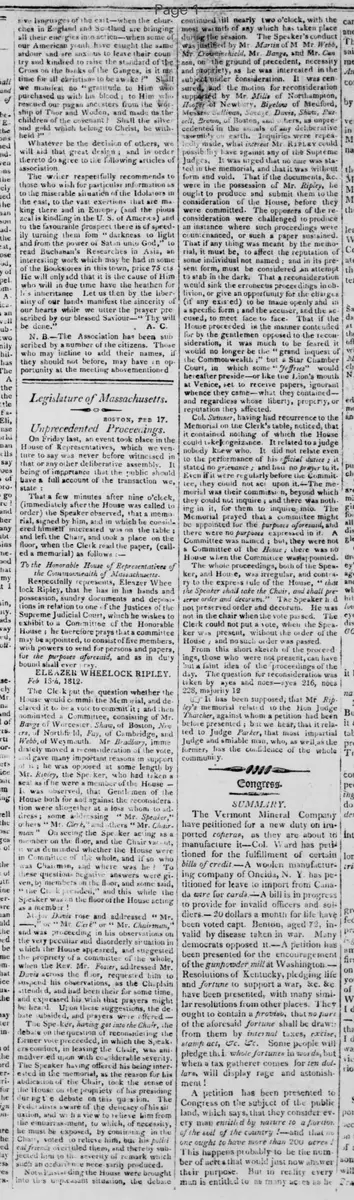
BOSTON, FEB 17.
Unprecedented Proceedings.
On Friday last, an event took place in the
House of Representatives, which we venture
to say was never before witnessed in
that or any other deliberative assembly. It
being of importance that the public should
have a full account of the transaction we
state:
That a few minutes after nine o'clock,
(immediately after the House was called to
order) the Speaker observed, that a memo-
rial, signed by him, and in which he consi-
dered himself interested was on the table:
and left the Chair, and took a place on the
floor, when the Clerk read the paper, (call-
ed a memorial) as follows:-
To the Honorable House of Representatives
of
the Commonwealth of Massachusetts.
Respectfully represents, Eleazer Whee-
lock Ripley, that he has in his hands and
possession, sundry documents and deposi-
tions in relation to one of the Justices of the
Supreme Judicial Court, which he wishes to
exhibit to a Committee of the Honorable
House; he therefore prays that a committee
may be appointed, to consist of five members,
with powers to send for persons and papers,
for the purposes aforesaid, and as in duty
bound shall ever pray.
ELEAZER WHEELOCK RIPLEY.
Feb 13th, 1812.
The Clerk put the question whether the
House would commit the Memorial, and de-
clared it to be a vote to commit it; and then
nominated a Committee, consisting of Mr.
Bangs of Worcester, Shaw, of Boston, New-
ers, of Northfield, Fay, of Cambridge, and
Webb, of Weymouth. Mr Bradbury, imme-
diately moved a reconsideration of the vote,
and gave many important reasons in support
of it; he was opposed at some length by
Mr. Ripley, the Speaker, who had taken a
seat as if he were a member of the House—
It was observed, that Gentlemen of the
House both for and against the reconsidera-
tion were altogether at a loss whom to ad-
dress; some addressing "Mr. Speaker,"
others "Mr. Clerk," and others "Mr. Chair-
man" On seeing the Speaker acting as a
member on the floor, and the Chair vacant,
it was demanded whether the House were
in Committee of the whole, and if so who
was Chairman, and where was he? To
these questions negative answers were gi-
ven, by members on the floor, and some said,
"the Clerk presided," and this while the
Speaker was on the floor of the House acting
as a member!
Maj. Davis rose and addressed "Mr.
—" or "Mr Clerk" or "Mr. Chairman,
and was proceeding in his observations on
the very peculiar and disorderly situation in
which the House appeared, and suggested
the propriety of a committee of the whole,
when the Rev. Mr. Foster, addressed Mr.
Davis across the floor, requested him to
suspend his observations, as the Chaplain
attended, and had been there for some time,
and expressed his wish that prayers might
be heard. Upon these suggestions, the de-
bate subsided, and prayers were offered—
The Speaker, having got into the Chair, the
debate on the question of reconsidering the
former vote proceeded, in which the Speak-
ers conduct, in leaving the Chair, was ani-
madverted upon with considerable severity.
The Speaker having offered his being inter-
est in the memorial, as the reason for his
abdication of the Chair, took the sense of
the House on the propriety of his presiding
during the debate on this question. The
Federalists aware of the delicacy of his sit-
uation, and with a view to relieve him from
the embarrasment, to which, of necessity,
he must be exposed, by continuing in the
Chair, voted to relieve him, but his political
friends overruled them, and thereby sub-
jected him to the severity of remark which
such an occurrence necessarily produced.
Notwithstanding the House were brought
into this unpleasant situation, the debate
continued till nearly two o'clock, with the
most warmth of any which has taken place
during the session. The Speaker's conduct
was justified by Mr Martin of M Mr. Webb.
Mr. Crowninshield, Mr. Bangs, and Mr. Can-
non, on the ground of precedent, necessity
and propriety, as he was interested in the
subject under consideration. It was cen-
sured, and the motion for reconsideration
supported by Mr. Mills of Northampton,
Hooper of Newbury, Bigelow of Medford,
Messrs. Sullivan, Sears, Davis, Shats, Rus-
sell. Brown, of Boston, and others, as unpre-
cedented in the annals of any deliberative
assembly on earth. Inquiries were repea-
tedly made. what interest Mr. Ripley could
possibly have against any of the Supreme
Judges, It was urged that no case was sta-
ted in the memorial, and that it was without
form and void, That if the documents, &c.
were in the possession of Mr. Ripley, he
ought to produce and submit them to the
consideration of the House, before they
were committed. The opposers of the re-
consideration were challenged to produce
an instance where such proceedings were
countenanced, or such a paper sustained.
That if any thing was meant by the memo-
rial, it must be, to affect the reputation of
some individual not named: and in its pre-
sent form, must be considered an attempt
to stab in the dark. That a reconsideration
would sink the erroneous proceedings in ob-
livion, or give an opportunity for the charges
(if any existed) to be made openly and in
a specific form; and the accuser, and the ac-
cused, to meet face to face. That if the
House proceeded in the manner contended
for by the gentlemen opposed to the recon-
sideration, it was much to be feared it
would no longer be the "grand inquest of
the Commonwealth;" but a Star Chamber
Court, in which some "Jeffries" would
hereafter preside—or like the Lion's mouth
at Venice, set to receive papers, ignorant
whence they came—what they contained—
and regardless whose liberty, property, or
reputation they affected.
Col. Sumner, having had recurrence to the
Memorial on the Clerk's table, noticed, that
it contained nothing of which the House
could take cognizance. It related to a judge
nobody knew who. It did not relate even
to the performance of his official duties; it
stated no grievance; and had no prayer to it.
Even if it were regularly before the Commit-
tee, they could not act upon it.—The me-
orial was their commission, beyond which
they could not inquire; and there was noth-
ing in it, for them to inquire into. The
Memorial prayed that a committee might
be appointed for the purposes aforesaid, and
there were no purposes expressed in it. A
Committee was named; but, they were not
a Committee of the House; there was no
House when the Committee was appointed.
The whole proceedings, both of the Spea-
ker, and House, was irregular, and contra-
ry to the express rule of the House, "that
the Speaker shall take the Chair, and shall pre-
serve order and decorum." The Speaker had
not preserved order and decorum. He was
not in the chair when the vote passed. The
Clerk could not put a vote, when the Spea-
ker was present, without the order of the
House; and no such order was passed.
From this short sketch of the proceed-
ings, those who were not present, can have
but a faint idea of the proceedings of the
day. The question for reconsideration was
taken by ayes and noes—ayes 216, noes
228, majority 12
It has been supposed, that Mr Rip-
ley's memorial related to the Hon Judge
Thatcher, against whom a petition had been
before presented; but we hear, that it rela-
ted to Judge Parker, that most impartial
Judge and amiable man, who, as well as the
former, has the confidence of the whole
community.
What sub-type of article is it?
What keywords are associated?
What entities or persons were involved?
Where did it happen?
Domestic News Details
Primary Location
Boston, Massachusetts
Event Date
Friday Last (February 13 14, 1812)
Key Persons
Outcome
motion to reconsider the vote to appoint a committee failed by a vote of 216 ayes to 228 noes (majority of 12 against reconsideration). the memorial likely targeted judge parker.
Event Details
Speaker Eleazer Wheelock Ripley left the chair due to personal interest in a memorial he signed, requesting a five-member committee to review documents and depositions related to an unnamed Justice of the Supreme Judicial Court. The House appointed the committee amid procedural confusion, as the Speaker acted as a member on the floor, leading to disorder in addressing the presiding officer. Debate ensued on the unprecedented nature of the proceedings, with prayers interrupting temporarily. Critics argued the memorial was vague and improper, while supporters justified it based on precedent and necessity.