Thank you for visiting SNEWPapers!
Sign up free
Alexandria Gazette & Advertiser
Alexandria, Virginia
What is this article about?
Detailed report of U.S. Congress proceedings on Dec. 10-11, 1822, including Senate and House sessions with introductions of bills on land titles, debt imprisonment, militia clothing, public lands, and resolutions on military affairs, infrastructure, and pensions; presidential messages on Indian lands and public buildings.
Merged-components note: Merged multi-page and multi-component report on Congressional proceedings into a single coherent domestic news article.
Clippings
1 of 2
OCR Quality
Full Text
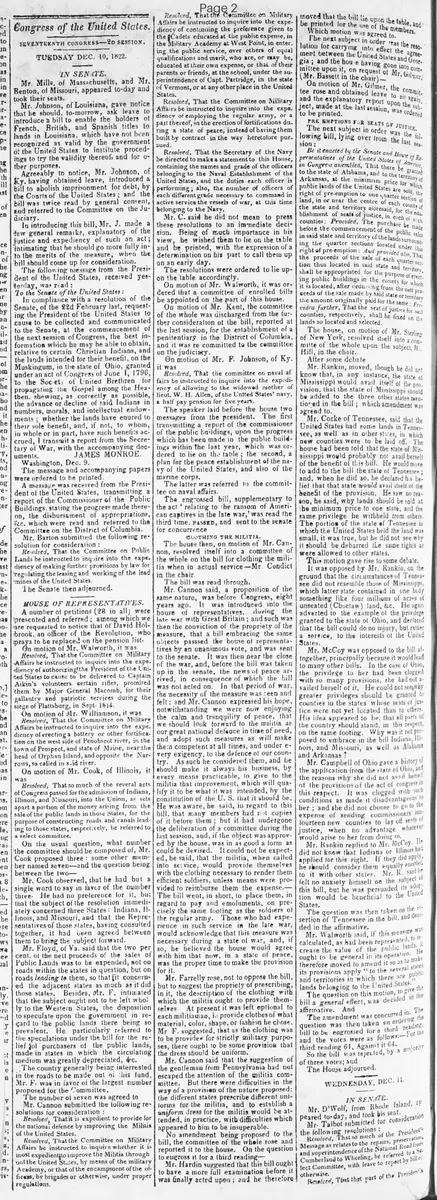
SEVENTEENTH CONGRESS -- 1st Session.
TUESDAY, DEC. 10, 1822.
IN SENATE.
Mr. Mills, of Massachusetts, and Mr. Benton, of Missouri, appeared to-day and took their seats.
Mr. Johnson, of Louisiana, gave notice that he should, to-morrow, ask leave to introduce a bill to enable the holders of French, British, and Spanish titles to lands in Louisiana, which have not been recognized as valid by the government of the United States to institute proceedings to try the validity thereof, and for other purposes.
Agreeably to notice, Mr. Johnson, of Ky. having obtained leave, introduced a bill to abolish imprisonment for debt, by the Courts of the United States; and the bill was twice read by general consent, and referred to the Committee on the Judiciary.
In introducing this bill, Mr. J. made a few general remarks, explanatory of the justice and expediency of such an act; intimating that he should go more fully into the merits of the measure, when the bill should come up for consideration.
The following message from the President of the United States, received yesterday, was read:
To the Senate of the United States:
In compliance with a resolution of the Senate, of the 22d February last, requesting the President of the United States to cause to be collected and communicated to the Senate, at the commencement of the next session of Congress, the best information which he may be able to obtain, relative to certain Christian Indians, and the lands intended for their benefit, on the Muskingum, in the state of Ohio, granted under an act of Congress of June 1, 1796, to the Society of United Brethren for propagating the Gospel among the Heathen, shewing, as correctly as possible, the advance or decline of said Indians in numbers, morals, and intellectual endowments; whether the lands have enured to their sole benefit, and, if not, to whom, in whole or in part, have such benefits accrued, I transmit a report from the Secretary of War, with the accompanying documents.
JAMES MONROE.
Washington, Dec. 9.
The message and accompanying papers were ordered to be printed.
A message was received from the President of the United States, transmitting a report of the Commissioner of the Public Buildings, stating the progress made thereon, the disbursement of appropriations, &c. which were read and referred to the Committee on the District of Columbia.
Mr. Barton submitted the following resolution for consideration:
Resolved, That the Committee on Public Lands be instructed to inquire into the expediency of making further provisions by law for regulating the leasing and working of the lead mines of the United States.
The Senate then adjourned.
HOUSE OF REPRESENTATIVES.
A number of petitions (28 in all) were presented and referred: among which we are requested to notice that of David Holbrook, an officer of the Revolution, who prays to be replaced on the pension list.
On motion of Mr. Walworth, it was
Resolved, That the Committee on Military Affairs be instructed to inquire into the expediency of authorizing the President of the United States to cause to be delivered to Captain Aikin's volunteers certain rifles, promised them by Major General Macomb, for their gallantry and patriotic services during the siege of Plattsburg, in Sept. 1814.
On motion of Mr. Williamson, it was
Resolved, That the Committee on Military Affairs be instructed to inquire into the expediency of erecting a battery or other fortification on the west side of Penobscot river, in the town of Prospect, and state of Maine, near the head of Orphan Island, and opposite the Narrows, so called in said river.
On motion of Mr. Cook, of Illinois, it was
Resolved, That so much of the several acts of Congress passed for the admission of Indiana, Illinois, and Missouri, into the Union, as sets apart a portion of the money arising from the sale of the public lands in those States, for the purpose of constructing roads and canals leading to those states, respectively, be referred to a select committee.
On the usual question, what number the committee should be composed of, Mr. Cook proposed three: some other member named seven -- and the question being between the two --
Mr. Cook observed, that he had but a single word to say in favor of the number three. He had no preference for it, but that the subject of the resolution immediately concerned three States: Indiana, Illinois, and Missouri, and that the Representatives of those states, having consulted together, it had been agreed between them to bring the subject forward.
Mr. Floyd, of Va. said that the two per cent. of the net proceeds of the sales of Public Lands was to be expended, not on roads within the states in question, but on roads leading to them, so that it concerned the adjacent states as much as it did those states. Besides, Mr. F. intimated that the subject ought not to be left wholly to the Western States, the disposition to speculate upon the government in regard to the public lands there being so prevalent. He particularly referred to the speculations under the bill for the relief of purchasers of the public lands, made in states in which the circulating medium was greatly depreciated, &c.
The country generally being interested in the roads to be made out of this fund, Mr. F. was in favor of the largest number proposed for the Committee.
The number of seven was agreed to.
Mr. Cannon submitted the following resolutions for consideration:
Resolved, That it is expedient to provide for the national defence by improving the Militia of the United States.
Resolved, That the Committee on Military Affairs be instructed to inquire whether it is most expedient to improve the Militia throughout the United States, by means of the military Academy, or that of the encampment of the officers, by brigades or otherwise, under proper regulations.
Resolved, That the Committee on Military Affairs be instructed to inquire into the expediency of continuing the preference given to the cadets educated at the public expense, in the Military Academy at West Point, in entering the public service, over others of equal qualifications and merit, who are, or may be, educated at their own expense, or that of their parents or friends, at the school, under the superintendence of Capt. Partridge, in the state of Vermont, or at any other place in the United States.
Resolved, That the Committee on Military Affairs be instructed to inquire into the expediency of employing the regular army, or a part thereof, in the erection of fortifications during a state of peace, instead of having them built by contract in the way heretofore pursued.
Resolved, That the Secretary of the Navy be directed to make a statement to this House, containing the names and grade of the officers belonging to the Naval Establishment of the United States, and the duties each officer is performing; also, the number of officers of each different grade necessary to command in active service the vessels of war, at this time belonging to the Navy.
Mr. C. said he did not mean to press these resolutions to an immediate decision. Being of much importance in his view, he wished them to lie on the table and be printed, with the expression of a determination on his part to call them up on an early day.
The resolutions were ordered to lie upon the table accordingly.
On motion of Mr. Walworth, it was ordered that a committee of enrolled bills be appointed on the part of this house.
On motion of Mr. Kent, the committee of the whole was discharged from the further consideration of the bill, reported at the last session, for the establishment of a penitentiary in the District of Columbia, and it was recommitted to the committee on the judiciary.
On motion of Mr. F. Johnson, of Ky. it was
Resolved, That the committee on naval affairs be instructed to inquire into the expediency of allowing to the widowed mother of Lieut. W. H. Allen, of the United States' navy, a half pay pension for five years.
The Speaker laid before the house two messages from the president. The first transmitting a report of the commissioner of the public buildings, upon the progress which has been made in the public buildings within the last year, which was ordered to lie on the table; the second, a plan for the peace establishment of the navy of the United States, and also of the marine corps.
The latter was referred to the committee on naval affairs.
The engrossed bill, supplementary to the act relating to the ransom of American captives in the late war, was read the third time, passed, and sent to the senate for concurrence.
CLOTHING THE MILITIA.
The house then, on motion of Mr. Cannon, resolved itself into a committee of the whole on the bill for clothing the militia when in actual service -- Mr. Condict in the chair.
The bill was read through.
Mr. Cannon said, a proposition of the same nature, was before Congress, eight years ago. It was introduced into the house of representatives, during the late war with Great Britain: and such was then the conviction of the propriety of the measure, that a bill embracing the same objects passed the house of representatives by an unanimous vote, and was sent to the senate. It was then near the close of the war, and, before the bill was taken up in the senate, the news of peace arrived, in consequence of which the bill was not acted on. In that period of war, the necessity of the measure was seen and felt: and Mr. Cannon expressed his hope, notwithstanding we were now enjoying the calm and tranquility of peace, that we should look forward to the militia as our great national defence in time of need, and adopt such measures as will make them competent at all times, and under every exigency, to the defence of our country. As such he considered them, and he should make it always his business, by every means practicable, to give to the militia that improvement, which will qualify it to be what it was intended, by the constitution of the U. S. that it should be.
He was aware, he said, in regard to this bill, that many members had not copies of it before them: but it had undergone the deliberation of a committee during the last session, and, if the object was approved by the house, was in as good a form as could be devised. It could not be expected, he said, that the militia, when called into service, would provide themselves with the clothing necessary to render them efficient soldiers, unless means were provided to reimburse them the expense. -- The bill went, in short, to place them, in regard to pay and emoluments, on precisely the same footing as the soldiers of the regular army. Those who had experience in such service in the late war, would acknowledge that this measure was necessary during a state of war, and, if so, he believed the house would agree with him that now, in a state of peace, was the proper time to make the provision for it.
Mr. Farrelly rose, not to oppose the bill, but to suggest the propriety of prescribing, in it, the description of the clothing with which the militia ought to provide themselves. At present it was left optional to each militiaman, to provide clothes of what material, color, shape, or fashion he chose. Mr. F. suggested, that as the clothing was to be provided for strictly military purposes, there ought to be some provision that the dress should be uniform.
Mr. Cannon said that the suggestion of the gentleman from Pennsylvania had not escaped the attention of the militia committee. But there were difficulties in the way of a provision of the nature proposed: the different states prescribe different uniforms for the militia, and to establish a uniform dress for the militia would be attended, in practice, with difficulties which appeared to him to be insuperable.
No amendment being proposed to the bill, the committee of the whole rose and reported it to the house. On the question to engross it for a third reading
Mr. Hardin suggested that this bill ought to have a more full examination before it was finally acted upon; and he therefore moved that the bill lie upon the table, and be printed for the use of the members.
Which motion was agreed to.
The next subject in order was the resolution for carrying into effect the agreement between the United States and Georgia; and the house having gone into committee upon it, on request of Mr. Gilmer, (Mr. Bassett in the chair) --
On motion of Mr. Gilmer, the committee rose and obtained leave to sit again, and the explanatory report upon the subject, made at the last session, was ordered to be printed.
PRE-EMPTIONS FOR SEATS OF JUSTICE.
The next subject in order was the following bill, lying over from the last session:
Be it enacted by the Senate and House of Representatives of the United States of America in Congress assembled, That from and after the passage of this act, in the state of Alabama and the territory of the United States in which public lands are sold at the minimum price for which lands of the United States are sold the pre-emption of one quarter section of land, to include the site of the seat of justice for each new county established in said state or territory, be granted to the county commissioners, or to the county court, for the use of the county, in trust for the county aforesaid: Provided, That the seat of justice in each of said counties, respectively, shall be fixed on the lands so located and selected.
The house, on motion of Mr. Sterling of New York, resolved itself into a committee of the whole upon the subject, Mr. Hill, in the chair.
After some debate
Mr. Rankin, moved, though he did not know that, in any instance, the state of Mississippi would avail itself of the provision, that the state of Mississippi should be added to the three other states mentioned in the bill; which amendment was agreed to.
Mr. Cocke of Tennessee, said that the United States had some lands in Tennessee, as well as in other states, in which new counties were to be laid off. The house had been told that the state of Mississippi would probably not avail herself of the benefit of this bill. He would move to add to the bill the state of Tennessee: and, when he did so, he declared his belief that that state would avail itself of the benefit of the provision. He saw no reason, he said, why lands should be sold at the minimum price to one state, and the same privilege be withheld from others. The portion of the state of Tennessee in which the United States held the land was small, it was true, but he did not see why it should be debarred the same rights as were allowed to other states.
This motion gave rise to some debate. It was opposed by Mr. Rankin, on the ground that the circumstances of Tennessee did not resemble those of Mississippi, which latter state contained in one body something like four millions of acres of unseated (Choctaw) land, &c. He again adverted to the example of the privilege granted to the state of Ohio, and declared that the bill could do no injury, but rather a service, to the interests of the United States.
Mr. McCoy was opposed to the bill altogether, principally because it would lead to many other bills. In the case of Ohio, the privilege to her had been clogged with so many provisions, she had not availed herself of it. He could not see why greater privileges should be granted to counties in the states whose seats of justice were not yet located than to others. His idea appeared to be, that all parts of the country should stand, in this respect, on the same footing. Why was it not proposed to embrace in the bill Indiana, Illinois, and Missouri, as well as Alabama and Arkansas?
Mr. Campbell of Ohio gave a history of the application from the state of Ohio, and of the provisions of the act of congress in the reasons why she did not avail herself this respect. It was clogged with such conditions as made it disadvantageous to her; and she did not choose to go to the expense of sending commissioners into her; and she did not choose to go to the justice, when no advantage whatever would arise to her from doing so. fourteen new counties to lay off seats of justice
Mr. Rankin replied to Mr. McCoy. He said he should consider them equally entitled to it with other states. Mr. R. said he felt no anxiety himself on the subject of this bill, but he was persuaded its adoption would be beneficial to the United States.
The question was then taken on the insertion of Tennessee in the bill, and decided in the affirmative.
Mr. Walworth said, if this measure was calculated, as had been represented, to increase the value of the public lands, it therefore moved to amend it so as to make general operation and provisions apply to the several states and territories in which there are public lands belonging to the United States.
The question on this motion, to give the bill a general effect, was decided in the affirmative.
And the votes were as follows: -- For the question was then taken on ordering the bill to be engrossed for a third reading 61, Against it 64.
So the bill was rejected, by a majority of three votes; and
The House adjourned.
WEDNESDAY, DEC. 11.
Mr. D'Wolf, from Rhode Island, appeared to-day, and took his seat.
IN SENATE.
Mr. Talbot submitted for consideration the following resolutions:
Resolved, That so much of the President's Message as relates to the repairs, preservation, and superintendence of the National Road from Wheeling referred to select Committee, with leave to report by bill or otherwise.
Resolved, That that part of the President's
A message which recommends the adoption of measures throughout the whole Union, be referred to a Select Committee, to consider and report thereon.
By Mr. Bartey, the Senate took up the resolution submitted to the Lead Mines, and agreed thereto.
The President of the United States, of the Message with the accompanying documents, were referred to the Committee on the Public Lands.
Mr. Johnson, of Louisiana, agreeably to the notice given by Mr. yesterday, asked and obtained leave, and introduced a bill to enable the holders of French, Spanish titles to lands in the United States to institute proceedings against the government, and the bill was read, and passed a second reading.
The bill yesterday introduced by Mr. Barton, relative to the lands in the State of Missouri, was read a second time and referred.
The Senate then adjourned.
HOUSE OF REPRESENTATIVES.
Mr. Blair, of South Carolina, resigned, Mr. John Carter, elected in the place of Mr. of Va. appeared and took his seat. Mr. Reid, of Georgia, and Mr. Spencer, of New York, Mr. Ball, Cuthbert, of the same state, also appeared. On his arrival we omitted noticing on Monday last, Mr. Lathrop, from Massachusetts, whose on that day took his seat.
Eleven petitions were presented to-day, and referred to different committees.
On motion of Mr. Cocke, the Committee on Revolutionary Pensions was discharged from the further consideration of the petition of Joseph Pickering, and it was ordered to lie upon the table.
On motion of Mr. Johnston, of Lou. the House took up the bill providing for the examination of the titles to land in that part of Louisiana situated between the Rio Hondo and the Sabine river; which was committed to a committee of the whole House, as also was, on his motion, the bill for the relief of Thaddeus Mayhew.
On motion of Mr. Alexander, of Va. it was Resolved, That the Committee on the Post Office and Post Roads be instructed to inquire into the expediency of changing the post route from Lombardy Grove, in Mecklenburg county, Virginia, so as to pass by Haskinton and Langley's Old Store, to St. Tammany, in said county.
On motion of Mr. Barber, of Conn. it was Resolved, That the Committee of Ways and Means be instructed to inquire into the expediency of granting an appropriation for completing and repairing Fort Griswold, in the state of Connecticut.
On motion of Mr. Cushman, it was Resolved, That the subject of the Public Buildings and the Public Lands, in the City of Washington, be referred to a select committee.
Mr. Colden, of N. Y. submitted for consideration the following resolution, which lies on the table one day of course: Resolved, That the President of the United States be requested to lay before this House such information as he may possess, with regard to any hostile expedition which may have been prepared in the United States, and sailed from thence, within the present year, against the territory or dependency of any power in amity with the United States, and to inform this House whether any measures have been taken to bring to condign punishment persons who may have been concerned in such expedition, contrary to the laws of the United States.
Mr. Condict, of N. J. offered the following resolution: Resolved, By the Senate and House of Representatives of the United States, in Congress assembled, that it shall be the duty of the Secretary and Clerk of the respective Houses to lay before Congress at the commencement of every session, a detailed statement of the expenditure of the contingent fund of each House during the preceding session, stating the items, quantity, prices, and to whom payment is made.
This resolution was read, and by the rules lies on the table one day.
On motion of Mr. Condict, of N. J. it was Resolved, That the Committee of Accounts be instructed to inquire and report whether any, and what part of the contingent expenses of this House can be curtailed, without detriment to the public service; and, that said committee revise the system pursued by the officers of this House in disbursing the contingent fund, and report whether any further restrictions, responsibilities, or checks, are necessary for its disbursement.
OCCUPATION OF COLUMBIA RIVER
The bill of the last session, providing for the occupation of the mouth of the Columbia river, being next in order— On motion of Mr. Floyd, the House went in and out of committee upon it, leave was given to sit again, and the bill was ordered to be re-printed.
A similar course being proposed on another bill Mr. Campbell, of Ohio, said he had no idea of sitting here, to receive motions to go in and out of committee, and to re-print bills; and suggested the propriety of some step to put an end to this (as it appeared to him) wasteful consumption of time.
No specific proposition, however, being made by Mr. Campbell, the Speaker proceeded in calling over the bills.
DISTRICT OF COLUMBIA.
The first bill which the house agreed to go into committee of the whole upon, was the bill to fix the compensation and fees of the Registers of Wills of the Counties of Washington and Alexandria, in the D. C.—Mr. Lathrop being called to the chair.
Mr. Neale assigned, at some length, the views of the committee which had at the last session shewed of the Congress importance reported of a this faithful bill intelligent administration of the duties of those officers and gave a view of the dature and extent of their labors and du- lies—all which, in his opinion, concurred to make the provisions of this bill.
for a light increase of their present emoluments, just and reasonable, as well in themselves as by comparison with the compensations of other public officers.
Mr. Hill and Mr. Walworth made some queries as to some of the details of the bill, which seemed objectionable to them; and Mr. Neale answered and explained.
Finally, after some amendment had been made to the bill— Mr. Cocke made opposition to it on principle; believing the fees now allowed by law to these officers to be sufficient. He moved to strike out the enacting clause of the bill. He considered the fees proposed by the bill to be enormous, and particularly objected to the fee of one dollar for stating each account and six and a quarter cents for examining each voucher.
Mr. Neale defended the bill, explained the bearing of these fees to the former fees, and shewed the fees now proposed to be allowed to the Registers of Wills to be less than had been allowed by an act of Congress to the Clerks of the Courts, &c.
The question on striking out the enacting clause, (rejecting the bill) was decided in the negative, by a large majority.
The bill being reported to the House, with amendments, was concurred in, and ordered to be engrossed, and read a third time to-morrow.
LAND OFFICE RECEIVERS. &C.
The House then resolved itself into a committee of the whole, on the bill, reported at the last session, fixing the compensation of Receivers of the Public Money, for their services in transmitting public moneys to safe places of deposit; Mr. Mallary in the chair.
No objection being made to the bill, the committee rose and reported it to the house, and it was ordered to be engrossed, and read a third time to-morrow.
To the same committee of the whole had been also referred the bill "for the relief of the Registers and of the Receivers of Public money of the several Land Offices, which was also ordered to be engrossed and read a third time.
A bill to enable the proprietors of lands, held by titles derived from the U.S. to obtain copies of their papers, was ordered to be engrossed and read a third time to-morrow.
The next bill in order was the bill "To abolish imprisonment for debt." Before taking up, The House adjourned.
Committees appointed by the Speaker.
On Mr. Cook's motion respecting Roads to Illinois, &c.- Messrs. Cook, Scott, Jennings, Floyd, Vance, Stewart, Nelson, of Md.
On the petition of B. Huffman.-Messrs. Jennings, Ross, Murray, Barber, of Connecticut, and Carter.
What sub-type of article is it?
What keywords are associated?
What entities or persons were involved?
Where did it happen?
Domestic News Details
Primary Location
Washington
Event Date
Tuesday, Dec. 10, 1822 And Wednesday, Dec. 11, 1822
Key Persons
Outcome
various bills introduced, referred, debated, passed, or rejected; resolutions submitted and committees instructed; presidential messages received and referred.
Event Details
Report of U.S. Senate and House proceedings: Senators seated; bills introduced on land titles in Louisiana, abolishing imprisonment for debt, lead mines regulation; presidential messages on Christian Indians in Ohio and public buildings; House petitions referred, resolutions on military rifles, fortifications, roads/canals, militia improvement, navy officers; debates on militia clothing bill and pre-emption for county seats bill (rejected 61-64); further proceedings on Dec. 11 including new members seated, more resolutions and bills on roads, land titles, post routes, forts, public buildings, hostile expeditions, contingent funds, Columbia River occupation, and compensation for officials.