Thank you for visiting SNEWPapers!
Sign up free
Editorial
June 14, 1888
The Chickasaw Messenger
Okolona, Chickasaw County, Mississippi
What is this article about?
Extract from Henry Grady's speech to the New England Society of New York, tributing Abraham Lincoln as the ideal American embodying Puritan and Cavalier virtues, calling for national unity. The Century praises the oratory's role in post-Civil War reconciliation between North and South.
Clipping
OCR Quality
98%
Excellent
Full Text
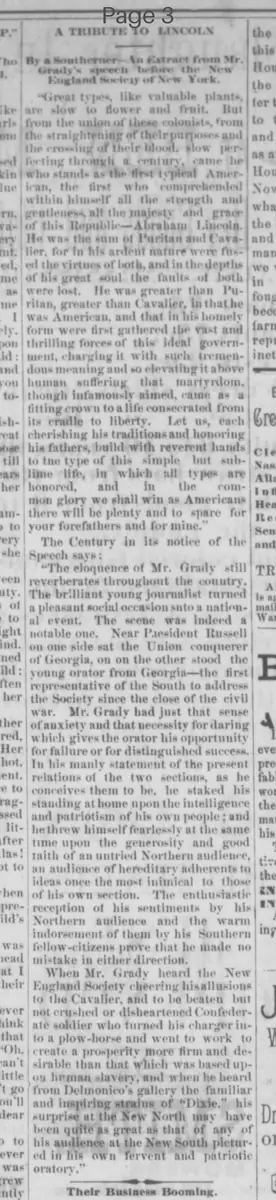
A TRIBUTE TO LINCOLN
By a Southerner—An Extract from Mr. Grady's speech before the New England Society of New York.
Great types, like valuable plants, are slow to flower and fruit. But from the union of these colonists, from the straightening of their purposes and the crossing of their blood, slow perfecting through a century, came he who stands as the first typical American, the first who comprehended within himself all the strength and gentleness, all the majesty and grace of this Republic—Abraham Lincoln.
He was the sum of Puritan and Cavalier, for in his ardent nature were fused the virtues of both, and in the depths of his great soul the faults of both were lost. He was greater than Puritan, greater than Cavalier. In that he was American, and that in his homely form were first gathered the vast and thrilling forces of this ideal government, charging it with such tremendous meaning and so elevating it above human suffering that martyrdom, though infamously aimed, came as a fitting crown to a life consecrated from its cradle to liberty. Let us, each cherishing his traditions and honoring his fathers, build with reverent hands to the type of this simple but sublime life, in which all types are honored, and in the common glory we shall win as Americans there will be plenty and to spare for your forefathers and for mine.
The Century in its notice of the Speech says:
"The eloquence of Mr. Grady still reverberates throughout the country. The brilliant young journalist turned a pleasant social occasion into a national event. The scene was indeed a notable one. Near President Russell on one side sat the Union conqueror of Georgia, on the other stood the young orator from Georgia—the first representative of the South to address the Society since the close of the civil war. Mr. Grady had just that sense of anxiety and that necessity for daring which gives the orator his opportunity for failure or for distinguished success. In his manly statement of the present relations of the two sections, as he conceives them to be, he staked his standing at home upon the intelligence and patriotism of his own people: and he threw himself fearlessly at the same time upon the generosity and good faith of an untried Northern audience, an audience of hereditary adherents to ideas once the most inimical to those of his own section. The enthusiastic reception of his sentiments by his Northern audience and the warm indorsement of them by his Southern fellow-citizens prove that he made no mistake in either direction.
When Mr. Grady heard the New England Society cheering his allusions to the Cavalier, and to the beaten but not crushed or disheartened Confederate soldier who turned his charger into a plow-horse and went to work to create a prosperity more firm and desirable than that which was based upon human slavery, and when he heard from Delmonico's gallery the familiar and inspiring strains of "Dixie," his surprise at the New North may have been quite as great as that of any of his audience at the New South pictured in his own fervent and patriotic oratory."
By a Southerner—An Extract from Mr. Grady's speech before the New England Society of New York.
Great types, like valuable plants, are slow to flower and fruit. But from the union of these colonists, from the straightening of their purposes and the crossing of their blood, slow perfecting through a century, came he who stands as the first typical American, the first who comprehended within himself all the strength and gentleness, all the majesty and grace of this Republic—Abraham Lincoln.
He was the sum of Puritan and Cavalier, for in his ardent nature were fused the virtues of both, and in the depths of his great soul the faults of both were lost. He was greater than Puritan, greater than Cavalier. In that he was American, and that in his homely form were first gathered the vast and thrilling forces of this ideal government, charging it with such tremendous meaning and so elevating it above human suffering that martyrdom, though infamously aimed, came as a fitting crown to a life consecrated from its cradle to liberty. Let us, each cherishing his traditions and honoring his fathers, build with reverent hands to the type of this simple but sublime life, in which all types are honored, and in the common glory we shall win as Americans there will be plenty and to spare for your forefathers and for mine.
The Century in its notice of the Speech says:
"The eloquence of Mr. Grady still reverberates throughout the country. The brilliant young journalist turned a pleasant social occasion into a national event. The scene was indeed a notable one. Near President Russell on one side sat the Union conqueror of Georgia, on the other stood the young orator from Georgia—the first representative of the South to address the Society since the close of the civil war. Mr. Grady had just that sense of anxiety and that necessity for daring which gives the orator his opportunity for failure or for distinguished success. In his manly statement of the present relations of the two sections, as he conceives them to be, he staked his standing at home upon the intelligence and patriotism of his own people: and he threw himself fearlessly at the same time upon the generosity and good faith of an untried Northern audience, an audience of hereditary adherents to ideas once the most inimical to those of his own section. The enthusiastic reception of his sentiments by his Northern audience and the warm indorsement of them by his Southern fellow-citizens prove that he made no mistake in either direction.
When Mr. Grady heard the New England Society cheering his allusions to the Cavalier, and to the beaten but not crushed or disheartened Confederate soldier who turned his charger into a plow-horse and went to work to create a prosperity more firm and desirable than that which was based upon human slavery, and when he heard from Delmonico's gallery the familiar and inspiring strains of "Dixie," his surprise at the New North may have been quite as great as that of any of his audience at the New South pictured in his own fervent and patriotic oratory."
What sub-type of article is it?
War Or Peace
Social Reform
What keywords are associated?
Lincoln Tribute
North South Reconciliation
American Identity
Civil War Aftermath
Henry Grady Speech
What entities or persons were involved?
Abraham Lincoln
Mr. Grady
Puritan
Cavalier
New England Society Of New York
Confederate Soldier
Editorial Details
Primary Topic
Tribute To Abraham Lincoln As The Typical American
Stance / Tone
Reverent Praise And Call For North South Reconciliation
Key Figures
Abraham Lincoln
Mr. Grady
Puritan
Cavalier
New England Society Of New York
Confederate Soldier
Key Arguments
Lincoln Embodies The Fusion Of Puritan And Cavalier Virtues
Lincoln's Life Consecrated To Liberty Ended In Fitting Martyrdom
Build Upon Lincoln's Sublime Life Honoring All Traditions
Grady's Speech Promotes Unity Between North And South Post Civil War
Reception Shows Mutual Generosity And Patriotism Across Sections