Thank you for visiting SNEWPapers!
Sign up free
Editorial
April 19, 1842
Democratic Standard
Georgetown, Brown County, Ohio
What is this article about?
Editorial defends Democrats against Journal's charges of ancient Federalism against Buchanan and Hubbard, counters by highlighting Whig leaders' Federalist ties and opposition to the War of 1812, focusing on Ohio politics and elections.
Clipping
OCR Quality
98%
Excellent
Full Text
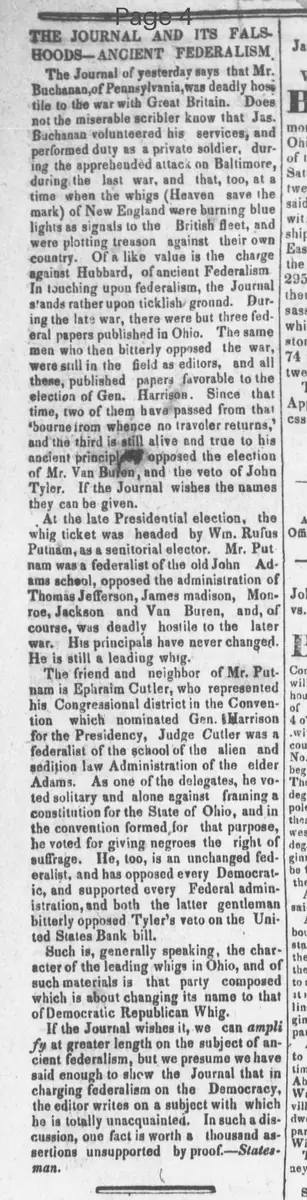
THE JOURNAL AND ITS FALSEHOODS—ANCIENT FEDERALISM.
The Journal of yesterday says that Mr. Buchanan, of Pennsylvania, was deadly hostile to the war with Great Britain. Does not the miserable scribbler know that Jas. Buchanan volunteered his services, and performed duty as a private soldier, during the apprehended attack on Baltimore, during the last war, and that, too, at a time when the whigs (Heaven save the mark) of New England were burning blue lights as signals to the British fleet, and were plotting treason against their own country. Of a like value is the charge against Hubbard, of ancient Federalism.
In touching upon federalism, the Journal stands rather upon ticklish ground. During the late war, there were but three federal papers published in Ohio. The same men who then bitterly opposed the war, were still in the field as editors, and all these, published papers favorable to the election of Gen. Harrison. Since that time, two of them have passed from that bourne from whence no traveler returns, and the third is still alive and true to his ancient principles opposed the election of Mr. Van Buren, and the veto of John Tyler. If the Journal wishes the names they can be given.
At the late Presidential election, the whig ticket was headed by Wm. Rufus Putnam, as a senatorial elector. Mr. Putnam was a federalist of the old John Adams school, opposed the administration of Thomas Jefferson, James Madison, Monroe, Jackson and Van Buren, and, of course, was deadly hostile to the late war. His principles have never changed. He is still a leading whig.
The friend and neighbor of Mr. Putnam is Ephraim Cutler, who represented his Congressional district in the Convention which nominated Gen. Harrison for the Presidency, Judge Cutler was a federalist of the school of the alien and sedition law Administration of the elder Adams. As one of the delegates, he voted solitary and alone against framing a constitution for the State of Ohio, and in the convention formed for that purpose. He voted for giving negroes the right of suffrage. He, too, is an unchanged federalist, and has opposed every Democratic, and supported every Federal administration, and both the latter gentlemen bitterly opposed Tyler's veto on the United States Bank bill.
Such is, generally speaking, the character of the leading whigs in Ohio, and of such materials is that party composed which is about changing its name to that of Democratic Republican Whig.
If the Journal wishes it, we can amplify at greater length on the subject of ancient federalism, but we presume we have said enough to show the Journal that in charging federalism on the Democracy, the editor writes on a subject with which he is totally unacquainted. In such a discussion, one fact is worth a thousand assertions unsupported by proof.—Statesman.
The Journal of yesterday says that Mr. Buchanan, of Pennsylvania, was deadly hostile to the war with Great Britain. Does not the miserable scribbler know that Jas. Buchanan volunteered his services, and performed duty as a private soldier, during the apprehended attack on Baltimore, during the last war, and that, too, at a time when the whigs (Heaven save the mark) of New England were burning blue lights as signals to the British fleet, and were plotting treason against their own country. Of a like value is the charge against Hubbard, of ancient Federalism.
In touching upon federalism, the Journal stands rather upon ticklish ground. During the late war, there were but three federal papers published in Ohio. The same men who then bitterly opposed the war, were still in the field as editors, and all these, published papers favorable to the election of Gen. Harrison. Since that time, two of them have passed from that bourne from whence no traveler returns, and the third is still alive and true to his ancient principles opposed the election of Mr. Van Buren, and the veto of John Tyler. If the Journal wishes the names they can be given.
At the late Presidential election, the whig ticket was headed by Wm. Rufus Putnam, as a senatorial elector. Mr. Putnam was a federalist of the old John Adams school, opposed the administration of Thomas Jefferson, James Madison, Monroe, Jackson and Van Buren, and, of course, was deadly hostile to the late war. His principles have never changed. He is still a leading whig.
The friend and neighbor of Mr. Putnam is Ephraim Cutler, who represented his Congressional district in the Convention which nominated Gen. Harrison for the Presidency, Judge Cutler was a federalist of the school of the alien and sedition law Administration of the elder Adams. As one of the delegates, he voted solitary and alone against framing a constitution for the State of Ohio, and in the convention formed for that purpose. He voted for giving negroes the right of suffrage. He, too, is an unchanged federalist, and has opposed every Democratic, and supported every Federal administration, and both the latter gentlemen bitterly opposed Tyler's veto on the United States Bank bill.
Such is, generally speaking, the character of the leading whigs in Ohio, and of such materials is that party composed which is about changing its name to that of Democratic Republican Whig.
If the Journal wishes it, we can amplify at greater length on the subject of ancient federalism, but we presume we have said enough to show the Journal that in charging federalism on the Democracy, the editor writes on a subject with which he is totally unacquainted. In such a discussion, one fact is worth a thousand assertions unsupported by proof.—Statesman.
What sub-type of article is it?
Partisan Politics
War Or Peace
What keywords are associated?
Ancient Federalism
Whig Federalists
Democratic Defense
War Of 1812
Ohio Politics
Party Accusations
What entities or persons were involved?
Mr. Buchanan
Hubbard
Gen. Harrison
Mr. Van Buren
John Tyler
Wm. Rufus Putnam
Ephraim Cutler
Journal
Statesman
Editorial Details
Primary Topic
Countering Charges Of Ancient Federalism Against Democrats By Exposing Whig Federalist History
Stance / Tone
Defensive Of Democrats, Accusatory Towards Whigs
Key Figures
Mr. Buchanan
Hubbard
Gen. Harrison
Mr. Van Buren
John Tyler
Wm. Rufus Putnam
Ephraim Cutler
Journal
Statesman
Key Arguments
Buchanan Volunteered In War Of 1812 Unlike New England Whigs
Ohio Federalist Papers Supported Harrison
Putnam Opposed Democratic Administrations And The War
Cutler Was Federalist, Opposed Ohio Constitution, Supported Negro Suffrage
Whigs Composed Of Unchanged Federalists Opposing Tyler's Veto