Thank you for visiting SNEWPapers!
Sign up free
Editorial
April 26, 1927
The Bismarck Tribune
Bismarck, Mandan, Burleigh County, Morton County, North Dakota
What is this article about?
The editorial praises veteran engineer Steve J. Standart's 50+ years of service, contrasts early railroading hardships with modern comforts, and calls for appreciation of railroad workers' demanding and responsible roles.
Clipping
OCR Quality
100%
Excellent
Full Text
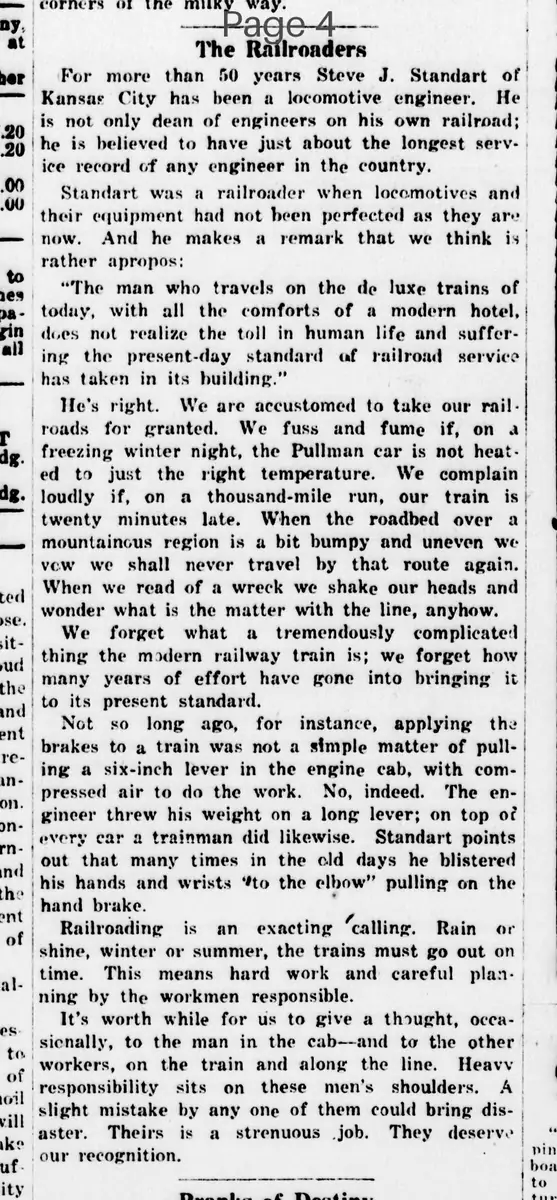
The Railroaders
For more than 50 years Steve J. Standart of
Kansas City has been a locomotive engineer. He
is not only dean of engineers on his own railroad;
he is believed to have just about the longest serv-
ice record of any engineer in the country.
Standart was a railroader when locomotives and
their equipment had not been perfected as they are
now. And he makes a remark that we think is
rather apropos:
"The man who travels on the de luxe trains of
today, with all the comforts of a modern hotel,
does not realize the toll in human life and suffer-
ing the present-day standard of railroad service
has taken in its building."
He's right. We are accustomed to take our rail
roads for granted. We fuss and fume if, on a
freezing winter night, the Pullman car is not heat-
ed to just the right temperature. We complain
loudly if, on a thousand-mile run, our train is
twenty minutes late. When the roadbed over a
mountainous region is a bit bumpy and uneven we
vow we shall never travel by that route again.
When we read of a wreck we shake our heads and
wonder what is the matter with the line, anyhow.
We forget what a tremendously complicated
thing the modern railway train is; we forget how
many years of effort have gone into bringing it
to its present standard.
Not so long ago, for instance, applying the
brakes to a train was not a simple matter of pull-
ing a six-inch lever in the engine cab, with com-
pressed air to do the work. No, indeed. The en-
gineer threw his weight on a long lever; on top of
every car a trainman did likewise. Standart points
out that many times in the old days he blistered
his hands and wrists to the elbow pulling on the
hand brake.
Railroading is an exacting calling. Rain or
shine, winter or summer, the trains must go out on
time. This means hard work and careful plan-
ning by the workmen responsible.
It's worth while for us to give a thought, occa-
sionally, to the man in the cab--and to the other
workers, on the train and along the line. Heavy
responsibility sits on these men's shoulders. A
slight mistake by any one of them could bring dis-
aster. Theirs is a strenuous job. They deserve
our recognition.
For more than 50 years Steve J. Standart of
Kansas City has been a locomotive engineer. He
is not only dean of engineers on his own railroad;
he is believed to have just about the longest serv-
ice record of any engineer in the country.
Standart was a railroader when locomotives and
their equipment had not been perfected as they are
now. And he makes a remark that we think is
rather apropos:
"The man who travels on the de luxe trains of
today, with all the comforts of a modern hotel,
does not realize the toll in human life and suffer-
ing the present-day standard of railroad service
has taken in its building."
He's right. We are accustomed to take our rail
roads for granted. We fuss and fume if, on a
freezing winter night, the Pullman car is not heat-
ed to just the right temperature. We complain
loudly if, on a thousand-mile run, our train is
twenty minutes late. When the roadbed over a
mountainous region is a bit bumpy and uneven we
vow we shall never travel by that route again.
When we read of a wreck we shake our heads and
wonder what is the matter with the line, anyhow.
We forget what a tremendously complicated
thing the modern railway train is; we forget how
many years of effort have gone into bringing it
to its present standard.
Not so long ago, for instance, applying the
brakes to a train was not a simple matter of pull-
ing a six-inch lever in the engine cab, with com-
pressed air to do the work. No, indeed. The en-
gineer threw his weight on a long lever; on top of
every car a trainman did likewise. Standart points
out that many times in the old days he blistered
his hands and wrists to the elbow pulling on the
hand brake.
Railroading is an exacting calling. Rain or
shine, winter or summer, the trains must go out on
time. This means hard work and careful plan-
ning by the workmen responsible.
It's worth while for us to give a thought, occa-
sionally, to the man in the cab--and to the other
workers, on the train and along the line. Heavy
responsibility sits on these men's shoulders. A
slight mistake by any one of them could bring dis-
aster. Theirs is a strenuous job. They deserve
our recognition.
What sub-type of article is it?
Labor
Infrastructure
What keywords are associated?
Railroad Engineers
Historical Service
Worker Hardships
Modern Railroads
Labor Recognition
What entities or persons were involved?
Steve J. Standart
Locomotive Engineers
Railroad Workers
Editorial Details
Primary Topic
Recognition Of Railroad Workers' Historical Hardships And Modern Responsibilities
Stance / Tone
Appreciative And Exhortative
Key Figures
Steve J. Standart
Locomotive Engineers
Railroad Workers
Key Arguments
Modern Railroad Comforts Overlook The Human Toll In Building The System
Past Railroading Involved Manual Braking And Physical Strain
Railroading Demands Exacting Work Regardless Of Weather
Workers Bear Heavy Responsibility To Prevent Disasters