Thank you for visiting SNEWPapers!
Sign up free
Southport Telegraph
Kenosha, Southport, Kenosha County, Wisconsin
What is this article about?
Speech by Mr. Noggle in the Wisconsin constitutional convention defending provisions for married women's property rights and homestead exemptions from forced sale, countering opponents' arguments on fraud and novelty, emphasizing justice, family protection, and democratic principles.
Merged-components note: Merged continuation of the speech by Mr. Noggle on the exemption article and rights of married women.
Clipping
OCR Quality
Full Text
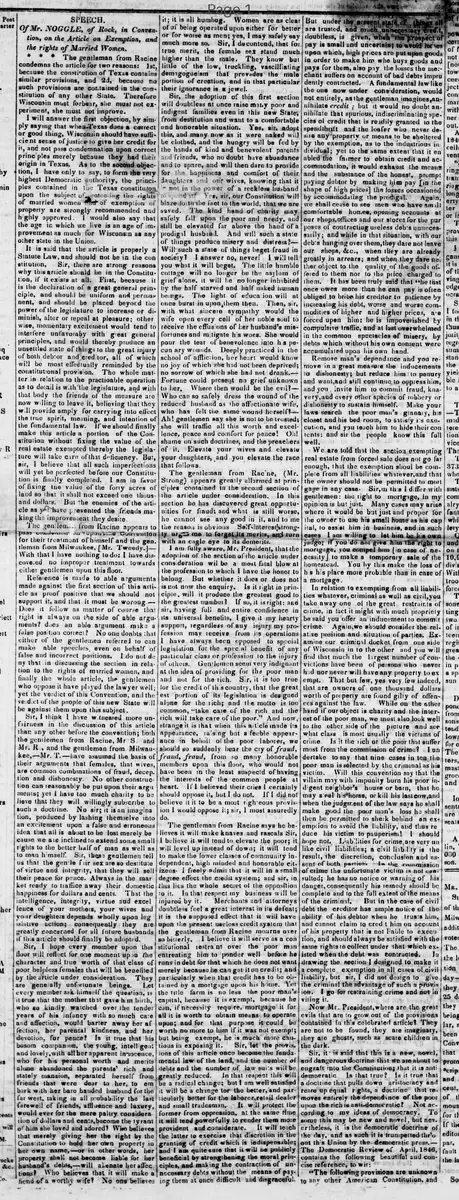
The gentleman from Racine condemns the article for two reasons: 1st, because the constitution of Texas contains similar provisions, and 2d, because no such provisions are contained in the constitution of any other State. Therefore Wisconsin must forbear, she must not experiment, she must not improve.
I will answer the first objection, by simply saying that when Texas does a correct or good thing, Wisconsin should have sufficient sense of justice to give her credit for it, and not pass condemnation upon correct principles merely because they had their origin in Texas. As to the second objection, I have only to say, to form the very highest Democratic authority, the principles contained in the Texas constitution upon the subject of protecting the rights of married women and of exemption of property are strongly recommended and highly approved. I would also say that the age in which we live is an age of improvement as much for Wisconsin as any other state in the Union.
It is said that the article is properly a Statute Law, and should not be in the constitution. Sir, there are strong reasons why this article should be in the Constitution, if it exists at all. First, because it is the declaration of a great general principle, and should be uniform and permanent, and should be placed beyond the power of the legislature to increase or diminish, alter or repeal at pleasure; otherwise, momentary excitement would tend to interfere unfavorably with great general principles, and would thereby produce an unsettled state of things to the great injury of both debtor and creditor, all of which will be most effectually remedied by the constitutional provision. The whole matter in relation to the practicable operation as to detail is with the legislature, and with that body the friends of the measure are now willing to leave it, believing that they will provide amply for carrying into effect the true spirit, meaning, and intention of the fundamental law. If we should finally make this article a portion of the Constitution without fixing the value of the real estate exempted thereby the legislature will take care of that deficiency. But, sir, I believe that all such imperfections will yet be perfected before our Constitution is finally completed. I am in favor of fixing the value of the forty acres of land so that it shall not exceed one thousand dollars. But the enemies of the article as yet have prevented the friends making the improvement they desire.
The gentleman from Racine appears to pass condemnation upon the Convention for their treatment of himself and the gentleman from Milwaukee, [Mr. Tweedy.]
With that I have nothing to do: I have discovered no improper treatment towards either gentlemen upon this floor.
Reference is made to able arguments made against the first section of this article as proof positive that we should not support it, and that it must be wrong.
Does it follow as matter of course that right is always on the side of able arguments? Does an able argument make a false position correct? No one doubts that either of the gentlemen referred to can make able speeches, even on behalf of false and incorrect positions. I do not deny that in discussing the section in relation to the rights of married women, and finally the whole article, the gentlemen who oppose it have played the lawyer well; yet the verdict of this Convention, and the verdict of the people of this new State will be against them upon this subject.
Sir, I think I have witnessed more unfairness in the discussion of this article than any other before the convention; both the gentlemen from Racine, Mr S. and Mr. R., and the gentleman from Milwaukee,—Mr. T.—have assumed the basis of their arguments that females, that wives, are common combinations of fraud, deception and dishonesty. No other construction can reasonably be put upon their arguments; yet I have too much charity to believe that they will willingly subscribe to such a doctrine. No sir; it is an imagination, produced by lashing themselves into an excitement upon a false and erroneous idea that all is about to be lost merely because we are inclined to extend some small rights to the better half of man as well as to man himself. Sir, these gentlemen tell us that the gentle sex are so destitute of virtue and integrity, that they will sell their peace for pence. Always in the market ready to traffic away their domestic happiness for dollars and cents. That the intelligence, integrity, virtue and excellence of your mothers, your wives and your daughters depends wholly upon legislative action; consequently they are greatly concerned for all future husbands if this article should finally be adopted.
Sir, I hope every member upon this floor will reflect for one moment upon the character and true worth of that class of poor helpless females that will be benefited by the article under consideration. They are generally unfortunate beings. Let every member ask himself the question, is it true that the mother that gave him birth, who so kindly watched over the tender years of his infancy with so much care and affection, would barter away her affection, her parental kindness, and her devotion, for pence? Is it true that his bosom companion, the young, intelligent and lovely, with all her apparent innocence, who on his personal worth and merits alone abandoned the parents' rich and stately mansion, separated herself from friends that were dear to her, to embark with her bare handed husband for the far west, taking in all probability the last farewell of friends, affluence and luxury, would ever for the mere paltry consideration of dollars and cents, become the tyrant of him she loved and adored? Who believes that merely giving her the right by the Constitution to hold her own property in her own name, —or in other words, her property shall not become liable for her husband's debts,—will alienate her affections? Who believes that it will make a fiend of a worthy wife? No one believes it; it is all humbug.
Women are as clear of being operated upon either for better or worse as men; yes, I may safely say much more so. Sir. I contend, that of true merit, the female sex stands much higher than the male. They know but little of the low, truckling, vacillating demagogueism that pervades the male portion of creation, and in that particular their ignorance is a jewel.
Sir, the adoption of this first section will doubtless at once raise many poor and indigent families even in this new State; from destitution and want to a comfortable and honorable situation. Yes, sir, adopt this, and many now as it were naked will be clothed, and the hungry will be fed by the hands of kind and benevolent parents and friends, who no doubt have abundance and to spare, and will then dare to provide for the happiness and comfort of their daughters and our wives, knowing that it is not in the power of a reckless husband to squander it Yes, sir, our Constitution will blaze forth to the world, that we are saved. The kind hand of charity may safely fall upon the poor and needy, and still be elevated far above the hand of a prodigal husband. And will such a state of things produce misery and distress?— Will such a state of things beget fraud in society? I answer no, never! I will tell you what it will beget. The little humble cottage will no longer be the asylum of grief alone, it will be no longer inhabited by the half starved and half naked human beings. The light of education will at once burst in upon them then. Then, sir, with what sincere sympathy would the wife open every cell of her noble soul to receive the effusions of her husband's misfortunes and mitigate his woes. She would pour the tear of benevolence into his pecuniary wounds. Deeply practiced in the school of affliction, her heart would know no joy of which she had not been deprived; no sorrow of which she had not drank.— Fortune could present no grief unknown to her. Where then would be the evil?— Who can so safely dress the wound of the reduced husband as the affectionate wife who has felt the same wound herself?
Ah! gentlemen say she is not to be trusted she will traffic all this worth and excellence, peace and comfort for pence! Oh! shame on such doctrines, and the preachers of it. Elevate your wives and elevate your daughters, and you elevate the race that follows.
The gentleman from Racine, (Mr. Strong) appears greatly alarmed at principles contained in the second section of the article under consideration. In this section he has discovered great opportunities for fraud: and what is still worse, he cannot see any good in it, and to me the reason is obvious Self-interest strongly urges me to forget its merits, and turn with an eagle eye to its demerits.
I am fully aware, Mr. President, that the adoption of the section of the article under consideration will be a most fatal blow at the profession to which I have the honor to belong. But whether it does or does not is not now the enquiry. Is it right in principle, will it produce the greatest good to the greatest number? If so, it is right: and sir, having full and entire confidence in its universal benefits, I give it my hearty support, regardless of any injury my profession may receive from its operations I have always been opposed to special legislation for the special benefit of any particular class or profession to the injury of others. Gentlemen seem very indignant at the idea of providing for the poor man and not for the rich. Sir, it is too true for the credit of this country. that the greatest portion of its legislation is designed alone for the rich; and the motto is too common, take care of the rich and the rich will take care of the poor." And now, strange it is that when this article made its appearance, raising but a feeble appearance in behalf of the poor laborer, we should so suddenly hear the cry of fraud, fraud, fraud, from so many honorable members upon this floor, who would not have been in the least suspected of having the interests of the common people at heart. If I believed their cries I certainly should oppose it, but I do not. If I did not believe it to be a most righteous provision I would oppose it; sir, I most assuredly do.
The gentleman from Racine says he believes it will make knaves and rascals Sir, I believe it will tend to elevate the poor; it will level up instead of down; it will tend to make the lower classes of community independent, high minded and honorable citizens. I freely admit that it will in a small degree affect the credit system; and sir, in this lies the whole secret of the opposition to it. In that respect my business will be injured by it. Merchants and attorneys doubtless feel a great interest in its defeat; it is the supposed effect that it will have upon the present useless credit system that the gentleman from Racine mourns over so bitterly. I believe it will serve as a constitutional restraint over the poor man entreating him to ponder well before he runs in debt for that which he does not want merely because he can get it on credit; and particularly when that credit has to be obtained by a mortgage upon his home. Yet the little farm is no less the poor man's capital, because it is exempt, because he can, if necessity require, mortgage it for all it is worth to obtain means to operate upon; and for that purpose it could be worth no more to him if it was not exempt; but being exempt, he is much more cautious in exposing it. Sir, let the provisions of this article once become the fundamental law of the land, and the number of debts and the number of law suits will be greatly reduced. In that respect this will be a radical change; but I am well satisfied it will be a change for the better, and particularly better for the laborer, retail dealer and small tradesman. It will protect the former from oppression, at the same time it will tend powerfully to render them more provident and considerate. It will teach the latter to exercise that discretion in the granting of credit which is indispensable; and I am quite sure that it will be publicly beneficial by strengthening the moral principles, and making the contraction of unnecessary debts without the means of paying them at once difficult and disgraceful.
But under the present state of things all are trusted, and much unnecessary credit, doubtless, is given, when "the prospect of pay is small and uncertain; to avoid losses upon which, high prices are put upon goods in order to make him who buys goods and pays for them, also pay the losses the merchant suffers on account of bad debts imprudently contracted. A fundamental law like the one now under consideration, would not entirely, as the gentleman imagines, annihilate credit ; but it would no doubt annihilate that spurious, indiscriminating species of credit that is readily granted to the spendthrift and the loafer who never desire any property or means to be sheltered by the exemption, as to the industrious individual; yet to the same extent that it enabled the former to obtain credit and accommodation, it would exhaust the means and the substance of the honest, prompt paying debtor by making him pay [in the shape of high prices] the losses occasioned by accommodating the prodigal. Again, we shall cease to see men who have small comfortable homes, opening accounts at our shops, offices and our stores for the purposes of contracting useless debts unnecessarily; and while in that situation, with our debts hanging over them, they dare not leave our shops, &c., when they are already greatly in arrears; and when they dare neither object to the quality of the goods offered to them nor to the price charged to them." It has been truly said that "he that once owes more than he can pay is often obliged to bribe his creditor to patience by increasing his debt, worse and worse commodities of higher and higher prices, are forced upon him: he is impoverished by compulsive traffic, and at last overwhelmed in the common spectacles of misery, by debts which without his own consent were accumulated upon his own hand.
Remove man's dependence and you remove in a great measure the inducements to dishonesty; but reduce him to penury and want, and still continue to oppress him, and you invite him to commit fraud, knavery, and every other species of robbery or dishonesty to sustain himself. Make your laws search the poor man's granary, his closet and his bed room, to satisfy its execution, and you teach him to hide their contents: and sir the people know this all well.
We are told that the section exempting real estate from forced sale does not go far enough, that the exemption should be complete from all liabilities whatever, and that the owner should not be permitted to mortgage in any case— Sir, in this I differ with gentlemen: the right to mortgage, in my opinion is but just. Many cases may arise where it would be but just and proper for the owner to use his small home as his capital, to assist him in business, and in such cases I am willing to let him be his own judge; if you do not give him the right to mortgage, you compel him in case of necessity to make a temporary sale of the homestead. You by this make the loss of his place more probable than in case of a mortgage.
In relation to exempting from all liabilities whatever, criminal as well as civil, you take away one of the great restraints of crime, in fact it might with much propriety be said you offer an inducement to commit crime.
Again, we should consider the relative position and situation of parties. Examine our criminal docket from one side of Wisconsin to the other and you will find that much the largest number of convictions have been of persons who never had nor never will have any property to exempt. That but few, yes very few indeed, that are owners of one thousand dollars worth of property are found guilty of offenses against the law. While on the other hand if our object is charity and the interest of the poor man, we must also look well to the other side of the picture and see what class is most usually the victims of crime. Is it the rich or the poor that suffer most from the commission of crime?—I undertake to say that nine cases in ten the poor man is selected by the criminal as his victim. Will this convention say that the villain may with impunity burn his poor indigent neighbor's house or barn, that he may steal his horse, or kill his last cow, and when the judgment of the law says he shall make good the poor man's loss he shall then be permitted to shirk behind an exemption to avoid the liability, and thus reduce his victim to pauperism! I should hope not. Liabilities for crime, are very unlike civil liabilities; a civil liability is the result, the discretion, conclusion and assent of both parties In the commission of crime the unfortunate victim is not consulted; he has no notice or warning of his danger, consequently his remedy should be complete and to the full extent of the means of the criminal. But in the case of civil debt the creditor has ample notice of the ability of his debtor when he trusts him, and cannot claim to credit him on account of his property that is not liable to execution, and should always be satisfied with the same rights to collect under that which existed when the debt was contracted. In drawing the section I designed to make it a complete exemption in all cases of civil liability, but sir, I did not design to give the criminal the advantage of such a provision, I go for restraining crime and not inviting it.
Now Mr. President, where are the great evils that are to grow out of the provisions contained in this celebrated article? They are not to be found, they are imaginary, they are ghosts, such as scare children in the dark.
Sir. it is said that this is a new, novel, and dangerous doctrine that we are about to engraft into the Constitution; that it is anti democratic Is that true? is it true that a doctrine that pulls down aristocracy and rears up equal rights, a doctrine that removes entirely the dependence of the poor upon the rich is anti-democratic? Not according to my ideas of democracy. To some this may be new and novel, but nevertheless, it is the democratic doctrine of the day. and as such it is trumpetted thro' out this Union by the democratic press.— The Democratic Review of April, 1846. contains the following beautiful and concise reference, to wit:
"The following provisions are unknown to any other American Constitution, and contain principles of exceeding importance and value. We hope that in some then he they may find their way into the fundamental law of the whole confederacy."
Texas Constitution, Sec. 19. "All property, both real and personal of the wife owned or claimed by her before marriage and that acquired afterwards by gift, devise; or descent shall be her separate property; and laws shall be passed more clearly defining the rights of the wife in relation as well to her separate property as that held in common with her husband. Laws shall also be passed providing for the registration of the wife's separate property.
Sec. 29. The legislature shall have power to protect by law, from forced sale, a certain portion of the property of all heads of families The homestead of a family not to exceed two hundred acres of land (not included in any town or city) or any town or city lot or lots in value not to exceed two thousand dollars, shall not be subject to forced sale for any debts hereafter contracted; nor shall the owner if a married man, be at liberty to alienate the same without the consent of the wife, in such manner as the legislature may hereafter point out."
Again in the Democratic Review of June 1846, page 420, we find the following excellent suggestion to the New York Convention:
"Some provision should be passed securing to females the sole right to hold and transfer, either by sale or devise after marriage, all property real and personal, belonging to them previous to and all property which they may become possessed after marriage, either by heirship, purchase, or in any manner whatsoever."
The editor adds the following, viz: "The provision in the Texas Constitution upon this point, is perhaps unexceptionable."
I might quote many more prominent organs of the democratic party to prove that it is recognized as the democratic doctrine of the day. But I think it unnecessary having above quoted from what is acknowledged to be the leading organ of the democracy in the United States.
Sir, in conclusion permit me to say that I took my seat upon this floor conscious that in this body a majority should rule. I have thus far submitted to the doings of the majority without a murmur, and exceedingly regret that gentlemen who should be presumed to have more good judgment, should stand upon this floor and threaten to defeat the Constitution, if the majority will not yield to the minority. It is justly despicable in any member who will take that course to awe the action of the majority.
What sub-type of article is it?
What themes does it cover?
What keywords are associated?
What entities or persons were involved?
Where did it happen?
Story Details
Key Persons
Location
Wisconsin Convention
Story Details
Mr. Noggle defends constitutional article protecting married women's property rights and exempting homesteads from forced sale, refuting claims of fraud and undemocratic nature, citing Texas constitution and Democratic Review, arguing it promotes equality, protects the poor, and reduces unnecessary debt.