Thank you for visiting SNEWPapers!
Sign up free
The Delaware Gazette
Wilmington, New Castle County, Delaware
What is this article about?
Satirical letter from British Minister Mr. Jackson to George Canning, published in the US, mocks failed diplomatic negotiations over trade restrictions, the Erskine arrangement disavowal, and the Chesapeake affair, portraying US rejection of British offers and ongoing political rivalry with President Madison.
Clipping
OCR Quality
Full Text
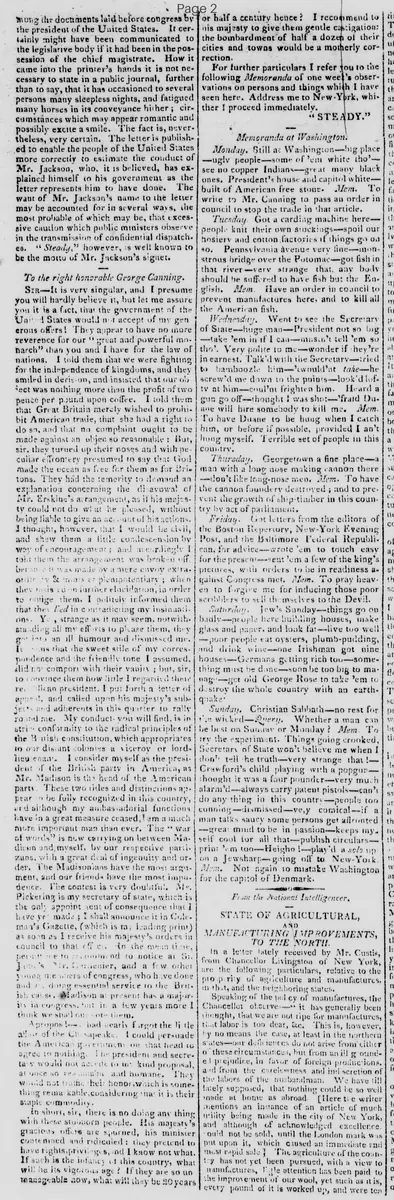
To the right honorable George Canning.
Sir--It is very singular, and I presume you will hardly believe it, but let me assure you it is a fact, that the government of the United States wouldn't accept of my generous offers! They appear to have no more reverence for our "great and powerful monarch" than you and I have for the law of nations. I told them that we were fighting for the independence of kingdoms, and they smiled in derision, and insisted that our object was nothing more than the profit of two pence per pound upon coffee. I told them that Great Britain merely wished to prohibit American trade, that she had a right to do so, and that no complaint ought to be made against an object so reasonable: But, sir, they turned up their noses and with peculiar effrontery presumed to say that (God made the ocean as free for them as for Britons. They had the temerity to demand an explanation concerning the disavowal of Mr. Erskine's arrangement, as if his majesty could not do what he pleased, without being liable to give an account of his actions. I thought, however, that I would be civil, and shew them a little condescension by way of encouragement; and accordingly I told them this arrangement was broke off, because it was made by an mere envoy extraordinary; when they asked for further elucidation, in order to oblige them, I politely informed them that they lied in contradicting my insinuations. Very strange as it may seem, notwithstanding all my efforts to please them, they got in an ill humour and dismissed me. It was that the sweet style of my correspondence and the friendly tone I assumed, did not comport with their vanity; but, sir, to convince them how little I regarded their republican president, I put forth a letter of marque, and called upon his majesty's subjects and adherents in this quarter to rally round me. My conduct, you will find, is in strict conformity to the radical principles of the British constitution, which appropriates to our distant colonies a viceroy or lord lieutenant. I consider myself as the president of the British party in America, as Mr. Madison is the head of the American party. These two titles and distinctions appear to be fully recognized in this country, and although my ambassadorial functions have in a great measure ceased, I am a much more important man than ever. The "war of words" is now carrying on between Mr. Madison and myself, by our respective partisans, with a great deal of ingenuity and order. The Madisonians have the most argument, and our friends have the most impudence. The contest is very doubtful. Mr. Pickering is my secretary of state, which is the only appointment of consequence that I have yet made; I shall announce it in Culeman's Gazette, (which is my leading print) as soon as I receive his majesty's orders in council to that effect. In the mean time, permit me to recommend to your notice at St. John's, Mr. Chaucier, and a few other young members of congress, who have done and are doing essential service to the British cause. Madison at present has a majority in congress, but in a few years more I think we shall out-them.
Apropos!--I had nearly forgot the little affair of the Chesapeake. I could persuade the American government on that head to agree to nothing. The president and secretary would not accede to my kind proposal, at once so reasonable and humane. They would not sacrifice their honor, which is something remarkable, considering that it is their staple commodity.
In short, sir, there is no doing anything with these stubborn people. His majesty's gracious offers are spurned, his minister contemned and ridiculed: they pretend to have rights, privileges, and I know not what. If such is the infancy of this country, what will be its vigorous age? If they are so unmanageable now, what will they be 20 years or half a century hence? I recommend to his majesty to give them gentle castigation: the bombardment of half a dozen of their cities and towns would be a motherly correction.
For further particulars I refer you to the following Memoranda of one week's observations on persons and things which I have seen here. Address me to New-York, whither I proceed immediately.
"STEADY."
Memoranda at Washington.
Monday. Still at Washington--big place--ugly people--some of 'em white tho'--see no copper Indians--great many black ones. President's house and capitol white--built of American free stone. Mem. To write to Mr. Canning to pass an order in council to stop the trade in that article.
Tuesday. Got a carding machine here--people knit their own stockings--spoil out hosiery and cotton factories if things go on so. Pennsylvania avenue very fine--monstrous bridge over the Potomac--got fish in that river--very strange that anybody should be suffered to have fish but the English. Mem. Have an order in council to prevent manufactures here, and to kill all the American fish.
Wednesday. Went to see the Secretary of State--huge man--President not so big--take 'em in if I can--mustn't tell 'em so tho'. Very polite to me--wonder if they're in earnest. Talk'd with the Secretary--tried to bamboozle him--'twouldn't take--he screw'd me down to the points--look'd off tv at him--couldn't frighten him. Heard a gun go off--thought I was shot--'fraid Duane will hire somebody to kill me. Mem. To have Duane to be hung when I catch him, or before if possible, provided I ain't hung myself. Terrible set of people in this country.
Thursday. Georgetown a fine place--a man with a long nose making cannon there---don't like long-nose men. Mem. To have the cannon foundery destroyed; and to prevent the growth of ship-timber in this country by act of parliament.
Friday. Got letters from the editors of the Boston Repertory, New-York Evening Post, and the Baltimore Federal Republican, for advice--wrote 'em to touch easy for the present--sent 'em a few of the king's pictures, with orders to be in readiness against Congress met. Mem. To pray heaven to forgive me for inducing those poor scribblers to sell themselves to the Devil.
Saturday. Jew's Sunday--things go on badly--people here building houses, make glass and paper, and look fat--live too well--poor people eat oysters, plumb-pudding, and drink wine--one Irishman got nine houses--Germans getting rich too--something must be done--soon be too big to manage--get old George Rose to take 'em to destroy the whole country with an earthquake.
Sunday. Christian Sabbath--no rest for the wicked--Query. Whether a man can be best on Sunday or Monday? Mem. To try the experiment. Things going crooked, Secretary of State won't believe me when I don't tell the truth--very strange that!--Crawford's child playing with a popgun---thought it was a four pounder--very much alarm'd--always carry patent pistols--can't do anything in this country--people too cunning--dismissed--very comical--if a man talks saucy some persons get affronted--great mind to be in passion--keeps my self cool for all that---publish circulars--print 'em too--Heigho!--play'd a solo up on a Jewsharp--going off to New-York.
Mem. Not again to mistake Washington for the capitol of Denmark.
What sub-type of article is it?
What keywords are associated?
What entities or persons were involved?
Where did it happen?
Foreign News Details
Primary Location
Washington, United States
Key Persons
Outcome
us government rejects british diplomatic offers on trade and chesapeake affair; ambassador dismissed; ongoing partisan 'war of words' with uncertain outcome.
Event Details
A satirical letter from Mr. Jackson to George Canning describes failed negotiations with the US government, including rejection of British trade prohibitions, disavowal of Mr. Erskine's arrangement, and proposals on the Chesapeake incident; Jackson positions himself as leader of the British party opposing President Madison, with memoranda mocking American society and suggesting repressive measures.