Thank you for visiting SNEWPapers!
Sign up free
Story
November 3, 1838
New Hampshire Statesman And State Journal
Concord, Merrimack County, New Hampshire
What is this article about?
Old Humphrey reflects on old houses as symbols of human mortality and the body's decay, urging aged readers to focus on preserving their souls for eternal life rather than futile repairs to the physical form.
Clipping
OCR Quality
98%
Excellent
Full Text
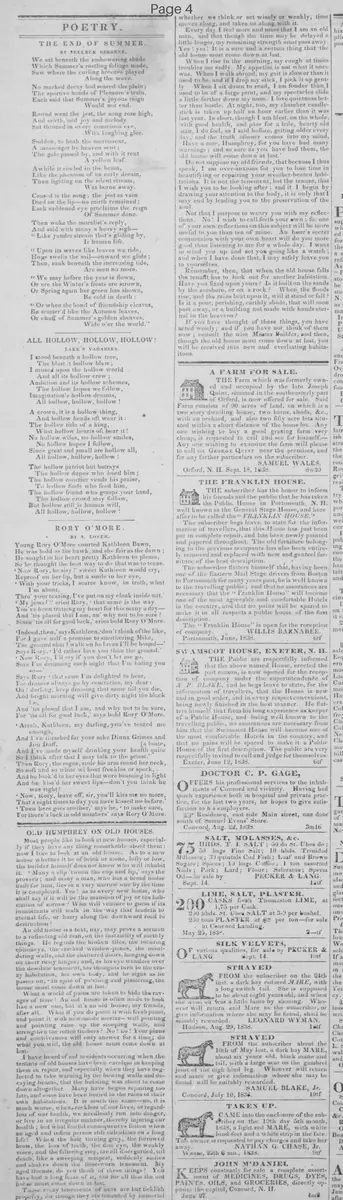
OLD HUMPHREY ON OLD HOUSES
Most people like to look at new houses, especially if they have any thing remarkable about them: now I like to look at an old house. As to a new house whether it be of brick or stone, lofty or low, the builder himself does not know who will inhabit it. 'Many a slip 'tween the cup and lip,' says the proverb; and many a man, who has a broad house built for him, lies in a very narrow one by the time it is completed. Yes! as to every new house, who shall say if it will be the mansion of joy or the habitation of sorrow? Who will venture to guess if its inhabitants will walk in the way that leadeth to eternal life, or hurry along the downward road to destruction?
An old house is a text, nay, may prove a sermon to a reflecting old man, on the instability of earthly things. He regards the broken tiles, the tottering chimneys, the cracked window-panes, the mouldering walls, and the shattered doors, hanging down on their rusty hinges; and, as his eye wanders over the desolate tenement, his thoughts turn to the crazy habitation, his own body, and he sighs as he passes on, 'In spite of patching and plastering, the house must come down at last.'
What a world of pains are taken to hide the ravages of time! An old house is often made to look like a new one, but it's an old house, my friends, after all. What if you do paint it with fresh paint, and point it with new-made mortar—will pointing and painting raise up the sloping walls, and strengthen the rotten timbers? No: no! Your plans and contrivances will only answer for a time; do what you will, the old house must come down at last.
I have heard of sad accidents occurring when the tenants of old houses have been careless in keeping them in repair, and especially when they have neglected to take warning by the bowing walls and decaying beams, that the building was about to come down altogether. Many have begun repairing too late, and some have been buried in the ruins of their own habitations. It is much the same—no, it is much worse, when—reckless of our lives, or regardless of our health, we needlessly run into danger, or live in an irregular manner, thereby injuring our health; but what fearful consequences follow when an aged and infirm person still calculates on a long life! When the hair turning grey, the furrowed brow, the loss of teeth, the dim eye, the weakly voice, and the faltering step, are all disregarded, till death, like a sweeping tempest, suddenly smites and shakes down the time-worn tenement. My aged friends, do you think of these things? You have had a long lease of it, but for all that the old house must come down at last.
These crazy tenements of ours are but ticklish property, for though they are tenanted by immortal souls, there is no security for their enduring even an hour. We cannot make them proof against fire and water; nor insure them against plague, pestilence, or famine, battle, murder, or sudden death. How easy it is to talk of these things to others, and how hard to bring them home to ourselves. We speak well and act ill. We pass ourselves off for wise men, when we know that we are very fools. But whether we think or act wisely or weakly, time moves along, and takes us along with it.
Every day I feel more and more that I am an old man, and that though the time may be delayed a little longer, my remaining strength must pass away. Yes! yes! It is a sure and a certain thing that the old house must come down at last.
When I rise in the morning, my cough at times troubles me sadly. My appetite is not what it once was. When I walk abroad, my gait is slower than it used to be, and if I drop my stick, I pick it up gently. When I sit down to read, I am fonder than I used to be of a large print, and my spectacles slide a little further down my nose. I love quietness better than bustle. At night, too, my chamber candlestick is taken up half an hour earlier than it was last year. In short, though I am blest, on the whole, with good health, and pass for a hale, hearty old man, I do feel, as I said before, getting older every day, and the truth oftener comes into my mind. 'Have a care, Humphrey, for you have had many warnings; and so sure as you have had them, the old house will come down at last.'
Do not suppose my old friends, that because I thus speak, I am over-anxious for you to lose time in beautifying or repairing your weather-beaten habitations. It is not the tenement, but the tenant, that I wish you to be looking after; and if I begin by drawing your attention to the body, it is only that I may end by leading you to the preservation of the soul.
Not that I purpose to weary you with my reflections. No: I wish to call forth your own; for one of your own reflections on this subject will be more useful to you than ten of mine. An hour's secret communion with your own heart will do you more good than listening to me for a whole day. I want to wind you up and set you going like a watch; and when I have done that, I may safely leave you to yourselves.
Remember, then, that when the old house falls the tenant has to look out for another habitation. Have you fixed upon yours? Is it built on the sands by the seashore, or on a rock? When the floods rise, and the rains beat upon it, will it stand or fall? Is it a poor, perishing, earthly abode, that will soon pass away, or a building not made with hands, eternal in the heavens?
If you have thought of these things, you have acted wisely; and if you have not think of them now; consult the wise Master Builder, and then, though the old house must come down at last, you will be received into new and everlasting habitations.
Most people like to look at new houses, especially if they have any thing remarkable about them: now I like to look at an old house. As to a new house whether it be of brick or stone, lofty or low, the builder himself does not know who will inhabit it. 'Many a slip 'tween the cup and lip,' says the proverb; and many a man, who has a broad house built for him, lies in a very narrow one by the time it is completed. Yes! as to every new house, who shall say if it will be the mansion of joy or the habitation of sorrow? Who will venture to guess if its inhabitants will walk in the way that leadeth to eternal life, or hurry along the downward road to destruction?
An old house is a text, nay, may prove a sermon to a reflecting old man, on the instability of earthly things. He regards the broken tiles, the tottering chimneys, the cracked window-panes, the mouldering walls, and the shattered doors, hanging down on their rusty hinges; and, as his eye wanders over the desolate tenement, his thoughts turn to the crazy habitation, his own body, and he sighs as he passes on, 'In spite of patching and plastering, the house must come down at last.'
What a world of pains are taken to hide the ravages of time! An old house is often made to look like a new one, but it's an old house, my friends, after all. What if you do paint it with fresh paint, and point it with new-made mortar—will pointing and painting raise up the sloping walls, and strengthen the rotten timbers? No: no! Your plans and contrivances will only answer for a time; do what you will, the old house must come down at last.
I have heard of sad accidents occurring when the tenants of old houses have been careless in keeping them in repair, and especially when they have neglected to take warning by the bowing walls and decaying beams, that the building was about to come down altogether. Many have begun repairing too late, and some have been buried in the ruins of their own habitations. It is much the same—no, it is much worse, when—reckless of our lives, or regardless of our health, we needlessly run into danger, or live in an irregular manner, thereby injuring our health; but what fearful consequences follow when an aged and infirm person still calculates on a long life! When the hair turning grey, the furrowed brow, the loss of teeth, the dim eye, the weakly voice, and the faltering step, are all disregarded, till death, like a sweeping tempest, suddenly smites and shakes down the time-worn tenement. My aged friends, do you think of these things? You have had a long lease of it, but for all that the old house must come down at last.
These crazy tenements of ours are but ticklish property, for though they are tenanted by immortal souls, there is no security for their enduring even an hour. We cannot make them proof against fire and water; nor insure them against plague, pestilence, or famine, battle, murder, or sudden death. How easy it is to talk of these things to others, and how hard to bring them home to ourselves. We speak well and act ill. We pass ourselves off for wise men, when we know that we are very fools. But whether we think or act wisely or weakly, time moves along, and takes us along with it.
Every day I feel more and more that I am an old man, and that though the time may be delayed a little longer, my remaining strength must pass away. Yes! yes! It is a sure and a certain thing that the old house must come down at last.
When I rise in the morning, my cough at times troubles me sadly. My appetite is not what it once was. When I walk abroad, my gait is slower than it used to be, and if I drop my stick, I pick it up gently. When I sit down to read, I am fonder than I used to be of a large print, and my spectacles slide a little further down my nose. I love quietness better than bustle. At night, too, my chamber candlestick is taken up half an hour earlier than it was last year. In short, though I am blest, on the whole, with good health, and pass for a hale, hearty old man, I do feel, as I said before, getting older every day, and the truth oftener comes into my mind. 'Have a care, Humphrey, for you have had many warnings; and so sure as you have had them, the old house will come down at last.'
Do not suppose my old friends, that because I thus speak, I am over-anxious for you to lose time in beautifying or repairing your weather-beaten habitations. It is not the tenement, but the tenant, that I wish you to be looking after; and if I begin by drawing your attention to the body, it is only that I may end by leading you to the preservation of the soul.
Not that I purpose to weary you with my reflections. No: I wish to call forth your own; for one of your own reflections on this subject will be more useful to you than ten of mine. An hour's secret communion with your own heart will do you more good than listening to me for a whole day. I want to wind you up and set you going like a watch; and when I have done that, I may safely leave you to yourselves.
Remember, then, that when the old house falls the tenant has to look out for another habitation. Have you fixed upon yours? Is it built on the sands by the seashore, or on a rock? When the floods rise, and the rains beat upon it, will it stand or fall? Is it a poor, perishing, earthly abode, that will soon pass away, or a building not made with hands, eternal in the heavens?
If you have thought of these things, you have acted wisely; and if you have not think of them now; consult the wise Master Builder, and then, though the old house must come down at last, you will be received into new and everlasting habitations.
What sub-type of article is it?
Biography
What themes does it cover?
Moral Virtue
Providence Divine
Tragedy
What keywords are associated?
Old Houses
Mortality
Aging
Soul Preservation
Divine Providence
Eternal Life
What entities or persons were involved?
Old Humphrey
Story Details
Key Persons
Old Humphrey
Story Details
Old Humphrey uses the metaphor of decaying old houses to reflect on human aging, mortality, and the importance of preparing the immortal soul for eternal life through faith in the divine.