Thank you for visiting SNEWPapers!
Sign up free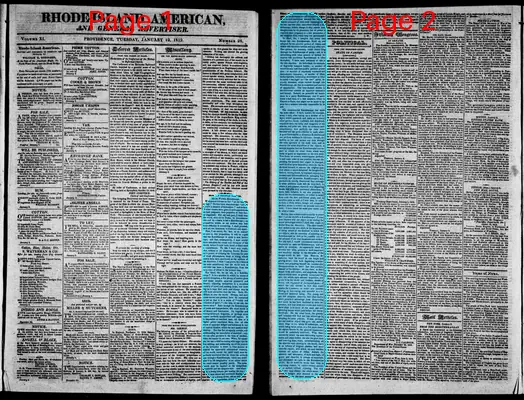
Literary
January 12, 1819
The Rhode Island American, And General Advertiser
Providence, Providence County, Rhode Island
What is this article about?
This essay from the Christian Observer uses the kaleidoscope as a metaphor for the world's deceptive beauty and human perceptual biases, from youth's fascination to party politics and religious doctrines, urging readers to adjust their views for true moral insight and happiness amid life's illusions.
Merged-components note: This is a continuation of the essay 'All the World a Kaleidoscope' spanning from page 1 to page 2; relabeled to literary as it is an essay rather than a narrative story.
Clippings
1 of 2
OCR Quality
95%
Excellent
Full Text
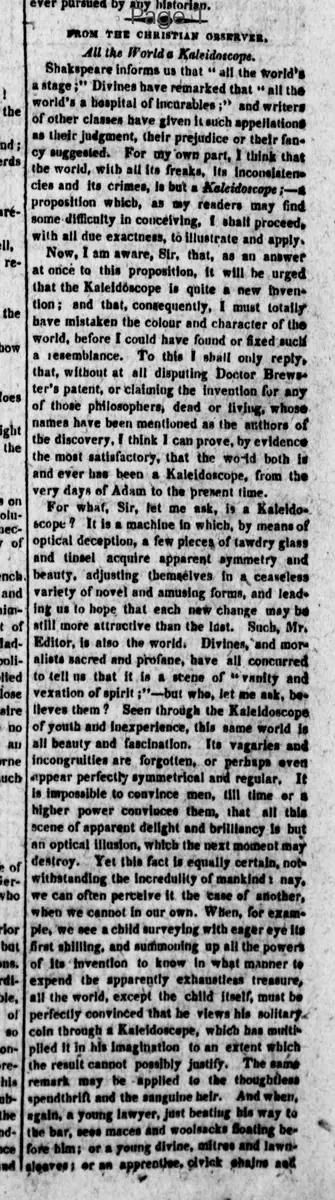
FROM THE CHRISTIAN OBSERVER.
All the World a Kaleidoscope.
Shakspeare informs us that "all the world's
a stage;" Divines have remarked that "all the
world's a hospital of incurables;" and writers
of other classes have given it such appellations
as their judgment, their prejudice or their fan-
cy suggested. For my own part, I think that
the world, with all its freaks, its inconsisten-
cies and its crimes, is but a Kaleidoscope;—a
proposition which, as my readers may find
some difficulty in conceiving, I shall proceed,
with all due exactness, to illustrate and apply
Now, I am aware, Sir, that, as an answer
at once to this proposition, it will be urged
that the Kaleidoscope is quite a new inven-
tion; and that, consequently, I must totally
have mistaken the colour and character of the
world, before I could have found or fixed such
a resemblance. To this I shall only reply,
that, without at all disputing Doctor Brews-
ter's patent, or claiming the invention for any
of those philosophers, dead or living, whose
names have been mentioned as the authors of
the discovery. I think I can prove, by evidence
the most satisfactory, that the world both is
and ever has been a Kaleidoscope, from the
very days of Adam to the present time.
For what, Sir, let me ask, is a Kaleido-
scope? It is a machine in which, by means of
optical deception, a few pieces of tawdry glass
and tinsel acquire apparent symmetry and
beauty, adjusting themselves, in a ceaseless
variety of novel and amusing forms, and lead-
ing us to hope that each new change may be
still more attractive than the last. Such, Mr.
Editor, is also the world. Divines, and mor-
alists sacred and profane, have all concurred
to tell us that it is a scene of "vanity and
vexation of spirit;"—but who, let me ask, be-
lieves them? Seen through the Kaleidoscope
of youth and inexperience, this same world is
all beauty and fascination. Its vagaries and
incongruities are forgotten, or perhaps even
appear perfectly symmetrical and regular. It
is impossible to convince men, till time or a
higher power convinces them, that all this
scene of apparent delight and brilliancy is but
an optical illusion, which the next moment may
destroy. Yet this fact is equally certain, not-
withstanding the incredulity of mankind: nay
we can often perceive it in the case of another
when we cannot in our own. When, for exam-
ple, we see a child surveying with eager eye its
first shilling, and summoning up all the powers
of its invention to know in what manner to
expend the apparently exhaustless treasure,
all the world, except the child itself, must be
perfectly convinced that he views his solitary
coin through a Kaleidoscope, which has multi-
plied it in his imagination to an extent which
the result cannot possibly justify. The same
remark may be applied to the thoughtless
spendthrift and the sanguine heir. And when,
again, a young lawyer, just beating his way to
the bar, sees maces and woolsacks floating be-
fore him; or a young divine, mitre and lawn-
sleeves; or an apprentice, civic chain and
mayoralty, we can scarcely avoid smiling at
the optical delusion under which they labour.
does; or a youthful beauty, splendid equipages and establishments—all which every spectator is well convinced there is not the most remote prospect of their ever enjoying—must we not say that such characters employ a Kaleidoscope, which, though it may amuse their imaginations by its phantoms, has no power to regulate their judgment to a due perception of the illusions with which they are surrounded?
In short, Sir, I imagine that every man keeps his own Kaleidoscope, fitted up and adapted for his peculiar powers of vision, and which will therefore seldom suit any other eye.
One person, for instance, views every thing through the Kaleidoscope of party; and it is astonishing with what powers of optical deception this particular Kaleidoscope is often furnished. I have seen instances of this in the late election. An individual, for example, of flagrantly immoral habits; or another of revolutionary and destructive political principles; or another of hopelessly wayward and inconsistent character; or another of blind, indiscriminate, unmeaning attachment to what is called "the high" or "the low" party, instantly becomes, when viewed through this Kaleidoscope, all that is consistent and worthy of approbation. The very darkest shades in his character assume an apparent symmetry and beauty. Indeed, so powerful an instrument is a party Kaleidoscope, that I never knew a bad man, or a bad measure, either in Church or State, that might not be made to appear for a moment tolerably respectable by its aid.
The controversial Kaleidoscope has much the same effect. I have known, for example, many a man, after taking up a system of religion which appeared, and justly so, to every other person, harsh, confused, and disjointed, expatiate upon the unity and congruity of his scheme, and point out, with no ordinary self-complacency, how perfectly the tints were blended and the parts adjusted to each other.
A good Calvinistic or Arminian Kaleidoscope can perform wonders in this way; though, unluckily, as but one person can look through the same aperture at the same time, and in exactly the same disposition of the objects, it seldom happens that the Kaleidoscopist can impart to others the exact views which have made so great an impression on his own mind.
Two forms or colours, which appear perfectly to suit each other in one position, become displeasing the moment that aspect is changed; and it is often quite impossible, even for the individual himself, to recover the original position which so much delighted his imagination.
Indeed, having found, by repeated experience, innumerable inconveniences in managing Calvinistic and Arminian Kaleidoscopes; and, particularly, having discovered that although in some positions each will do very well, in others it will present objects in very disgusting forms, and with very unnatural distortions; have been induced, in my own practice, to blend the two instruments; or rather to select from each the best and fairest gems, and to combine them as well as I was able, in order to form a third, which, though not altogether perfect, seems to answer my purpose tolerably well. I have found the same plan useful also in similar cases.
Having thus endeavoured cursorily to prove that "all the world's a Kaleidoscope," I trust your readers will not object to my stating the moral advantages which I think they ought to derive from the discovery. The chief benefit that occurs to my own mind, is the importance of being aware of the illusions to which we are subject, and the necessity of adjusting our Kaleidoscopes as well as we possibly can for the purpose of our true happiness and welfare.
For this end, I would recommend every man frequently to open his Kaleidoscope, and examine its contents. An apparently small alteration will often produce a most important and beneficial change in the character of the images which lie before him. Does he, for instance, view the world as one bright and glaring scene; thus both neglecting a better world, and preparing himself for innumerable disappointments in this? Let him convince himself of the illusion: let him view, in their simple form, and colour, and magnitude, those objects which have so greatly enraptured his eye,—but which, upon minuter inspection, will prove to be but beads and baubles, shreds of finery, and fragments of variegated glass; of which the only wonder is, how they could appear for a moment, or under any possible illusion, so interesting and splendid to a rational and immortal being. The young and gay and sanguine observer, will often derive much practical advantage from discovering how much he has been deceived by mere impression, and how little real worth and reality there often is in many of the most gay and glittering scenes which pass before his enraptured eye.
On the other hand, the gloomy and unhappy will find not less advantage in adopting the same process. It was, perhaps, but one sombre object that gave the melancholy tinge to the whole Kaleidoscope, and which being taken away, or a few more cheerful objects thrown in, the general appearance would be materially improved. Why, then, constantly select the most distressing appearances, and place before the eye the most dark and lowering hues, when, notwithstanding all the miseries ever existing in the world, there is an infinity of brighter shades, and more cheerful objects, with which we may lawfully enliven our sphere of vision.
Indeed, the mixture and succession of dark and light, of grave and cheerful, is always so uncertain, and oftentimes so rapid, in the Kaleidoscope of life, that it would be worse than folly, in any thing human, to rejoice without sorrow, or to sorrow without rejoicing. The very next turn may change the whole scene: the liveliest images may succeed to the most melancholy, or the most melancholy to the
All the World a Kaleidoscope.
Shakspeare informs us that "all the world's
a stage;" Divines have remarked that "all the
world's a hospital of incurables;" and writers
of other classes have given it such appellations
as their judgment, their prejudice or their fan-
cy suggested. For my own part, I think that
the world, with all its freaks, its inconsisten-
cies and its crimes, is but a Kaleidoscope;—a
proposition which, as my readers may find
some difficulty in conceiving, I shall proceed,
with all due exactness, to illustrate and apply
Now, I am aware, Sir, that, as an answer
at once to this proposition, it will be urged
that the Kaleidoscope is quite a new inven-
tion; and that, consequently, I must totally
have mistaken the colour and character of the
world, before I could have found or fixed such
a resemblance. To this I shall only reply,
that, without at all disputing Doctor Brews-
ter's patent, or claiming the invention for any
of those philosophers, dead or living, whose
names have been mentioned as the authors of
the discovery. I think I can prove, by evidence
the most satisfactory, that the world both is
and ever has been a Kaleidoscope, from the
very days of Adam to the present time.
For what, Sir, let me ask, is a Kaleido-
scope? It is a machine in which, by means of
optical deception, a few pieces of tawdry glass
and tinsel acquire apparent symmetry and
beauty, adjusting themselves, in a ceaseless
variety of novel and amusing forms, and lead-
ing us to hope that each new change may be
still more attractive than the last. Such, Mr.
Editor, is also the world. Divines, and mor-
alists sacred and profane, have all concurred
to tell us that it is a scene of "vanity and
vexation of spirit;"—but who, let me ask, be-
lieves them? Seen through the Kaleidoscope
of youth and inexperience, this same world is
all beauty and fascination. Its vagaries and
incongruities are forgotten, or perhaps even
appear perfectly symmetrical and regular. It
is impossible to convince men, till time or a
higher power convinces them, that all this
scene of apparent delight and brilliancy is but
an optical illusion, which the next moment may
destroy. Yet this fact is equally certain, not-
withstanding the incredulity of mankind: nay
we can often perceive it in the case of another
when we cannot in our own. When, for exam-
ple, we see a child surveying with eager eye its
first shilling, and summoning up all the powers
of its invention to know in what manner to
expend the apparently exhaustless treasure,
all the world, except the child itself, must be
perfectly convinced that he views his solitary
coin through a Kaleidoscope, which has multi-
plied it in his imagination to an extent which
the result cannot possibly justify. The same
remark may be applied to the thoughtless
spendthrift and the sanguine heir. And when,
again, a young lawyer, just beating his way to
the bar, sees maces and woolsacks floating be-
fore him; or a young divine, mitre and lawn-
sleeves; or an apprentice, civic chain and
mayoralty, we can scarcely avoid smiling at
the optical delusion under which they labour.
does; or a youthful beauty, splendid equipages and establishments—all which every spectator is well convinced there is not the most remote prospect of their ever enjoying—must we not say that such characters employ a Kaleidoscope, which, though it may amuse their imaginations by its phantoms, has no power to regulate their judgment to a due perception of the illusions with which they are surrounded?
In short, Sir, I imagine that every man keeps his own Kaleidoscope, fitted up and adapted for his peculiar powers of vision, and which will therefore seldom suit any other eye.
One person, for instance, views every thing through the Kaleidoscope of party; and it is astonishing with what powers of optical deception this particular Kaleidoscope is often furnished. I have seen instances of this in the late election. An individual, for example, of flagrantly immoral habits; or another of revolutionary and destructive political principles; or another of hopelessly wayward and inconsistent character; or another of blind, indiscriminate, unmeaning attachment to what is called "the high" or "the low" party, instantly becomes, when viewed through this Kaleidoscope, all that is consistent and worthy of approbation. The very darkest shades in his character assume an apparent symmetry and beauty. Indeed, so powerful an instrument is a party Kaleidoscope, that I never knew a bad man, or a bad measure, either in Church or State, that might not be made to appear for a moment tolerably respectable by its aid.
The controversial Kaleidoscope has much the same effect. I have known, for example, many a man, after taking up a system of religion which appeared, and justly so, to every other person, harsh, confused, and disjointed, expatiate upon the unity and congruity of his scheme, and point out, with no ordinary self-complacency, how perfectly the tints were blended and the parts adjusted to each other.
A good Calvinistic or Arminian Kaleidoscope can perform wonders in this way; though, unluckily, as but one person can look through the same aperture at the same time, and in exactly the same disposition of the objects, it seldom happens that the Kaleidoscopist can impart to others the exact views which have made so great an impression on his own mind.
Two forms or colours, which appear perfectly to suit each other in one position, become displeasing the moment that aspect is changed; and it is often quite impossible, even for the individual himself, to recover the original position which so much delighted his imagination.
Indeed, having found, by repeated experience, innumerable inconveniences in managing Calvinistic and Arminian Kaleidoscopes; and, particularly, having discovered that although in some positions each will do very well, in others it will present objects in very disgusting forms, and with very unnatural distortions; have been induced, in my own practice, to blend the two instruments; or rather to select from each the best and fairest gems, and to combine them as well as I was able, in order to form a third, which, though not altogether perfect, seems to answer my purpose tolerably well. I have found the same plan useful also in similar cases.
Having thus endeavoured cursorily to prove that "all the world's a Kaleidoscope," I trust your readers will not object to my stating the moral advantages which I think they ought to derive from the discovery. The chief benefit that occurs to my own mind, is the importance of being aware of the illusions to which we are subject, and the necessity of adjusting our Kaleidoscopes as well as we possibly can for the purpose of our true happiness and welfare.
For this end, I would recommend every man frequently to open his Kaleidoscope, and examine its contents. An apparently small alteration will often produce a most important and beneficial change in the character of the images which lie before him. Does he, for instance, view the world as one bright and glaring scene; thus both neglecting a better world, and preparing himself for innumerable disappointments in this? Let him convince himself of the illusion: let him view, in their simple form, and colour, and magnitude, those objects which have so greatly enraptured his eye,—but which, upon minuter inspection, will prove to be but beads and baubles, shreds of finery, and fragments of variegated glass; of which the only wonder is, how they could appear for a moment, or under any possible illusion, so interesting and splendid to a rational and immortal being. The young and gay and sanguine observer, will often derive much practical advantage from discovering how much he has been deceived by mere impression, and how little real worth and reality there often is in many of the most gay and glittering scenes which pass before his enraptured eye.
On the other hand, the gloomy and unhappy will find not less advantage in adopting the same process. It was, perhaps, but one sombre object that gave the melancholy tinge to the whole Kaleidoscope, and which being taken away, or a few more cheerful objects thrown in, the general appearance would be materially improved. Why, then, constantly select the most distressing appearances, and place before the eye the most dark and lowering hues, when, notwithstanding all the miseries ever existing in the world, there is an infinity of brighter shades, and more cheerful objects, with which we may lawfully enliven our sphere of vision.
Indeed, the mixture and succession of dark and light, of grave and cheerful, is always so uncertain, and oftentimes so rapid, in the Kaleidoscope of life, that it would be worse than folly, in any thing human, to rejoice without sorrow, or to sorrow without rejoicing. The very next turn may change the whole scene: the liveliest images may succeed to the most melancholy, or the most melancholy to the
What sub-type of article is it?
Essay
Satire
What themes does it cover?
Moral Virtue
Religious
What keywords are associated?
Kaleidoscope Metaphor
Worldly Illusions
Moral Perception
Optical Deception
Religious Perspective
Party Bias
Calvinism Armenianism
Literary Details
Title
All The World A Kaleidoscope.
Key Lines
All The World's A Kaleidoscope
The World, With All Its Freaks, Its Inconsistencies And Its Crimes, Is But A Kaleidoscope
It Is A Scene Of "Vanity And Vexation Of Spirit;"
Every Man Keeps His Own Kaleidoscope, Fitted Up And Adapted For His Peculiar Powers Of Vision
The Importance Of Being Aware Of The Illusions To Which We Are Subject