Thank you for visiting SNEWPapers!
Sign up free
Editorial
October 27, 1904
Mexico Weekly Ledger
Mexico, Audrain County, Missouri
What is this article about?
Editorial criticizes President Roosevelt for highlighting corruption in his 1903 annual message to Congress—frauds in post-office, naturalization, and public lands—yet failing to act decisively, contrasting with his praise in the 1904 acceptance letter amid upcoming election.
Clipping
OCR Quality
92%
Excellent
Full Text
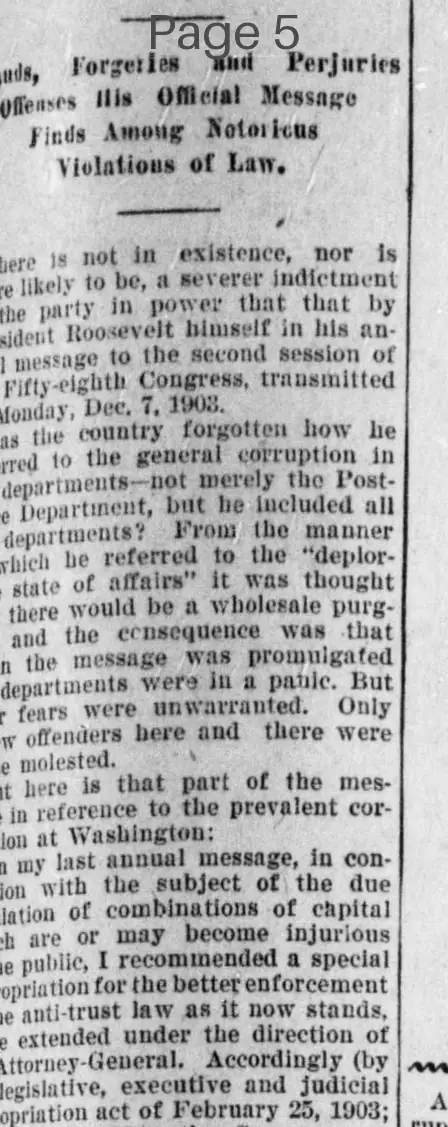
Forgeries and Perjuries.
Offenses in His Official Message Finds Among Notorious Violations of Law.
There is not in existence, nor is there likely to be, a severer indictment of the party in power than that by President Roosevelt himself in his annual message to the second session of the Fifty-eighth Congress, transmitted Monday, Dec. 7, 1903. Has the country forgotten how he referred to the general corruption in departments—not merely the Post-office Department, but he included all departments? From the manner in which he referred to the "deplorable state of affairs" it was thought there would be a wholesale purging, and the consequence was that when the message was promulgated departments were in a panic. But the fears were unwarranted. Only a few offenders here and there were molested.
It is here that part of the message in reference to the prevalent corruption at Washington:
"In my last annual message, in connection with the subject of the due regulation of combinations of capital which are or may become injurious to the public, I recommended a special appropriation for the better enforcement of the anti-trust law as it now stands, to be expended under the direction of the Attorney-General. Accordingly, by legislative, executive and judicial appropriation act of February 25, 1903, the Congress appropriated for the purpose of enforcing the various Federal trust and interstate-commerce laws the sum of five hundred thousand dollars, to be expended under the direction of the Attorney-General in the employment of special counsel and agents in the Department of Justice to conduct proceedings and prosecutions under said laws in the courts of the United States. I recommend as a matter of the first importance and urgency the extension of the purposes of the appropriation, so that it may be available under the direction of the Attorney-General, and until used for the enforcement of the laws of the United States in general, and especially of the civil and criminal laws relating to postal affairs and offenses and the subject of naturalization. Recent investigations show a deplorable state of affairs in these three departments of vital concern by reason of frauds and by forgeries and perjuries. Through collusion, acres of the public domain, embracing lands of different character and extending through various sections of the country, have been greatly acquired. It is hardly necessary to urge the importance of restoring these dishonest acquisitions to the people, and of promptly and duly punishing the offenders. I have in another part of this message referred to crimes and offenses which threaten the sacred right of citizens in precisely the same asserted and that iniquities heretofore perverted to base ends by similar means—though not to the same extent—have been committed in connection with the public lands and by similar shameful disregard of the laws relating to the proper conduct of the public service in general and to the due administration of the Postoffice Department have been notably violated. And indictments have been found, and the consequent selections are in course of preparation or on the eve thereof, for the reasons indicated and so that government may be prepared to enforce promptly with the greatest efficiency the penalties for such violations of the law. And to this end may be furnished with sufficient instrumentalities and competent legal assistance for investigations and for prosecutions which will be necessary at many different parts of the country. Upon the Congress the necessity of making the appropriation available for immediate use for such purposes to be expended under the direction of the Attorney-General. Nothing is a public man's character to be judged than by what he says to the public. Shall the people who will vote for President in November better arrive at a fair judgment of the character of Theodore Roosevelt, as he is, than by his latest utterances? His supporters and advisers say that he consulted them and discussed with them his most important acts and declarations. What is left to be said of a President, however influenced, who in one breath finds fault with all of his departments, saying that by frauds, forgeries and perjuries they are in a deplorable condition, and, in the next breath, as in his letter of acceptance, sings of his administration's record as: "A truthful recital would leave no room for adverse comment?"
The man who wrote the message to Congress only last December sincerely was his recital "truthful?" The same man who wrote a letter accepting the Republican nomination for President—sincere?
Offenses in His Official Message Finds Among Notorious Violations of Law.
There is not in existence, nor is there likely to be, a severer indictment of the party in power than that by President Roosevelt himself in his annual message to the second session of the Fifty-eighth Congress, transmitted Monday, Dec. 7, 1903. Has the country forgotten how he referred to the general corruption in departments—not merely the Post-office Department, but he included all departments? From the manner in which he referred to the "deplorable state of affairs" it was thought there would be a wholesale purging, and the consequence was that when the message was promulgated departments were in a panic. But the fears were unwarranted. Only a few offenders here and there were molested.
It is here that part of the message in reference to the prevalent corruption at Washington:
"In my last annual message, in connection with the subject of the due regulation of combinations of capital which are or may become injurious to the public, I recommended a special appropriation for the better enforcement of the anti-trust law as it now stands, to be expended under the direction of the Attorney-General. Accordingly, by legislative, executive and judicial appropriation act of February 25, 1903, the Congress appropriated for the purpose of enforcing the various Federal trust and interstate-commerce laws the sum of five hundred thousand dollars, to be expended under the direction of the Attorney-General in the employment of special counsel and agents in the Department of Justice to conduct proceedings and prosecutions under said laws in the courts of the United States. I recommend as a matter of the first importance and urgency the extension of the purposes of the appropriation, so that it may be available under the direction of the Attorney-General, and until used for the enforcement of the laws of the United States in general, and especially of the civil and criminal laws relating to postal affairs and offenses and the subject of naturalization. Recent investigations show a deplorable state of affairs in these three departments of vital concern by reason of frauds and by forgeries and perjuries. Through collusion, acres of the public domain, embracing lands of different character and extending through various sections of the country, have been greatly acquired. It is hardly necessary to urge the importance of restoring these dishonest acquisitions to the people, and of promptly and duly punishing the offenders. I have in another part of this message referred to crimes and offenses which threaten the sacred right of citizens in precisely the same asserted and that iniquities heretofore perverted to base ends by similar means—though not to the same extent—have been committed in connection with the public lands and by similar shameful disregard of the laws relating to the proper conduct of the public service in general and to the due administration of the Postoffice Department have been notably violated. And indictments have been found, and the consequent selections are in course of preparation or on the eve thereof, for the reasons indicated and so that government may be prepared to enforce promptly with the greatest efficiency the penalties for such violations of the law. And to this end may be furnished with sufficient instrumentalities and competent legal assistance for investigations and for prosecutions which will be necessary at many different parts of the country. Upon the Congress the necessity of making the appropriation available for immediate use for such purposes to be expended under the direction of the Attorney-General. Nothing is a public man's character to be judged than by what he says to the public. Shall the people who will vote for President in November better arrive at a fair judgment of the character of Theodore Roosevelt, as he is, than by his latest utterances? His supporters and advisers say that he consulted them and discussed with them his most important acts and declarations. What is left to be said of a President, however influenced, who in one breath finds fault with all of his departments, saying that by frauds, forgeries and perjuries they are in a deplorable condition, and, in the next breath, as in his letter of acceptance, sings of his administration's record as: "A truthful recital would leave no room for adverse comment?"
The man who wrote the message to Congress only last December sincerely was his recital "truthful?" The same man who wrote a letter accepting the Republican nomination for President—sincere?
What sub-type of article is it?
Partisan Politics
Crime Or Punishment
What keywords are associated?
Government Corruption
Presidential Message
Forgeries
Perjuries
Post Office Department
Public Lands
Roosevelt Administration
Republican Party
What entities or persons were involved?
President Roosevelt
Republican Party
Congress
Attorney General
Post Office Department
Editorial Details
Primary Topic
Criticism Of President Roosevelt's Administration For Corruption In Government Departments
Stance / Tone
Strongly Critical Of Roosevelt And The Republican Party
Key Figures
President Roosevelt
Republican Party
Congress
Attorney General
Post Office Department
Key Arguments
Roosevelt's Annual Message Indicts His Own Administration For Corruption, Frauds, Forgeries, And Perjuries In Departments
Despite Admitting 'Deplorable State Of Affairs,' Only A Few Offenders Were Punished
Contradiction Between Message's Criticism And Acceptance Letter's Praise Of Administration's Record
Need For Appropriation To Enforce Laws Against Postal, Naturalization, And Public Land Frauds
Roosevelt's Sincerity Questioned In Light Of His Utterances