Thank you for visiting SNEWPapers!
Sign up free
Daily National Intelligencer
Washington, District Of Columbia
What is this article about?
A letter to the National Intelligencer discusses the House of Representatives' rejection of a Senate bill for the District of Columbia's Circuit Court, highlighting concerns over the District's political rights, including self-government, property protection, and opposition to taxation without representation, drawing on constitutional principles and Revolutionary ideals.
Clipping
OCR Quality
Full Text
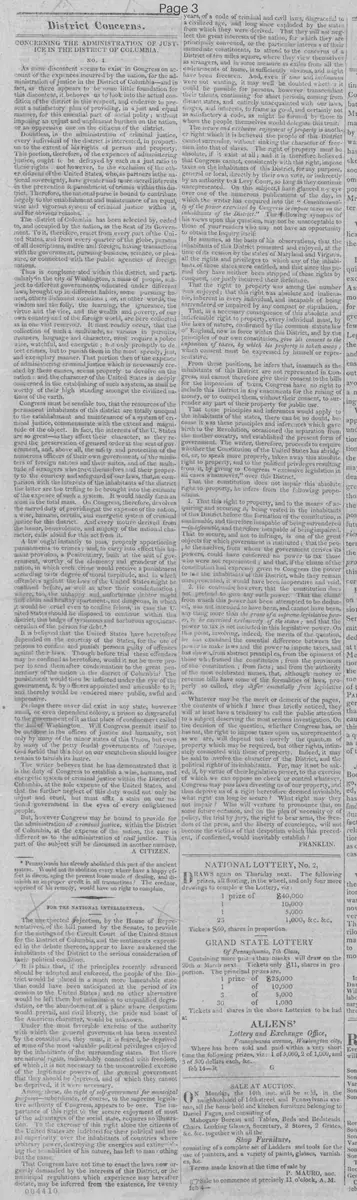
The unexpected rejection, by the House of Representatives, of the bill passed by the Senate, to provide for the sittings of the Circuit Court of the United States for the District of Columbia, and the sentiments expressed in the debate thereon, appear to have awakened the inhabitants of the District to the serious consideration of their political condition.
It is plain that, if the principles recently advanced should be adopted and enforced, the people of the District would be placed in a much more lamentable state than could have been anticipated at the period of its cession to the United States; and no other alternative would be left them but submission to unqualified degradation, or the abandonment of a place where despotism would prevail, and civil liberty, the pride and boast of the American character, would be unknown.
Under the most favorable exercise of the authority with which the general government has been invested by the constitution, they must, it is feared, be deprived of some of the most valuable political privileges enjoyed by the inhabitants of the surrounding states. But there are natural rights, indissolubly connected with freedom, of which, it is not necessary to the uncontrolled exercise of the legitimate powers of the general government that they should be deprived, and of which they cannot be deprived, if it were necessary.
Among these, the right of self-government for municipal purposes—subordinate, of course, to the supreme legislative authority of Congress, appears to be one. The importance of this right to the secure enjoyment of most of the advantages of the social state, requires no illustration. To the exercise of this right alone the citizens of the United States are indebted for their political and moral superiority over the inhabitants of countries where arbitrary power, destroying the energies and extinguishing the sensibilities of his nature, has left to man nothing but the name.
That Congress have not time to enact the laws now urgently demanded by the interests of this District, or the municipal regulations which experience may hereafter dictate, may be inferred from the existence, for twenty years, of a code of criminal and civil laws, disgraceful to a civilized age, and long since exploded by the states from which they were derived. That they will not neglect the great interests of the nation, for which they are principally convened, or the particular interests of their immediate constituents, to attend to the concerns of a District of ten miles square, where they view themselves as strangers, and in some measure as exiles from all the endearments of home, is sufficiently obvious, and might have been foreseen. And, even if time and inclination were not wanting, it may well be doubted whether it could be possible for persons, however transcendent their talents, continuing for short periods, coming from distant states, and entirely unacquainted with our laws, usages, and interests, to frame as good, and certainly not as satisfactory a code, as might be formed by those to whom the people themselves would delegate this trust.
The secure and exclusive enjoyment of property is another right which it is believed the people of this District cannot surrender, without sinking the character of freemen into that of slaves. The right of property must be absolute, if it exist at all; and it is therefore believed that Congress cannot, consistently with this right, impose taxes on the inhabitants of this District, for any purpose, general or local, directly by their own vote, or indirectly by an authority to a Levy Court, so long as they continue unrepresented. On this subject, I have glanced my eye over one of the numerous publications of the day, in which the writer has enquired into the "Constitutionality of the power exercised by Congress to impose taxes on the inhabitants of the District." The following synopsis of his views upon this question, may not be unacceptable to those of your readers who may not have an opportunity to obtain the Inquiry itself:
He assumes, as the basis of his observations, that the inhabitants of this District possessed and enjoyed, at the time of its cession by the states of Maryland and Virginia all the rights and privileges to which any of the inhabitants of those states were entitled, and that since this period they have neither been stripped of these rights by conquest, nor justly incurred their forfeiture.
That the right to property was among the number thus enjoyed; that this right was absolute and inalienable, inherent in every individual, and incapable of being surrendered or impaired by any compact or stipulation.
That, as a necessary consequence of this absolute and indefeasible right to property, every individual must, by the laws of nature, confirmed by the common statute law of England, now in force within this District, and by the principles of our own constitution, give his consent to the imposition of taxes, by which his property is taken away; which consent must be expressed by himself or representative.
From these positions, he infers that, inasmuch as the inhabitants of this District are not represented in Congress, and cannot therefore give their consent to the bills for the imposition of taxes, Congress have no right to include this District in any enactments for the raising of money, or to compel them, without their consent, to surrender any part of their property for public use.
That these principles and inferences would apply to the inhabitants of the states, there can be no doubt, because it was these principles and inferences which gave birth to the Revolution, occasioned the separation from the mother country, and established the present form of government. The writer, therefore, proceeds to enquire whether the Constitution of the United States has abridged, or, to speak more properly, taken away this absolute right to property, and to the political privileges resulting from it, by giving to Congress "exclusive legislation in all cases whatsoever," over this District.
That the constitution does not impair this absolute right to property, he infers from the following propositions.
1. That this right to property, and to the means of acquiring and securing it, being vested in the inhabitants of this District before the formation of the constitution, is unalienable, and therefore incapable of being surrendered—indefeasible, and therefore incapable of being impaired. That to secure, and not to infringe, is one of the great objects for which government is instituted; that the people themselves, from whom the government derives its powers, could have conferred no power to tax those who were not represented : and that, if the clause of the constitution had expressly given to Congress the power to tax the inhabitants of this District, while they remain unrepresented, it would have been inoperative and void.
2. He contends, however, that the constitution does not pretend to give any such power. That the clause from which this power has been attempted to be deduced, was not intended to have been, and cannot have been, any thing more than the grant of a supreme legislative power, to be exercised exclusively of the states ; and that the power to tax is not included in this legislative power. On this point, involving, indeed, the merits of the question, he has examined the essential difference between the power to make laws and the power to impose taxes, and has shown, from abstract principles, from the opinions of those who framed the constitution ; from the provisions of the constitution ; from facts; and from the authority of the most celebrated names, that, although money or revenue bills have some of the formalities of laws, properly so called, they differ essentially from legislative acts.
Whatever may be the merit or demerit of the pages, the contents of which I have thus briefly noticed, they will at least have a tendency to call the public attention to a subject deserving the most serious investigation. On the decision of the question, whether Congress has, or has not, the right to impose taxes upon us, unrepresented as we are, will depend not merely the quantum of property which may be required, but other rights, intimately connected with those of property. Indeed, it may be said to involve the character of the District, and the political rights of its inhabitants. For, may it not be asked, if, by virtue of their legislative power, to the exercise of which we can oppose no check or control whatever, Congress may pass laws divesting us of our property, and thus deprive us of a right heretofore deemed inviolable, what right can long be secure? What right may they not impair ? Who will venture to pronounce that, on some future occasion, and on the plea of necessity or of policy, the trial by jury, the right to bear arms, the freedom of the press, and the liberty of conscience, will not become the victims of that despotism which this precedent, if confirmed, would inevitably establish?
FRANKLIN.
What sub-type of article is it?
What themes does it cover?
What keywords are associated?
What entities or persons were involved?
Letter to Editor Details
Author
Franklin.
Recipient
National Intelligencer
Main Argument
the inhabitants of the district of columbia should retain rights to self-government for municipal purposes and absolute property rights, including opposition to taxation without representation, as congress's exclusive legislative power does not extend to impairing these natural rights, consistent with constitutional principles and the revolution's foundations.
Notable Details