Thank you for visiting SNEWPapers!
Sign up free
Story
March 6, 1869
The Evening Telegraph
Philadelphia, Philadelphia County, Pennsylvania
What is this article about?
Editorial commentary on President Grant's new Cabinet appointments, praising some like Judge Hoar while criticizing others as based on personal loyalty rather than merit. Contrasts with Lincoln's rival-filled Cabinet, portraying Grant's as subordinates chosen for business efficiency to secure his dominance.
Clipping
OCR Quality
95%
Excellent
Full Text
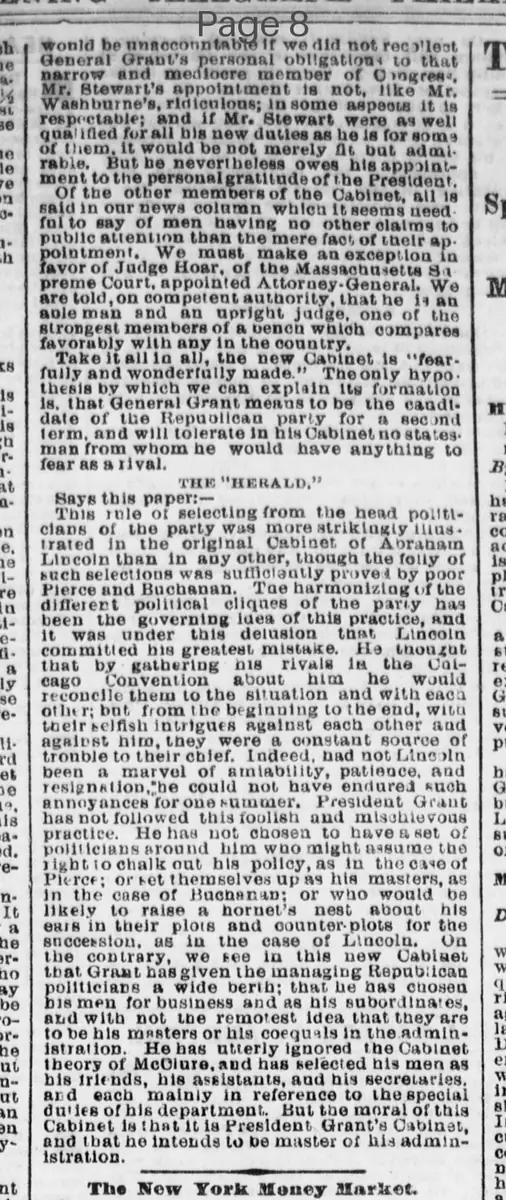
would be unaccountable if we did not recollect General Grant's personal obligations to that narrow and mediocre member of Congress, Mr. Stewart's appointment is not, like Mr. Washburne's, ridiculous; in some aspects it is respectable; and if Mr. Stewart were as well qualified for all his new duties as he is for some of them, it would be not merely fit but admirable. But he nevertheless owes his appointment to the personal gratitude of the President. Of the other members of the Cabinet, all is said in our news column which it seems need ful to say of men having no other claims to public attention than the mere fact of their appointment. We must make an exception in favor of Judge Hoar, of the Massachusetts Supreme Court, appointed Attorney-General. We are told, on competent authority, that he is an able man and an upright judge, one of the strongest members of a bench which compares favorably with any in the country. Take it all in all, the new Cabinet is 'fearfully and wonderfully made.' The only hypothesis by which we can explain its formation is, that General Grant means to be the candidate of the Republican party for a second term, and will tolerate in his Cabinet no statesman from whom he would have anything to fear as a rival.
THE 'HERALD.'
Says this paper:-
This rule of selecting from the head politicians of the party was more strikingly illustrated in the original Cabinet of Abraham Lincoln than in any other, though the folly of such selections was sufficiently proved by poor Pierce and Buchanan. The harmonizing of the different political cliques of the party has been the governing idea of this practice, and it was under this delusion that Lincoln committed his greatest mistake. He thought that by gathering his rivals in the Chicago Convention about him he would reconcile them to the situation and with each other; but from the beginning to the end, with their selfish intrigues against each other and against him, they were a constant source of trouble to their chief. Indeed, had not Lincoln been a marvel of amiability, patience, and resignation, he could not have endured such annoyances for one summer. President Grant has not followed this foolish and mischievous practice. He has not chosen to have a set of politicians around him who might assume the right to chalk out his policy, as in the case of Pierce; or set themselves up as his masters, as in the case of Buchanan; or who would be likely to raise a hornet's nest about his ears in their plots and counter-plots for the succession, as in the case of Lincoln. On the contrary, we see in this new Cabinet that Grant has given the managing Republican politicians a wide berth; that he has chosen his men for business and as his subordinates, and with not the remotest idea that they are to be his masters or his coequals in the administration. He has utterly ignored the Cabinet theory of McClure, and has selected his men as his friends, his assistants, and his secretaries, and each mainly in reference to the special duties of his department. But the moral of this Cabinet is that it is President Grant's Cabinet, and that he intends to be master of his administration.
THE 'HERALD.'
Says this paper:-
This rule of selecting from the head politicians of the party was more strikingly illustrated in the original Cabinet of Abraham Lincoln than in any other, though the folly of such selections was sufficiently proved by poor Pierce and Buchanan. The harmonizing of the different political cliques of the party has been the governing idea of this practice, and it was under this delusion that Lincoln committed his greatest mistake. He thought that by gathering his rivals in the Chicago Convention about him he would reconcile them to the situation and with each other; but from the beginning to the end, with their selfish intrigues against each other and against him, they were a constant source of trouble to their chief. Indeed, had not Lincoln been a marvel of amiability, patience, and resignation, he could not have endured such annoyances for one summer. President Grant has not followed this foolish and mischievous practice. He has not chosen to have a set of politicians around him who might assume the right to chalk out his policy, as in the case of Pierce; or set themselves up as his masters, as in the case of Buchanan; or who would be likely to raise a hornet's nest about his ears in their plots and counter-plots for the succession, as in the case of Lincoln. On the contrary, we see in this new Cabinet that Grant has given the managing Republican politicians a wide berth; that he has chosen his men for business and as his subordinates, and with not the remotest idea that they are to be his masters or his coequals in the administration. He has utterly ignored the Cabinet theory of McClure, and has selected his men as his friends, his assistants, and his secretaries, and each mainly in reference to the special duties of his department. But the moral of this Cabinet is that it is President Grant's Cabinet, and that he intends to be master of his administration.
What sub-type of article is it?
Historical Event
What themes does it cover?
Social Manners
Justice
What keywords are associated?
Grant Cabinet
Political Appointments
Lincoln Cabinet
Presidential Administration
Republican Party
Cabinet Rivals
What entities or persons were involved?
General Grant
Mr. Stewart
Mr. Washburne
Judge Hoar
Abraham Lincoln
Pierce
Buchanan
Story Details
Key Persons
General Grant
Mr. Stewart
Mr. Washburne
Judge Hoar
Abraham Lincoln
Pierce
Buchanan
Story Details
Commentary critiques Grant's Cabinet for favoring personal loyalty over merit, excepting Judge Hoar; contrasts with Lincoln's rival-inclusive Cabinet that caused troubles, portraying Grant's as efficient subordinates ensuring his control.