Thank you for visiting SNEWPapers!
Sign up free
Daily National Intelligencer
Washington, District Of Columbia
What is this article about?
On the 11th instant, Mr. Seybert presented a report in the House of Representatives recommending the collection, preservation, and public exhibition of flags and standards captured by U.S. forces from enemies, citing historical precedents and national pride.
Clipping
OCR Quality
Full Text
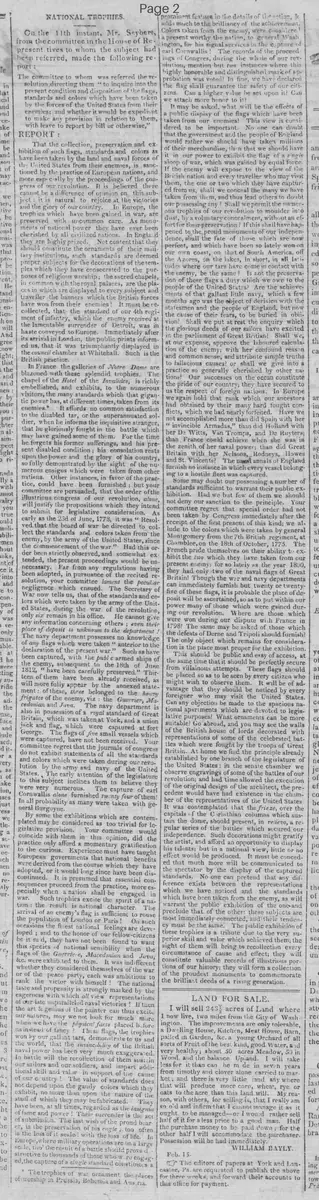
On the 11th instant, Mr. Seybert, from the committee in the House of Representatives to whom the subject had been referred, made the following report:
The committee to whom was referred the resolution directing them "to inquire into the present condition and disposition of the flags, standards and colors which have been taken by the forces of the United States from their enemies; and whether it would be expedient to make any provision in relation to them, with leave to report by bill or otherwise,"
REPORT:
That the collection, preservation and exhibition of such flags, standards and colors as have been taken by the land and naval forces of the United States from their enemies, is sanctioned by the practice of European nations, and more especially by the proceedings of the congress of our revolution. It is believed there cannot be a difference of opinion on this subject: it is natural to rejoice at the victories and the glory of our country. In Europe, the trophies which have been gained in war, are preserved with uncommon care. As monuments of national power they have ever been cherished by all civilized nations. In England they are highly prized. Not content that they should constitute the ornaments of their military institutions, such standards are deemed proper subjects for the decorations of the temples which they have consecrated to the purposes of religious worship; the sacred chapels, in common with their royal palaces, are the places in which are displayed to every subject and traveller the banners which the British forces have won from their enemies! It must be recollected, that the standard of our 4th regiment of infantry, which the enemy received at the lamentable surrender of Detroit, was in haste conveyed to Europe. Immediately after its arrival in London, the public prints informed us, that it was triumphantly displayed in the council chamber at Whitehall. Such is the British practice.
In France the galleries of Notre Dame are blazoned with these splendid trophies. The chapel of the Hotel of the Invalides, is richly embellished, and exhibits, to the numerous visitors, the many standards which that gigantic power has, at different times, taken from its enemies. It affords no common satisfaction to the disabled tar, or the superannuated soldier, when he informs the inquisitive stranger, that he gloriously fought in the battle which may have gained some of them. For the time he forgets his former sufferings, and his present disabled condition; his consolation rests upon the power and the glory of his country, so fully demonstrated by the sight of the numerous ensigns which were taken from other nations. Other instances, in favor of the practice, could have been furnished; but your committee are persuaded, that the order of the illustrious congress of our revolution, alone, will justify the propositions which they intend to submit for legislative consideration. As early as the 23d of June, 1778, it was "Resolved that the board of war be directed to collect the standards and colors taken from the enemy, by the army of the United States, since the commencement of the war." Had this order been strictly observed, and somewhat extended, the present proceedings would be unnecessary. Far from any regulations having been adopted, in pursuance of the recited resolution, your committee lament the peculiar negligence which ensued. The Secretary of War now tells us, that of the standards and colors which were taken by the army of the United States, during the war of the revolution, only six remain in his office. He cannot give any information concerning others; even their place of deposit is unknown to the department! The navy department possesses no knowledge of any flags which were taken "anterior to the declaration of the present war." Such as have been captured, with the public armed ships of the enemy, subsequent to the 18th of June 1812, "have been carefully preserved." Thirteen of them have been already received, as will more fully appear by the annexed statement: of these, three belonged to the heavy frigates of the enemy, viz: the Guerriere, Macedonian and Java. The navy department is also in possession of a royal standard of Great Britain, which was taken at York, and a union jack and flag, which were captured at fort George. The flags of five small vessels which were captured, have not been received. Your committee regret that the journals of congress do not exhibit statements of all the standards and colors which were taken during our revolution by the army and navy of the United States. The early attention of the legislature to this subject inclines them to believe they were very numerous. The capture of earl Cornwallis alone furnished twenty four of them! In all probability as many were taken with general Burgoyne.
By some the exhibitions which are contemplated may be considered as too trivial for legislative provision. Your committee would coincide with them in this opinion, did the practice only afford a momentary gratification to the curious. Experience must have taught European governments that national benefits were derived from the course which they have adopted, or it would long since have been discontinued. It is presumed that essential consequences proceed from the practice, more especially when a nation shall be engaged in war. Such trophies excite the spirit of a nation: the result is national character. The arrival of an enemy's flag is sufficient to rouse the population of London or Paris! On such occasions the finest national feelings are developed: and to the honor of our fellow-citizens be it said, they have not been found to want this species of national sensibility when the flags of the Guerriere, Macedonian and Java, &c. were exhibited to them. It was indifferent whether they considered themselves of the war or of the peace party, each was ambitious to rank the victor with himself! The national taste and propensity is strongly marked by the eagerness with which all view representations of our late unparalleled naval victories! If then the art & genius of the painter can thus excite our natures, may we not look for much more when we have the physical facts placed before us instead of fancy? These flags, the trophies won by our gallant tars, demonstrate to us and the world, that the invincibility of the British naval power has been very much exaggerated. In battle will the recollection of them sustain our sailors and our soldiers, and impart additional skill and valor in support of the cause of our country! The value of standards does not depend upon the gaudy colors which they exhibit, no more than upon the nature of the stuff of which they may be fabricated. They have been, at all times, regarded as the insignia of fame and power! Their surrender is the act of submission. The last wish of the proud bearer, is the preservation of his eagle; too often is the loss of it sealed with the loss of life. In Europe, where military operations are on a large scale, tho' the result of a battle should prove destructive to thousands of those who were engaged, the capture of a single standard constitutes a prominent feature in the details of the action, & adds much to the brilliancy of the achievement.
Colors taken from the enemy, were considered a present worthy the nation, to general Washington, for his signal services in the capture of earl Cornwallis! The records of the proceedings of Congress, during the whole of our revolution, mention but two instances where this highly honorable and distinguished mark of approbation was voted! In fine, we have declared the flag shall guarantee the safety of our citizens. Can a higher value be set upon it? Can we attach more honor to it?
It may be asked, what will be the effects of a public display of the flags which have been taken from our enemies? This view is considered to be important. No one can doubt that the government and the people of England would rather we should have taken millions of their merchandise, than that we should have it in our power to exhibit the flag of a single sloop of war, which was gained by equal force. If the enemy will expose to the view of the British nation and every traveller who may visit them, the one or two which they have captured from us, shall we conceal the many we have taken from them, and thus lead others to doubt our possessing any? Shall we permit the numerous trophies of our revolution to moulder in dust, by a voluntary concealment, without an effort for their preservation? If this shall have happened to the proud monuments of our independence, shall the fate of those which are now perfect, and which have been so lately won on our own coast, on that of South America, off the Azores, on the lakes, in short, in all latitudes where our tars have come in contact with the enemy, be the same? Is not the preservation of these flags a duty which we owe to the people of the United States? Are the achievements of that gallant little navy, which a few months ago was the object of derision with the statesmen and the people of England, but now the cause of their fears, to be buried in oblivion? Shall we put at rest the enquiry which the glorious deeds of our sailors have excited in the parliament of Great Britain? Shall we, at our expense, approve the laboured calculation of the enemy; with her confound reason and common sense, and attribute simple truths to fallacious causes? or shall we give into a practice so generally cherished by other nations? Our successes on the ocean constitute the pride of our country: they have secured to us the respect of foreign nations. In Europe we again hold that rank which our ancestors had obtained by their many hard fought conflicts, which we had nearly forfeited. Have we not accomplished more than did Spain with her "invincible Armadas," than did Holland with her De Witts, Van Tromps, and De Ruyters; than France could achieve when she was in the zenith of her naval power; than did Great Britain with her Nelsons, Rodneys, Howes and St. Vincents? The naval annals of England furnish no instance in which every vessel belonging to a hostile fleet was captured.
Some may doubt our possessing a number of standards sufficient to warrant their public exhibition. Had we but few of them we should not deny our sanction to the principle. Your committee regret that special order had not been taken by Congress immediately after the receipt of the first present of this kind; we allude to the colors which were taken by general Montgomery from the 7th British regiment, at Chamblee, on the 18th of October, 1775. The French pride themselves on their ability to exhibit the trophies which they have taken from our present enemy: for so lately as the year 1800, they had only two of the naval flags of Great Britain! Though the war and navy departments can immediately furnish but twenty or twenty-five of these flags, it is probable the place of deposit will be ascertained, so as to put within our power many of those which were gained during our revolution. Where are those which were won during our dispute with France in 1798? The same may be asked of those which the defeats of Derne and Tripoli should furnish.
The only object which remains for consideration is the place most proper for the exhibition. This should be public and easy of access, at the same time that it should be perfectly secure from villainous attempts. These flags should be placed so as to be seen by every citizen who might wish to observe them. It will be of advantage that they should be noticed by every foreigner who may visit the United States. Can any objection be made to the spacious national apartments which are devoted to legislative purposes? What ornaments can be more suitable? Go abroad, and you may see the walls of the British house of lords decorated with representations of some of the celebrated battles which were fought by the troops of Great Britain. At home we find the principle already established by one branch of the legislature of the United States: in the senate chamber we observe engravings of some of the battles of our revolution; and had time allowed the execution of the original design of the architect, the precedent would have had existence in the chamber of the representatives of the United States. It was contemplated that the frieze, over the capitals of the Corinthian columns which sustain the dome, should present, in relievo, a regular series of the battles which secured our independence. Such decorations might gratify the artist, and afford an opportunity to display his talents: but in a national view, little or no effect would be produced. It must be conceded that much more will be communicated to the spectator by the display of the captured standards. No one can pretend that any difference exists between the representations which we have noticed and the standards which have been taken from the enemy, as will warrant the public exhibition of the one and preclude that of the other: these subjects are most immediately connected, and their tendency must be the same. The public exhibition of these trophies is a tribute due to the very superior skill and valor which achieved them; the sight of them will bring to recollection every circumstance of cause and effect; they will constitute valuable records of illustrious portions of our history; they will form a collection of the proudest monuments to commemorate the brilliant deeds of a rising generation.
* The trophies of war ornament the places of worship in Prussia, Bohemia and Austria.
What sub-type of article is it?
What keywords are associated?
What entities or persons were involved?
Domestic News Details
Event Date
On The 11th Instant
Key Persons
Outcome
recommends collection, preservation, and public exhibition of captured flags and standards in legislative chambers to honor national victories and inspire patriotism.
Event Details
Mr. Seybert's committee report to the House of Representatives discusses the historical practice of preserving war trophies, laments past negligence in the U.S., details current holdings from the Revolution and War of 1812, and proposes legislative action for their public display to foster national pride and character.